Muharrem Musliu

Pristina | Date: October 27, 2023 | Duration: 173 minutes

Afrim Loxha and I took two revolvers from Sabri Novosella. Uncle Metush decisively told both me and Afrim, ‘Don’t shoot at the army or the police because they’ll kill you. But be careful from the sides so they don’t kill you.’ He was one of the greatest visionaries I’ve ever known, Metush Krasniqi.


[…] Now these nine people were imprisoned. I was friends with all of them. I was talking about what to do, to carry out an action, damn it. I thought, I’ll throw a bomb at the District Court one night before these guys go to trial. In Hogosht, I got a bomb that I still have today, I mentioned this at the symposium for the 50th anniversary of the ‘68 demonstrations.


But Uncle Metush decisively told me, ‘No,’ he said, ‘because then they’ll be sentenced twice as harshly as terrorists.’ I had prepared the whole area behind the court since I used to pass by there day and night, I knew the alleys where to enter, and I was 28 years old, playing in the Second Central League of former Yugoslavia in football, meaning I was in good condition. I had calculated where to hide everything.


Anita Susuri (Interviewer), Ana Morina (Camera)

Muharrem Musliu was born in 1940 in Marec, Municipality of Pristina. After finishing gymnasium in 1961, he applied to the Social Accounting Service and was accepted as an athlete. In the 1990s, he was part of the leadership of the Kosovo Football Federation, from where he retired after the war. Mr. Musliu lives with his family in Pristina.

Muharrem Musliu

Part One

Anita Susuri: Mr. Muharrem, if you could introduce yourself, your year of birth, and tell us something about your earliest memories?

Muharrem Musliu: Yes, I am Muharrem Musliu. I was born in the village of Marec, in the municipality of Pristina, about 30 kilometers from the city. It is the village with the largest territory in the Albanian lands. I come from a poor family. But because of poverty and all that, in 1943 we moved to Prishtina, in fact, to the Pozerka neighborhood, as they say, by the Llap Mosque, there. So I know little about Marec, because I left very young. But I know quite a lot about Pristina, since I grew up there, I was educated there, and I still live in Pristina.

As a child in Pozerka we had a childhood that was not very good. At that time the language of the time was Turkish, and somewhat they, they also, they used to insult us by calling us çili, which in Albanian means “villager.” Until we were five or six years old we stayed only inside our neighborhood, we did not dare go outside of it. But when we reached seven or eight years old, and in our family we were four sisters and at that time two brothers, we learned Turkish in four or five years (laughs). Like it or not, we learned Turkish. In 1947 I enrolled in the first grade at the Alaudin School. It is by the mosque near Dodona…

Anita Susuri: Like the madrasa.

Muharrem Musliu: Like the madrasa, not a regular school, but that is how it was. And my first teacher was Muzafere Hatipi. So I finished the first and second grades of primary school at Alaudin. Then we stopped, in general half of the youth of Pristina stopped for two years and did not go to school, because there were no school buildings. In 1951, the Emin Duraku School opened in Pozerka, and I finished the third and fourth grades there with teacher Vesel Pagarusha, the father of Nexhmije Pagarusha, one of our best singers.

I also finished primary school, and then I enrolled in the Pristina Gymnasium, it was called Ivo Lola Ribar. At that time there was a lower gymnasium and a higher gymnasium, we called the higher one “i naltë.” The lower gymnasium was there. About 15 to 20 of us from our neighborhood would regularly go to the gymnasium. Then I finished the eight year school, that is, the lower gymnasium, and enrolled in the higher gymnasium. I finished there in 1960–61. But our hardships were almost indescribable. The economic situation, and then the political situation.

The economic situation perhaps somehow was overcome, but the political situation was not right. Because they looked at us a bit differently, those of us who were from the villages. They all had information about which political party our parents had belonged to. My uncle was in the NDSh1 party. My uncles on my mother’s side, from Dabishevc, were also in it. My cousins in Mramor were also NDSh members. So I grew up in the spirit of the NDSh. In the gymnasium we had many hardships.

It may be interesting to tell this to the younger generations. In the eight year school we had most subjects in Albanian, because we had teachers from Albania. There was Zekerija Rexha, there was Sali Kolgeci, we had Hajdar Jakupi. We had teachers of a very high level. But when I enrolled in the gymnasium, we had only two subjects in Albanian. History was taught by a local man here, Shariq Qehaja, and Albanian language by Ramiz Hoxha. We had all the other subjects in Serbian.

It is perhaps interesting to say this to the younger generations, who often cannot understand it. Forty six of us enrolled in the first year, sixteen of us finished the gymnasium. Today only four of us are still alive. Sixteen finished because all the others were expelled for a single word. I remember very well, I finished the eight year school and went to enroll in the gymnasium, and there was a certain Vlasta Nikolic, a Latin teacher, an extreme chauvinist. When she asked, “Why have you come?” the students did not know how to say “I have come to enroll” in Serbian. “You are not fit for school.”

I went, and she saw that I knew Serbian, since I had grown up in Pristina. She said, “For you there is absolutely no problem.” Imagine… we had two math subjects, Albanian, three subjects, and Serbian. They did not ask me anything and admitted me (laughs). Only because I knew Serbian. Political issues should be taken from the time I can remember. Especially from 1947 onwards, it was a time of imprisonments, a time of maltreatment, a time of no time. No one knew whom they would take, and whom they would not.

Since I had my uncles in prison. Uncle Alush had been an escort of Gjon Sereçi2 in Shipashnicë there, together with a certain Muharrem Pograxha. Now they have put a plaque for them there in Shipashnicë. Then my cousins Sylë and Sadik there in Mramor, when Xhon Sereçi came out in Gollak, certainly all the older generations had Xhon Sereçi as an idol. My cousin escorted him. So they approximately knew which kind of family we belonged to. But I also started in sports, and sport helped me somewhat to get away from these things, which later I will certainly tell, how sport helped me politically, not only economically but also politically…

Anita Susuri: I would like to ask you a bit more about those family members you mentioned who were in the NDSh. You surely know about their fate, how they ended. Were they persecuted? You said your uncles were in prison.

Muharrem Musliu: My uncles Zenel and Hasim were killed in 1943 in the defense of the border. Uncle Alush was escorting Gjon Sereçi, and in 1947 they imprisoned him together with Gjon Sereçi and Muharrem Pograxha. They were tried here in the Pristina Gymnasium, in the hall of the Pristina Gymnasium, by Ali Shukriu. I say it openly, Ali Shukriu, as it is known. They executed Gjon Sereçi, Ajet Gërguri and the others, and sentenced my uncle to seven years in prison, as well as Muharrem Pograxha.

As for my other cousins from Mramor, they killed Syla, they imprisoned his wife, and it is interesting to tell you this. In the Pristina Prison, near the museum in the city, there was the prison. My cousin’s wife gave birth there, and the fellow prisoners wanted to give the baby the name Zullum. Zullum is a Turkish word, you know what it means. You know what…

Anita Susuri: Trouble.

Muharrem Musliu: Trouble, yes, it means trouble, and they instead named him Zamon. Zamon means “time,” also in Turkish. He died this year, Zamon.

Anita Susuri: So he was born in prison?

Muharrem Musliu: He was born in prison, he was six weeks in prison. But everyone knew him as Zamon. Since I worked in the former Social Accounting Service, later the Central Bank of Kosovo, I hired him there. He worked until he retired. He has eight children, all of them educated. So NDSh families were persecuted. Let me give you another example. You had here Shazije Gërguri, the daughter of Ajet Gërguri. Her husband, because Shazije probably did not tell you this, Beqir Hasangjekaj, finished the Faculty of Physical Education in Belgrade.

He played handball, he played for Partizan Belgrade. He was one of the best handball players at that time. But when they found out that he was engaged to the daughter of Ajet Gërguri, they expelled him. Because Beqir Hasangjekaj had to stay here and Shazije here. As soon as they found out to whom he was engaged, they immediately removed him from sport and from Partizan. So they did not leave anything to chance, they did not leave anything, absolutely nothing, to chance. But that is how life was…

Anita Susuri: I am also interested in something else you mentioned, that they were killed. Is anything known about the graves of your relatives?

Muharrem Musliu: Yes, for Syla, yes, because they killed him in an ambush in Mramor. He had, he had been in Marec, and my family had sheltered him since my father was his uncle. But he was killed in an ambush in Mramor. He was reburied after the war, their graves are known. Uncle Alush, the one who had escorted Gjon Sereçi, died in 1984 here in Pristina, and his family is here. And I, for myself, have never been a member of any party in my life, not even of the League of Communists, although they proposed that I join in school, in the gymnasium, I did not accept.

They proposed that I join in the Social Accounting Service, when I worked here in Pristina, I did not accept. I said, “I am not capable.” They proposed me also in the army, and I did not accept there either. Because my ideology was with the NDSh, like my parents and cousins. But the NDSh, in 1957, the first NDSh members were arrested here in Prishtina, led by Rexhep Avdullahu, the Novoja brothers, Islam Mumxhiu, a footballer, one of the best players. Shemsi Perani, Vebi Ruva, he was a policeman at that time, but he was too. They were sentenced… Kadri Deva, I forgot to mention.

In our class at the gymnasium they arrested Kadri Deva, the math teacher from Mitrovica. Believe me, my body still shivers when I remember how some, let me call them in that language of the time, bandits, came into the classroom. They just looked around, grabbed him and tied him in the classroom, in the Pristina Gymnasium, Kadri Deva. In 1957 they took him. They sentenced them to very long terms. That was a really extraordinary mass imprisonment. What is also interesting is that generally, in 90 percent of the cases, they spoke Turkish at home. But they were Albanians with their hearts, with their soul and with their body. It was the language of the time. The language of the time back then.

Anita Susuri: Now I am interested…

Muharrem Musliu: After… just one more thing.

Anita Susuri: Yes.

Muharrem Musliu: In 1956 there was the weapons collection campaign.3 To tell you about the weapons campaign, one would need not months but years. That was something that rarely repeats in the world, rarely repeats. I was 16 years old then, returning at night, or whenever, past the Emin Duraku School in Pozerka. I could hear people screaming, crying from beatings, from torture. There was a chief policeman, Zenun Avdija from Junik. He was a monster, a monster. With specific intentions he took control of Pozerka.

Pozerka, as is known, stretches from the Llapi Mosque to Hani i Dilit as they call it. Mostly villagers had come to live there. There was Tophane, the Çeklik neighborhood, the Divanjolli neighborhood, the Maravska neighborhood, as they used to call it. Those were mostly townspeople. While in Pozerka most people came from villages. He took it over. There is one case, at the place where the ceramics factory is, which we used to call “Cigllana”. One morning I got up to go to school and saw some children gathering by the Llapi Mosque and going somewhere.

Imagine, a man had hanged himself. In the weapons campaign, a man from Mramor, some Xhemshit, Xhemshit Gashi, I have still not forgotten his name because I knew him, had hanged himself from the severe torture and in order not to hand over weapons or who knows what. He hanged himself. They did not take him down until about ten or eleven o’clock. They left him there with specific intentions so that the people, the “mileti”, as they used to say, the people, would see.

Then, in 1957, the migration to Turkey4 began. That was like 1999 when they expelled us from here. Roughly the same. We had neighbors there, three brothers, they were called Jalivali, and they spoke Turkish at home. Two days earlier they came and said to my father, “Uncle Rrahmon, we will never leave Prishtina, never, we will never leave it.” Two days later, in the morning, they knocked on the door and said, “Uncle Rrahmon, they came and said, either you leave or you will be executed. We are fleeing. We are going to Skopje and from Skopje to Turkey.” Until 1964. But 1957, ‘58, ‘59, Prishtina was like in 1999.

But Prishtina at that time was much smaller, and what is most important, we all knew each other. We knew each other well. We knew which family stayed, which left and which did not. They would come to the door, just like in 1999. “Why are you not going to Turkey? Why are you not going? You are not Albanians, you are Turks.” That is what they told us all the time. “Why are you not going?” It was a horror that those who have lived through 1999 can understand what that was. With their families, with everything, they left everything there and left.

Anita Susuri: Do you remember who later came to live in those neighbors’ houses? Did they sell them or what happened?

Muharrem Musliu: In general nothing was sold here in Prishtina. Serbs came. Right next to us, near those Janjevans, a certain Stana came. I remember Stana. She would not say where she came from, they would not say where they came from. But interestingly, they tried to behave somewhat better than the locals here. To behave a bit better. Do you know why? Out of fear, they were afraid. Because generally we were Albanians. There in Pozerka there were about six or seven Serbian houses, not more.

In other words, every neighborhood had around six or seven, maybe seven or eight Serbian houses. There were not more than that. But in 1960, ’61, ’62 they started coming from Serbia. There is perhaps a case worth telling. I finished the gymnasium in 1961, I applied to the Social Accounting Service here, and they accepted me as an athlete. Since I played football with a team here, Grafiqari of Rilindja,5 the Social Accounting Service had a football team, and thinking that I would come and play for them, here is the case I want to tell. In 1961, twenty six of us were hired.

Twenty five were from Niš, Prokuplje and Kuršumlija, I was the only one from Prishtina or from Kosovo. The only one, and they accepted me as an athlete. I worked in an office where there were twenty five Serbs, Serbs in general, and I was the only Albanian (laughs). This sounds unbelievable but it is true. Today I still know their names and surnames, because I have given them several times when needed, who they were, from Niš, from Prokuplje, from Kuršumlija. There were some from Bela Palanka, some from Pirot, from Serbia. They came here.

At that time I was playing football for Grafiqari of Pristina, later it became Kosova. In Pristina all the players came from Montenegro and Serbia, the local ones remained… Islam Mumxhiu was already in prison. Only one Karabeg, Ferat Karabeg, remained. He considered himself Turkish and died as a Turk.

Anita Susuri: I would like to talk a little about your parents, what they did. Your father. About your family, the environment.

Muharrem Musliu: My father… my uncle, since we lived together with my uncle here, my father got a job in Ramiz Sadiku as a guard. Ramiz Sadiku was a construction company, and he worked there as a guard. But he was quite ill, he had ulcers in his stomach. He died relatively young, in 1967, at the age of 57. He was a hardworking man, a man who tried with all his body and soul to raise us and to educate us. My mother was from Dabishevc, she was, as all my friends say, something like all those famous mothers, like the mother of Ismajl Dumoshi or of Jusuf, mother Ajshe, and many other mothers.

She was unbreakable. My mother is the one with a kind of scarf who led the demonstrations6 from ‘81 to ‘99 with two fingers raised. She was short. She led the women when they set off from here to go toward Drenica (laughs). When the police arrested Flora Brovina here by the Sports Hall, my mother pulled her out of their hands, she took her from them. Later, when they took Flora from the Albanological Institute, my mother was there with my eldest sister and they beat them quite badly. She died in 2008 at the age of 102. So our family grew up relatively poor.

However, all those from 1964 who were in prison, those from 1968, 1975, they all passed through my house, they ate bread in my house, they stayed in my house. We were friends, and we have remained friends with all of them. But in general, my closest friends have finished with this world, they are in the other world now. Today I still meet again and again with those friends I have had for more than sixty years.


1 Albanian National Democratic Movement, an anti-Jugoslav and anti- communist resistance movement in Kosovo active from 1945 through 1947. The full name would be Lëvizja Nacional-Demokratike Shqiptare LNDSh but NDSh is a short version.

2 Gjon Sereçi (1920–1947) was an Albanian intellectual, teacher, and one of the leading figures of the Albanian National Democratic Movement (LNDSH) in Kosovo, which opposed Yugoslav communist rule and advocated the unification of Kosovo with Albania. Arrested by Yugoslav authorities in 1947, he was sentenced to death and executed in Prishtina.

3 In 1956, as Minister of the Interior, Ranković launched a Weapons Collection Action in Kosovo to collect illegal weapons he argued were a grave risk to the security of the state. This campaign was characterized by widespread abuses of the Albanian population, and was criticized for that reason after the fall of Ranković in 1966.

4 From the 1950s onward, Muslims from Yugoslavia, including ethnic Albanians and Turks from Kosovo and Macedonia, emigrated to Turkey. The migration was shaped by political pressure, bilateral arrangements, and economic and social factors. Its scale and the degree to which individual departures were voluntary or forced remain subjects of historical debate.

5 Rilindja, the first newspaper in the Albanian language in Yugoslavia, initially printed in 1945 as a weekly newspaper.

6 The 1981 demonstrations in Kosovo were a series of mass protests led by Albanian students demanding greater rights and autonomy for Kosovo within Yugoslavia. Beginning in March at the University of Prishtina, the protests soon escalated into widespread demonstrations involving large segments of the Albanian population. Key demands included recognition of Kosovo as a republic within Yugoslavia, equal treatment for Albanians, and improved living and educational conditions. The Yugoslav government responded with harsh repression, including mass arrests, police brutality, and purges of Albanians from political and educational institutions. The events marked a turning point in Kosovo’s struggle for political rights and are considered a precursor to later movements for independence.

Part Two

Anita Susuri: I am interested if you can describe Pristina a bit. You told us there used to be a bazaar, there were places that no longer exist today, do you remember these?

Muharrem Musliu: How could I not remember them (laughs), since I grew up here. There was a small market, there was a small stadium here, where the Hortikultura is today, right there. A small market there. People usually came there. From the Rinia Cinema that is here, and where the last houses used to be, where the Grand Hotel now is and all that, all of this used to be gardens. Where we are sitting now used to be gardens. There were gardeners. A certain Milazim had his fields right here. There was the Muhaxher neighborhood and what we called Çeklik, where the park is today, that was all cemetery, it used to be a graveyard. There was that big dividing line.

So where Slovenia Sport is today, those were the last houses of Pristina, at Slovenia Sport. Here, by the new hospital as we used to call it, was Divanjoll. They were mostly Roma. Divanjoll is a Turkish word, it roughly means a vertical street, divan means vertical, a straight road is a divanjoll. The old hospital where the Ministry of Health is today. What we call Dragodan was vineyards all the way up to the cemetery on the other side. Across the bridge, over the railway, I remember there were no houses at all, except the brick factory. Not a single house.

Perhaps it is worth mentioning, by the bridge on the way to Podujeva, over the railway, there used to be the second cemetery. In 1959, since most people do not know, where the Arsim Vokshi School is now, it is built exactly on top of that graveyard, in 1959 these graves were covered over with a specific intention, and I was one of the leaders. Personally I was there, since I was in the gymnasium at that time, 1959. It was done by the high schools. They chose me, I was involved in sports and they chose me as a kind of, let us call it, the commander for covering those graves in 1959, where the Arsim Vokshi School and all those houses are now.

So the City Park of Pristina and the Muhaxher neighborhood used to be cemeteries, they were covered over with a specific intention. The other mass graves where the Arsim Vokshi School is now also used to be cemeteries. In 1959, not that long ago, I was nineteen, they were covered. All this with specific aims, with specific intentions. Some of the graves were moved here to the Matiqan neighborhood, those from the first cemetery too, and later they covered those as well. Then, something that rarely gets mentioned, at Taukbahçe, where there used to be what we called Strilishtja, they executed more than two thousand members of the National Defense, over two thousand of them. They then covered it with the high-voltage power line route that goes toward Taukbahçe.

They put those high voltage lines there with all the infrastructure. There lie buried, perhaps even alive at the time, more than two thousand patriots of the National Defense. The National Defense was an organization. Sabri Novosella has written a little about this, Jakup Krasniqi has written a bit. But nobody has done anything. So there is that as well. Then the Jewish Cemetery a bit further up, because there were Jews in Prishtina. I know them very well and I used to know their names. They destroyed that cemetery, but after the war someone showed some goodwill and at least partially…

Anita Susuri: Do you remember that near Qafa somewhere there was this, for the Jews, what do you call it…

Muharrem Musliu: Synagogue.

Anita Susuri: Synagogue?

Muharrem Musliu: I will tell you now. There was a small synagogue here at Qafa. In 1956, some say 1958, there was also a mosque where the Iliria Hotel now stands, and a church where the old department store is, by the bust of Zahiri Pajaziti. They destroyed both of them. That was more a synagogue than a Catholic church. Because Jews went there… it was here, but they demolished it right away. There used to be four or five teqe, you might know what teqe are.

Anita Susuri: Yes.

Muharrem Musliu: Dervish lodges. They destroyed them all, only one remained by the gymnasium, belonging to the Maksut Shehu family, only that one remained. One was in Pozerka by the Bankoviç mill, as we called it. There was another at Kandilia, by the Emin Duraku School, that is why we called that neighborhood, Kandilia. They destroyed them with specific aims. So systematically they wanted to destroy everything that was Albanian. But for the younger generations I do not know if they are very interested, which makes me sad. Still it is good to know these things, it is good to know what happened in the 50s, 60s, 70s, 80s, and also in the 90s.

Until 1958, here in Pristina, until the age of eighteen, we did not dare go into town. Until 1958. In ’57 and ’58 all the secondary schools were closed, not only in Prish\tina but throughout Kosovo. They said there were no students. The only one that remained was the Prish\tina Gymnasium, Ivo Lola Ribar, later Sami Frashëri, which remained as a lycée. A lycée means something higher. That is where I went, where there were a few of us, and it produced some of the best cadres. Later the Shkolla Normale1 of Pristina, which was the nursery of education, the nursery of teachers. If someone had not finished the Shkolla Normale it was difficult to become a teacher.

Anita Susuri: I would like to ask you too, since you mentioned the Jews, were there any here after the Second World War. Did you know what people did?

Muharrem Musliu: After the Second World War there were many, but in general they had shops. One family had a shop here, opposite our municipality, on that side where earlier it was called “te magarxhit” (laughs) because the men with pack donkeys used to stay there. Later we called it the lane of flour, because flour was sold there. Later it became the lane of women (laughs). No offense, that is how it was called. Because women used to stand there and sell things, you know. “Lanë” they call it, you know that is an Albanian word, where things were sold, that is where it was.

And then, there were the Bërliqevićs, who spoke Serbian. As for their background, their mother was Jewish, but she had presumably married an Orthodox Christian. There was also another family somewhere around Divanjolli, opposite Meto Bajraktari School. They had left early, too. At the time, though, somehow we regarded them as people who were not one of us. I don’t know, we saw them as outsiders. I don’t know how to explain it, you know. We would say, “Jew, Jew.” We didn’t even know what a Jew was, calling them “Jew, Jew, Jew.” They were being persecuted.

People say that between 1940 and 1943, many people came to Prishtina after fleeing Serbia. They sought refuge here. For example, the Rezniqi family, who owned the Slovenia Sport shop, were of Jewish origin. Hazbije Rezniqi was actually a classmate of mine. But we only found out later, because they hadn’t told us. Most of my schoolmates whose fathers had been executed here in Prishtina never spoke about it. They didn’t talk about it at school or elsewhere, so that they wouldn’t be mistreated. That is entirely understandable.

Perhaps someone might be interested in a story concerning Miladin Popović. I’ve told it two or three times, and I also told it to a television station, but they never broadcast it. Two of my friends from secondary school, Ismet Sadiku from Ferizaj and Ali Buqinca, lived with Aunt Shahë. Aunt Shahë belonged to the Gjingji family. Their house was near the library here, which was called “Miladin Popović.” I used to visit my friends there, and I would speak Turkish with Aunt Shahë. Her son, Agush, had been in the same class as my brother Shaip. We would sit and talk.

During one of our conversations, I mentioned that I had heard Haki Tafa had been killed in that house. I asked her about it, and she told me, “Yes, it’s true.” They had a house in Prishtina with an upper floor. In Turkish, they called it a samallëk, which in our Albanian terminology was a plemë, a place where straw and whatever else was needed were kept. Aunt Shahë’s daughter, Selvete, heard something moving in the loft. She went to investigate and saw a man there. She was about to scream, but he told her, “Don’t scream!” She immediately ran outside and shouted, “Police! Police! Police!”

According to Aunt Shahë’s account—and I’m repeating her words—“It happened several times, many times,” she said. “He would take out his revolver and shoot himself. When the police arrived, they found him dead.”

What is interesting, though, is that nobody in Prishtina would marry Selvete, whom I knew personally. Nobody would take her as a wife. They say she eventually married a Serb named Buda. Buda was a drunkard who wandered the streets of Prishtina. She had remained unmarried for a long time, and nobody would take her because people knew she had betrayed someone.

By chance, two years ago, I met one of Agush’s nephews. I don’t know how true the story is, but he told it to me quite openly. He said that Selvete’s son, who had lived in Belgrade with that Buda, had worked as a driver for Serbia. In 1999, when a bus was bombed near the bridge in Lluzhan, killing many of its passengers, he had been the driver and had also been killed. What an extraordinary coincidence! All the old residents of Prishtina know that the Xhinxhi family still lives in that area and that their houses are still there.

There was a space there that we called yeni hajat. Yeni means “new” in Turkish, and hajat was what we called a space where people used to dance. That area is still there. It is also believed that a family living there betrayed Haki Tafa.

However, historians rely on certain documents written by the Serbs themselves, and they never tell the truth. In other words, they left no authentic documents. They left behind a document that wasn’t true, and then that version became accepted as the truth. I don’t know whether this period is of interest to you, but back then we hated the Albanians who were involved in politics because we considered them collaborators.

Anita Susuri: I’d also like to ask you something about the postwar period, specifically the area around Tre Sheshirat, where the university is today. I think there used to be a waterfall there, or something like that?

Muharrem Musliu: There used to be fields there. Later, the army had some barracks there, which we called sajak. The army used to leave quite a lot there for people to take. The school below, where the cathedral stands today, was initially the municipal building. Later, it became a barracks, and it was also used as a health centre. All those things were there. That was the only building there. The whole area above it, where the university and the Faculty of Philosophy stand today, consisted of fields. The army also had some barracks and huts. Until fairly recently, some of those huts were still standing near the television station. Back then, they were outside Prishtina.

Where the Central Bank and the Grand Hotel stand today, there used to be something called a sallahane. A sallahane was a place where animals were slaughtered in the old days.

Where Faik Konica School stands today—the one you mentioned near Tre Sheshirat; I initially said Arsim Vokshi, but I meant Faik Konica—there used to be a market. There was a market there, and another one further up in Pozerkë, beyond the Han i Dilit. The Han i Dilit, where Xhelal Sveçla’s house stands today, was the last one. Further along, that area eventually became Flamurtari Stadium.

Beyond Flamurtari Stadium, Prishtina had a swimming pool. There was a pool where the Officers’ House stands today, where EULEX is now located. The first football stadium in Prishtina was also there, enclosed by wooden boards. I had the opportunity to play there myself until the pitch over here was built.

They say that in 1936 Prishtina had a population of 16,000. What is interesting is that, until 1960, everyone in the city knew one another. We knew the whole city. We knew every street and knew one another personally. Today, though, we sometimes don’t even recognise ourselves. (Laughs.) I don’t know what else I can tell you about life here up until the 1960s.

Anita Susuri: For example, there is the Llokaç Mosque that people mention…

Muharrem Musliu: Listen, the Llokaç Mosque was demolished in 1956. There used to be the Llukaç Bridge, where the Skënderbeu Café is now, the one they have recently built there. There used to be a bridge at that spot. In Turkish, people called it Qypri Llanasi, meaning “Cabbage Bridge,” because a lot of cabbages were sold there. In Serbian, they called it Kupusishte. So there was a bridge there, the Llokaç Bridge, and the Llokaç Mosque stood nearby. The mosque was demolished in 1956. The synagogue near the bust of Zahir Pajaziti was also demolished.

Anita Susuri: I think that area over there also had something like a kapali çarşı, a covered bazaar…

Muharrem Musliu: Yes, the kapali çarşı, or covered bazaar, was where Parliament stands today, and the old post office used to be a little further down. From the old post office to the Bazaar Mosque, as we call it today, there was a whole area resembling a covered bazaar. The mosque is still there, near the roundabout, and has yet to be renovated.

All kinds of craftsmen worked there, including my brother’s tailoring shop. My brother Shaip had his shop there. It was truly something extraordinary. There were coppersmiths, tinsmiths, tailors and all kinds of other craftsmen. They demolished the whole thing.

The Social Security office was also located in that area, in the building that stands there today. The entire complex extended from the old post office to that point. There was a road where the monument stands today, where the cross used to be. One road led towards the Llapi Mosque, another towards the city centre and the secondary school, and another ran down this way. But they demolished everything.

Perhaps the story of the monument would also interest you. When they began building it, the only person who objected was Ilaz Kurteshi. He was the only one who spoke out at the time. He said it did not represent brotherhood and unity, but rather a monument depicting the Kingdom of Serbs, Croats and Slovenes, with those three figures arranged in a triangular shape. (He gestures with his hands to illustrate the triangle.)

I said this publicly at a gathering attended by academics. I told them, “I personally stated publicly that this monument is an insult to the Turks, as well as to the Slovenes and Croats.”

The upper part represents the Kingdom of Serbs, Croats and Slovenes, which existed before the Second World War. They presented it as a symbol of brotherhood and unity. The Serbs used to make jokes about it—I’m saying Serbs, not using the derogatory term for them. They would say, “The Serbs, Croats and Slovenes are up there, while you Albanians, with your broken ribs, are down here.” They would use the Serbian expression slomljena rebra, meaning “broken ribs,” to describe us down below. They said it openly. That is exactly how it was.

I don’t know. Mistakes were made there, perhaps intentionally, perhaps unintentionally. The church on the university campus could have been demolished in 1999, and anyone could have demolished it without being held responsible, you know. The same goes for the monument. But both have remained there. They are still there, and today you can no longer do anything about them, regardless of who is in power. They could have been removed in 1999. During the war that year, I stayed in Prishtina with my entire family. I was right here. I never left Prishtina.

Anita Susuri: We’ll talk about that as well, but now I’d like to return to what you mentioned earlier. You said you completed your schooling at what was then called Ivo Lola Ribar School. Did you continue your education after that, or…?

Muharrem Musliu: No. I started working immediately and never continued my education. My family circumstances required it. There were eleven of us in the family, and my father became ill and could no longer work. We were eleven family members, and I had to support them. That was the most important thing.

I worked and played football. In other words, I helped support my family through both my job and football. I started working here, and later I went to Obiliq to play in the Central Second League of the former Yugoslavia. I continued playing until 1971.

I remember that in 1965 I was earning 48,000 dinars at my job, while I earned 60,000 from football. There were eleven members of my family, and I was the only one working, so I had to provide for everyone. That was my life.

Often, I would travel from here to Obiliq without having eaten lunch. I would return home, and we wouldn’t even have lunch there. Instead of proper shoes, we wore what we called Jadrankas, sandals held on by two straps across the toes. When one of the straps broke, I had to walk home barefoot. That is how life was. We didn’t even have enough clothes to wear…

I remember another incident we mentioned at school. Around 1952 or 1953, we bought some flour. It turned out to contain egjër, a weed—you young people probably don’t know what that is. It was a kind of intoxicating substance. It was a type of grass that grew alongside wheat. When my mother used that flour to make bread, eating it practically put us to sleep.

I remember it extremely well. I had to go to school with my eyes almost closed. I couldn’t see anything. My classmates would help me. I couldn’t see a thing. The whole family was affected in the same way. But we had to eat it in order to survive.

When I came home, I would often find almost all the family members younger than me lying down. That is what egjër did to you, but we had to eat it. We had nothing else to live on.

It is difficult to look back on those times. Often, I don’t even dare to revisit my own past, just as I sometimes cannot bring myself to look back at what we experienced here in 1999. But life was full of challenges, full of challenges, and a person had to live through them and find the strength to overcome them all.


1 Shkolla Normale refers to a teacher training institution, a school specifically established to educate and prepare future teachers in pedagogy and curriculum. The term comes from the French école normale, originally created to set standards or “norms” for teaching and was widely used historically in Europe and elsewhere for teacher training colleges. In Kosovo and Albanian-language regions during the Second World War era, Shkolla Normale “Sami Frashëri” in Prishtina was established in 1941 to train Albanian-speaking teachers and operated until its closure in 1944, with later continuations after the war.

Part Three

Anita Susuri: You mentioned that you began working and participating in sporting activities in 1961. I’d like to know what those years were like for you. How did things go at work, for example? What were the training sessions like?

Muharrem Musliu: As far as work was concerned, here in Prishtina I was one of the best employees, if I may say so with all due modesty. I took part in competitions organised at the federal level by what was called the Social Accounting Service, and on four occasions I was selected as the best. The Social Accounting Service had between 12,000 and 13,000 employees across Yugoslavia. I was among the best because I loved my work, took it seriously and respected it. I was never late.

I have never had to answer to anyone, I have never in my life had an Albanian boss, I have never had an Albanian director. I always had a Serb. Never in my life did I say to a boss, “May I go somewhere,” I would just say, “I am going.” They knew where I was, only when I really needed something I would tell them. But to go to training… because we played all over Serbia, starting from Vranje, Leskovac, Niš, Kragujevac and Kraljevo, Čačak. All these places, you had to go, you had to travel. They knew this, they knew it in the service here. But I would come to work, I would work and sometimes I would stay maybe all night.

Later I became what they called a kind of expert, even though I only had finished secondary school. I worked, they sent me to help in the Social Accounting Service in Mitrovica and in Prizren, Gjakova and Peja, in Ferizaj, Gjilan and everywhere. I know Kosovo like my own pocket, there is almost no village in Kosovo that I do not know. There is no road, no lane that I do not know. Because I had friends everywhere, even in the Presheva Valley. Sports helped me a lot. Then I was in that council for Blood Feud Reconciliation, we went everywhere.

There are some things that make my life interesting, because what suits me most is to be on the move, but nature above all, nature above everything. I do not like cities very much, I do not like them. I love nature very much. I am regularly in Germia, everyone knows this. I walk ten to fifteen kilometers. In the 60s we used to go through Serbia to play football, and believe me, they would curse the Albanian mother in the stadium as if it were a market. And even though we were only me, Hamdi Gogori and an Ismet Maliqi, and all the others were Serbs, they also cursed the Serbs with “your Albanian mother.”

I remember in 1966 in Bar of Serbia there were about fourteen thousand people. On one side they were yelling at us, “Majku vam šiptarsku,” and then the others in chorus, “your Albanian mother,” they were cursing. We were, I was, uncompromising. Physically I was one of the best prepared players in Kosovo. In 1963 Gani Ajeti had gone, he was not the best, but physically the best prepared, because there were many, many who were better players than me. In the 50s and 60s there was an Avni Zhubi who is still alive. Then in the 70s and 80s our legend Fadil Vokrri appeared. One of the best players Kosovo has ever had.

Then in the 90s I was in the leadership of the Kosovo Football Federation, almost the main one. We had Rexhep Avdullahu as president, but I was the most active. For all the cup matches at that time they took me in by the police five or six times. They never beat me. They would ask, “Where do you work?” I would say, “In the Social Accounting Service,” because the Social Accounting Service was a state institution. “What are you?” “Inspector.” “What kind of inspector are you, in this wild league, divlja liga,” you know. I would say, “Well, that is my profession,” because I was also the coach of Besëlidhja. They did not beat me, that is the truth. About six times they questioned me and took me to the station, but they never beat me.

Anita Susuri: The 90s?

Muharrem Musliu: The 90s.

Anita Susuri: I am interested now, how did all this political activism begin. In ‘68 with the demonstrations,1 you were a participant, how did it start?

Muharrem Musliu: In 1958 Adem Demaçi2 was imprisoned, I was in the Pristina Gymnasium at that time. Adem was three cohorts ahead. When I was in the lower gymnasium he was in the upper gymnasium and so on. Usually we younger ones know those who are older. He used to go to some literary evenings, I dealt with sports, with football. So, without any false modesty, we all knew Adem, but many also knew me, both Serbs and Albanians, because I played football.

When Bac Adem was imprisoned with Nehat Islami the journalist, with Gani Spahiu, with Ismet Sadiku, with Nysret Zijabegu the doctor, sometimes we would not talk openly but we would talk about how he was arrested, why he was arrested, how he ended up in prison. We were interested. I came from a family where my relatives were in NDSh, and in gatherings and in the guest rooms at our house and wherever we went, nothing else was talked about except national issues. So I took it from my family, from my uncles, from my cousins. I felt that national burden very clearly, but with friends we did not really talk much.

With Hilmi Rakovica I was in the same class from first grade of primary school for eight years. Then he went to the Shkolla Normale and I stayed in the gymnasium. We were each other’s closest friend in life, as if two friends. In Prishtina they used to say, if there are two closest friends, those were me and the late Hilmi Rakovica. We always kept each other company. In 1963 Hilmi joined Adem Demaçi’s organization. I went to the army. But when I came back in ’64 on leave, they had all been arrested. And Hilmi Rakovica had been imprisoned as the youth leader.

Then in ’65 I came back, Hilmi was released from prison. In ’67, then those of the ’64 demonstrations began to be released from ’67 on. I had already known them from before, but with Hilmi I was always together. I knew almost all those in Kosovo who had been in prison in ’68. If there were around a hundred, I knew roughly ninety, and they had all been in my house. There was no other kind of conversation in our house or in our circle of friends. No other topics, only national issues, nothing else.

In 1968 I knew them, because they used to come to my brother’s tailor shop, the one near the old television building. With Osman Dumoshi, with Skender Muçolli, with Skender Kastrati, this Hasan Dermaku, Afrim Loxha. We used to socialize and go with them. Ismail Dumoshi had said to his brother Osman and to Hasan, “Why do you not start too. They have started in Belgrade, in Croatia, in Czechoslovakia,” those student movements. Ismail Dumoshi was the godfather of the demonstrations of 1968.

Now, if you are interested to know roughly, I was the second line, not the first line. The first line were those who were imprisoned, those nine and many others. The second line… Ismail Dumoshi was the “godfather,” and in the second line were Ali Boletini, the grandson of Isa Boletini,3 the husband of Hyrije Hana, then Hyrije Hana4 herself, Metush Krasniqi,Sabri Novosella, Hilmi Rakovica, and me, now I have to say, me as well. We used to meet regularly beforehand.

Two days before the demonstrations were to be held, that is, on 27 October 1968, we were at Hilmi Rakovica’s house in the Muhaxherët neighborhood, where Hasan Dërmaku was, and Osman Dumoshi, and Selatin, and this Skender Muqolli, Skender Kastrati, Afrim Loxha, I was there, my brother Shaip was there. There were also two tailors, Ramush and Tefik, who later got caught up with them. They were held for about two months and then released. There were many of us there.

So, two days before the demonstrations took place. The demonstrations were set to begin at 4:00 p.m. at the Faculty of Philosophy. I was working at the Social Accounting Service, where Ipko is now in the center. I knew that they started at 4:00. But ten minutes before 4:00 I left work, and when the crowd came down from there, from Tre Shëshirat, which you mentioned a bit earlier, Afrim Loxha was carrying the national flag. Not the flag of Albania, as many compare it. That is the national flag, the national flag. I took the flag, Afrim Loxha’s flag.

A policeman was on the opposite side, and he fired three times with his revolver, he fired into the air. So he gave the alarm. Then we came here into the city. They began bringing out what they called tankers, to spray us with water. Right there in the center, in front of the theater, where the statue of Skanderbeg is today, there was a small rise and Afrim Loxha, the late Afrim who was killed in 1999, climbed up on it, grabbed that hose and turned it back on the policemen. I have Afrim in front of me like a picture.

After that the mistreatment and beatings began. It was decided that a letter would be read out in front of the theater there. Osman Dumoshi tried to read it, but could not. Skender Kastrati took it and read it. Then that night they chased us and hunted us all through the streets of the city.

The next day I went to work. You know, they knew I had taken part. But because of football, and because I was from the city, and because I had a lot of friends and maybe our families had some weight, they had a kind of fear, I say this openly.

But a colleague of mine at work, Mehmet Dervishaj, went down to the security office there. He said, “Muharrem Musliu, he watched the clock all day, ten minutes before 4:00 he left work.” They told me this later in a meeting, in front of everyone, they told me this there at the Social Accounting Service when they were holding a session to condemn the demonstrations. So we had that information from Albanian speakers. When the demonstrations took place, we turned back where the Army House is now, there on the main street. We gathered there.

But what happened? The army and the police fired, but they fired into the air. Someone fired from the apartment buildings, and they hit Skender Muqolli here, in the chest. I think he still has that jacket with the mark on it, here on this spot.

Anita Susuri: He kept it.

Muharrem Musliu: He kept it. They hit him here in the chest. Then some so-called Albanian provocateurs came and said, “They arrested Fehmi Pushkolli.” Fehmi Pushkolli was a teacher at the Shkolla Normale, a history teacher, and he had raised the national flag. That Fehmi Pushkolli, based on my analysis which is true, was at the old television building with Hysen Rakovica and Muhamet Limani and the others. The Pioneers’ Center was there.

But they arrested him. Then others started going to try to get him out of prison. That is where Murat Mehmeti was killed there, while going to get them out. When they wounded Skender, he was near me. The weapons were kept at Sabri Novosella’s shop. He had his tailor shop where Skanderbeg’s statue is now, a bit lower down there was a small garden, they called it Kozara. Afrim and I went there. We found Hyrije Hana, Ali Boletini and Metush Krasniqi there. They were watching from there how things were unfolding, what was happening.

When we went in, I told them what was going on. We took two revolvers, Afrim and I, from Sabri Novosella. Brother Metush very firmly told both me and Afrim, “Do not shoot at the army or the police because they will kill you. Stay to the sides so they do not kill you.” He was one of the greatest visionaries I have known, Metush Krasniqi. “Stay safe so they do not kill you.” We did not shoot either. The moment to shoot never came, but that is where we took the revolvers.

Now those nine were arrested. I had all of them as friends. And I was thinking what to do, to carry out some damned action. I said, I will throw a bomb at the District Court one night before they go on trial. In Hogosht I got a bomb, which I still have today. I have said this also at the symposium for the 50th anniversary of the ’68 demonstrations, I said it at the symposium. I wanted to hand it over to the police afterwards, but I still have that bomb at home today. I had decided to throw the bomb at the court in the evening.

But Brother Metush very firmly said to me, “No, because then they will be sentenced twice as heavily, as terrorists.” I had prepared the whole terrain behind the court, because I passed that way day and night, I knew all the little alleys, how to get in, and I was 28 years old, playing football in the Second Federal League of the former Yugoslavia, so I had the stamina. I had calculated everything, where to hide.

Brother Metush, as Liman Ahmeti also writes in that book, I read it, says very clearly, “Do not you dare throw it, because then they will be sentenced twice as heavily and will be considered terrorists,” he told me in 1969. So I was left like that, and I still keep that bomb at home. I say it openly like this. That is how it was.

Anita Susuri: I am interested, before the demonstrations took place, in the organization that happened, the slogans that were written there…

Muharrem Musliu: The slogans, all of them, the main slogan was “Kosova Republikë” – “Kosovo Republic.” All the slogans were written by Skender Muçolli. Selatin Novosella kept them all at his house. They were stored there. With a horse cart, Selatin Novosella brought them up to the Faculty of Philosophy. “We want a constitution,” “Either with goodwill or with war,” “Kosova Republikë.” Those were the main ones. The main slogan was, “Constitution, either with goodwill or with war,” and “Kosova Republikë.” In the Yugoslav-wide context at that time. That is how it was then, at the level of Yugoslavia.

Meanwhile we, that whole generation of NDSH people from ’43, ’44, ’56, ’57, ’64, ’68, all of them were for unification. But we saw unification as a trampoline. You know what a trampoline is? What the diver jumps from into the sea. A trampoline for unification. Just like today that we have our own state, Kosovo, it is a kind of trampoline for unification, you understand? I have dedicated my whole life to unification and I am still for unification, still for unification.

Maybe I am jumping from one topic to another, because at sports matches the spectators always shout “Ethnic Albania”. Now I will say something in front of you, which I have not said in front of anyone else, a truth, because there was never the occasion. The only institution of Ethnic Albania is the National Football Team of Albania. Because it has players from coastal Albania, which is today’s Albania. It has players from continental Albania, which means Kosovo, Macedonia and the Presheva Valley.

The only Ethnic Albania you can see is in the Albanian National Football Team, the only institution. Others, singers and everyone else, sing about Ethnic Albania and all that, but in practice the only Ethnic Albania is this national team. I do not know if you agree or not, but this is the truth.

Anita Susuri: It is true. But I am also interested, was there any call at that time, for example, or in the 1980s, leaflets that were distributed, was there anything like that then?

Muharrem Musliu: There were, there were, but not many. Because we had decided not to talk much about those who were in power then. At that time Veli Deva, or Fadil Hoxha, or this Ali Shukriu, and we all knew that Ali Shukriu was the most anti Albanian person. There was no one more anti Albanian than Ali Shukriu at that time. The four biggest traitors of the nation are buried in Belgrade: Esat Pashë Toptani, Ali Shukriu, Mehmet Hoxha and Rrahman Morina.

Now, about Mehmet Hoxha, so that you know because you do not know these things: Mehmet Hoxha was the uncle of Hyrije Hana. Her brother was killed in 1948 as a result of Gjakoviq. Mehmet Hoxha’s own nephew, where the old Prishtina Television is, he was proclaimed a hero in Albania, Xheladin Hana. And when Gjije Hana, the mother of Hyrije Hana, died, her uncle came to bury his own nephew, and Hyrije Hana did not accept her uncle. And at that same cemetery up there, the League of National Liberation Fighters of Kosovo brought a wreath, and Hyrije Hana did not accept it, she threw it away. She was unbreakable, Hyrije Hana.

I have been on the radio for her, I have spoken four or five times on Radio Kosova, with a certain Radije Hoxha. She has a night program. I spoke four or five hours because no one knew her better than I did. She believed more in Metush Krasniqi and in me than in anyone else. But these things are being forgotten. People often tell me, “You remember everyone,” and I do. I remember even in first grade who my classmates were, but I myself am a bit lazy and did not write things down. What has been written is what my friends wrote from what I told them.

I told you, they have come to me several times… One day a guy came while I was sitting with some friends. “Will you tell us something about the NDSH?” I said, “No, because you do not write it down properly.” Today, if Muharrem Musliu wants to write a book about himself, he has to pay some professor or someone like that five thousand euros to write it, and then I would say things that are not mine at all, unbelievable things. “I beat up so and so, I was there, I saved this one, that one,” and so on. There are many untruths. Everything I am telling you now is true, all of it, things I have seen, experienced and analysed.

Anita Susuri: Now I am interested, you mentioned that thing in ’69 with the bomb. How did it continue after that? Did you get involved again in any activity or how did you follow the situation afterwards?

Muharrem Musliu: Well, in ’71, on 9 January 1971, my closest friend, Hilmi Rakovica, died. And Zeqir Gërvalla, the poet, who is in America, wrote something and I read it there at the cemetery. I read it back then, at a time when it was very difficult to read anything about political prisoners. A heavy snow was falling. I read it while crying. Everything I had about Hilmi Rakovica I handed over to the “Hilmi Rakovica” school, which today bears his name.

It had an exceptionally good headmaster, an Ajet Brajshori. He knew Hilmi Rakovica’s life better than we did. They regularly invite me every anniversary. Our conversations always revolved around the national question, about what we would do and how we would do it. In 1972 and 1973 those who had been in prison started to be released. We met regularly, we talked.

In 1974 Adem Demaçi and Xhafer Mahmutxhiku were released. Xhafer had been in prison with Adem Demaçi in ’64. Zeqir Gërvalla too. Osman Dumoshi was there as well. And I was in the former Bozhur Hotel, which today is Iliria. We were discussing that someone had to go and bring Adem from the prison which was near Bor, near Zaječar. We were saying, “We need someone to go and get him, not to let them bring him this way, because they might stage an ‘accident’, run him over with a car and kill him.”

The conversation turned to my brother, Shaip, who was a tailor, and he had a small van. He knew Serbia very well because he travelled to all the markets in Serbia to sell clothes. We decided that he should go and bring him. But we knew that Ahmet Haxhiu, grandfather of Albulena Haxhiu, our friend, had already gone. He had Adem as his uncle, they were uncle and nephew. But as a driver he was not very good, he had already killed two or three people in accidents (laughs). It is a story, everyone knows his life story.

We knew that it was impossible for Ahmet Haxhiu to do anything without informing Hyrije Hana. I went and left the others at the hotel, and I went to see Hyrije. I sat with her as usual, without telling her anything, because we did not want to make a big show out of it. Then Ahmet called from Nish and said, “Sister, we are in Nish.” Hyrije went to the phone in the Pejton neighborhood and said, “Thank you for informing me. Start coming this way, via Bujanoc and Gjilan.” I said, “No, no, Hyrije, let them come via Nish and Prokuplje, because they know that way.” Then Hyrije, without thinking at all, said, “No, brother, come this way.”

As soon as she said that, two or three minutes later… because later she used to tell me, “You are a traitor,” Hyrije, because I did not tell her (laughs). I came back to the Bozhur Hotel and told Shaip, “Set off with Zeqir Gërvalla,” both of them are still alive. They left from here towards Prokuplje. On the way, Shaip saw Ahmet Haxhiu coming. He drove his car in front of Ahmet’s, stopped him, got out, pulled Adem Demaçi out of Ahmet’s car, still in his prison clothes, and put him into his own car. They drove him straight here to his sister’s house, near the City Park, to his sister Ajshe. They brought Adem there. Ahmet Haxhi was coming with his own car from behind.

It seems they had been following Ahmet, because when he went to his house, where he lived in that neighborhood we called “te Mullini i Bankoviçit,” when Ahmet got out of the car and went into the house, no one else got out. They were puzzled. It was an incredible level of organization, what we managed to do. From ’74 to ’75 I was mostly with Adem and Ahmet Haxhi; we visited Metush and all the others. In 1975, when Adem Demaçi was imprisoned again, there were no groups, no organized structures at all.

What happened was this. He wrote a job application to Higjiena Teknike as a translator, and I took it there for him. He also wrote an application to Bankos, the former Bankos, and at the end of it he wrote, “Death to fascism, freedom to the people.” I personally delivered that application. At Bankos, the director was Latif Bunjaku, whom I knew very well because we had contact between the banks, but we had also been together in the gymnasium. He took the letter and sent it to the Party Committee, saying, “Adem Demaçi has applied. He meets the conditions. Shall we hire him or not?”

At that time, Mahmut Bakalli was hoping to become Minister of Foreign Affairs of Yugoslavia. And so, in order to liquidate Adem Demaçi and present himself as loyal to Belgrade, I say it openly because it is true, they found two people and with them they formed a group of 19 around Adem and imprisoned them with sentences from six to fifteen years. Those two were there just to provide the excuse. One of them is Hetem Bajrami from Gjilan. He is still alive. Those two were there to help liquidate Adem Demaçi, and to also hit those from ’68, because they had been sentenced too lightly and it still bothered them.

They took in again: Osman Dumoshi, Hasan Dërmaku, Xheladin Rekalia, Skender Kastrati and Ilaz Pireva. Bac Adem knew those, because he had been in prison with them. But the other 14, from the Gjilan area, from around Shipashnicë, he did not know a single one of them, not a single one, at all. But they had had an organization, and someone had found a letter, so they said, “Let us imprison these too.” They were sentenced from six to fifteen years.

In the most sincere way, this has certainly been said also by Selatin Novosella and maybe also by Ilaz Pireva, who is one of the strongest. There was no organization. We had conversations. Wherever we went, when they arrested us, they said, “Wherever you have gone, you spoke against us wherever your feet stepped,” which was true. But there was no organization. This was done to remove Adem Demaçi from Kosovo and for those who led us then to show their loyalty to Belgrade. That was the main purpose.


1 During October and November 1968, many demonstrations were organized by the Albanian population across Kosovo. The main demand was to recognize Kosovo’s right to self-determination. The first and most massive demonstration was organized in Prizren on October 6, 1968. This demonstration ended in front of the League of Prizren, where for the first time the demand for the Kosovo Republic was publicly articulated.

2 Adem Demaçi (1936-2018) was an Albanian writer and politician and longtime political prisoner who spent a total of 27 years in prison for his nationalist beliefs and political activities. In 1998 he became the head of the political wing of the Kosovo Liberation Army, from which he resigned in 1999.

3 Isa Boletini (1864-1916), an Albanian nationalist figure and guerrilla fighter. He was one of the leaders of the Albanian Revolt of 1910 the Kosovo Vilajet and became a major figure of Albanian struggle against the Ottomans and Serbia and Montenegro. His remains, originally buried in Podgorica where he was killed, were reburied in the village of Boletin, in the northern side of Mitrovica, in June 2015.

4 Hyrije Hana (1929-2004) was a notable Kosovar Albanian patriot, actress, and political activist. Born in Gjakova, she was among the first professional actresses in Kosovo and spent significant periods in prison for her political beliefs under the Yugoslav regime. She was also the sister of activist Xheladin Hana and is remembered for her resistance work and cultural contributions.

Part Four

Anita Susuri: We talked about 1975 and these schemes, so to speak, that were made in order to sentence Adem Demaçi. Seeing all of this, the orchestration of it all, what was your experience like when such injustices were happening? What were your thoughts?

Muharrem Musliu: Well, my thoughts could not really be anything else, because I knew that we had always started the same way, by imprisoning people, the younger the better, the younger the better. Because wherever they thought there was some movement or that someone was associating with certain people, they would imprison them, as they themselves admitted. There were almost 250,000 files. Rrahman Morina himself admitted it. Two hundred thousand, that is, 750,000. Meaning that every second Albanian had a file. Everyone knew this. Then, in 1975, they were imprisoned and sentenced, but we still did not stop. We still did not stop.

Because Adem Demaçi and Metush Krasniqi… Metush Krasniqi had said in 1974, in a conversation where it was only the two of them and I was the only other person present, that we spent five or six hours together, just the three of us. In that five or six hour conversation, Metush Krasniqi always held that view, because he was a committed NDSH member. He said, “Without Albania becoming stronger, without America helping us, we can never be liberated,” which turned out to be completely true. Whereas Brother Adem thought a bit differently. He thought differently even much later. Brother Metush was decisive, “Without war there is no victory.”

Then Brother Metush, together with Sabri Novosella, Shefqet Jashari from Strofc, who are both alive, and Ahmet Krasniqi, the general who was killed in Albania, Ahmet Krasniqi, who was also part of our organization, formed an organization and we created the group of three. In that period, 1976, 1977, 1978, 1979, I was also part of that group, in Sabri Novosella’s group, the group of three. But Shefqet Jashari was arrested in 1979, together with others. Sabri Novosella escaped.

Now, if Sabri Novosella had fallen into prison, maybe I would have fallen too. Maybe I would have dragged two of my own people with me as well, maybe, I say maybe. But Sabri Novosella escaped to Albania and from Albania went to Turkey. I stayed behind. Today Shefqet Jashari tells how a man named Asllan Sllamniku beat him the most because of Muharrem Musliu. Shefqet said, “I do not know him.” Metush and the others knew that I was in the group with them, but he did not admit knowing me, at all. He said, “The greatest suffering was inflicted on me by Asllan Sllamniku.” He is probably still alive. The greatest torment was inflicted on him because of me.

A friend had told him, “This Muharrem Musliu, just do not let him fall into my hands, because I would beat him badly.” And I did not care at all, I was strong back then. Brother Metush did not fall, and Shefqet Jashari was saved, he did not give him up. In 1983 they arrested me as well. They tormented me the most about Brother Metush, but I did not give him up. Until 1985, when it came to one of my closest friends, Ramadan Haiziri from Ferizaj, one of the closest friends of my life.

In prison, practically two weeks after he was released, he died, as a result of beatings. Not just beatings, but brutal, inhuman beatings. The man who did this is alive today, here. I have said it on television. It is Zymer Zymeri from Mulliq. He is a two-meter tall man, paralyzed, walks with a crutch, and one of his eyes is paralyzed. I had him as an interrogator for five months. We were at a gathering a little earlier in honor of Metush Krasniqi, and Professor Haki Bajrami was there as well. He said, “You should not mention names and surnames because they have children.” I stood up and said, “No. He should have thought about his own children, because I had children too, and Brother Metush had five children. Let him think about his own children, why should I think for him?” I say it openly, with name and surname, on television.

I first said it on TV Mitrovica. I said that Zymer Zymeri killed Metush Krasniqi. This was around 2005 or 2006, I am not sure. I was with Fehmi Elmazi, with Fehmi Bajrami whom you mentioned earlier, and with Sabri Novosella. I said it openly, I said it on television. This is the truth. He said, “He made me climb onto a chair, he lay me down and stood on me with both feet,” because he is big, “he jumped on my chest.” He suffered two heart attacks while he was in prison. In 1985.

Something very interesting. In 1983 my interrogators were Zoran Dragović, Zymer Zymeri, and Lufti Ajazi, known as General Luta from Drenica. He has died. I do not know how many times they have removed him… he died in Kuršumlija where he fled. They buried him in Stankovc here in Drenica, but they keep digging up his grave and removing his body. The Serbs also called him General Luta. He was merciless, completely heartless. As for Zoran Dragović, he was my player, because I had been a coach for a long time. Now I am coming back to myself. When I was arrested in 1983…

Anita Susuri: How did the arrest initially happen?

Muharrem Musliu: My arrest was interesting, and all of Kosovo was surprised. One of my cousins was a policeman. He worked as a policeman. He went to the Albanian border, to where Vërmica is, where their police checkpoint was. He went there supposedly to inspect something and stayed for a while, then another one came and the police went out to the border. He had a bag with him and two revolvers. He said to them, “Good day, I am going to Albania,” in broad daylight. They said, “Ali, where are you going?” It was Ali Buzaku being questioned. “Ali, where are you going?” He said, “I am going to Albania.”

Then the Albanian soldier told him, “Ali, stop, you are entering the Republic of Albania.” He said, “No, I am coming to die among you.” They told him three times, and he crossed over while they watched. Later it was explained. He entered Albania. He stayed there for some time. We were all shocked. Ali Buzaku, a policeman, escaped to Albania. Around 1982 or 1983, he appeared on television two or three times. They sent him back. Ismail Dumoshi told me that they carried out an extradition. They handed over two collaborators of Albania whom they had caught here, and Albania handed over Ali Buzaku.

He appeared on television. Sali Sahiti, who worked at Television of Prishtina and was my classmate, said, “I saw him two or three times on our television.” He said, “My friends were moved aside.” I thought to myself, someone is going to pay dearly for this. They broadcast him two or three times on television, because until today only two imprisoned people have appeared on television, Ali Buzaku and another one.

Anita Susuri: On RTP1?

Muharrem Musliu: On RTP, on Yugoslav television, Serbian television. Only two people have appeared on television to this day, one of them you know, I do not want to mention him, and Ali Buzaku. I went to my aunt’s house, completely normally. On July 27, I was staying in an apartment in Ulpiana. I had fallen asleep around 5:00 in the morning when Zoran Dragović pulled the sheet off me and woke me up. He had been my player, I had been his coach. He said in Serbian, “You are deprived of your freedom.” I saw that 20 or 30 people had entered the apartment.

I saw that the entire building, block E12, opposite the dormitories, just after the traffic lights toward the hospital, had been surrounded. They started searching. They tied me up. I had no idea what was happening. They tied me up and searched. They asked, “Do you have any weapons?” I said, “No.” In truth, they found two revolvers belonging to my younger brother, who was married. One of them said, “You get dressed too.” When I saw that they had come for me, I did not want them to take my brother as well, so I said, “They are mine,” the two revolvers.

They wanted to take me to the office where the Central Bank is now. I worked on the third floor and had my own office. I was a kind of minor supervisor. They searched me. Xhavit Kuqi searched me, the main one, Xhavit Kuqi. He worked in State Security, he is alive. He found some books I had bought from Rilindja, history books. I said, “These are Rilindja publications.” Anything that was sensitive and only interesting to me, not to the state, I had kept in official folders marked, for example, R1, accounting service matters. I had my documents there. I was not that foolish.

While going upstairs with the three escorts, I also told two inspectors, “Come with me.” They were surprised. It was Sadri Demë Shijaku and another Muharrem from Peja, whose name I cannot recall now. I said this so they would not plant something on me and say they found it. I wanted two witnesses. They tied me up there. I handed the office key to my Serbian boss. I said, “Here is the office key.” Zoran told them, “He will be with us for some time.” The Serbs had organized a banquet there. This is true, my friends later told me.

They took me for interrogation the next day. “Who do you know?” I said, “Ask. I am a sportsman. Ask me about anyone, where I know them from.” I had a cover. They asked, “Do you know Metush Krasniqi?” I said, “Yes.” “How do you know him?” “Through Hilmi Rakovica.” “Do you know Adem Demaçi?” “Yes.” “How do you know him?” “From high school.” “Do you know Xhafer Mahmutxhiku?” “Through Hilmi Rakovica.” I said everything through Hilmi, because Hilmi had died, my closest friend. They said, “We know who Hilmi Rakovica was.”

Five months of interrogation there. Then Zymer Zymeri, who is alive, said, “You should have been arrested in 1968, 1975, and 1979.” I said, “Why didn’t you arrest me?” He said, “They did not allow us to interfere with sports.” Because athletes had privileges. That is true. In 1968 I played in the Second Federal League of former Yugoslavia. In 1975 I was the coach of Besëlidhja of Prishtina. In 1979 I led the boys’ and girls’ handball teams in the Second Yugoslav League of Prishtina. So I was a kind of sports activist.

He said, “They didn’t allow us to interfere with sports,” which is true. Because among all the athletes I mentioned earlier, in 1957 they imprisoned Islam Mumxhiu, from Pristina. He was one of the best players Kosovo ever had. So, as footballers, Islam Mumxhiu then and Muharrem Musliu in 1983. But he said, “In 1968, 1975, and 1979.” I said, “Yes.” It was interesting because in 1968 those from the committee of the Social Accounting Service came to judge the demonstrations two or three days later. Our center was down there too, where IPKO is now.

Now they proposed three people to judge three Albanians. The Serbs proposed Muharrem Musliu, Banush Gashi, and Selman Istrefaj. The other two accepted, I did not. I stood up and said, “I know why you proposed me, I know your intentions,” but then I moved from one topic to another. I said, “Fadil Hoxha said, ‘Whoever is against Skanderbeg and whoever is against the national flag is also against the League of Communists of Yugoslavia.’” I said, “You are so shameless you don’t even have a face,” in Serbian, and I left the meeting.

They proposed Rasim Sholla in my place and did not dare tell me there. Later some of my friends stayed, but I said, “Why didn’t you stand up? Did you say a word?” Not a single word. I did not accept. Banush accepted. Banush was short, an economist. Selman Istrefaj, a translator, also accepted. They accepted, I did not. I would not accept it. That’s how it was.

Then they took me to the investigating judge in Prizren, because the Ali Buzaku case was handled there. I told you that Fadil Nushi questioned me. I had nothing to admit because there was nothing true.

Ali Buzaku had said that Muharrem Musliu convinced him and incited him to escape to Albania. For what? For ten minutes. That was not true, and even today I acknowledge that it was not true, because I knew who Ali Buzaku was. I knew he was weak. I knew he was weak. Never in my life would I have done something like that. Today I can say openly that this is the truth.

When they sent him to Albania, among other things, it is very interesting that after the war I officially went to Albania because I worked at the Central Bank. There, the son of Kelmendi worked, the son of my professor Zekerija Rexha. Zekerija Rexha had also worked in the Ministry of Internal Affairs. Through Kelmendi I met someone who had worked in Albania’s state security and who had known Ali Buzaku. A colleague, who also worked at the Central Bank.

He told me approximately what happened. Among other things, they put Ali Buzaku in a helicopter and flew him around, telling him they would return him to Yugoslavia. They took him to an office where Tito’s photograph was hanging, and the man who was supposed to speak with him in Serbian told him, “Ali, you did not fulfill your duty as you should have.” Ali started saying, “They mistreated me, they beat me, they tortured me.” The man cursed him and said, “You are still in Albania, you are still on Albanian soil.”

They sent him back, and I suffered a lot. I suffered a lot. For two months I did not know why I had been arrested. I kept asking. After two months they said, “You sent Ali Buzaku to Albania.” I started laughing. It’s my nature. I asked for a confrontation.

After two months they took me to court in Prizren. They went inside and talked. Two policemen were guarding me. They had brought Ali Buzaku and then brought me in. They had turned Ali toward the wall, and I was brought inside.

The inspectors told him, “Turn around, Ali.” Ali turned. “Who is this?” “This is Muharrem Musliu.” “Who sent you to Albania?” He said, “Muharrem Musliu incited me.” Then they asked me, “Do you know him?” This is my nature, I said, “Of course I know my aunt’s son.” That’s how I talk. I said, “Of course I know my aunt’s son. Ali, are you stupid?” I’m telling this exactly as it happened. He said, “Why?” I said, “Come on, smash your head against the wall. I tell you to go to Albania and maybe you get killed at the border or not, and I stay in bed in Pristina like a gentleman. Does that make sense?” He said, “No, you convinced me, this and that.”

Then they said, “Come give a statement.” I thought to myself what state security was doing. I had experience, from being around political prisoners, and later from films. I have watched many films here. Even today I watch four films a day. Avni Zhubi, myself, and a certain Bedri Hoxha, who was known as a film champion in Pristina, we were like that.

They left the two of us alone. I knew they had left cameras or listening devices, I was not that naive. I was 43 or 44 years old. I did not want to speak at all. Nothing. I just turned my head like this to the left. Ali was there, I was here, a small office like yours. I did not want to speak. What was there to say when they were listening?

“Come give a statement.” I gave a statement. After five months they took me directly to court in Prizren. My family had hired a lawyer from Prizren. I remember his name now. When they questioned Ali Buzaku, they did not allow me to be present. When they questioned me, Ali was present. I saw that my lawyer was Engjell Çeta.

Ali would stand up and spit on the prosecutor’s desk. He was sitting on a black bench, like me, being tried. I had nothing to say. A judge named Sulejman Limani fined my lawyer 15 dinars for defending me. Ali Buzaku stood up and said, “I cut my veins in Albania because they tortured me so much, I tried to kill myself.” There were over 100 people present. My friends had all come, my uncles too, and also Ali’s uncles, because he was my cousin.

I knew that a dog had bitten him on the veins at his uncles’ place there. By God, I did not have the heart to say, “Ali, why are you lying? Look, here are your uncles and here are mine.” A dog bit you at your uncles’ place. I could not put myself in his position, and I could not bring myself to do it.

A prosecutor named Skender Rugova treated me very badly, very disrespectfully, very, excuse my expression, filthy. I had no choice. At one point I stood up. I said, “Listen, prosecutor.” There were over 100 people there. I said, “Twenty years will pass, and I will have a conversation with you.” I turned to Judge Sulejman Limani and said, “Take what I just said to the prosecutor as an aggravating circumstance.” That is my nature.

Sulejman Limani said, “I know how to take it.” I heard that after the war he fled immediately, somewhere to Switzerland. Now what happened? I was sentenced to three years, Ali Buzaku was sentenced to seven years. I was released to defend myself at liberty.

After three years, when the retrial took place, in Prizren Ali Buzaku had been in prison with Tahir Geci, who had been sentenced to 12 years. Ali had told people, “I was a driver at Ramiz Sadiku, I killed a child and now I am in prison.” But when I was sentenced and it was reported in the press, Ali Buzaku was in the same cell in the Prizren prison.

After three years, during the retrial, Ali Buzaku said, “Comrade judge, everything I said about Muharrem Musliu was a lie.” I want to be fair. I am a sportsman, I want to be fair and correct. “Comrade judge, everything I said about Muharrem Musliu was a lie.” Judge Sulejman Limani said, “Ali, you were sentenced to five years for espionage and now you are sentenced to seven.” Ali said, “Everything I said about Muharrem Musliu was a lie. State security threatened to kill me,” he said, “led by Franjo Herljević.” He said this openly, in front of many people. He admitted, “I lied.” At that point I was released, after three years.

Anita Susuri: And the three years you were free, right?

Muharrem Musliu: No, I spent five months in prison and then I was free.

Anita Susuri: And how is that, because it doesn’t…

Muharrem Musliu: Listen, those who are sentenced to more than five years have the right to defend themselves in freedom. That means you appeal to the Supreme Court, and if the Supreme Court sends the case back, you can be sentenced again, even more than three years, four years or five years. I appealed to the Supreme Court. In the Supreme Court I told them like this, “Prove it in one trial,” while I was in prison, “prove it. If I told Ali Buzaku to escape to Albania, then sentence me another 30 years, I will serve them. But it is not true.” Because it was not true. But they said, “In ‘68, ‘75, and ‘79 we should have imprisoned you.” And now Muharrem Musliu was getting away.

And it was after ‘81, it was about this: When the ‘81 demonstrations happened, at the bank, the Social Accounting Service where the Central Bank is now, the director stood up, talked and talked and talked. He was a Serb. He said, “There is no need for anyone to speak.” I stood up, I am like that, I stood up. He said, “We need to be calm.” I said, “How can we be calm? When you see so many planes, so many helicopters, so many tanks,” I said, “you also see so many soldiers, so much police,” I said, “how can we be calm?” I told them, “The external enemy is not as dangerous as the internal enemy,” I said, “the internal enemy are those who are provoking,” because some Serb women started, “Now ours have come, now Albanians will see who we are.” They were provoking. I said, “Those ones.”

There was a certain Mileva Tevović, I had worked in an office with her a bit. She started something, I told her, “Ćuti tamo seljanko jedna, shut up you lousy villager,” in front of everyone. That is my nature. No one opened their mouth after that, no one.

And then in ‘81 some Albanians also stood up. A Musa Tropoja was deputy director. He openly said, “Muharrem, you are indoctrinating the youth.” When an Albanian tells me that, why should I not be angry? And so, to make sure I did not escape without being imprisoned, they found Ali Buzaku. I suffered a lot, I suffered a lot.

At that time I had been allocated a three room apartment. But I lost it (laughs). I had children, my daughter was three years old, my sons were, one almost 15, the other 13, the other eight years old. There was nothing. My wife was unemployed. While others were sentenced to about ten years, fifteen years, twenty years…

Anita Susuri: Where were you during those three years?

Muharrem Musliu: Here in Pristina and in Prizren.

Anita Susuri: How was the prison?

Muharrem Musliu: Prison here, when they first arrested me in ‘83, they put me in room three. Room three was underground. There was a kind of platform, like a bed. There were planks. The planks were like this, straight, with one guard rail here, one there. I was completely alone. I stayed there for 34 days. You had to sleep more or less like this, stretched out, because if you tried to sleep sideways it would not fit. Just plank on plank. No mattress, no blanket, nothing, nothing at all, for 34 days. I was only in a shirt and some summer trousers, because it was 27 July. Thirty four days.

But after 34 days somebody escaped, I say “escaped” in quotation marks, from the Prishtina prison, from the second floor. I say “escaped” in quotation marks, cell number 26. Around ten o’clock I could hear them shouting, “Shaip, Shaip,” my brother Shaip. I started shaking, I thought they had arrested my brother too. Shaip was a deputy commander of the Prishtina prison. A very humane man, very humane. They just came and took me. When they took me to the second floor, there were two mattresses there, on the floor, carpets and two mattresses. I found a Roma guy there. They put me in that room.

Anita Susuri: In that same room where those men escaped?

Muharrem Musliu: That same room where they escaped, that same cell where he “escaped”. Then that guy, he was from Fushë Kosovë, a thief, said to me, “Look up there.” I looked. Up there was the window, with iron bars, at the top where the light came in. They had cut the wires. One had escaped and the other they had caught there. That is a story in itself.

Anita Susuri: We have interviewed both of them.

Muharrem Musliu: They put me in that cell (laughs).

Anita Susuri: What a coincidence, what a chance.

Muharrem Musliu: I see the mattress there. Two mattresses. Then they brought two more, for murder, plus that Roma guy, three of them, and I was the fourth. So the three of them slept on one mattress, they left one mattress just for me. Because they would take me ten, fifteen times a day, never less than five times, for questioning, for interrogation. They had an understanding about that. I had one whole mattress, they were three almost crammed onto the other one, I will never forget that. It was really something extraordinary. I felt sorry for them. Just as soon as I would come back from interrogation, sometimes they would call me again immediately.

There was another interesting thing, that this same Zymer Zymeri and Zoran Dragović would drag me by the arms along the corridor to questioning. There was an Arif Riza, he was also a state security inspector. He came and said, “Muharrem, how are you?” I said, “Fine, comrade inspector.” He said, pardon the expression, “Don’t give a damn, they know nothing about you,” and I swear it was as if they had released me from prison when he said that. I knew they did not know much, but when he said it…

That Arif Riza is the uncle of Beka Riza, who was killed in Kumanova. The first one to leave state security was this Arif Riza. He lives in Pristina, whenever I meet him it is impossible not to sit for coffee with him. Because in ‘83 he had the courage to tell me, “Do not worry, they know nothing about you,” which took enormous courage. So even among those who worked there, there were extremely good people. But that Lutfi Ajazi, he was a beast. Zymer Zymeri was a beast. Bashkim Kursani was a beast. And many, many others.

When I went in, that Lutfi Ajazi took out some batons and said, “Which one do you want me to beat you with?” I said, “I do not want you to beat me with any of them” (laughs). “With a longer one or a shorter one?” I said, “Man, you do not need to beat me, I do not want to be beaten, why should you beat me?” “No, with which one, because I am going to beat you with one of them, but which one?” They shot him later, but he escaped to Kurshumlia. He worked there after the war. Two or three years ago he died. They buried him here in Drenica, but three or four times people have dug up his grave and removed his body.

These are our stories as political prisoners, that we tried to keep the fire alive. You know what hun is, that log that smolders to keep the fire going. Wherever we went we spread the word about the national cause. That was the time, today is no longer the time for such things. But even today things are not going well for us, though I do not want to talk about that. If you want to talk about that, we can talk now or another time. I am very negatively surprised.


1 Radio Television of Prishtina (RTP) was Kosovo’s public broadcaster and the first Albanian-language television service in the province. In July 1990, Serbian authorities took control of the broadcaster and dismissed most of its Albanian employees, marking a major moment in the suppression of Albanian-language media in Kosovo.

Part Five

Muharrem Musliu: The demonstrations of 1968 were autochthonous, they were ours, we organized them ourselves. Without the help of any security service, neither of Albania nor of any other. In 1981 there were huge entanglements. There were forty or fifty foreign intelligence services involved: Bulgarian, German, Russian, Serbian, from everywhere. Those gains that 1968 brought us gave us the 1974 Constitution, which was a great achievement. With ‘81 we almost lost everything.

Anita Susuri: You were released in ‘85, right?

Muharrem Musliu: In ‘85.

Anita Susuri: In ‘85. How did things continue afterwards, were you able to return to your job?

Muharrem Musliu: Yes, because the Supreme Court declared me innocent. What is interesting is that this Musa Tropoja, the deputy director, because the Serb director was in hospital, and Ruzhdi Mjekiqi was an independent advisor, he is still alive. They did not want to accept me back. “He indoctrinates the youth.” It is true that all the young people who were employed came to me, boys and girls, because I was the oldest. They all trusted me, that is true. Especially those from the Economic High School who came for practice, they came to me so I would teach them, write in their daily practice logs, explain things and sign their notebooks.

I went to our headquarters. There was a Leonid Nikoliqi, the deputy director, he was a Vlach, a Cincar. I had played football with him. He said, “Go and start work.” I came back to the office here and they still did not accept me. I went back there again. Then the general director came out, a certain Sveto Vuković. He said, “Muharrem, you are not our employee, you belong to the branch,” he said, “go to the office and work. You have been declared innocent, you go into the office and work.” I got up and went straight and entered the office. I started working.

So these two went to our central headquarters there to ask a certain Marsenić, who was a lawyer. Marsenić told them, “Are you normal? If the general director said he should go to work, what do you want?” They were Albanians. Today, Ruzhdi Mjekiqi is still alive. This same Ruzhdi Mjekiqi, after the war, retired, and one of our friends became deputy mayor here in Obiliq, Hajriz Bekteshi. Do you know what he told Ruzhdi? “We Albanians had Muharrem as our blanket, he covered us all.” But that same man had gone to the party committee against me, to the committee, saying I was indoctrinating the young Albanians. Why? Because I only talked about national issues.

Those who ruled over us had collaborators everywhere. In every pore they had collaborators. But I had uncovered some on our side and I will tell you openly. The Albanian porters – I knew that porters everywhere had collaborated, generally speaking. When I got out of prison and went up to the office on the third floor, I looked through some documents, some things.

I took a blank sheet of paper, tore it up and put it in my pocket. I went and put it in the porter’s pocket and said, “Throw this on the first floor, drop it in the toilet and flush it because they are following me.” He got up immediately instead of asking, “Muharrem, why did you not drop it there yourself?” I swear to you, we later checked, this Hajrizi followed him, he went straight to the SUP, to the police, and handed it over. There was not a single letter on it, it was completely blank paper (laughs). Because they played games with us and we tried to play games with them.

Anita Susuri: I want to talk a bit about, you spoke about political activity, but you also mentioned films. We know that here in Pristina there was Kino Rinia, there was…

Muharrem Musliu: Kino Vllaznimi [Brotherhood Cinema]

Anita Susuri: Yes. Can you talk a bit about that cultural life?

Muharrem Musliu: Cultural life here, the films in general, because Kino Rinia had an outdoor hall and an indoor one, and Vllaznimi a bit later. But I started with the Cinematheque. The Cinematheque was run by some rough guy, a Roma, who worked there, it was somewhere a bit lower than where the Skanderbeg bust is now. In ‘48 it was there. As a child I started going to the cinema. When Kino Rinia was built, it was… I used to go twice a day.

Because there was nothing else to do. Or to go to those balls they called igranka. There mainly Serbs went, and Serbian girls. Our girls did not go at all, not in the ‘50s, ‘60s or ‘70s, they did not go. The Serbs went, and only rarely an Albanian. We had literary evenings instead, especially the Shkolla Normale or in the gymnasium, or in the cinema. I had a season ticket for films regularly into the ‘80s, in the ‘50s, ‘60s, ‘70s, up to the ‘80s.

Because we went to the films, for example when we went with Hilmi Rakovica, when there were American and Indian westerns. Everyone clapped when the Americans beat the Indians, but Hilmi and I clapped for the Indians, because we knew they were the natives. I tell you this in the most sincere way. We knew they were the natives. And we compared them with ourselves.

Jusuf Gërvalla was a film critic and I once went to the shop of Sabri Novosella and I saw Jusuf there. So we were talking and Sabri said, “Muharrem goes to films regularly.” Then Jusuf Gërvalla asked me to make a comparison. I said, “Jusuf, American films are extremely well shot, technically they are very advanced and the stories are very well developed. In our films, they develop one situation well, but then they cut it and jump to another straight away. But when it comes to the issue of emotion,” I told him, “those films did not make me cry, but ours did.”

I took the film Komisari i drites [Commissar of Light] as an example.1 When the teacher gives up his own house, his grandfather’s house, and turns it into a school. Then the children had nowhere to sit, just some stools. One boy, you know, was disabled, on three legs, and some sat on the floor. That is how they showed it. And then they could not find a bell (cries). Then the old man, the grandfather, goes and takes the bell off a goat and uses it to call the pupils. There was no one who did not cry. Even now I am tearing up, excuse me (cries).

Anita Susuri: Drink some water if you want.

Muharrem Musliu: No, no, no. But these are moments that… And I told this to Jusuf. Then, the film I teti ne bronz [The Eighth in Bronze],2 because people loved Enver Hoxha. Without really knowing him, we loved him. In Kino Vllaznimi they were showing The Eighth in Bronze, when the main character at the end picks up Enver’s bust and walks with it, you know. Everyone applauded. Or the film Skanderbeg3 when we saw it in Vllaznimi for the first time, to see the national flag in public.

Because most of us who had NDSH families had heard, “Red and black with an eagle in the middle.” Red and black, red and black. Most people did not know. For the first time here in Pristina, when the film Skanderbeg was shown… The film Skanderbeg was shot by Russia, not Albania. When he appeared with Skanderbeg’s flag, the whole hall stood up (cries). These are moments that were recorded in us and remained in our memory as unforgettable moments.

But almost everything was more individual, family-level, until ‘99. ‘99 was terrible, ‘99 was terrible. Whoever is strong, who was here in Kosovo, or at war, or abroad, these experiences are not easy to explain. I was there in Ulpiana, on the second floor, and on the fourth floor the paramilitaries came into that flat, those special units, to kill them, to take money, it was in May.

The daughter and daughter-in-law somehow managed to escape and came to us. They told us, “They went in,” those paramilitaries, “to kill them.” We all got dressed, because my brother was there too. My brother had five daughters, I had my son, my daughter and my daughter-in-law. Two of my sons were abroad. That night we all stayed dressed, waiting for them to come in and kill us too.

In the morning around six, those girls and the daughter-in-law of Bedri Keqa, the doctor, were crying thinking the whole family had been killed. My wife got up and when she went she found them alive. They did not know that Bedri’s daughter and daughter-in-law had been with us. That was just one example. There was terror here in Pristina.

We did not dare go out much in the city. When we met especially… They called me in May because I had a position at the Social Accounting Service, a job that no one else knew how to do except me (laughs). Director Marko Privica called me on the phone. “Muharrem,” he said, “are you coming?” It was May ‘99. “Because your work has been left a mess,” he said. I said, “I am coming.” I told him openly I would come, because they had given all of us two months off on 30 April. “Go home,” they said. I said, “I am coming.”

But one of my coworkers went and told the director, “If Muharrem comes, they will kill both you and him,” a Serb told him. I had gone. I said, I will go. They did not let me, because he wanted to kill me.

Anita Susuri: And you worked all through the 90s? You did not stop?

Muharrem Musliu: No, in our branch they did not fire anyone. There was a director from Laplasella, a certain Stanimir Stević, then came Marko Privica. Marko Privica, as a Montenegrin, did not fire anyone. In our branch he did not fire a single person. Why? The Montenegrins and Serbs resented him for that. But this Montenegrin… He always consulted with me, always. This one, and Vojadin Koprivica was an advisor, and a certain Denić Bane was in charge of control. Those three were the main ones during the 90s.

They consulted with me because I was fair and correct and I knew my work. They also knew that no one had ever been able to corrupt me, they knew that. It did not exist. They trusted me. Regardless of the fact that they knew I was nationalist number one, they still trusted me. They consulted with me. Because when it came to the strikes of 2 and 3 September, I was on vacation, but I went in the next day.

And I went to the director and said, “Listen, you are firing us from work,” you know how it is with some Albanians, when someone is fired, people come to see. “Now thirty people will come to me, and to those thirty I will have to say that Stanimir Stević threw me out. And those thirty will tell another thirty, and so on, everyone will know.” He said, “Muharrem, I will tell you this: those with secondary school here, I will punish only 5 percent. Those with higher education, 10 percent, but do not tell anyone.” And I did not tell anyone.

When I went in for questioning with the company lawyer, he knew that I knew. We talked about sports, about football. I knew they were going to punish us. But Marko Privica did not fire anyone, not one person from work.

I went by chance, not really by chance, but they sent me to Peja, to the Social Accounting Service, to help them. There was a director named Dragan there. His son was killed in the Panda case.4 Dragan’s son. He was among those six who were killed.

Anita Susuri: Yes, yes.

Muharrem Musliu: And now Dragan is telling me, but we were not talking about his son. He tells me, “Muharrem, I have not dismissed a single Albanian. Tell them they can form their own union but that they should not leave our union, because if they leave our union then I have to dismiss them. But let them give money however they want and let them form their own union, I will not stop them. But they should not withdraw from our union,” very fair, very correct. He did not dismiss anyone.

And there was a certain Šošević Slobodanka in Ferizaj, a, excuse the expression, a magjup5 woman, with whom I had not spoken at all since ‘75 (laughs). As long as she was director there I kept my distance. She dismissed people. They dismissed them in Gjilan, dismissed them in Mitrovica. But some were not dismissed. They did not dismiss any of us, not a single person was dismissed. I worked in the Social Accounting Service for 40 years and some. I knew it was my second home, I was very interested. In ‘99 I went to check every day, I passed by there.

On 14 June – NATO entered [Kosovo] on the 12th – on 14 June I went to the director, Marko Privica, and I said, “Give me the keys to the building, from today on I will manage the building, the bank.” He said, “Here are the keys, Muharrem,” because they did not dare stay at night. So I took the keys and that night I went to guard it with my sons, I went to guard. I went to the headquarters, where the Central Bank is, I went with my son and guarded it that night.

The next day I called some of those who were in Prishtina, whoever had remained. There was Qefsere Hatashi, there was Sherafedin Kulinxha, Afërdita Spahiu. There was also this Fahrije Dragusha. I called them to come during the day to guard, at night I guarded. This was on 14.06. On 16.06 I called the woman who had been head of the vault cash desk, very interesting, the head of the treasury cash desk, a Popović. I called her, she said, “I am in Niš,” I said, “Where are the keys to the vault?” You know what a vault is (laughs). She said, “They are with Višnja in Graçanica.” I took a taxi straight to Graçanica, on 16.06.

I went to Višnja and said, “Višnja, the money has arrived from the National Bank of Belgrade,” this is something a person could not see even in a dream. But I threw that in. How else could I say it but “from the National Bank of Belgrade”… I said, “The money has arrived from the National Bank of Belgrade, take the keys and come to open the vault.” She thought it was true. How could it arrive on the 16th, but anyway… she came. I took the keys and we opened the vault and we did the inventory of the vault.

With us there was account number 100, that is how the vault account was. I took Filipović, Filip, a Serb, Sabedin Shujaku and Hysni Rudi. I said, “Let us do the full inventory of the vault.” We found about 13 million dinars and 8617 and something. It means they had not touched it, they had not touched it, they had not taken anything. They took one car from us, because I did not let them take anything else. Everything in the Central Bank is exactly as the Social Accounting Service left it. Then with those 13–14 million we called the firms that had funds there and we gave them all back.

Then UNMIK came and brought first an Englishman as director. I went there two or three times because I had authorizations from the provisional government, to choose two directors. There were about 40 Serbs left there. Now they were asking for me to become director, I had only secondary school, for me to become director. The director from the National Bank of Belgrade also called me, because they knew me. He said, “Muharrem, you become director.” I said, “No, I will not become director.”

Then they all began to seek help from me, these Serbs, men and women, “Help us because they are taking our apartments.” I told them, “Well, you never helped us at all,” “We are not guilty, the state is guilty.” What is this? “We are not guilty, the state is guilty.” While among us I guarantee for these people and that is it. They never guaranteed for anyone. “Why,” I would say, “did you not help us?” “We are not guilty, the state is guilty.”

I told them… because I had those authorizations. I chose a director. I told Muharrem Uka, “You become director.” To this Hysni Rudi I said, “Here are the vault keys, from today you are the chief.” To all those Serbs I said, “From today you all have one month of paid annual leave,” I told them all. We gave them decisions for one month of paid annual leave. They went, not a single one came back (laughs). Because I played that game, I am born for such things, I played that game.

I knew completely where the funds were going during the 90s. This is not really for you to know, but no one came to ask me until 2007 when I retired. I had the tapes, those round reels, for all the branches in Kosovo. They brought them to me because I was the main person for funds for everyone. No one was interested to come and ask where the funds went, how much money they took, how much they did not. No one knew better than me, no one, I say it openly today. My friends know it too.

I knew approximately since ‘93 all the contributions that were paid. Because salary and contributions are 51 to 49. Meaning if you are to receive 100 euros salary, you get 51 and 49 go to contributions, taxes. In 1993 all those taxes that our workers paid, we were about 300–350 thousand employed in Kosovo, all went to Serbia’s war fund. No one is interested to come and say, let us ask this Muharrem Musliu. Because they know. I knew the doctors, professors, all the cadres here and they knew me. It did not interest them. In 2007 when I saw those tapes I threw them away, I slammed them, I put them in the container.

Anita Susuri: I wanted to ask you also about 1990 when the Reconciliation of Blood Feuds started, you said you were there…

Muharrem Musliu: Yes, yes. I was already involved earlier because the people from the Gollak area knew me. Gollak means from Orllan, Batllava, you know that better, and almost down to Presheva on this side. I knew those villages and they knew me, I used to go. But in the 90s I was also in the federation and I was known among them. With Professor Anton Çetta, with Bajram Hoti, with Musa Limani, with Professor Kajtaz Recaj. He was also my teacher for two years in high school. There was Mujë Rugova, all of them. Then some on the Gollak side I would organize in Mramor and in Marec and Dabishevc and so on. Because I knew them and I knew the area better.

We went to these reconciliations. Then we also went to Drenica and everywhere. It was very exhausting. I know that in some places the police would wait for us and escort us. Once when we were going to Mramor we knew that that house where we were going was not exactly “clean,” but we said we would go, let them arrest us and take us to prison if they wanted. Because we had to reconcile one good family with one bad family. But we never went to the murderer’s family’s house, we never drank coffee there. Never, not once.

Then, we had a rule in that Central Council for the Reconciliation of Blood Feuds that we went to reconcile, not to arrange. Not with conditions. Not with leaving the village, not with money, not with an oath, not with… no, no, without conditions. Those who started with conditions, they are arranging people, while we went to reconcile. We spoke in the name of youth, in the name of God, in the name of the war, in the name of the nation. These things. People… It was something extraordinary.

Anita Susuri: Do you remember some specific case?

Muharrem Musliu: There was one in the Bellopojë area, near Llap, now I remember the name. They had killed his two sons on the road. Almost for nothing. And he would not reconcile. We got up and went there, Musa Tropoja was there, Professor Musa Limani. There was also a man in the bus with us. He was reporting what we were saying. Then we asked, “Where is Shaban’s?” Now I remember his surname too, because he has a very characteristic surname and sometimes I forget, I am 83–84 years old now. “Where is Shaban Kuleta’s house?” He said, “I will take you,” he said, “wait here.” We were waiting at the door. He went in through another door, then came and opened the door for us (laughs).

He let us in. Now we saw. Musa was the most transparent among us, Professor Musa Limani. He said, “Listen, bac Shaban!” He said, “Speak professor.” He said, “Will you forgive your two sons so that I may go stand on the fence against the Serb tonight?” Fence, you know what that is?

Anita Susuri: Yes.

Muharrem Musliu: On the border. He said, “Yes, of course professor.” He said, “Not these two that you still have alive, but those two dead ones.” The next day in Lluga nearly 13 disputes, blood feuds were reconciled after Shaban Kuletolli forgave. This was a case where you see how one needs to know how to behave. He said, “Will you forgive them, I will stand tonight on the Serbs’ fence, on the border?” He said, “Yes, I forgive them.” “Not these two that you have, but those two.” One had to be that kind of man, there was also Mulla Idrizi in that religious way, especially around Presheva. Once we were in Miratoc there, near Presheva. Those were big religious figures, you know. Mulla Idrizi had the Quran and such things. When he spoke they were amazed. There were other moments too, but these are touching, sensitive moments.

Anita Susuri: Do you know approximately how many families you have been with, or reconciled?

Muharrem Musliu: Well, around two or three thousand killings were reconciled. Only the disputes, the reconciliations are over ten thousand. Disputes, reconciliations and such. There were many. Once we went to Marec, the professor was there too. I took with me a Sejdi Kryeziu from Rogana, Rogoçica there, and there was a certain Rrahim Kosova. Rrahim Kosova in France, he was forbidden to come to Kosovo. He was an NDSh member, he had killed here. He broke out of prison in Yugoslavia, he escaped. Anyway, he wrote a book, an Albanian writer mentions Rrahim Kosova, Redenica.

I also took him along. He had a brother, the one we were supposed to forgive in Marec, but they had come from Hogosht. He had a moustache down to here {to the chin}, this brother of Rrahim. Now, they stand up and say, “We forgive you until Kosovo is liberated.” “We did not accept the conditions,” I said. The professor stands up and says, “No, this is not reconciliation, we cannot accept this reconciliation. Either you must forgive and reconcile forever or”…

Now this older Rrahim called his brother, they called him Bubi. He also called his nephews. He also took Sejdi Kryeziu, because Sejdi Kryeziu had been in Idrizovo prison in Macedonia, they had been together. He said, “Get up, brother.” He went and pushed his brother and his nephews into the room (laughs), into the room where the women were. He took off his revolver and hit his brother and nephews on the head and bloodied them. He said, “Do you know, all of Kosovo has come to me,” he said, “I have Professor Anton Çetta6 here and you want to shame me.”

He had beaten them up. When that Bubi they called him, Rrahim’s brother, came out, his moustache was all bloody, his nose too. He came and said, “May they be forgiven, we have reconciled.” When they went out, Anton says to him, “What did you do, Rrahim?” He said, “I was about to kill them but Sejda did not let me,” his brother and the others. There are some cases that are unimaginable but they are true.

Anita Susuri: You said that in the 90s you continuously worked while there was a very tense situation in Prishtina…

Muharrem Musliu: In Prishtina it was very tense, but I was also in the Football Federation of Kosovo and I had a job position that… because the Social Accounting Service was a state institution. When I said, “Inspector in the SDK,” it was different, they all looked at me differently. But they did not bother us because we played in meadows, in fields. They took all the pitches from us. They left only the Flamurtari pitch here. We played in fields, in meadows and they did not bother us.

The situation in Prishtina in the 90s until ‘96, ‘97 was such that we could freely go out. In ‘97, ‘98, ‘99, I do not know how to say it, we only dared to go from Hotel Grand to those main traffic lights there. That area. On this side nobody dared to go out. But what happened? The Muhaxherët neighborhood, Pozerka as they call it, and Kodra e Trimave up there, they opened all the walls, they made sokaxhik, kapixhik. Kapixhik in Turkish means a small door, a little gate.

So they opened them so that you could leave your house and walk through the whole neighborhood without going out on the street at all, without going out on the street they opened them. Especially the Muhaxherët neighborhood and on the other side Kodra e Trimave. They opened the houses. This means people moved through the houses. From house to… and nobody ever said, “Why are you entering my yard,” or something, “why are you breaking my wall,” or something. They had broken them, that is how life was. But people were killed here in Prishtina, for example they killed a cousin of mine. Now there at the Hajrat well his father went out and attacked them, “Why did you kill him?” They killed him too. They buried him in the yard.

Here where I was in Ulpiana, in building S12, just below the street there immediately, in the first building a woman died and my wife went and washed her, washed her, out of honor. There were five daughters of my brother and my daughter. They said, “No, you have to go somewhere else, to a bath, for washing, you cannot come in here.” My wife went and cleaned her, washed her and prepared her, there was nobody else, nobody dared. Only some Roma came with carts and took them to mass graves, into those pits. It was a time out of time. The young people did not dare go anywhere. But that organization was working in Prishtina, the wartime organization, it was here.

They killed, for example, that guy from Llap at the dormitories, whom they killed during the war. In front of him, my son, two hundred people swore an oath in the Muhaxherët neighborhood. There was a presence, especially up there near the church when you go uphill, Bled street and also Rasim Kiqina. Up there our army people always stayed. I had to take aid there two or three times. Once we went with this Hajriz Bekteshi and a certain Ferat to take aid to Zllashë. Zllashë is connected with Mramor and Marec up there. Two policemen stopped us in Slivovë on the road.

I got out and said, “I am from Marec, an uncle of mine died and I am going to the funeral.” I went in, then went into a shop to buy some sugar and some tea. I said, “Because it is customary to take sugar and tea.” We had something else in the car. Now the policeman had come in behind me. I told that saleswoman, it was a saleswoman, I said, “Listen, tomorrow or the day after they will come to control you because you are not delivering the revenue to the Social Accounting Service.” I played that game, because… that policeman said, to me in Serbian, “I understand a bit of Albanian, you know?” I said, “Yes, yes, it will officially come out tomorrow and the day after in all these villages.”

We took the aid up there. When we were returning, again I said, “Again you stop us,” and they let us go. We took aid there with Hajriz two or three times. I have been to Drenica, we took aid there and so on. But I passed relatively well. Except for that imprisonment. As I said, in the federation I organized all the matches. In the year 2000 I left the Football Federation, I turned 60. I stayed on at work there. Last year this Agim Ademi, the president of the Football Federation of Kosovo, called me and gave me a wristwatch for 60 years in football. He gave me a certificate of appreciation, which I am very grateful for. For me it is a very big thing when someone values you, respects the effort we gave there.

Anita Susuri: After you retired, did you continue with football?

Muharrem Musliu: No, not at all, I left it. I left it and dedicated myself to myself. I go to Gërmia to walk. I go out with friends, we sit there, we are five or six friends who sit regularly together. We walk, we go out. I go to Gërmia regularly, I walk ten, fifteen… until recently I used to go out with one friend because many of my friends, my generation, have died, I am left only with a Mustafa Breca with whom I was in high school together and we worked together and played football together.

But he… in 1962 he broke the leg of a Bora Gerković, the brother of a hero, Trajko Gerković, whose name is also on the factory. He broke his leg here in Prishtina on purpose because he had broken his room there (laughs). He was banned from playing for life. I used to go out with him to Gërmia until four or five years ago, now he is not well with his health, he does not go out. I go out regularly. I am still mobile, I am active in life. I go out with friends, sit, and I will soon be 84 years old on 1 January.

But in social settings I am always in a good mood, I am always ready to accept things, I do not hold grudges against anyone, I do not hate anyone. I never speak out of spite about anyone, I never speak out of spite. I often tell my friends, “I know about you, you can say whatever you want about me, I say it openly, I do not give five cents.” I respect my friends, I call them. This is my life.
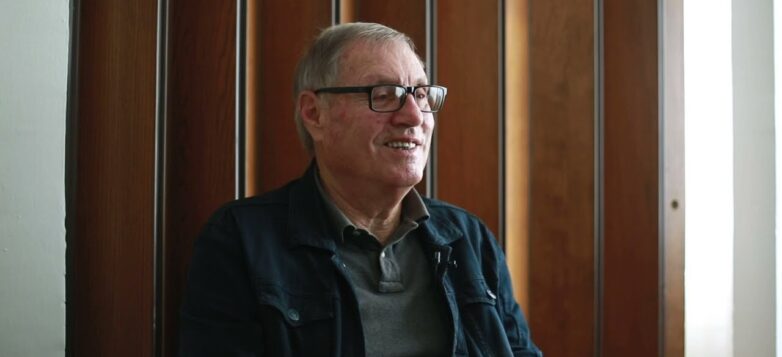

1 1966 Albanian film. After the Second World War, more than 85% of the Albanian people were illiterate. Partisan soldier Dritan Shkaba is tasked with opening new schools in north Albania to enlighten the population.

2 1970 Albanian film. On the anniversary of the death of Commissioner Ibrahim Kovaçi, seven of his war friends are accompanying his statue to his native village, where a ceremony will be held. During the road, each of them remembers moments related to the life of Ibrahim.

3 Skanderbeg (1953) is an Albanian-Soviet historical film about Gjergj Kastrioti Skanderbeg, the fifteenth-century Albanian leader known for his resistance to Ottoman expansion. It was the first feature film produced through Albanian-Soviet collaboration.

4 The “Panda case” refers to the still-unsolved shooting at the Panda café in Peja on 14 December 1998, during the Kosovo War. Serbian authorities initially blamed Kosovo Albanians, and six young Albanian men were arrested, tortured in custody, and acquitted of the killings in 1999 for lack of evidence. In 2013, Aleksandar Vučić, then Serbia’s deputy prime minister, acknowledged that there was no evidence that Albanians had carried out the attack. A new Serbian investigation began in 2016, but no one has been held responsible. In 2023, Kosovo authorities unveiled a commemorative plaque attributing the killings to Serbian state security, although this attribution has not been established by a judicial verdict.

5 Magjup is a derogatory term used across various Balkan languages to refer to Roma, Ashkali, or Egyptian communities.

6 Anton Çetta (1920–1995) was an Albanian folklorist, university professor, and prominent figure in the reconciliation movement in Kosovo during the 1990s. He led efforts to resolve blood feuds among Albanians, promoting peace and unity through traditional methods of conflict resolution. His work significantly contributed to reducing violence and fostering social cohesion in Kosovo during a tumultuous period.

Part Six

Anita Susuri: If you want, is there anything you would like to add at the end?

Muharrem Musliu: Well, I do not know what I would say at the end. I am not a member of any party, I said that earlier, I have never been. I was involved with these NDSh people but that party belongs to its time, it was a party of its time. It is not of today’s time. There are these political parties now, which makes me very sad. In America they have two political parties. In Macedonia, Macedonians, Bulgarians, Macedonians have two political parties, the LSD and the VMRO-DPMNE. Our Albanians have 32 parties.

My biggest surprise is that they go to the Assembly and do not speak about national issues, they do not speak about economic issues, but only about accusing one another, insulting one another. Why then, for example in my life there has never been a person that I, well, I had Metush Krasniqi, I will not say as an idol, but I respected him the most because he was a visionary and I loved him. But I never turned a person into something sacred, like they are doing now. They made Ibrahim Rugova1 sacred, whom I knew, I have photographs with him and all. They made him sacred. Now they are making Albin [Kurti],2 who is not sacred, sacred.

I told them, “Leave it to history, history will have”… I do not trust. I said it openly. I have facts that I do not trust him, but do not make him sacred. You cannot turn a person into a deity, you cannot make him a deity. He has mistakes. There is no person who does not make mistakes. But they say every mistake can be corrected except treason, treason is never corrected. Never treason. The song about Bajram Curri,3 for more than 100 years, “O Kadri, Kadri Mehmeti, faithless and traitor.” That means every mistake can be corrected, treason cannot be corrected. Those who have committed treason and who are committing treason, the people will punish them. The people will punish them.

Treason is never corrected. No matter who it is. You cannot betray the people, you betray them once, twice. Our biggest misfortune is that, “Ah, Muharrem Musliu speaks well, he is a good man.” Look at my deeds, what I do, those, based on those deeds. There were people there, good men, let us say in the Social Accounting Service, about whom you would say, “He was neither a good worker, nor a good father, nor anything.” Why? Because he never spoke, he sat like a gentleman. Look at his deeds, look at his behavior, those, and not based on words. If Muharrem speaks well he is a good man, but what, look at my deeds, for example. These things, my good girl.

I have spoken as far as I still remember things I have experienced, that I have experienced myself and that I have analyzed. For which I have been a witness to all these events, I have been a witness. To ‘57 and ‘58, and ‘64, at that moment I was a soldier, and to ‘68 I was involved, and to ‘75 I told openly everything. Adem stayed almost a full year in my house with Ahmet Haxhi. Which I forgot to mention. In 1969… since I mentioned this Ahmet Haxhi, who is Albulena’s grandfather.

He went to Gjakova to Din Spahiu and took him to Albania. Few, very few people know this. I said it one day when one of Ahmet Haxhi’s sons died, I told it in Grand where they held the wake, I was with my family, with my three brothers and with our three wives. They bring him back from Albania. Because Din Spahiu is a friend of ours from Gjakova who took him. They send him back, they tell him, “You are more needed in Kosovo than in Albania.” Which was true. This was seen in the 90s later. He died.

I was at Hilmi Rakovica’s in the Muhaxherët neighborhood. On the night of March 13, ‘59, it was cold, windy. He comes, enters inside. “So, Uncle Ahmet,” he said, “By God, I have come from Albania,” like this, like this he said, “I am afraid the authorities might look for me, I want,” he said, “you to take me to this brother here,” to me, “at least for a month.” I had an apartment in Ulpiana near Hasan Prishtina, 44 square meters, eleven family members. I took Ahmet that night. From there with Hilmi we went to my place, for one month. The family did not know at all who he was (laughs). I did not tell them, because I did not want them to know.

After a month, Ramadan Haziri came, this friend of mine who died five years ago, one of the closest friends of my life. We enter the kitchen there, I had two children then and my mother and my brothers and sisters. I go and say, “Uncle Ahmet,” he was in the room, I said, “Dani has come here,” he said, “All right.” We went with Dani, when Dani saw him he said, “Muharrem, you are keeping him here in this apartment, that is no good at all,” he said, “we will take him and move him,” he worked as a teacher in a school in Prelez near Ferizaj. “I will hide him,” he said, “in the school.” It was very interesting. At night we set off, Ramadan Haziri, my peer, Ahmet Haxhi, Metush Krasniqi, Hyrije Hana, and I, straight to Ferizaj on foot.

Anita Susuri: On foot?

Muharrem Musliu: On foot at night, not during the day, at night. This was in ‘59, at night. When we saw that a car was passing, we would go off the road, you know, so they would not see us on the road. When we arrived there in the morning we were exhausted. Hyrije fell down, she immediately collapsed. Walking the whole night. We sacrificed without anything at all. For about a month he stayed there. He hid him, sheltered him in the school there. After a month my brother Shaip, the tailor, gets up, takes this Zeqir Gërvalla and they go and take him.

From there they took him to Dajkovc to Uncle Metush, to Metush Krasniqi. One month. After three months nobody was looking for him anymore and then he went out freely (laughs). It was very interesting. At that time, in ‘69, to shelter a person who was wanted by the authorities, there were very few families. Only we who risked ourselves for one another.

When I entered the room that Roma was saying to me, “Look up,” when I look, those wires were really there… I told you, I did not believe him, I said, “The investigators have sent him on purpose to discover something.” He said, “No, they escaped and cut them. We were outside and it rained that night.” There was, I think, a Kamer, Kamer Hoxha, a guard up there. But when it rains over the prison there are those tin sheets and the rain makes a noise, you know, it rattles or however they say it, it makes a kind of crackling. There, as he told me, as this Roma told me and there was one from Kaçanik for murder…

Anita Susuri: Yes, Ilaz Dardhishta, or I do not know…

Muharrem Musliu: I do not know, you know why I do not know, I will tell you now. “When the first one, the first one escaped,” he said, he did not know his name to tell me with name and surname. He said, “He escaped, went up there, and now when that one from Kaçanik entered, he clapped his hands and the guard heard him and came and they caught him. Before he could get out. Half his body, half of it was in the room,” as he was telling me, now how true it is. This Roma as he was telling me. “They took him,” he said, “and gave him two or three punches.”

Now I know that they caught him, I know that they took him because when they took me out, when they took me out of cell three which was below ground, they had brought him there. And they took me upstairs. So this is one hundred percent that they caught him. He, for murder, had killed his uncle’s son. Maybe they told you and you know the case.

Anita Susuri: Yes, yes. He had been sentenced to 15 years, I think.

Muharrem Musliu: Yes. Do you know why he killed him?

Anita Susuri: No.

Muharrem Musliu: It is not important. Because he told me and the judge also told me. The next day, Vesel Latifi, the professor who taught at the faculty — he died two or three months ago — at that time was the minister, as they called it, of jurisprudence, of justice. Since the prison had been broken, he had to inspect the prison. He had a Serb as his assistant, a Serb woman. Now when he goes he asks, “Who is in this room 26?” They say, “Muharrem Musliu,” and he does not enter because Vesel and I were friends, Vesel Latifi.

He had been one generation behind me in high school. But we also had some friendship. He only sent that assistant of his, a Serb. Now, when she entered and asked, I said, “Me,” I said, “they just brought me, they brought me at night.” Now she asks that Roma person; he said, “I do not know, I was, we were out on walk, when we came back,” he said, “we found the wires cut there, they cut the wires in order to escape, I only know that much.” What I know is that they took me, from cell no. 3 three they took me to 26. And that one from Kaçanik, they took him and brought him to 3 down there.

Now when I got out after four or five years I met Vesel. He said, “No, really, I did not dare enter there,” “Why?” I said. “If I had asked you what you were in for, you would have said for nothing,” (laughs). He said, “What was I supposed to talk with you about?” he said, “I sent that secretary in”…

Anita Susuri: Did you notice, for example, did anything happen after that…

Muharrem Musliu: They brought a net, they brought a net there, they brought a net for us, three-stranded, something three-stranded, they brought a net. Because down there in three I did not see anything, there was only, only, only one bulb in three down there. That was on 24 hours, because there were no windows anywhere in cell three where I stayed 34 days underground down there. There were no windows. There was no window. It only had one bulb inside there on the wall that gave light there. That is how it had been.

Then I laughed later, when it was opened as a museum. It was when that minister was there, Vlora Dumoshi, the daughter of Ismail Dumoshi. She grabs me and hugs me, you know, “Bac Muharrem.” I said, “Yes, here in three.” Jeta Xharra said, “I want to do an interview,” I did not accept. And if I had known you well, maybe I would not have come to you either (laughs). Because I do not give an interview to everyone, I do not want to be misused.

Anita Susuri: Mr. Muharrem, I wanted to thank you very much both for your contribution and the time for the interview you gave us, thank you very much again!

Muharrem Musliu: Look, good girl, it has also been a privilege for me to tell at least a little about our national issue, in which I have been a tiny, a one thousandth, a one millionth part of this issue where we kept that ember alive from 1878 from the League of Prizren4 onwards. It never went out, it never went out and even today it does not go out. Even today there are people who truly work in a legal way, not in an illegal way but in a legal way, for national unification, for which, since I know myself, I have been for national unification.

This is what they call a gift from God that he has given us Albanians together, that we will live together, that we will have a common state. No one will ever be able to stop this, never, no one will be able to. Whether it is today, or tomorrow, or the day after tomorrow… and regardless of who will make this unification I would embrace it, regardless of who. Because the ideological issue does not interest me, I am only interested in the national issue. I have never been tied to ideology and I am not.

I feel sorry for some young people who still have, or some analysts, some analysts who want to form a Kosovar nation. This is a permanent struggle of the Serbs for something like that, to separate us Kosovars, the Albanians of Kosovo. Because until recently, until the ‘70s, they called us “Shiptari,” Albanians. When we went abroad for example, they said “Shiptari.” They were surprised in France when “Shota”5 went to France there to dance and everything, they presented them, “Shiptari sa juga Jugoslavije, the Albanians of the south of Yugoslavia.” They were surprised where this Albanian nation was born from. They were surprised. If they had said “Albanski,” Albanians, it would have been different, but “Shiptar!” So, they were surprised where an Albanian nation was born.

And I see some Halil Kadosh, some Halil Matosh, this Spahiu from Mitrovica, that Nexhmedin Spahiu and others, the Kosovar nation. Where was it born? These are very dangerous, Wahhabism among us is also dangerous. It is very dangerous. This is more dangerous than all the others. But I think that just as we have lived for two thousand years, Kosovo did not have a state, today we became a state. Is it… because in history a thousand years is nothing, one hundred years. This is a gift from God. God will unite us all, we will be together to live, perhaps with our neighbors regardless of what they have done to us, what they have done to us. But when we become a mass, when we become together, what can they do to us?

Thank you also from you! There are things that I had more to say but maybe I did not see them as necessary or I have forgotten them, you should not hold it against me. Since at an advanced age, at almost 84 years. I have tried to be fair, correct, without any boasting and so on. Thank you!

Anita Susuri: Thank you! It was a pleasure!


1 Ibrahim Rugova (1944–2006) was a prominent Kosovar Albanian politician, writer, and journalist. He was the founder and leader of the Democratic League of Kosovo (LDK) and served as the President of Kosovo during the war and after until his death. Rugova was a key figure in the non-violent resistance movement against Serbian rule and played a crucial role in Kosovo’s struggle for independence.

2 Albin Kurti (1975) is a Kosovo Albanian politician and leader of the Vetëvendosje (Self-Determination) Movement. He first became prominent as a student activist in the late 1990s, organizing peaceful protests against Serbian control of the University of Prishtina. Arrested by Serbian authorities in April 1999, he was transferred to a prison in Serbia and released in December 2001. He later became Prime Minister of Kosovo, first serving in 2020 and subsequently returning to office in 2021 and 2026.

3 Bajram Curri (1862-1925) was an Albanian chieftain, politician and activist who struggled for the independence of Albania, later fighting for Kosovo’s unification with Albania, following the 1913 Treaty of London.

4 The 1878 Albanian Alliance that fought against border changes decided at the Congress of Berlin by the Great Powers. The League demanded autonomy from the Ottoman Empire. The building where the Albanian leaders made their besa (sworn alliance) is on the river, upstream from the center of town. It is now a museum. The current building is a reconstruction of the original one, which Serbian troops burned down in 1999.

5 “Shota” is a folkloric dance ensemble, which was established on September 30, 1950, as the National Ensemble, with the decision of the Assembly of the Autonomous Province of Kosovo, as well as three other ensembles in the former Yugoslavia: Llado – Zagreb, Kollo Belgrade and Tanec – Skopje.

Download PDF