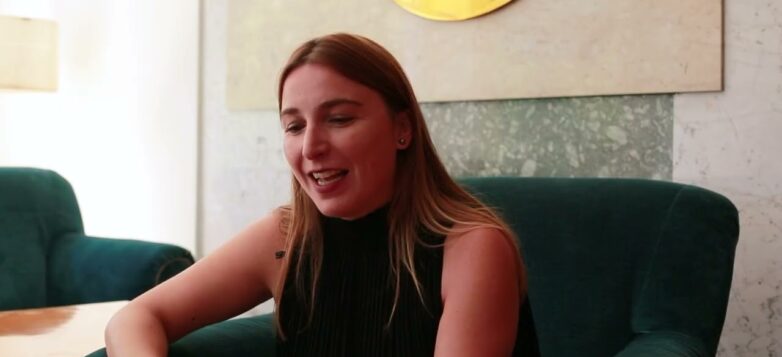
Diona Budima: Could you briefly introduce yourself and describe your role here at the Villa?
Nita Deda: So I am Nita Deda, I am part of the Art Explora team in Tirana. My position is coordinating the program here at the Villa. I’m here in Tirana since one year doing this job. This is a decision that was taken two years ago to transform this villa, which is the villa of the dictator Enver Hoxha, where he lived with his family, to transform it and to open it up to the public. And to do this through a collaboration with French Foundation Art Explora, which is an art foundation that is based in Paris. They run a very prestigious residency program in Cité des Artsin Montmartre. They have many other projects, though the mission of this foundation is to make art accessible to all.
So, different projects include also a festival, a boat museum that is traveling through the Mediterranean and that is stopping by in different cities of the Mediterranean. And this also included a stopover in Durrës this April. So a moment of this festival in Albania as well. So, yeah, I arrived here in October. I’m since one year here, we had the opening in April. The opening in April was marked with the open studios of the first artists that were here in residence that arrived in January of this year.
Diona Budima: And what drew you to take up this role? And how has this shift between the Kosovar artistic context and Tirana been to you?
Nita Deda: I mean, it’s– so we’ve– I’ve– in all of the works that I’ve [done], all of the jobs that I’ve done, we’ve always had a very close connection with the scene here. And we’ve always collaborated. I thought, when I took this role, a role I thought it’s very challenging, but also very inspiring. And I really trusted this mission of– I trusted this mission of this house being opened after more than 30 years for the public. Being a house, a villa, that carries a very dark history and that is located in the middle of the city, but that was not opened. It was opened for very smaller activities in the last years.
And I really liked the idea of this villa starting, almost like starting a process of being transformed because what is happening here is that the program of the residency, of Art Explora in this villas, it’s an open call that is inviting artists to apply with an idea of a research or a project that they would like to develop. And from this call, there was a jury of six members that is selecting up to 30 artists a year. These artists apply from more than a 100 countries from the world. So from all over the world. And the sessions are divided in three sessions a year. These artists, they live in the, they live in the house.
There’s a studio, they have a studio space, and they have a working and living space here. They have a grant to develop a new work. And they also have a lot of help from the team, which is the team, us here, to link them to the local context and to also link them to the scene here and to help them develop the research that they want to do. And then there’s three moments from this program when the whole house opens for the public. To show the works that were created, but also we curate a whole public program around each of the works, that takes the form of screenings, of talks, of music, of performances. This house, it’s a very– it’s a big, big house, and it has been renovated to host or to welcome different kinds of activities.
So this, I mean, the idea of this, of this house being… Starting this transformation with people that come and stay here, reflect here and then show work here, for me was a very, very, exciting opportunity and inspiring, to come and be part of this. So I was very honored to join the team last year and to start this. Of course, there was many challenges because we had the– it was the first opening, the first public opening. So we didn’t know what to expect. Also like how the city is going to, how the people are going to…
Diona Budima: Respond?
Nita Deda: Respond to this. But I, I mean, I believe we had a very good opening in April because what we did is that we not only had, obviously we had all of the artists that worked very hard for this moment of the opening, the first session of artists that was here, but we also curated the whole parallel program to address the opening of this house, and what this means. And how we did this is, we co-curated a symposium together with Elidor Mëhilli, who is the historian that we worked with since we came here.
We commissioned him also to do a text about the house, which is in the entrance of the house. Elidor Mëhilli, he’s an associate, he’s a professor of history at Hunter College. He’s an author of the book, From Stalin to Mao, and he has been a big help, in helping us navigate the historical context of this house. So we co-curated with him a symposium that started with a keynote speech, a lecture from him that draws from his 15 years research that he has done on the house and on the time of dictatorship in Albania.
And it continued with another panel on the architectural transformation of the villa that included also the two of the architects that did the restoration, Tibo Makra and Lucy Nani, who are the architects from the agency called NEM, that have been working in the last two years to transform the villa and to bring a concept. And so their concept was to protect the structure of the villa, then to also add a layer of the white furniture to change the functions of the rooms so that the villa can host eight studios, and can host the cinema, and can host workshops spaces, and many other spaces, but also like to see, in their concept the villa is seen as this– the restoration is seen as the first– It’s seen as a tool, it’s seen as the step to this transformation, which is then completed, or that the start of it is with the problems that happened here. The start is with the artists that spend time here and that–
Diona Budima: While we’re at this topic of the, you know, this physical heritage of the villa, is the villa a protected monument by the National Institute of Heritage?
Nita Deda: Yes. Art Explora has an agreement to work and use the space in the next five plus five years, in proposing the program, managing the residence and funding this program and proposing public programs. And also, you know, navigating the collaborations. Because since we opened in April, we then had a very, you know, we opened with a very active program of public programming, of having two to three events a week, in the basement floor where there was a screening room, but also in the first floor. And–
Diona Budima: How are those public talks curated?
Nita Deda: So they’re curated. We are two people here that we’re proposing the program. We– there’s also Doruntina Vinca that is proposing educational– the program of education and public reach. And we– so there’s a collaboration also with the artistic team of Art Explora and a lot of it is also branching out from the residents that are here. So it’s, for example, previous works or previous films or just different practices that we want the city to get to know prior to the open studios. So this is one aspect of it. There is a very important aspect of collaborations because the space has been opened and the idea behind it, the idea of ArtExplore behind it, is that this space is for, also for the local collectives and institutions, and curators and galleries, to propose their programs here.
So we are also navigating a lot of these proposals that come from outside. So for example, now we have Art Lab Tirana, Art Lab “Curating with Care,” a fantastic program for young curators, for young regional curators that go through a three-month weekend lectures and that get to actually curate an exhibition here in December. And this edition of “Curating with Care,” because it’s taking place here, it also has a theme of how you can deal– dealing with the past in curatorial practices. We have the Albanian Cinematheque that we have collaborated in the opening, but that they again propose monthly film programs.
This is an incredible initiative by Iris Elezi and Thomas Logoreci, that is dedicated to film education and film programming. And we have another film program of, that was proposed by Blerina Hankollari and Gentian Koçi from the Art Lab film productions, which is the authors meet authors, which is an initiative that we have screenings of– monthly screenings and in between, this first edition is in between filmmakers from Kosovo and Albania to have screenings and then to have a conversation, which is then also documented, and streamed for future viewing.
There is, you know, also [the] next one. So there’s many, many, many, proposals that we have from outside that we’re usually very keen to have here and to host here. And then there’s also an aspect of dealing with the past within our program, because for the obvious reasons of the House being a house that carries this very difficult history of Albania. So we have different screenings that are dealing with the past or book launches, book promotions and talks. Just to also explain, also for the opening, this parallel program. We also had a collaboration with the authority for the information of State Sigurimi (security) files, which is an institution that sits under the Ministry of Defense of Albania.
And we were very, very honored, or very good to have this collaboration because they, in the opening in April, they had their team here. They were also part of the symposium, in one of the panels, and they had here an information desk with the teams, with their teams and all of their publications. And they had an intervention, an exhibition that was also showing different typologies of this machinery of surveillance that actually in the end came from this house, and it was, it was good because we could direct a lot of the journalists, and a lot of people for more context about this house. We collaborate with this authority to bring all of the authors that come here also for a visit at this institute.
But, so throughout– The way how we see actually this part of this house, is not that we want to have a room and to say, “We’ve dealt with this past and this is here,” but we see it as a problem that is taking– that is always part of the house, of the public program of the House. And that is taking [the] form of film screenings, conversations we have. For example, we had a– part of our educational program, we had a conversation with the– about also: how do you talk to children about this past, you know? Because we have a lot of children that are coming here.
And for us, too, it’s important to also learn: how do you talk about this, too. So yeah, I mean, the symposium, also because I didn’t– to go back a bit to the symposium, we had the architectural transformation. But then we also had curators, and artists in one panel that was also discussing about how– what does it mean to curate in contested spaces as this one. So in a way, I mean, our– the way we approach this is that we give, we propose and we give space, and we give space to talk, and to reflect, and to meet.
And this is why I think this project is– why I believe in this mission of this this project, it’s the way of exactly how I see art that is there to go deeper into, also, difficult paths. That is not there to decorate it, to hide it, but it’s there to go deeper in it. And I’ve seen, also, this with many of the works that were created, because obviously the artists that apply here, they don’t– there’s no obligation to apply a theme that is dealing with the house or the– it’s different practices and different themes. But it’s a very flexible residence in the sense that– once they’re here, they can also decide to change the idea and we will be there to help.
So it happened, especially in this first year, that many artists that were [here], they were affected by the history that this house carries and they decided to do work that is addressing this history. What we do for the artists that come here, as well, to– because it’s three months, it’s not, you know, such a long time. So for the first month, it’s very important for us to also just to organize as many lectures and moments as possible to– for that, this landing, for this context of the house which includes, you know, lectures with historians like Elidor Mëhilli or visits, and meetings at the Institute of Anthropology with the director Olsi Lelaj there, a visit at the post socialist archive, and a lecture with Jonida Gashi at the Academy of Sciences.
A film program from the Albanian Cinematheque that is touching upon a bit on the history of film here. So films and conversations. And this is a program of, like this program of introduction, of context, to this– to the scene, and to the country, and to the space.
Diona Budima: Yeah. And I’d like to hear more about what you said, that art allows us to sort of dig deeper and engage more deeply with this heritage. What do you think is the advantage of preserving collective memory through artistic engagement instead of, say, more traditional ways of preserving memory, like turning it into a House Museum?
Nita Deda: I think both are, like, necessary to preserve the history of a country. And I think that one doesn’t cancel the other and that one is not better than the other. But if, for example, in the neighborhood that we are, there’s two museums on dealing with that particular period of the history of Albania, then I think for me this is more interesting because it’s lively. As I said, it’s like it’s alive, it’s always like it’s a process of being transformed, of every three months having great artists, because we have more than 2,000 applications of the 26 ones that get to have this space.
They’re really, you know, good artists and good thinkers. And I think this is– it’s a much more lively way to interact and to preserve this history. Of course, a lot of the artists, they’re working with archives and with more traditional forms of preserving history, so–
Diona Budima: Yes. Have you noticed any recurring themes, questions or challenges in how the artists respond to the context of the villa and the residency? Because from our interviews, we’ve seen that a lot of their projects changed when they came here and they were in contact with this context. It affected them a lot.
Nita Deda: I’m not– I mean, in the first session, I think we had a lot of the artists that were appearing in each other’s works. It was more of this, “Okay, we have to open together, we’re in this together, all of us.” And it was a lot of collaborations, and a lot of working maybe. Yeah, working together. I think, of course, for the Albanian artists that are part of the residency, this, it’s more of an emotional journey, I would say. This is what I’ve seen.
Diona Budima: A lot of them told us that they were having very vivid dreams when they came here.
Nita Deda: Yes, yes. And there was one idea. I don’t know if that’s going to happen, but we had one artist that had a very good idea of putting a box and of people writing their dreams, of what they’re dreaming here, and maybe after ten years, to have an archive of what people are dreaming here. And maybe after ten years to open up. I think it was Stanislava Pinchuk that had this idea of– then after ten years to open up this, and to maybe, like, do something to this archive of dreams here. But yeah, I mean, for example, Stanislava also connected to her own upbringing. It’s not that, you know, that this is a trigger of also like other similar realities, you know, of growing up in the Soviet Union, for example.
So, yeah. I mean, the last session, we had more people that were affected by the history, so they changed their ideas in the meantime. In this session now, because we just had, we have the new group of artists that just arrived now in September. We don’t have many projects that are actually dealing with the history. So yeah, we’ll see. We have the open studios in November.
Diona Budima: You spoke about collaborations with local institutions and how helpful and useful that has been. What role do you think the villa plays in fostering dialogue between local and international perspectives?
Nita Deda: It’s, I mean, it’s a great opportunity for the artists that are here in residence, for the network that the Art Explora has, to connect them. So we have, you know, we’re having studio visits, we have a whole curatorial platform that we’re developing in having, inviting curators that spend a longer time here, so that spend up to two weeks at the villa. We will have the first one coming in autumn. Asrin Haidari is a curator of Moderna Museet. So to have a longer research, or interaction with the scene, and the whole programming here is also connected to the other programs Art Explora is doing in other countries. So in that way, I think that the– it’s built around that. Basically to also engage in this collaboration.
Diona Budima: And the residents are always a mixed group between internationals and locals. Is there a fixed way on how you go about it?
Nita Deda: There’s like a vision, or a mission, is to have at least up to 30% of the artists being from the Balkans. So, not only from Albania, but from the whole Balkans, so that this is– has an impact on the Balkan scene. And we’ve had, you know, luckily we’ve had many, many very good applications from the Balkans, especially in the– now, for the next year.
Diona Budima: Could you speak about the challenges that you’ve encountered? Be it sort of logistic, or political, or conceptual.
Nita Deda: I mean, you know, obviously, because of everything that I’m speaking about, it was a very… The main challenge is that you’re opening a space, but that also that the space you have, the space is very sensitive and the space is like a trigger for trauma. And how do you create space to carry and to respect that?
[The interview was interrupted here]
Diona Budima: And has dealing with these challenges changed or evolved the vision of what the initial idea for the residency was?
Nita Deda: Not– I can’t say, like from the beginning when we came here, the mission of Art Explora was the– you know, the main program is the program of the residency. But actually, this is an ecosystem. It’s a cultural ecosystem. It’s here to collaborate with the students, it’s here to collaborate with high schools, with the local art scene. And this obviously takes different shapes, and we’re learning a lot from session to session, or we’re learning from different programs. But the mission of it, or the values of it, I think these are things that were here when I arrived last year.
Diona Budima: Maybe to end. How do you envision the future of the residency program, and what are your hopes for the circulation of the work that is produced here? In our conversations with the artists, a lot of them describe their process here as more of an opening up of a question, and the start of something. And they all had ideas about continuing the projects.
Nita Deda: I mean, what is very, for me now, very inspiring, is that what I see, some of the– these works, the lives that they’re– or the places that they’re starting to go to. For example, we have some Stanislava Pinchuk returning next week. She’s going to continue her research. She’s doing a whole project with Sezgin Boynik from Rab-Rab Press that she met while she was in the residence here. Or, you know, there’s ideas of Franziska continuing, Franziska Von Stenglin, continuing her research and her project with the Institute of Anthropology here.
So there’s a lot of collaborations or moments that started here that I see developing, and that I’m very happy about because this is a moment to reflect this, the residencies, that it’s a moment to reflect and to start a research, and many times this is not a finished work. It’s a question. It’s a process. It’s also in the open studios, it’s a showing of this process, of how these three months have been and yeah, I’m very happy to see many of the artists that were here, to continuing collaborations that have– that took place or that started here.
Diona Budima: Okay.
Nita Deda: Thank you.
Diona Budima: Thank you very much.