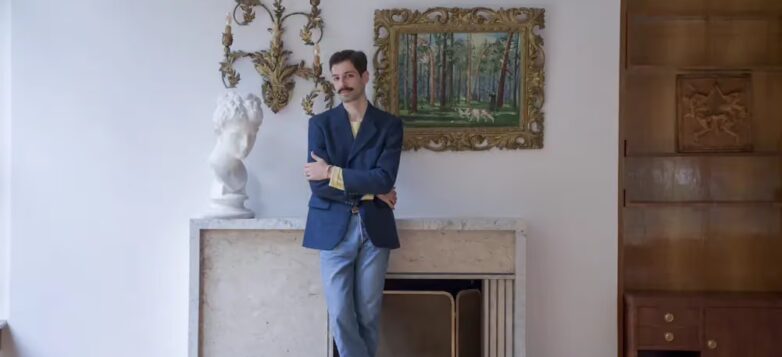
Wandrille Potez: I knew that there was, like, difficulty to connect about the history in this house, in this very particular relation that Albanians have with it, and I just talked to this guy about his project and it was a very nice conversation. Like about migration, because his special estimates about Palestine, about connection between experiences, and he just– I told him that I was in the Villa 31, and I saw the switch, like, and suddenly he became quite unfriendly.
Diona Budima: Oh.
Wandrille Potez: Like very [unfriendly] in a way. And because he’s sure that it could be, it should be a place reserved for Albanian artists because they need it. So I first explained that all artists need it, like not only in Albania, and he tried to explain to me that this… because of the difficulties here in a way, not only because of the history they need a place for them, like, but for me it’s same things that I heard sometimes in France when some French people are afraid to see foreign workers because they think that foreign workers will take the work of French ones, and I think it’s a very, very dangerous idea. Because art is also a kind of work not so different in every kind of practice, and for me it’s like the comparison is good, so…
And just realized that later on my bike when I came to you, and I said, “Oh, I should explain to him this like my mind in this way, and why I was so surprised to his…” you know, because it sounds very nationalistic in a way, and very xenophobic. So to think that only Albanian artists have something to think, and to say, and to show about [inaudible] or about Albania, I think it’s a very bad thing. So it was also a good experience in a way because I was, thanks to this short conversation, able to understand why it was so difficult during the previous session, even between some residents, to manage this kind of trauma in a way, but it’s interesting.
Diona Budima: Yeah.
Wandrille Potez: Sorry to start with this because it’s very recent.
Diona Budima: No, that’s actually part of our conversation. Yeah.
Wandrille Potez: And I was not very into these problematic questions because during our session it was super fluent, and we had discussions, very nice ones with all the residents, and…
Diona Budima: Discussions about being here?
Wandrille Potez: About…
Diona Budima: Everything.
Wandrille Potez: Everything. Not only this, that was also very good.
Diona Budima: And how how did you feel being it is a site of very difficult heritage…
Wandrille Potez: But it’s a very difficult heritage, but for me it’s heritage, like, and I’m working on heritage, like, in every field, and usually heritage is problematic, not only the stones themselves but the use of it, like, even for the monasteries, for example, some people think that represents only the, like, real Albania in a way, because Christian Albania. So it’s always very political, not only this house, but every kind of heritage can be instrumentalized, like, can be the object of some political projects, and I’m trying to study it in a way, just, not only in an aesthetic way.
That’s why it was very important like for me to– When I presented this [inaudible] in Paris, to say that it’s not all Albania, and this region is not only Christian, not only monasteries, so I organized a concert with Sufi Albanian music in– with churches around, to show to the Parisian people that Albania is also this, with this Ottoman heritage. And… So for me the same tension when I speak about churches that– when I speak about this house.
Diona Budima: Okay. Let’s take a step back, and maybe tell us a bit more about your practice in general. Actually, could you state your full name, where and when you were born just for the record, and then maybe tell us a bit about your background, and how you came into your artistic practice.
Wandrille Potez: So, my name is Wandrille Potez, I’m French. I’m from Normandy, and I was born in 1996, and I was formally– I studied history of art. So, I’m supposed to be a historian. That’s the beginning. And [inaudible] I came to photography [inaudible] artistry because I needed to take many, many pictures to document my research. At the beginning it was mostly decorative arts in Saxony, from the– at the beginning of the 18th century. So something completely, in a way, completely different. But I find now some connections because I worked on the taste at the Saxon court at this period for oriental art, and it was very interesting to this strange Europe, like, how to explain this kind of interest for other places outside Europe at this time, also for political reasons.
So for me, like, the discovery of the Balkan space was connected with this kind of research because I was very interested by central Europe and after southern Europe. So I am sure there is a link somewhere, but after– so I worked as a researcher, as a creator, and finally my biggest project failed after three or four years of work between Germany and France, and I had a huge time to just go back in my personal project, to go back in Albania, my bike at the beginning, and my food now mainly, to document heritage, and it was, like, for me the occasion to be, like, really a photographer and to, you know, involve artistic stuff only and not– so it connected with history but in a different way.
Diona Budima: And what was the big project that failed if I may ask?
Wandrille Potez: It was an exhibition about, like, the marvelous French collection of furniture from the 18th century rediscovered in the storage of the Museum for Decorative Arts in Dresden, like, during the past decade. And all these incredible, rare objects were restored and, it was very unknown because after the war many people thought that this collection was destroyed, and in fact not at all. So it was, it is a huge [inaudible] for the French liberated arts because this kind of objects in France disappeared during the revolution mainly, or just after. And this, like, furniture with this so high quality from France for a rail court in Germany, it’s something very, very special. And it never changed since the 18th century, so the conditions of the furniture were also exceptional. That’s why I wanted to show it in Paris and to publish in the largest way possible.
But finally, it was the year of the Olympic games and for all the cultural institutions in Paris, it was very complicated because many of them were closed for the preparations in the city of the festivities later, and also the ignition space, like, my– So finally we had to postpone perhaps one day [inaudible]
Diona Budima: [inaudible]
Wandrille Potez: It was a very nice project. I would be able to [inaudible]after.
Diona Budima: So is heritage preservation and restoration were sort of the main…
Wandrille Potez: Yes.
Diona Budima: …the main of your work.
Wandrille Potez: It’s connected with the urgency of protection, like, necessity to show the, like, this furniture as this church is, to preserve it, and also to connect histories, like, in between France and Germany for example, and also here between Europe and Albania because in a way, like, in Western Europe we see Albania only as a Muslim country. And for many people in France, it’s a huge, it’s a big surprise to realize that this kind of Byzantine or post-Byzantine churches are not only in Greece. Because this current border is something, like, just in mind, but for architecture means nothing. Many artists who painted these churches worked also in the north of Greece, so I guess they are connected to [inaudible], it’s very connected.
So I worked usually with this kind of topic, especially when it’s necessary, like, when it’s– something happened. In this case for Albania it was– because my first visit was very impressive because the churches were in very, very bad conditions and we had to do something. I can’t alone, so my scale, at my scale it was just to document it and hope for a better future, and now I see that there is many local initiative to restore it, to take care of it for the– since the last week there is also governmental projects to think about the future of this region, I hope in a nice way, so it’s not [inaudible], but I’m very happy to see this kind of new– also throw photography sometimes for people, like, they are surprised to see foreign interest for the local heritage and it can change their mind. So that’s why I think it’s very interesting to have sometimes [inaudible] trip even mine.
Diona Budima: So you had been here before and that drew you to apply to the residency?
Wandrille Potez: Yes, many times. The first time in 2017, and I came five years later. So the first time was by bike to Italy and Greece. I discovered just by chance Albania on my way, like, from the north to the south and I was amazed in every direction possible. It was a huge, like, beautiful surprise, also because it was very unexpected in a way. I had a completely wrong idea of it. I had no precise ideas. I was surprised and I wanted to go back also to see Tirana because I had this very, very special connection with the city almost 10 years ago. And when I came back in 2022, it was completely different. I wasn’t able to recognize the city. My favorite parts disappeared completely.
So I realized that all the things I saw in the countryside were also going to disappear. Even the [inaudible] which seem eternal, like biblical landscapes, like something very… Like room churches. But we could have this impression that it’s like this forever and I realized thanks to the example of Tirana, that in fact all it’s on the point to change. All the natural reserves are on the point to be destroyed, the churches were at this time going to fall down. So I decided to start this photographical project during this first like [inaudible] day in 2022. I took many, many, many photographs and I lost all of them just after this [inaudible]. So I lost two months of work when I came back to Paris. It was very funny for me and also connected with the prejudice on Albania, because usually people say, “Oh be careful, you lost your material in Albania, it’s a very dangerous place,” and at the end it was stolen in Paris in a very shitty [inaudible], and I never, never lost something in…
Diona Budima: It was stolen in Paris?
Wandrille Potez: Yes.
Diona Budima: Oh, okay.
Wandrille Potez: So it was very funny also for me to realize that in, like… Okay the prejudices are like complete, be careful in Paris, [inaudible] is not where we think. And that, it was a good motivation also for me to come back and okay, perhaps the first photographs were very bad, it’s a chance to lose it. So since I come at least once a year and now twice or more.
Diona Budima: And could you describe the work that you did here, the form that is– so what can we see here?
Wandrille Potez: Yes. So this part is only one part of my work in Albania. It’s not the main part because I had more time to research on it, but it’s, like, this project especially is connected with this region in the south around Gjirokastër, where I discovered, like, not, it was not, I was not the first visitor but it was a discovery for me, and it’s important for me to say it because many people have this kind of exploration projects in mind in only adventure way, and for me it’s quite dangerous to think that the spaces are virgin, like, I don’t want to be in this kind of colonial perspective, to consider Albania or Balkan as something to discover, like no, there is already life before you’re there, and also even on these churches. Also study a bit on it so…
Diona Budima: How do you research them?
Wandrille Potez: It was not my specialty at all as an [inaudible], so I had this enthusiasm to discover something completely new for me and unknown. And I discovered for the first time one, and I see first the buildings and I decided to search later to understand what it is, what is the era from which it is. But the first sensation for me is very like sensual something connected with the stone, with the reality, the most concrete one, and research came later, even during this residency for example, because usually before I was at the countryside to take some photographs but not to research, I don’t have enough time.
To just be on the path, to see the monuments, and to enjoy, to stay for a long time around, to be able to open it and– so to resume its kind of constellation of monasteries as we can find in some famous part of Greece in Meteora, in Athos, in Peloponnese, some part, and a very harmonious [inaudible] of [inaudible] buildings with– in a very special landscape and that’s why I decided also to present it as an ensemble because they are all in the middle between… at the same situation between the bottom of the valley and the sockets of the small mountains in the south, in a high situation, quite hidden when you come, but from the church you can see, like, huge panorama of the valley, sometimes until Greece.
So there is also this very special connection between nature and stones, also because of, thanks to the abandoned– like in a way it’s so well preserved. Okay, the conditions of the building are very bad. But thanks to this isolation, the nature is amazing. It’s one of the most beautiful nature I saw in Europe. And I think Albania is one of the, like, rare space where you can find this quality of nature where it’s still intact.
Diona Budima: And what camera did you use to shoot this?
Wandrille Potez: I’m using a Leica Q3, because it’s very strong, so very sweet.
Diona Budima: Yeah. And could you speak a bit about your aesthetic choices? These are all– I mean the vision is very unified, the perspective.
Wandrille Potez: Yes. Because I’m working on the idea of inventory and to document it because for me it’s my artistry background. We need some inventories to conserve. So even aesthetically, I think in my mind it’s something very clear, that we need inventories especially in this kind of endangered place. It’s, for me, the only way to preserve it, not artistically but just also scientifically, or if we have to restore it later it’s good to have some kind of documentation. So a huge part of my work is not aesthetic at all, just technical views. And I’m trying to also, like, connect my work in this kind of scientific document [inaudible]
Diona Budima: And I wanted to ask about that because in your– you also write these personal narratives that accompany the pictures, and the writing persona is very– sounds a lot like this 19th century explorer.
Wandrille Potez: Yes.
Diona Budima: And because you said this before, you’re also very critical of that, like, western explorer who comes to the, you know, quote unquote “orient…”
Wandrille Potez: There is a paradox.
Diona Budima: Right, and discovers the orient. So could you tell me a bit about this tension in your work, being sort of aware of the fetishistic nature of that figure, but also kind of using the romanticism of that figure.
Wandrille Potez: Yes, it’s the heart, I think, of my project, like, really it’s a tension I want to find because we need these kind of beautiful images to have good representation of our heritage in a way, especially in Albania because like not only in Albania, but in this, like, country with political difficulties are connected with culture… Because, like, many artists worked on bad constructions in Tirana for example, on destructions of the coast, on the poverty, and I do it also, but I find, I want to find another way, more aesthetic perhaps, also to give a better idea, even for Albanians, to the heritage, to show that it could be, like, also in bad conditions but beautiful. I’m not afraid by beauty.
So that’s why it’s very connected with 19th century. But I don’t want to do this, just take some beautiful pictures and come back to France to edit a beautiful book. It’s not my objective. If I can publish a book later with this kind of research, could be great, but I can’t do this without a connection with Albania, with Albanians. My idea is very connected to bring this image in Albania. I do it for Albanians. I want to think about it with Albanians. Even in Paris, like, the talk we organized with the villa last week was with [inaudible], she’s like Franco-Albanian and she worked, she works on heritage and [inaudible], like, and curable dimensions too, and it was very nice to think with her about the future of these monuments.
I don’t want to just, like, take this beauty and keep it for me, it’s not– that’s how I’m trying to do something different and to connect not only with the history, but also with the places, like, that’s why I wanted to do this residency here. Like, I’m trying to, like, also with Ilda Mara who was very engulfed with this kind of heritage questions in Albania. To think about the future. For me the goal is not only to promote the idea of restoration of the places. It’s connected with, I just– for sure, I don’t want just to take a picture. I want to– I’m also a journalist, so I want to speak about the churches, I want to publish it, to keep some attention on it. So it’s a kind of self mission.
But I saw in many different places that if you just think about restoration, it’s just a part of the job, it’s very useless in a way because you give the idea of, okay, this place has value because we decided to restore it. But at the moment we consider that this place has a value, we want to protect it. We close the door because Albanians, like, because of their own prejudice, couldn’t use this place correctly and it’s very dangerous, and it kills the heritage as a lively space. We have to think about restoration, but we have to think about opening the spaces, about… we have to think about the access of the spaces, the protection of the area, but in the in the most global way, like, also the preservation of the nature.
That’s why I choose black and white, I don’t want to transform these places as touristic destination. For sure, I want to keep attention because these places need visitors, and all the villages around need new people inside, like, even from local families, they need a good reason to come back and to have foreigners, visitors, tourists, to reopen the coffees in the middle of the village, to find new dynamic and present heritage as a chance and not as a charge. But if you do it in the current governmental way, you kill the space, like, you decided to put asphalt on the tracks. So you give the idea to bring some paths, high next to the monasteries, you destroy the nature around, you destroy the spirits of the place, of the spaces.
You destroy the animals life because now we have to consider this heritage as, even inside the churches, as natural place because it’s a refuge for bats, for snakes, for insects, and I think I’m trying, in Albania, to think about it with, like, all the people I’m trying to know, to try to change the mind collectively, like, as a discussion That’s also a way for me to resist against my own orientalistic aesthetic, so it’s a kind of balance.
Diona Budima: Yeah. And I mean if these places open up and have more tourists, do you think they would lose the mysticism that we see in your pictures? Even though these are, you know, you say you’re doing an inventory, but they do have this mysticism.
Wandrille Potez:Yes.
Diona Budima: In them, which comes from them being half ruined, close and isolated. Yeah.
Wandrille Potez: And it’s very difficult to, like, to think about about it as a global thing because usually the the local idea of restoration is to make the buildings solid, like, I think it’s connected with an idea of masculinity, like, if it’s good, if it’s valuable, it has to be a resistant, and it’s very fragile and I think we couldn’t– we cannot change it, like, it will stay fragile. And we have to protect this idea of fragility as a condition of the preservation of the space.
Diona Budima: And you mentioned cultural heritage that [inaudible] organization, did you have any kind of collaboration with them or you…?
Wandrille Potez: Yes, because– very independently but I proposed, like, last year, in 2024, I prepared a file, an application to bring some foreign money, especially from America in this region, thanks to the [inaudible] fund, so thanks to the pictures, thanks to some writings, I explained that it needs [inaudible] urgent help, and this help is– so it worked, the churches were selected to be a part of the watch list of 2025. And it’s– now the relay of this operation is in Albania Cultural Heritage Without Borders, and they do a great job because they work with local archaeologists, with local materials, and some churches, like this one for example in Duvian Chenoli, like we can see the light through the roof now, but it was in 2023, and since last year, thanks to Cultural Heritage Without Borders, there is new beautiful stone roof, perfect conditions, but something that’s very discrete, a work [that’s] very respectful of the area, and yes.
And this kind of– just to respond to your previous question, this kind of tension between, like, mysticism and problematic conditions is also something that interests me, like, in my writings because when I enter in a church like this, I find it, like, wonderful, you know, it’s beautiful like this because thanks to the holes in the roof there is lights on the frescos and it’s a chance, like a beautiful chance to be able to see it like this. Very few people saw it like this. And at the same time there is this kind of anxiety because you see, you know that it’s on the point to disappear, the building or the atmosphere, like, if they restore it. So there is also a kind of contradiction, and very into– when I choose to take a photo to try to deal with it, like, a mix between admiration and anxiety. So…
Diona Budima: Are there any specific texts or authors that references, that inform and inspire your work? I saw in the wall there you have exposed French historians. Could you tell us about those?
Wandrille Potez: It’s a very, like very special books. It’s not… it was not at all my references before. And I’m working, like, usually in this area without any references even in literature. So I’m not very into, like, adventure narratives. I find it very, often, egocentric. So I have some trouble with it. Even now it’s interesting to see that in France, like, the most famous French literature in this way are always very right positions, and I found it so interesting, so I don’t want to be a part. That’s why I’m trying to see it in a political way. Like, this book, it’s something completely different it’s not like– it wasn’t literature references, but I discovered it in the library, the personal library of Enver Hoxha, and I wanted to come in this residency to connect my work with the reasons of the condition of my subjects, because these churches are, like, in a part of it abandoned because this broken link between population and religious places, because of the politics of Enver Hoxha.
They were not allowed anymore, from the middle of the 60s, to enter in the church, to have a religious use. So to be in this villa was– I wanted to find explanations, and I was in the archives, in the archives of the National Institute for Cultural Heritage. They are beautiful materials, like photographs of these churches from the 60s, from the 70s, 80s, only, mostly from the police regime, and I found this paradox also very, very interesting for my subject, because I realized that many stories I heard in the– I listened in the village were legends, like it was fake stories. They told to me that communists wanted to destroy the church, but in fact, yes, like in the north, Catholic churches were very hardly destroyed even in the center of the cities like in Përmet, they destroyed the churches to build new cultural places.
But in this region, in a very strange way, I need also more answers, I had to ask people in [inaudible] still now, but I realized that at the same time they decided to have very hard politic against religion, they decided to bring in these places historians, archaeologists, photographers to document it and to take care of it in a way. So it’s a very complex history because also for nationalistic reasons, they had to protect the heritage, to present Albania as a great cultural historical country, also to– against Greece, against Yugoslavia. So by chance in way, these churches are on the [inaudible] of this kind of contradictions of the regime, and I found also this contradiction about my, like, own subjects in the library of Enver Hoxha because I wanted to find answers.
I looked at all the books and I thought if I will find only books against religion, like, very critical books, and not at all, like, for sure I found something like about atheism, about history of the destruction of Christian Europe, and it was quite funny because it’s a kind of projection of what Hoxha wanted to do here. So I wanted to play a bit with this kind of reference, and also with other references, like, very religious one. He was not– we can see in this library, not only hate of religion, but fear of it, fascination for it. There are books not only against, but on religion, even on medieval Islam, many books on the connection between political power, like, that’s what I saw about Islam probably, and religious power, like, how people can use the religion against the state.
There was also some books for example about Greeks Christian figures, characters as Jean [inaudible] in France, and I found it so funny to imagine that it could be also a source of inspiration for Enver Hoxha to realize that if the people in his country are religious, they could fight him and win perhaps. So– and I found also a novel on conversion history. And I found it also very interesting to imagine, in this space, like, because it was his bedroom, to imagine that Hoxha, like, he decided to destroy the churches, to [inaudible] the access to it. At the same same time, in his bed, he’s able to read a novel about a great pure conversion to Catholicism, to Christianism,and I found it very, very interesting. Also to understand this very paradoxical history because it seems abundant, but I saw in many places that it wasn’t.
There is some life who continues in many different interesting ways. You can see some lights in some churches even when there is no priest. You can see new small icons just put in front of the rooms of the [[inaudible]. So it failed, he failed in a way. These religious spaces are still alive. And I had, sometimes, during these times to read some of this book. So– because it was in French, and I discovered so many, just by chance, but connections with my interests. For example, it was very interesting to find a resurrection like [inaudible] because it speaks about disappeared civilizations, and he tried to explain, like, to speak about it in a very romantic way like in case of lost civilizations, and I realized that because of Enver, in a way ancient Albania, because of this acculturation process, this religious heritage are also a part of a lost civilization because the link between the society and this heritage is broken.
And I’m trying to do the same, like, to speak about it and to keep it alive, and to propose another life, like, if we find another way to use the sites and to open for tourism in a way. So it was one of my readings. Also another one was very interesting, and I prepared a small publication on it for the– it was supposed to be ready this weekend but finally not here. I find a poetry from Joachim Du Bellay from the 16th century, and it’s poetry on ruins at a time when Du Bellay is in Rome during the 16th century, during the Renaissance and he described the ruins of ancient Rome, and it was like the same process for me to realize that I was exactly in the same situation in a foreign country trying, by art, to speak about something lost, also in a political way because he speaks about the rest of the reason of the lost.
He speaks about the pope in a very bad way because for him it’s a, like, the contrary of the beautiful Roman Empire and, like, he speaks about the fall of the eagle and I found it so interesting to compare with Albanian eagle. So in this publication I’m trying to mix my photographs and the poems of Du Bellay because it speaks about the same thing. It describes the ruins in the sky who enters in the building. It describes the difficulty to represent this kind of paradoxical beauty. So him, through poetry, and me through photography. So it was very even, like, it was super nice to have this time to think about it, to connect, like, each photograph with each poem and to try to do something.
Diona Budima: To end, could you tell us what you’re excited about in your near future and where do you see your project going next?
Wandrille Potez: I think it’s still the beginning for me about this topic. So I’m very… like, can’t wait to publish this small book, and also to speak about it in France because it’s in French. And to prepare a bigger book on it, like a real one, with archives. So thanks to my work during this residency, I know now that there is enough material to mix and connect the archives from the National Institute of Cultural Heritage and my photographs, not only stylistically but to connect the history in every dimension, to connect my work from France and the local work from the this past by local photographers, because there is also this kind of documentalistic, like, document– photographical documentation in [inaudible]. Marubi and all this history.
And I would make a book around this… on this connection. So– and I would also, for sure, my project on Albania, it’s not only on churches, but on all the places that I find still very interesting and with this kind of urgency, like on the point to disappear, but who seem still intact, and many photographs I I took, we couldn’t imagine that it could change in very, like, next month or next year and I’m working on this idea in many different places. So that’s why I go by foot in the north, in the mountain, also near the lake, around to [inaudible], which is, for me, one of the most beautiful and interesting areas in Albania because it’s connected with Greece and Macedonia.
So it’s also this trans-Balkanic approach, like, cherish, so archeological sites like [inaudible] Antigonia, Finiq, all these places, Butrint, are changed now because there is huge project to build new concrete entrances, to make it accessible in way, but also more fancy and more European in the worst way possible. And I’m trying to document all these places before, not in a nostalgic perspective, but just to keep an image, like, as a proof that it was like this, and probably in a few years other person will find other interest. So I don’t want to be pessimistic at al,l but I’m trying to arrive at time in this kind of very strange, specific places. And I would also, like, go further on this kind of topic all around. I need more times.I have to come back, that’s my confusion.
Diona Budima: Okay, thank you very much!
Wandrille Potez: Thanks for your questions.