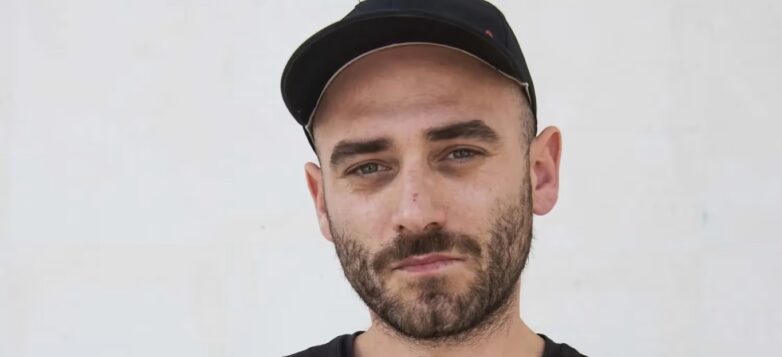
Diona Budima: Hi.
Vangjush Vellahu: Hi.
Diona Budima: Can you please state your full name for the record and introduce yourself? And tell us a bit about your background and how you came to your current artistic practice.
Vangjush Vellahu: Okay. So my name is Vangjush Vellahu from Pogradec, living and working between Berlin and Tirana. Studied art, actually design and art, in Bucharest and Chile. And my current pratcie… like I don’t have a current practice. I think it’s more like a continuity of… Yeah, it’s been a very long time. It’s been a very long project I’ve been working on. So, like, the villa was more, the villa being here was more of a cut and like… yeah, rethink my presence here. As I mentioned before, like I’ve been away for quite some time, so I wanted to use the villa as a, or the residency here as an opportunity to be here for a while and catch up with Albania or Tirana or the region.
And so I wouldn’t consider this my current practice. I just like, I think I just use the time [the] at villa mostly to recalibrate, or to refocus on theory and actually read mostly. So it’s been pretty much, most of my time here has been like reading and taking notes, and writing notes. But I wouldn’t say this is my– I would not say this is a practice for me. It’s actually getting outside of my practice and trying something different.
Diona Budima: What is your practice?
Vangjush Vellahu: I mostly work with videos and publications, but…
Diona Budima: Any specific theme?
Vangjush Vellahu: Yes, there is one specific theme and it’s like, I’ve been working with the idea of unrecognition, or unrecognized states, starting point of Kosovo and then checking other states that are similar to Kosovo status, such as Taiwan, or Western Sahara, or Palestine and so on. So that’s been my long term project for like the last ten years.
Diona Budima: What kind of videos do you…?
Vangjush Vellahu: I don’t know what kind of videos there are, but it’s just like short videos that I take in these places, and like, I interview people, usually one to two people. So it’s like a combination of travelog with, like… I don’t think the video in itself is like the– although that’s the outcome, but I don’t think that’s the main… I think the process in itself has been very important for me to be able to… understand this nationalistic geographies behind… behind this very specific location or like, behind this sort of patriotism or behind this… Yeah, behind the region, you know.
So I don’t want to enter much into detail for that because it’s a bit more… I’m still working on it actually. Like on the final part of it, but…
Diona Budima: Could you then describe the focus of your research here at the villa? And what form it took, and what you showed during the open studios?
Vangjush Vellahu: So yeah, the project that I was just talking [about], that was the idea to still continue here because I’m doing the second publication and that’s the final part of this almost ten year project. But then the villa kind of stopped, stopped me somehow, you know. Because it’s like, although I don’t have a direct connection to the villa, so it’s not like I couldn’t sleep. There’s this whole narrative, it’s not like, “How can you sleep there?” and so on and so forth. I don’t think I had a direct problem with the villa, but I think the villa was more… yeah, it just stopped me from doing what I was doing. So I decided to repurpose my focus and like mostly read. Sorry, what was your question again?
Diona Budima: The focus of your research and the form that it took. You could describe the nodes and why you decided to go…
Vangjush Vellahu: So actually there is a connection between my project and this project, which is because in many ways, it’s like trying to understand, like I said, unrecognition, I don’t… I mean, starting point is Kosovo as a legal form, but actually it refers to the, I will say that Albanians scattered through the Balkans, and the way the borders were cut and the balkanization, shortly. But, so I think from that point, actually, I had an interest to see as to like why Albania had survived 1912, or why Kosovo had survived. So I wanted to understand why other places are finding it more difficult to survive in that sense.
And so in a way, it connects also to the project at the villa, because I think that was a push. And then Villa was kind of a continuation, but also stopped because… So there are a few factors, okay? Like one of the factors is like the rapid changes of Albania and especially Tirana or even the villa in itself, becoming what has become. The residents which were here but like they are also connected to somehow, once you get out of the villa there is plenty of foreigners actually. And I don’t mean tourists, I mean more people who have, like, taken certain positions in Albania. And then the political orientation of Albania, which is like going extremely west.
So I think this combination kind of made me… like created the need for me to actually research a bit more. Yeah, I don’t want to put the word “orientalism,” but like to research a bit more on this notion of what what is it actually after 1912, like historically speaking, because there is very little, at least for me, I don’t know how other people experience this. For me [there] has been very little time to check Albania’s past, you know, like to… history. It’s not much I’ve learned, unfortunately. So I had to catch up and there have been a few books which I found extremely important during this period, and local, which is like Hasan Kaleshi, and Enis Sulstarova, and Piro Rexhepi, which for me were really important to again, recatch with Albanian narrative.
So then I started to– and also the, like I said, the residents did have an impact on me, like the way they perceived the villa, the way they reacted with the villa, the way they reacted with Albanian narrative, the way they wanted to produce on it, to speak about it and so on. It’s basically what’s created the need of collecting, reading, collecting information, writing something, copying something somewhere else. And like that’s why I called them nodes. It’s not like connecting things with each other and like creating some sort of… Yeah, I wouldn’t say narrative, but some sort of interconnected stories, which like go back in the past and come back in the present.
Diona Budima: And there were 19 nodes in total.
Vangjush Vellahu: There were 19 nodes in total, yeah.
Diona Budima: They were installed in the format of a QR code?
Vangjush Vellahu: Yeah. So like the the easiest way for me, I realized that I cannot print just papers like this. So I, and also they were actually initially made in English. So then I had to make an Albanian translation. So then there was an option on the, you scan the, the idea of the QR codes is that the you could explore the villa by finding them and then you scan them, and then you have an option of English or Albanian to read them. It was supposed to be a bit of a game, but of course it didn’t function because it’s a lot to read. So I realized that nobody will have the time to read the stuff.
Unless they– I mean, I also produced like a brochure that people could take and then scan it at home. So if they wanted to read.
Diona Budima: And the texts are– take the form of a personal diary and other…
Vangjush Vellahu: Something like this, something like this. Yeah.
Diona Budima: So it’s really mixed.
Vangjush Vellahu: It’s mixed, exactly. So it’s not a work– That’s what I’m saying. Like it’s more of like thoughts and more of, like a collection of thoughts. It’s, at this point, I think it was not so important for me if they are mine or somebody else’s. It was important for me that they connect time and space, actually, in a way. Because I, like for me, that’s the problem, like it’s constantly I feel like things are being disconnected actually. As if there is no past or as if there is no future.
And some things are put like in a very… yeah, some things are intentionally put in a very specific corner, so to say, and they want to see this– Like even when we talk about the villa you now, it’s like a, at least from the residents. When they arrived here, there was this common knowledge of like, “Enver Hoxha, who was he?” like Wikipedia sort of style, as a oppressor, as a criminal, and which has nothing to do with the truth or the lie.
It’s just for me, the problem was that the complexity was missing from this narrative, you know. It’s like when you position something as good or as bad, you just miss the larger picture.
Diona Budima: Yeah. And then there is a very thin line between rehabilitating a problematic site and transforming it in a way that reclaims the space for the future generations. And, I wanted to hear more about how you think that thin line has been negotiated. Because in one of your no node text,you write, I quoted that, “The transformation of Hoxha’s villa to an arts residency is officially framed as a gesture of cultural revitalization, yet this rebranding risks aestheticizing authoritarian memory and stripping it of its political and historical past and weight.” Could you tell us a bit more about that?
Vangjush Vellahu: So like I said, it’s, things are a bit more complex now. Like, I wouldn’t say the Villa is just this or Villa was just that, or is becoming just this. I think many things are entangled. So I think the moment you… The moment you create this residence, you know, like you bring these people like, let’s say a group of ten people each of three months, I don’t know what is the purpose of it exactly, but it’s definitely for me, those three months are not enough for… And again, I need to make this clear that I, when I came here as a resident, I did not see neither Villa nor Albania as just another residency, like I could not. It was not possible for me, you know.
So like– And maybe that was my mistake to also imagine or want that other people also don’t see it like this, you know, because it’s different when you go to a residency in Paris or, I don’t know, in Germany, but I think the moment you come here, things get more complicated. So I think in that sense, I felt like the villa is becoming again, especially if you look at the opening of the residency, those three days, it becomes this kind of spectacle, you know, which is fine. It’s entertainment. But the problem is that… So I think on one hand, it’s kind of… Yeah, like I said, for me, it was not a problem to sleep here, you know.
So like if you ask people who are older, they would probably say, “How can you sleep there?” And so I can only imagine that generations that [are] coming after, they would probably not even know exactly what that even meant. Like all of these notions, you know. So I think in that sense, you come to the villa, you don’t get any information inside. I mean, now there is, or before [there] was like a small text explaining something about the villa, but I don’t think… Yeah, I don’t think there is a, I don’t think there was a really good…
Diona Budima: Context?
Vangjush Vellahu: Of context of the villa, yeah. So I think in that sense it does risk to become this sort of… Yeah, I mean, a form of spectacle, you know. And then there is the problem of, again, I don’t want to enter much in detail, but like I came on the first opening of the first session when it was opened, and really there are a lot of topics that are being imported from outside, which are very relevant outside. But I found them of little relevance here because I think there is this triangle, or like this connection of usually as we talk about gender, race and class, and sometimes I feel like there is only two of them really being good translated into the Albanian, or at least recently, into the Albanian society through European funds and so on and so forth.
But like, what is really, really left behind is class and nobody wants to talk about it really. And I think that already creates a rupture for me to even consider the other two topics, because it just makes it very difficult. And again, I go back to this spectacle idea of…
Diona Budima: And if it’s a spectacle whose gaze is it for do you think?
Vangjush Vellahu: Yeah, that’s a good question. So I think I think you can also understand the answer yourself, like again, who is the founder, how is the– Because that was one of my nodes, [it] was like understanding how this came to exist, you know. Like for me it’s important to know because again, if I was in Paris, I would not care so much because… I don’t know. But being here, for me, it was important to understand how this came to exist. And I think that brings you very much to the point of the, “Whose gaze it is.”
And obviously, I think not just the villa. Generally, there is a Western gaze or a way of like… And then we go back to orientalism again, to Enis Sulstarova, and so on. So, on talking about how much the need of Albania is to reshift and readapt its whole entire ideology towards the West, which actually wouldn’t be that problem for me. But when you have the need to erase something from the past, I think that’s what the problem becomes now. It’s like you are not just orienting yourself, but you are parallel also erasing something behind you.
And I think that’s what creates the problem and makes this very Western gaze problematic for me. Yeah.
Diona Budima: So do you find this Western gaze not just directed at us from these Western organizations, like ArtExplora, but is it also our own internalized…
Vangjush Vellahu: Of course it’s our own, but it’s like it’s a very, again, this is a very long… it didn’t happen with the ArtExplora or the villa. It’s like it’s been a very, very, very long process. And it goes really, you can take it as far as 500, 600 years ago. You can take it as far as 100 years ago. But it’s like… Yeah, it’s interesting because I think also where the villa becomes or Enver Hoxha, again, or [the] villa becomes an interesting… I think Enis Sulstarova had this interesting orientalist map which shows again, Albania jumping between East and West in different etapa (stages) of time.
And then again, Enver Hoxha enters into aligning itself with the East, you know, like with the Soviet, and then with China. And so like undesirable for the Western parallelism. So yeah, it’s again it’s like I’m jumping through time and space but it is complicated. So like I don’t want to reduce it, again, ArtExplora, just for me it’s just another project. It’s not fundamental but it is another part of the puzzle to the entire subject.
Diona Budima: During your time here, have you collaborated with any local researchers or writers, communities?
Vangjush Vellahu: I tried. Actually I tried to… I actually tried to do– my first initiative was to work actually with two other residents. One from Albania, born outside, and one from Germany. They were both residents here.
[The interview was interrupted here]
Vangjush Vellahu: I wanted to do something with Fatos because once we ended up in Spaç and for me it was also interesting to see how the opposite of the villa actually, like ideologically the opposite of villa… Something really weird was going on there, you know, like, first of all, it’s considered a historical monument, so it should be protected by the state. But it’s not, so it’s left, like, completely in ruin. And then there was some protest going on, against some filmmaker who wants to do a film about the… there was a moment, I think ‘73, I don’t remember when it was, but like the resist– the, some sort of resistance against the communism, which was the first time in history of the communism when they first put the flag of Albania, Albanian flag without the star.
But the problem with the project was that they were erasing a lot of actually, archeological, if you want, of the present Spaç. So there was this weird… and then you had Fatos Lubonja narrating changes that have been done intentionally to, again, create some sort of future touristic spectacle, I think, or some something like this attraction. And so I think I really got focused and I really got carried on with this narrative of the place. And so I wanted to do something with Fatos, but then the problem with that was, again, refocusing or shifting my actual or my… yeah, that meant refocusing on the past. And again, the past is important for me, but I really wanted to check what’s going on with the present.
So I wanted to understand the villa of the present rather than the villa of the past, because I think the past is important, that past, but it’s also really consumed. It’s not like there is no information, but there is very little– Actually, if you ask outside, nobody knows about the villa, that it’s a residency. Like literally nobody knows. Some of them think it’s a museum, you know, some of them think it’s without [a] ticke, some think it’s with a ticket. Some don’t know that it’s open. So it’s like there is no clear information about how to access this villa actually, you know.
And then you have the guards, you have a police at the door, which is, for me, a lot of anxiety every time I have to enter. And I had to enter for three months every day, which I think is really creepy. And I talked about it, but nobody did anything about it. So, yeah, I really wanted to delve into the present rather than into the past. So I think that kind of broke my initial…
Diona Budima: You did link up a text of Fatos Lubonja.
Vangjush Vellahu: Yes, I– after all, I realized that actually I can include him as part of the new rather than as something of the past. Even though Fatos would have talked about the present as well. I know that. But, more from his own perspective. And I wanted to talk more from my own perspective as I’m here for three months.
Diona Budima: Okay. Where do you see this research going next? Do you plan to continue and expand?
Vangjush Vellahu: Yeah, that is something I don’t know yet because… Yeah, I don’t know. I stopped having it as a QR code because of, because it’s different polemics that appeared in the project. But I do want to continue, maybe not exactly as it is because there is parts I don’t need. I think this sort of information was specifically produced for the villa, connected to the villa and, again, interconnected with stories in time and space, but which somehow pass through the villa because at the end of the day, it’s a system, it’s a specific historical context.
But I do want to, yeah, I do want to look at it further, maybe in a different format, maybe as a book or maybe as a PhD, or maybe as something visual. I don’t know yet because I needed a break. Eventually it was very intense for me, so I needed a break from this.
Diona Budima: Okay. To end, could you tell us what you’re currently excited about? Be it personally, or artistically, or politically? Is there anything you’re looking forward to?
Vangjush Vellahu: I mean, excited, I don’t know, but looking forward for sure. Like I said, I want to… I want to, yeah, I want to research more and to engage more in the, in our direct narrative rather than– because until now in the project that I mentioned at the beginning, has been more like my background has been more in the background. So like my, “who am I and where I come from,” and all of this has been more like as a… Yeah, as a push, but like, not really out there. And I think at this point I feel more I need to… I need to engage more within here. And that makes it look into the future for me, I think the new future. I don’t know if that is excitement, because it’s been also really tough to…
Yeah. It’s a… yeah, it’s not easy because it’s, we are talking about a generation that is all looking somewhere towards a direction, and it’s very hard, including myself. I mean, I’m not special or specific in this. And that kind of stopping or looking into the present and the near past, it requires a lot of work, actually. And the reason why I realize that nobody is going to read this, because it’s like so much to, and this is just like a really small percentage of understanding, actually the process we are in, as a country or like as a people. So I think that is more like something– but more when I talk about looking into it, not really into just an academic sort of view, but like as a more into like an artistic perspective. I don’t know yet. I really don’t know yet.
Diona Budima: Okay.
Vangjush Vellahu: Yeah.
Diona Budima: Thank you very much.