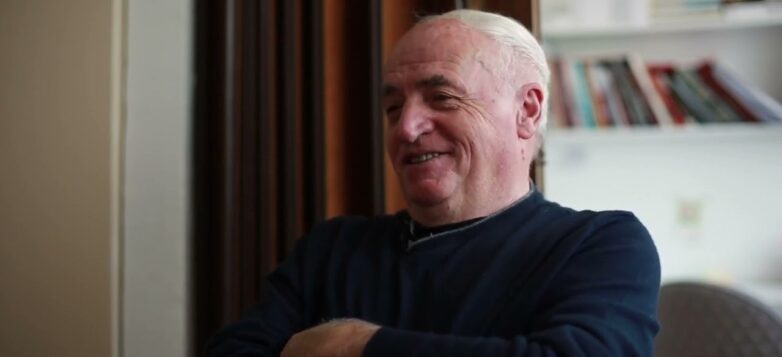
Anita Susuri: You worked for a while in Pristina and then…
Selim Krasniqi: In Fushë Kosova, from 1980, yes.
Anita Susuri: What was the difference between primary school and secondary school?
Selim Krasniqi: At Elena Gjika I worked for only four months, and then I immediately moved to secondary school. Look, in primary school, for those of us who had completed university, it was a little more difficult because we were not prepared to teach children in the sixth, seventh, and eighth grades. Secondary school was much easier for teachers. I say “teachers” because those who graduate from the faculty receive titles such as teacher, instructor, or professor. But I use the title teacher because it is the best, the most sacred title. Professor Beqa used to tell us: “Dear colleagues, I would advise you that the teaching profession is a mission, not an emission, but a mission. It is a sacred mission. Because you are the ones who will raise others up and teach them properly.”
Often we are asked about the years after 2000, after the war, when the PISA test began: “We came last,” or “next to last,” or “we don’t know how to read.” It is true that we came second to last. I myself participated in 2015. But those who design the questions are not necessarily wrong. For example, in Japan, a child studies ethics until the sixth grade, whereas we begin at the age of six. The questions were inaccessible. I have said this in other programs and in writings I have done. For example, at that time there were questions about vaccination. How could a student from the periphery, from a village, know when vaccinations are given, at what age they begin? Fertility, infertility — these are exam topics for medical students. Or other such topics.
Now take the Finnish school system as an example. Students have a specific subject on how to prepare for life, how to find their way in life. In the 1970s we had a subject called home economics, but our teachers did not really teach us that either. In the end it was like a craft subject, where students had to make something out of wood or metal, and then they made their parents do the work for them. Until we begin to work in that way, it is impossible to achieve success. People say: reading. They are not reading. Everyone knows how to read, but how much do they understand? The state institutions are at fault there, because the curricula need to be changed. Not as they have been until now. There should be fewer subjects, so that students are not stretched out like an accordion.
The curricula should be a little simpler. Students should be freer. More creative learning should be taught. Children should judge for themselves the work they do. Or take mathematics, for example. Logical mathematics should be worked on properly. Teachers are very well prepared. Students are prepared too. But there needs to be commitment, and surely in the future this will happen, and other curricula should be examined. We cannot simply look at Finnish curricula; we should look at those of the region. Among regional countries, our schools are quite good by comparison, perhaps even better than others, regardless of what ranking they receive.
Anita Susuri: I wanted to move into the years when you were at the gymnasium and the parallel system, as it was called, began. Do you remember the day when the police came, or did the police come? How did it happen that you were expelled?
Selim Krasniqi: From 1989, with the removal of the Constitution of the Republic of Kosovo, the first attempts began to remove us from the schools. Especially because the curricula were changed in Albanian language, Albanian literature, visual arts, and history. At that time, we in the Association of Linguists at the Albanological Institute held a meeting and assigned the authors of the curricula. For secondary schools, I was responsible. For the university, in the field of language, it was Professor Shaqir Berani. In literature, Professor Rexhep Qosja. We began working on those curricula, and by 1990 the first removals had almost already begun.
The first expulsions happened in 1991, first at the gymnasium in Fushë Kosova. A first-year class had just begun, and they removed us from teaching. We went to the Zogaj neighborhood, which we later proudly named “The Albanian School.” Then, from 1991 onward, all schools in the municipality of Fushë Kosova began operating this way. There were students in the Grajçevci neighborhood, the Merovci neighborhood, in the village of Akër, at the Kelmendi family’s place, and in other locations as well. What should I mention about that time? The secondary schools had the greatest difficulties, because older students, seventeen or eighteen years old, had to pass by three or four Serbian family homes, and then by the police.
For eight years our gymnasium worked in the school in Lismir. Crossing the railway tracks was especially difficult; it was almost impossible for a night to pass without some student being frightened or beaten by the police of that time, the Serbian militia. Fortunately, the parents contributed a great deal. Without their help, we could not have achieved anything, neither then nor today. They sent their children to school and said: “The children are yours. You take care of them while they are in school. On the road, you cannot escort them.” We had at least 400 students. Four hundred students could not be escorted by five teachers.
Those were the most difficult years. But fortunately, in the house-schools where we worked, the students tried hard. Even in those small, narrow rooms, they would sit on a carpet, with a notebook or a piece of wood beneath them. Boards were used instead of blackboards. They were extremely disciplined and worked a lot. Many of them succeeded, and today we have many intellectuals who work at the University of Prishtina and abroad.
Anita Susuri: I’m interested in how the organization happened. Did you take part? Did you go to families, or did they come forward themselves?
Selim Krasniqi: The organization at that time was done by the political parties. We, as teachers, had only the obligation to go and hold classes, organize the students, and hold meetings with them. Those tasks were carried out by activists in the municipality of Fushë Kosova. I will mention that at that time in Lismir, the family of Ibush Gojnovci helped us greatly. They paid all the gymnasium teachers’ salaries for six months. For the entire municipality of Fushë Kosova, there was a man from Bardh i Madh named Sylë Gërguri, who for one year paid 40 or 50 euros each to all 400 teachers of Fushë Kosova. He made a very great contribution.
I often told the graduating students, especially after the war: “Look, among you there are people who took care of us, who paid for us. In the end, the people took care of us.” That three percent fund was given for us; we received our income from them. We should not forget 1993, when workers under the Serbian regime had no income greater than what would now be two or three euros, or two or three marks in the 1990s, because there was inflation in Yugoslavia. The people paid us as much as they could, and for that we were rewarded. The greatest reward is when people say: “This is the people’s teacher.” We were teachers of the people. I call the parents and students heroes of the 1990s.
Anita Susuri: I’m also interested in the students’ situation. How prepared or willing were they to study outside the schools?
Selim Krasniqi: At the time when the house-schools first began in Fushë Kosova, and then throughout the Republic of Kosovo, the Albanian Teachers’ League Naim Frashëri also helped. The students were convinced of the importance of it, and we thought that especially the graduating students, eighteen or nineteen years old, if they had not come to school, would have become involved in other activities. They might have gone abroad as well. We kept them inside. That was the greatest merit of our teachers, our parents, and our citizens. They were prepared. They read at home, perhaps even more than when we were in regular schools, and more than after the war, when school reconstruction began and we started having some resources again. At that time, a great deal of work was done. Perhaps the ideal kept them working more than today.
Anita Susuri: Were there problems, for example, or incidents?
Selim Krasniqi: There was not a day when our students, especially the graduating students, were not stopped or mistreated. But they did not tell us at school. They did not even tell their friends, except for two or three who knew. They did not tell their parents either, because they knew that the next day they would no longer be allowed to come to school, and out of fear they would not continue their education. It was not easy for us. We knew, for example, about their suffering. When classes were held in Fushë Kosova, which was the so-called headquarters of the revolution of those 1990s years, teaching continued regularly. In our notebooks, in the registers we kept, there were almost no absences. We recorded attendance in order to know what was happening. If someone was ten minutes late, they still came. For this reason, I say this was an extraordinary achievement.
Anita Susuri: And how many houses was your gymnasium spread across?
Selim Krasniqi: Our gymnasium was in only three houses in the Zogaj neighborhood. One house served as the teachers’ room, and in three other houses we had our classes. There were forty to fifty students per class. But they caused no damage. I can mention that those who gave up their houses often had only a sleeping room and one living room. And we occupied that living room. This was a great thing. No one else would have done that except our people, who are generous and noble.
Anita Susuri: Can you describe how, for example, you adapted a living room into a classroom?
Selim Krasniqi: Look, I’ll speak about where I myself worked in secondary school. There was a simple carpet laid on the floor. On that carpet, we placed a block or some piece of carpet. The students brought things themselves. They sat like that. There was nothing else. Each room had a stove, which the homeowners had provided and cared for. I’ll mention one case, that of my colleague Shemsedin Zogaj, who now works as a professor. He worked for us; he would light the stove, and he himself was a professor at the gymnasium in Drenas. The students thought he was a worker or servant there. We did not tell them until they finished secondary school. There was no distinction there between parent, teacher, or anyone else. If one of our teachers was late in one of the two houses, someone would replace him until he came. But he would not tell them he taught that subject; he would simply say, “I’ll stay with you until my colleague arrives.”
Anita Susuri: How difficult was it to get books?
Selim Krasniqi: As for books, most of the Rilindja publications at the time were located in Lipjan. The children passed them on to one another, from one generation to the next. We teachers were forced to dictate lessons, even though dictation was forbidden, but we had no choice. Fourth-year students passed books on to third-year students, and so on. For primary schools I do not know exactly, since I was not working there at the time, but they mainly held classes in the house of Skender Zogaj, where there were eight or nine parallel classes running in two or three shifts.
Anita Susuri: In some places the primary schools remained inside institutional buildings.
Selim Krasniqi: In the municipality of Fushë Kosova, not a single one. Not one. The only exception was that from 1992 onward we, the secondary school, moved to Lismir, because there were no Serbs there at all. From Fushë Kosova to there it was nearly seven kilometers. Our teachers had to walk at least forty minutes from the crossroads to reach it. But the main problem was the railway tracks — how to cross them, because the Serbian police were stationed there.
Anita Susuri: And was that because Fushë Kosova had a large Serbian population?
Selim Krasniqi: Yes, it had a large Serbian population, and the nationalist-chauvinist headquarters was precisely in Fushë Kosova. The disintegration of Yugoslavia was orchestrated from Fushë Kosova.
Anita Susuri: And the rallies and demonstrations that happened, how did they affect the people? You?
Selim Krasniqi: On the contrary, they united the students even more. Perhaps that is where the bond between students, parents, and teachers became strongest. They understood what was happening, and they were not afraid. They overcame fear. Fear no longer existed.
Anita Susuri: During the day, how difficult was it to hold all the classes?
Selim Krasniqi: The classes were not shortened. The schedule was almost the same as in schools today. But we organized things so that, for example, one day would be dedicated to social sciences, and the next day to natural sciences such as physics, chemistry, biology. This was so students could be freer, teachers could prepare better, and there would not be so much moving around. The houses were only twenty or thirty meters apart, all in the same neighborhood. That way we avoided breaks. We did not give students breaks because it was a residential neighborhood. For the students it was a little more difficult; for us it was not. We followed the schedule and moved from one class to another after five minutes. The students remained in their respective groups.
Anita Susuri: How difficult was it to safeguard the school registers and documentation?
Selim Krasniqi: We kept the documentation ourselves. In those houses it was easier. During the 1990s, when records remained in the schools, the administration protected them. The Ministry of Education had instructed administrative workers who were still employed under the Serbian regime to preserve as much as they could. But most records from the 1990s were lost. After the war we had a few cases where former students came looking for documents. We still had our own registers, notebooks, and notes. When records had been preserved and we knew those students, we issued diplomas only to those who had truly attended regularly.
Anita Susuri: Until when did this continue? Until 1999?
Selim Krasniqi: Until March 21 or 22. The NATO bombings began on the 24th. Schools in the municipality of Fushë Kosova functioned until March 21 or 22, until Friday. Those were very difficult days. We tried not to show the students what was happening. I was teaching that day in Lismir. We were preparing for the school celebration on March 5. That day we could hear the shelling from Prekaz. I was late because I had traveled from farther away, from the Drenica area. Someone said to me, “As a teacher you should have arrived at eight or nine because we have the program.”
I stayed silent so the students would not hear. Then I called the principal aside and said: “I’m late because there is war there. In the Prekaz area there is fighting. I came from the Lipjan-Magura area and barely managed to get here. There is war.” I told him: “We will not hold the March 5 program. We will only sing the KLA march and dismiss the students so they can go home.” People were still working, but by then they too had realized what was happening. Villages around Fushë Kosova — Harilaç, the area around Sllatina — were close to the border with Drenica and knew there was war. Meanwhile, in Fushë Kosova and Pristina, work continued. In Fushë Kosova classes continued until the date I mentioned.
Anita Susuri: And when the bombings began, were you still in Fushë Kosova?
Selim Krasniqi: Most of us were. At that time I was living in Pristina. For those trapped in Fushë Kosova, the only way out was through meadows and fields to reach Prishtina. After March 24, actually after March 21, no more classes were held in Fushë Kosova until we returned after the war. We resumed teaching around September. From 1998–99, I also worked as a regular journalist for the newspaper Kosova Sot. Every day I kept notes about the municipality of Fushë Kosova, about the schools, the displacements, everything. Once a colleague asked me, “I think I saw your initials somewhere?” I said, “No, no, you didn’t see them anywhere. Don’t say anything.”
I continued working and documenting events. The only period I did not work was from April 1 until June 28. Then I resumed. I worked for the Kosova Press News Agency and for the newspaper Rilindja covering the municipality of Fushë Kosova. In fact, most of the findings related to Fushë Kosova were preserved through the electronic reports we wrote for Kosova Press. Especially the Behluli family, but others too. At that time we collaborated with Sheh Idrizi, who chaired the Council for Missing Persons in the municipality of Fushë Kosova. We kept extensive records, especially concerning the cemeteries in Mes Bardh, Pomozotin, and Vragoli. Unfortunately, many people are still missing today.
Anita Susuri: During the period when you said you were not working, did you leave for Macedonia?
Selim Krasniqi: I spent almost two months in Macedonia, in Gostivar.
Anita Susuri: Did you have to stay in Blace?
Selim Krasniqi: Only one night. Just one night.
Anita Susuri: After the war, did you continue working to help identify people…?
Selim Krasniqi: After the war, for three or four years, even longer, we continued working until Rilindja was shut down. I worked continuously until then.
Anita Susuri: At the same time as a teacher and as a…
Selim Krasniqi: As a teacher, and also for Rilindja and the Kosova Press News Agency, until Rilindja was closed.
Anita Susuri: In what condition did you find the schools when you returned?
Selim Krasniqi: After the war, the situation in Fushë Kosova was miserable. Most residents had burned houses. More than 1,600 people were missing. Yet even under those conditions we began working again. They did not even allow us to use our former gymnasium building in Bresje. We made several attempts, but permission was denied. We started instead in an annex of the Selman Riza Primary School. After several years, the new gymnasium was built, the one that still exists today.
Anita Susuri: Was all this difficult to accomplish?
Selim Krasniqi: Extremely difficult. But I must mention that at that time all collaborators from the political parties cooperated with one another, as did the provisional government. Things became somewhat easier later, when reconstruction of the schools began. Even today the municipality of Fushë Kosova has many students and many residents. Classes remain crowded. In the gymnasium we always had up to fifty students in one class, whereas the average elsewhere was around 21.4 students per teacher. Even today Fushë Kosova has more than thirty students per class. So the numbers have not declined, perhaps in the villages, but overall the average remains the same, both today and five years ago.
Anita Susuri: You mentioned that you retired in 2020. Could you compare, for example, the years before the 1990s, the 1990s themselves, and the postwar years in education? How did you experience them? What changed? Which period was the most difficult?
Selim Krasniqi: The most difficult period was from 1981 to 1990, because we were monitored step by step, and the curricula were constantly being changed. In the 1990s, when we were teaching in house-schools, we were free and able to work honestly. After the war, work became easier because we were free. But I avoided focusing on war topics, because many students had missing family members, and others who were ten or fifteen years old still had fresh memories of corpses they had seen. We mainly tried to use modern teaching methods and avoid assigning war-related themes that would reopen those wounds again.
Today things are much easier. Fortunately, the children of those years are now in their twenties. They have completed their studies and are working. That is our greatest satisfaction, because we teachers are the richest people of all: among our former students we now have pilots, engineers, doctors, and professionals from many other fields.
Anita Susuri: Mr. Selim, thank you very much for the interview and your time!
Selim Krasniqi: Thank you!