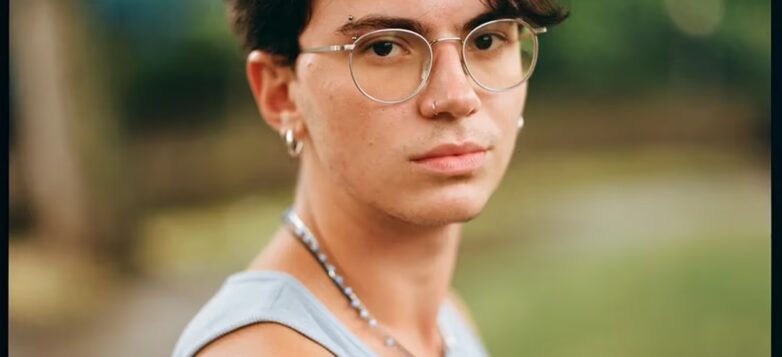
Diona Budima: Can you please start by stating your full name and where and when you were born? And then could you speak a bit about your background and how you came to your artistic and research practice?
Kairo Urovi: Okay, cool. My name is Kairo Urovi. My pronouns are he/they. I was born and raised in Italy, in 2000. And I currently live in London. How I came to my artistic practice, I think… I’m trans and queer, and I think I started seeing parts of my identity that I couldn’t really see represented through photographic work, especially being of Albanian descent and coming from Shkodër. So that’s how I kind of started my research and kind of looking into my own queerness and transness. And I’m very interested in archives. A lot of my practice has elements of performance to it. So, yeah, I would say I’ve kind of come to photography through understanding myself. Both things went hand in hand.
Diona Budima: Is queerness one of your main sort of questions and things that you explore?
Kairo Urovi: So far it has been. Like, I’ve been working on these long term projects. This… I’ve been working on this long term project, where I hadn’t visited Albania in like 12 years. And then I came back three years into my transition and I said hi to my family. And, the project consists of this kind of being in between spaces, but also how do you inhabit a space that doesn’t fully feel yours at the same time?
So it kind of deals with a lot of this gray area of what it means to belong to a place. [It] was also kind of having to consider parts of yourself that may not be as accepted or visible. So, yeah, I think it’s a big part of my work and my practice. It’s not the only part. A lot of my other projects have been looking into history. My own personal history, collective kind of ways of remembering. So, yeah.
Diona Budima: And what drew you to apply to this residency? Was it part of exploring this kind of like being between places and maybe returning to Albania?
Kairo Urovi: Yeah. On a practical sense, what drew me to this residency was the money. I never got any funding from my projects. So I saw this call, I saw that I was based in Albania, and I thought, perfect. You know, if I want to be honest, a lot of my personal projects have been self-funded. So I initially applied to finish this work about my return to Albania. And kind of I wanted to wrap it up and get the money and do my work, and then hopefully publish a photobook. So that was the idea, to spend most of my time in Shkodër and also see how my experience being trans, trans masc, is read in Tirana.
I think it’s quite different. Just slightly different, actually. But then when I came into this context, I just didn’t really want to deal with that. You know, it changed everything because the place kind of changed my ways of thinking. What I was thinking about, my being here. And, so I put that project again, to the side to explore back home in Shkodër.
Diona Budima: What would have been the subject of that photobook that you first envisioned?
Kairo Urovi: The subject?
Diona Budima: Yeah. Like the subjects of the pictures.
Kairo Urovi: I’ve mostly taken…. That’s a good question, because I never… (laughs). It’s a lot of self-portraits, a lot of, occupying a space with my body, and performing for the camera in a way. I’m very interested in this, like, friction between being seen and being invisible. So a lot of it is self-portraits where sometimes I’m, like, standing in front of you and I’m confronting the camera. And other times I actually run away from it. And then it’s in these like, visual metaphors and how they present in the landscape. So, for example, like, I don’t know, just concrete like blocks of, I don’t know, like benches that are like wrapped in some, I don’t know, like just visual metaphors that explain this idea of being constricted, but also, like loose at the same time.
Ana Morina: E këto janë bo ku? (And where were these taken?)
Kairo Urovi: Janë bo te… (They were taken at…) I did an exhibition in Bologna, PhMuseum. I shot it in Paris for Paris Photo in 2023. But now it’s kind of, I want to finish the project and then show it around in a few places, but I just want to have it, like, done and then kind of look for ways of it being presented.
But, yeah, it’s called Stray Dog because I was bitten by a stray dog and I was in Shkodër. And then I went back home to my grandma two years ago. It was just a tiny dog, but, it was like, I went back home and I told my grandma and my grandma was like, “Oh, just put some raki over it, you know, it’ll be fine.”
And then I kind of was like, yeah, I was fine in the end, but I was thinking a lot about the stray dogs that are in Shkodër, most of Albania and how they always protect the neighborhoods like this, especially in Shkodër. There’s specific stray dogs in each neighborhood, and they kind of belong to the neighborhood, but also eventually always end up sleeping outside.
And I think that’s my kind of metaphor for who I am. And the way that I inhabit that space is that I’m always walking around the streets of Shkodër looking for something, like scraps, like the stray dog looks for food, but like, I’m looking for something, you know, that I may never find, but I’m still kind of part of that. I still belong to it. But at the same time, I’m an outsider. And I think that’s my positionality with this project and just with my being.
Diona Budima: Well that’s interesting, because your work here changed, it evolved a lot from the initial idea.
Kairo Urovi: Yeah.
Diona Budima: But this question of being inside and outside, I feel like it carried through? Because you play so much with being sort of inside the story, inside of reality and outside of it. Can you say a bit more about how this new work emerged?
Kairo Urovi: Yeah. I never thought about it that way, actually. It’s very cool. The first two months of this residency, I kind of saw it as an opportunity to absorb everything about the context of Albania because I’m, like, super new to it. And usually I would come here for a week or two and I would go back to my grandma’s house and just live there, but here is completely different. So I was exposed to many different, you know, problems about Tirana, like the art scene and just kind of getting to know Albania from this place and a lot of the time, I think as artists we’re so focused on producing that we don’t actually… I at least need a lot of time to, like, think. And so this project came up, like I’ve done it in the last two weeks.
I was having a conversation with some artists about the way that this place is turned into an art residency and our being here, and how a lot of the furniture, a lot of the history is almost kind of being erased little by little in the way that this place was renovated. Also in the fact that there’s no information about, like, who lived here, where do they live?
It’s kind of all, kind of gone. And so the need for this history to be archived or to be circulated, you know, and it wasn’t there. It wasn’t, it just, it’s not happening. And that was what we were discussing. And then I started thinking, okay, what if there was an archive that is fictional, and what would they have to say about these, this place, this collective.
And it started to take shape, through this storytelling, through Bajram, who is a gardener, and he works at the villa and the story is completely fictional. There are, I think there have been, there’s a whole genre of people who actually worked here, who have been interviewed and have come out saying their stories and their experiences here.
And I’m not really interested in sharing that. I’m interested in the wider kind of semantics of what does it mean to create an archive that is not there, and do you occupy it with information? And how do you then approach archives in, not only in Albania, but like outside? And a lot of the archives I’ve been to and I’ve visited through this, throughout this residency.
I have… not only arts, a lot of the times catered for Westerners and tourists, but a lot of the times the information is not actually correct, like some things just don’t really make sense. And they have just been put there and people come and see it and they’re like, wow, you know, this is amazing.
But then I’ve seen it’s not true. Like I spoke to Elidor Mëhilli, who’s an art historian, and he said that in the House of Leaves, some of the stuff doesn’t make sense that they put there. So then what do you… when you go, when you walk into the space, how do you then think about these things? Do you take it as the truth? Because it’s being presented to you like that.
So then, yeah, this whole archive of cultural continuity was born, and Bajram’s story sits within this archive, that is completely fictional and doesn’t exist. Maybe it should exist. And maybe that’s what people should take away from this project.
Diona Budima: Could you just describe for our audience there, what the installation consists of?
Kairo Urovi: Yeah. So the installation consists of a video interview that I had with Bajram. Do you want me to also explain the plot? Like, “Bajram, who was a…” Okay. Cool. So the exhibition consists of an interview with Bajram Hysa, who was a gardener who worked at the villa between the years of ‘80 and ‘81. And he explains his, like, obsessive kind of passion and interest for these objects that he collected throughout his life, but especially these eight objects that he collected when he was, like, working in the garden at the villa.
And I took pictures of these objects and they are presented in the next room. There’s also a letter from the Archive of Culture of Continuity, which suggests that after, upon reviewing these objects, they deemed them as speculative materials, essentially implying that they don’t know whether Bajram’s story is true or it’s completely fictional. And so take it with a pinch of salt.
Diona Budima: Well, that’s so funny because the archive itself is fictional. So it’s almost like it’s commenting on itself.
Kairo Urovi: Yeah, it’s a comment on the actual institution that is completely made up.
Diona Budima: But in the in… the wall texts, in the descriptions, there is no information that this is a fictional story. And in our conversation earlier, we were discussing how the viewer might come to the realization, you were saying, that even though there is no clear statement that this is fiction, put some clues. Could you say more about those, those clues that you think can lead one to understand that this is fictional?
Kairo Urovi: Yeah, yeah. It depends who it is that’s watching the video and looking at the work. But if you know a little bit about the history of Albania, then you would… it is true that Enver [Hoxha] would come out wearing his, like, hats and sunglasses and it’s not true that Nexhmije loved roses, Enver did.
It is absurd that a gardener would collect any form of objects from the garden. This place was highly secured. You know, people were checked. It was impossible for that to happen. And it’s this very absurdity that should make people question the work, and I think… but it’s also the way it’s presented here. And I think if you show it here, it’s like almost anything goes in this place. It gives this credibility.
And also the objects themselves, like a lighter, like you can never find a lighter, you know, back in the day, especially in the garden, like in the soil, who would have buried it?
Ana Morina: What were the objects that you chose?
Kairo Urovi: I found them on the street. It was random, random stuff. I found some stuff from, like, antique shops, like, pieces of metal, like, I would just walk around and look down, and there was some, like, weird pieces of metal, a plastic necklace that looked, it was silver enough to look like an actual necklace. Yeah. It was like. Like a pin. A metal pin. From the date of those years. But it was… Yeah.,I’m questioning these things, but also kind of the way it was photographed is very archival and mysterious. So it’s also the role of photography in truth-telling.
Diona Budima: And the letter as well was typed with them or it was meant to look like an old archival letter.
Kairo Urovi: Yeah.
Diona Budima: And the interview as well. We were saying earlier how it’s sort of like, how to put it, it’s too perfect. It seems like all of these objects take their method to an extreme, that they’re so perfect that they become absurd.
Kairo Kay: Yeah, yeah. The letter was the last piece that I made of all the works because I was unsure, like I was saying, “How do you tell the truth then? Do you tell it?” And if yes then how do you tell it in a way that doesn’t just… like the lie doesn’t completely fall and people already walk in knowing that they’re walking into a lie.
So the letter suggests it, and it was printed on this piece of paper that I found in one of the cupboards in the villa. And I think it was like some sheets that were, like, removed from the papers. And then there was a stack of French books, architecture books from the 70s that I found, which could be part of the archive. Yeah, just in a stack in the cupboard.
So I printed it using that old paper because it gives a little bit more seriousness to what is being said. And then, DoctorFabio Kurti signed it. So you get the signature from the director of the Archive of Cultural Continuity. So, yeah, it’s, that was my way of kind of leading people to question these materials.
So far, no one has actually realized unless I directly kind of question them or like… yeah. People just take it as the truth.
Ana Morina: What do you think that says about people’s relationship to that house?
Kairo Urovi: I think, yeah, I think it says a lot. I think it has a lot of… the… not the inability, but the kind of just taking things as they are because they are here and not really kind of question the role of the artists or the photographer who’s presenting something and taking it as the truth. I think that’s what I kind of wanted to aim at.
Diona Budima: I’d like to know a bit more about your references or inspirations. Are there any specific texts or thinkers or artists that influenced the way that you think about this work and about your practice in general?
Kairo Urovi: I have a stack of books that I’ve been, like, reading throughout the past three months, mostly Walid Raad, The Atlas Group, big, big influence. He created The Atlas Group, which is a fictional collective. And just throughout like 13, 12 years, it’s all like, it’s this kind of mystery of what is true and what is not. And he deals especially with the Lebanese civil wars. And it’s so playful, but also being quite sensitive to the topic and, yeah, he was, like, the biggest kind of input and voice into making this. I don’t know. I’ve been reading like, this complete… I don’t know if it has anything to do, but Edward Said, Mahmoud Darwish. I’ve been reading a lot of Palestinian kind of literature whilst being here.
Diona Budima: Why do you think that is?
Kairo Urovi: Why do you think that is? I wanted to know Albania’s positionality with the current genocide. And there was also an incident that happened, there was an incident. I put the Palestinian flag on the balcony, on the second week of being here, and it caused like a massive thing.
Diona Budima: What thing? [20:30]
Kairo Urovi: So the residency, it’s, this villa is owned 50% by the state, like this ground floor. And, the rest is owned by ArtExplora. And so there’s been this kind of relationship that they have been building together, whilst being here. And I think they’re still learning to kind of be with each other. But the way that I saw it was that that’s my studio, it’s my place to say whatever I want, so why the fuck not say something? Especially when the Prime Minister is, you know, siding with Israel.
And so I, I was like, pushed by a guy when I was taking pictures, a guy, and then the lady who works for the state went into my room and took the flag out, after asking me to remove it, which I didn’t see as a necessity or an urgency. So I just left the villa, did my things. And then when I came back, they had removed it.
So, which was nice. I mean, it’s not like there was much direct action that I was aiming at. It was more like a symbolic statement. But I’ve also been in direct contact with a young man from Gaza. So I think that kind of has prompted my wanting to take some time and read Palestinian literature.
There’s also, what’s it called, Arratisje nga Lindja by Enis Sulstarova which is a great book. I’ve been reading Pirro Rexhepi, White Enclosures. A lot of Paul Preciado, which is going back to the, my queerness and transness within this context and the difficulties that come with that, that I haven’t yet touched in the work here because it’s too complex to produce right now, but I think it will aid me in the next few months after leaving this place.
Diona Budima: You think that this work that you produced here will develop further?
Kairo Urovi: Yeah. For sure. I’m just gathering, the Archive of Cultural Continuity is gathering materials to then present again, so…
Diona Budima: The archive will grow.
Kairo Urovi: Yeah. The archive was meant to grow. Yeah. That was just the first, the first contribution. But there have been multiple people who have wanted and reached out to, to donate their works and their stories about the villa. So I’m slowly gathering them and presenting them. They will be presented in the next few months.
Diona Budima: How do you imagine that this will circulate, or be presented?
Kairo Urovi: I hope to have a whole exhibition of these contributions, and also online perhaps. Yeah, I’m thinking more online. There’s like, the bathrooms have been carefully… The bathrooms are actually the most fascinating part of this villa that I find, because every bathroom has a different color scheme and every bathroom has a different flower, like in the tiles. So I’m gonna speak to an art historian, who’s going to contribute to the archive, through this reading of what it means, these different flowers and tiles.
Diona Budima: What flower did your bathroom have?
Kairo Urovi: I don’t know the name. I’ve just been looking at it and it looks pretty. (laughs)
Diona Budima: What colors does it…
Kairo Urovi: It’s green. Yeah. It’s pretty nice. Yeah
Diona Budima: And you stayed in Nexhmije’s room?
Kairo Urovi: Nexhmije’s studio actually.
Diona Budima: Studio, okay. How was that?
Kairo Urovi: It was interesting. There’s quite a few artifacts left. Like the books that she had on the shelves. The signs of the kind of corners of the books that were left and… Yeah, I was thinking a lot about her and the books she read there. I couldn’t really sleep. Like I said, I couldn’t sleep for six weeks, but it was…
Diona Budima: What kind of books was she reading?
Kairo Urovi: I don’t know, I think there’s something, I think… I don’t know what books he was reading, not books on… I don’t know. That’s something I’m gonna have to ask people who have worked here. (laughs)
[The interview was interrupted here]
Kairo Urovi: But, yeah, I think, there’s a heav[iness]… this kind of… This place is like a vacuum that, I’ve felt it as a, like a vacuum. Like it holds you down in a way. And I think I didn’t have an easy time here because I could never forget about the context of where I am in relation to the present. And it was almost like if you forget about it, it was like you turn away from history. So I think that’s why I couldn’t sleep at night, because I was like, “Fuck, I am, I’m here,” you know, and, yeah, it’s, it’s so stuck in time in a way, like, like I was saying, none of the clocks work.
This furniture is absurd. You walk out and you then see all these skyscrapers and buildings, and it’s so… There’s a guard like when you come in and out, there’s no sense of, you know, you know where you’re walking into because there’s a police guard waiting for you. So it’s absurd. And it feels like, very distant from the reality that surrounds Tirana and Albania.
So I didn’t spend much time in my studio. I was out, I was out just kind of looking at things, and I couldn’t really think much there. And, I think I need some distance from the place in order to look at it from a different angle. So…
Diona Budima: Yeah. I wonder if that’s why you chose to make these alterations of facts, you know, in order to get some kind of distance. I was particularly intrigued that you changed the fact that Enver Hoxha liked roses to Nexhmije liking roses. Because it seems to be so charged gender wise. It’s, you know, such a gender-typical switch to make Nexhmije like roses.
Kairo Urovi: Yeah.
Diona Budima: Have you thought about that? The motivation behind these changes that seem so random, but then when you look at them a second time, it doesn’t seem so random anymore.
Kairo Urovi: True, yeah. I was, I was thinking those years, from ‘80-‘81 up until his death in ‘85, Nexhmije was the head of… she would control everything. And that is true in the story. And, I always kind of imagine her also kind of maneuvering the garden and dictating what flowers go in and what, like what flowers you grow and what flowers you don’t.
Yeah, I never… I didn’t actually consider it, no. It was only the last night when I was adding the subtitles, that I was working with someone who said, you read the text, and she was like, “No, actually it was Enver who loved roses. If you’ve seen all the pictures, he’s always pictured next to red roses.” Yeah.
Diona Budima: Well, since you mentioned Elidor Mëhilli, he did some work on Hoxha’s diaries and he went into the archives and looked at the editing of his memoirs, and you can see this Nexhmije’s handwriting all over it. Sort of deleting things and saying this should be added. So she was kind of like directing, as you were saying, really directing what should or what should not come out now.
Kairo Urovi: Yeah. That’s also like, changing, kind of the course of how history is being read and perceived. So yeah, she was very… I think she was, yeah, very strategic in her way of thinking and being, which is probably why I couldn’t, I didn’t really sleep well that night like, not that night. The most ones. Then she had a very, very big role. Very big role that I think is often maybe overlooked. And, yeah, at the time.
Diona Budima: Okay. What are you currently excited about? For the [inaudible].
Kairo Kay: What I’m excited about…
Diona Budima: Artistically, politically and personally.
Kairo Urovi: Oh, that’s a good question. Nice. Yeah. That’s actually really nice. What I’m excited about. I’m excited to go back to my grandma’s house in Shkodër, and just be with her. I think that’s my kind of comfort, comfort place. I’m excited to go back to London and have more distance from this place. And then think about it, and my work a bit more critically, you know, which is nice. And, I have a friend, I did this other project in Kenya with Vela, who is a photographer and a trans person in Nairobi who has a shelter for trans and gender-queer people. And we did this project last year where we photographed and met, I think it was 23 trans masculine people across Kenya.
And then I met and photographed around 12 trans masc people in the UK. And he’s coming over to the UK in September and we’re going to do an exhibition. And it’s his first time. It’s his first time in the UK. So I’m excited to create that space for us, especially with the way things are going in the UK right now for trans rights. So yeah, I’m excited about that and kind of holding space for more conversations. Yeah. Like I said, the Archive of Cultural Continuity is going to continue on the side. But yeah, it’s different. Yeah.
Diona Budima: Thank you so much.
Kairo Urovi: Thank you.