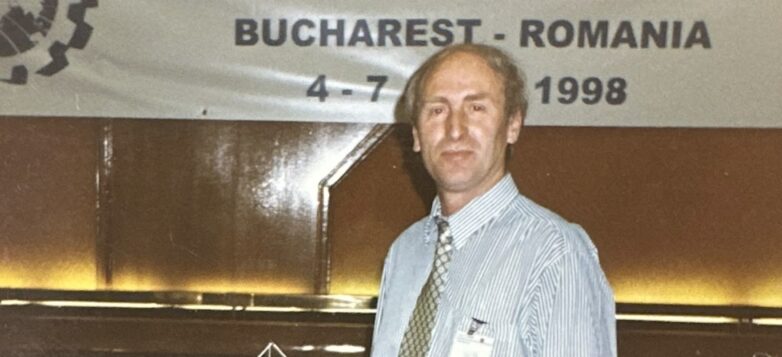
Hasan Abazi

Pristina | Date: November 17, 2023 | Duration: 123 minutes

We talked, ‘What do you think? Are you up for a demonstration tomorrow? Do you support us?’ Most of them supported us, but there were also those who did not know what a demonstration was. Because there were no demonstrations until then. Then I had to explain to a group of two or three what a demonstration was. ‘When protested for Vietnam.’ Back then there was the war in Vietnam. Same with the slogans and that’s how we went over it. ‘Now we know what a demonstration is.’ So around 6:00-6:30 at the corner of Hotel Ljubeten we met with the rest of our friends. Some of them came later, but most importantly, we, the friends of the organizing group of the demonstration in Ferizaj, met.


[…] The demonstration continued until 3:30 PM. The time… our goal was for the workers who leave the factories they worked at at 3:00 PM, to see what their children were demanding. We did not want to implicate the workers in the demonstration. Our goal was to save them because they were being fired from their jobs, and if one worker lost their job, it would be a problem for their family. So we talked all the time with my friends that there should be no workers at the demonstrations, but that the main ones carrying it should be the students of Ferizaj, of course also the pupils who were in Ferizaj.


So at 3:30 PM, up to five thousand demonstrators gathered in Ferizaj. They also reported this on the radio from Ferizaj, but they also asked me several times during the investigation, ‘How were you able to gather five thousand people in two days? When we have to spend three months propagandizing for one gathering and barely bring five thousand people to the gathering?’


Anita Susuri (Interviewer), Ana Morina (Camera)

Hasan Abazi was born in 1947 in the Davidovc village, Municipality of Shtime. He studied at the Higher Technical School in Pristina. Mr. Abazi was an MP in the Parliament of Kosovo during the years of 1992-1998. He was a co-founder of BSPK in 1990 and the founder of the Independent Unions of Metalworkers of Kosovo. He is currently retired and lives with his family in Pristina.

Hasan Abazi

Part One

Anita Susuri: Mr. Hasan, if you could introduce yourself, tell us something about the place where you were born? When were you born? About your memories?

Hasan Abazi: Thank you. I am Hasan Xhemajl Abazi, born in the village of Davidovc, now the municipality of Shtime, at that time it was the municipality of Ferizaj. I started my childhood in the village, I finished primary school and the eight year school in the village and in Shtime. While I started the technical high school in Ferizaj, the first generation.

Anita Susuri: What kind of family was yours?

Hasan Abazi: We were a family of average economic condition. Following my family’s tradition, my grandfather whose name I carry, Hasan, was an organizer against the agrarian reform in 1924. Together with other villagers from the villages of the municipality of Shtime and Ferizaj they opposed the taking of land for colonists at that time. So I am continuing the activity of my grandfather. Later my father, even though he was uneducated, always had the wish that we should be educated. Because from the hardships he had at that time he understood that without education there is no other possibility. So within our economic possibilities he made it possible for us to get an education.

Anita Susuri: Do you know anything more about this activity of your grandfather? Did it have any consequences later? Was he persecuted?

Hasan Abazi: Yes, all the time in fact our family was persecuted by the Serbo-Yugoslav authorities of that time. We were always in the eyes of the authorities. In fact, we were constantly watched and controlled. My father… Since my grandfather died in ‘40, a little before the beginning of the Second World War, further political activities remained with my father and of course others who at that time continued this activity.

Especially our uncle, Shaip Abazi, continued a more vigorous activity. During that time, at a young age, from ‘40 to ‘45 he carried the flag in the gatherings of that time for the issue of national freedom. But after 1945, they mobilized my father and sent him to Tivari. So he told us all the time about the Tivari massacre. He had the luck with a group of fellow villagers and some others who escaped from the Tivari massacre and all the time in our guest room he explained to guests and friends about that issue. I also heard such a thing because I was young and curious to know that bitter history of our people.

Anita Susuri: You mentioned your father who at that time was taken by the Yugoslav forces and sent to Tivari, the Tivari massacre happened. Can you tell us what your father said?

Hasan Abazi: My father said that there had been seven battalions mobilized and when they continued the road to Prizren, in the direction of Albania, he said that in their battalion there were some from the district of Pristina, Ferizaj, Lipjan. And the other battalions were battalions from Drenica, and with those traditional national clothes. So he says, when they went to the Castle of Shkodra, a young man approached them and said, “Oh you Kosovars, you do not know what is waiting for you.” “There,” he said, “he made us aware.”

But they were surrounded by large forces, both Albanian and Yugoslav, which was the worst according to my father’s statement. After a time they pushed them into Tivari, he said, into a building where they dried tobacco. He called it the tobacco depot. When they went into that place, they noticed a massacre that had been done before they arrived. Meanwhile, they again surrounded this battalion of my father and they fired with rifles and machine guns upward with the intention to make them run and then they could commit another massacre by shooting on those who fled.

But all of them decided not to move from that place and he says, “So we were spared.” Meanwhile a general or military officer from Croatia came and he took these in front of him and they continued as far as Trieste. In Trieste, and on the way back here in this direction, he says, “We suffered a lot because people were tired, without bread, without water and most of the people, when they asked for water or bread from the Montenegrin forces, were killed.” A person who asked for water or bread in fact never returned to their unit. So whenever we went on vacation to Ulqin he would cry in Tivari. This is something (cries).

Anita Susuri: Do you want to take a break?

[Here the interview is interrupted]

Hasan Abazi: After returning from Trieste home, even though in Shtime with its surroundings only 2% of the population were Serbs, all the administration was in Serbian hands at that time. Immediately they took him, even though he had been on the war front, because then they said like this, “We are following, we are driving out the Germans,” and forced my father to go as a soldier in the Yugoslav army, for two years. Even though they had no right, the Serbian administration had this approach, to empty Kosovo of people as much as possible. So at that time, in ‘47, I was born, the second son of the family of Xhemajli and my mother Hanumshah.

Anita Susuri: How many children were you?

Hasan Abazi: In fact, we were five children but the others passed away and only three brothers remained: Ahmet, Hasan and Hysen. These names, Hasan, Hysen, are names inherited from our grandfathers and earlier from our great grandfathers. So, according to this tradition, the names of people were renewed. So, with my birth in fact they sent [my father] a telegram so that he could come home, at least for seven days. That date matches exactly my date of birth and it is peculiar that my birth date did not change. Because there are cases in which the birth date was registered later, after a year and so on. This is connected with my father in the army and the telegram about my birth.

Anita Susuri: And your father then came only for a visit or did they…

Hasan Abazi: No, only for a visit, a seven day visit and then he continued his military service. What is important, in fact, when I was nine or ten years old, our mother died. I remained an orphan in terms of family supervision. When I was a child then my father was forced to remarry but we, in fact because of our economic conditions, always slept in the oda1 of guests, as we called it at that time. All the time as a child I grew up and was educated in the oda of guests through the conversations that took place in the oda at that time.

Since there was no radio or television, the conversations were like that, but at the same time we dealt with songs and with my uncle’s statements. He, as he had studied at that time from ‘40 to ‘45 in the schools with Rexhep Shpendi in Shtime, taught us the anthem of the flag, he taught us different poems which he also recited in the gatherings of that time.

In fact, that was also a part of the education which pushed you to understand the hardships of the regime of that time, the regime that existed in Kosovo after ‘45. And especially because of the banning of the flag, everyone was worried that the Albanian flag could be banned when there had always been a struggle to become equal. With my mother’s death another hardship began, the time of Ranković2 around the collection of weapons. My father… My father was mistreated the most, with the pretext of searching for a rifle.

I remember a few days before my mother’s death that my mother gathered a piece of bread and some salt and put it in his inside pocket and said to him, “Bread and salt will save you from mistreatment.” I was small there and while following my father, we waited to see whether he would return home alive or dead in fact. The time was difficult, it was winter. Heavy snow, ice, and cold. They tortured him for three days and three nights in the police station of Shtime.

But my uncle managed somehow and provided a rifle in Macedonia and with that my father also passed this hardship. But it was not about the rifle, an iron rifle which was of no use to anyone at that time. It was exactly the hardships caused by my grandfather, that is, our family that was in the sight of the regime of that time. My father also tells about the hardships during the time that he dealt with transporting goods to Prizren.

So when they went to Caralevë, there was a gendarmerie station there, all those citizens who went to Prizren were always mistreated there, because “You have loaded the animals too much and you are torturing the animals.” Various hardships when they were able to find a pretext. So all these were our parents’ stories, by which we, as the new generation, their descendants, were formed.

A little earlier I said that he had the wish that we be educated, so then I started Technical High School. I am the first generation in the Technical High School in Ferizaj. Two classes were enrolled, one in Serbo-Croatian, one in Albanian. In Albanian about 40 students were enrolled and in the second year only six of us passed. So even here the power of Ranković was seen in the discrimination that was done. All the time they told us that we were not made for school and especially not for this technical school: “You are made for planting peppers, tomatoes, and working the land because you are not for this kind of schooling.”

Anita Susuri: And you said that you continued that schooling in Ferizaj, did you travel or did you live there or how was that period?

Hasan Abazi: I traveled in most cases, I traveled. Classes finished late, at eight o’clock in the evening, and I traveled 12 kilometers from Ferizaj to the village of Davidovc. The hardships were great because around Gllavicë, there is a village where Montenegrins used to live. They had very aggressive dogs and we had to, we were forced to take off our shoes even though we did not have shoes but those cheap ones at that time, only so that we would not make noise with our steps and that the dogs would not attack us. Because then their dogs served as guards, supposedly as if someone was attacking the village of those Montenegrins.

Then after some time there was a bus that they called the local one and my younger brother Hysen also came in that bus. Then sometimes we went by bus and we found a room to stay in Ferizaj. But we always took bread with us for a week, because of the conditions that existed. I managed with my friends to graduate from the Technical High School. Six of us managed to graduate and four friends who in this Technical School had lost the year came from Pristina. We became ten.

In the second year they joined us with the Serbian class and we always listened to the lessons in Serbo-Croatian even though for us it was difficult, because we did not know the Serbo-Croatian language, since at that time in my village there were no Serbs so that we could communicate. It is important to emphasize that in 1966 we were in the fourth year of Technical High School when Ranković fell. Then the conflict began between the Serbs and us Albanians. Because they defended the actions of Ranković while we Albanians defended the activity and struggle of Emin Duraku,3 Fadil Hoxha4and others.

So, the conflict was born here, and from that conflict we had very great hardships from our authorities. In some meetings they closed us in the physics laboratory with the aim that we would reconcile. We could not reconcile with people who defended the butcher of our people, Ranković. So, there was also physical conflict between us. But they punished me and one friend, Hysen Muhaxheri. Instead of rewarding us, they punished us with the conduct grade “insufficient.” At the end of the year the school collective decided to correct the punishment and so we graduated.

However, these were always the hardships, the resentments that we felt directly on our own skin. This was what made us, at that young age of ours, try to see how we could get out of the shell of Serbo-Slavia at that time. After graduation from the Technical High School, we started to enroll in faculties and higher schools. I and a now deceased colleague of mine, Ismet Ramadani, who was also a classmate, enrolled in the Higher Pedagogical School in Prizren, mathematics physics. While the other colleagues enrolled, some in the higher school that was in Pristina, some in Ljubljana, some in Rijeka. So the generation of ‘66–‘67 was scattered.

What is important for me to mention, a pleasure now in the middle of all that, was the match Albania-… Yugoslavia–Albania in Belgrade. Our great wish was, not so much to see the game, but it was our great wish to go and see the flag when it waved in Belgrade. So we heard, we heard that in Rilindja5 because at that time some news was censored. We started to collect money. Each of us went back home and we asked because normally we had no other income except from our parents.

I went back and I didn’t really ask my father for money. But my uncle had come from Skopje and I said to him, “Uncle, I need some money,” “Why?” I said, “We want to go to Belgrade.” “Why Belgrade?” I said, “The game Yugoslavia–Albania is being played and there the flag will wave.” His eyes filled with tears. He took out the money and his eyes filled with tears and he said, “Here you go, go.” So we went to Belgrade and all my generation and the later ones who dealt with the demonstrations of ‘68 were there for the flag.

There we managed to get to know each other, especially with Afrim Loxha, Skender Muçolli, Asllan Dumoshi who had come from Ljubljana to see the match. I want to tell you, because it’s very important, the Partizan Stadium was almost full, I can say that 70–80% were Albanians from all the territories of former Yugoslavia, of course, from Albania I don’t believe they were allowed to come to the match. So how was this noticed? When the ball went near the goal of the Yugoslav side, the whole stadium roared. In fact, even there it was a demonstration without slogans. That’s how I thought of it.

For the first time Afrim Loxha had an embroidered emblem of the flag in his hand and he gave it to Ismet Ramadani, that friend. Because they knew each other from the first generation in Pristina. There, in the presence of all the friends he said, “I,” he said, “this emblem that you gave to me,” he said, “I will give it to my friend Hasan.” And from that moment I had, from ‘67, I had the emblem of the flag from Afrim Loxha. Now I say Afrim Loxha even though he passed it on through Ismet Ramadani. So we were pleased that we were close to the flag, it was not very important whether the Albanian national team lost or won but it was…

Anita Susuri: Did it lose or win?

Hasan Abazi: It lost, it lost, unfortunately it lost but nevertheless it was a pleasure, it was a spiritual relief for all the people who… imagine, there were even woodcutters, Albanians, who worked in Belgrade cutting wood, they had come to that match. So it has remained as a memory also in my memories of ‘68. I have written, I say, the demonstration in Belgrade without slogans.

Anita Susuri: Do you remember any detail from this, for example? What the city was like or how you with your friends found yourselves? In the city? How did you go? Any details, if you remember?

Hasan Abazi: Usually we of the generation, let’s say, the first generation of the Technical School, became ten friends. Those ten friends, we would meet sometimes in my room, sometimes in… because at that time there were few cafés in Ferizaj. In fact, the Hotel Luboten was the meeting place of students but also of other meetings, among friends. For drinking coffee or talking, there was the Hotel Luboten. So in the Hotel Luboten we had a kind of corner, like in the form of a half circle. There was a round table there and that table in fact was for us students.

The waiters during the service to us would say, “We have this reserved for you, for you, the students. This is your place.” Even though in the other part there were songs, songs in Serbo-Croatian, in other languages, and a bit in Albanian. But we were more interested in the conversation among friends and the situation that prevailed at that time. Ferizaj was not arranged like this, it had one main street and one secondary street. The rest was different from what you see today. But the main thing is that it had, it had the train.

In fact, that railway was built in 1878 and Ferizaj was also called tasjan6 because it is a station. So in Turkish and other languages… and people have traveled by train from Ferizaj to Belgrade, to Munich, to Skopje, to other places. This is important because at the moment when the train was placed, Ferizaj’s economic development also began. First there, Feriz Shashivari, built an inn or a kind of guest house and from that, because there were no houses like this then.

There was a settlement around Ferizaj but in Ferizaj at that time there was no settlement. So gradually, as people came to travel in these directions, they also began to settle in the town of Ferizaj, as far as I know, even though my generation is later compared to the founding of the station. But I know this from others who have said that Ferizaj developed after the placement of the railway station in Ferizaj. There were two coffeehouses like this, but one was of rakia,7 where we as youngsters did not go much. Whereas all our activities happened in the Hotel Luboten, all our conversations, all our worries both of studies and politics, we talked them through, we discussed them with friends there, in that place.

Anita Susuri: And how was it, in Ferizaj was there any cultural, social life like this? Any activity?

Hasan Abazi: Cultural life in Ferizaj began to flourish after me, after the fall of Ranković. After the year 1966. Then in 1967 the Ensemble of Songs and Dances Kastrioti was founded in Ferizaj. In a way, the coming of other ensembles enlivened life in Ferizaj. There also existed the Writers’ Association De Rada in Ferizaj. In fact, cultural life, as far as I can perceive, developed with great momentum in Ferizaj after 1967. Thanks also to some intellectuals in Ferizaj who created Radio Ferizaj and at the same time these associations which dealt with cultural issues.


1 Oda is a traditional men’s guest room in Albanian homes, used for receiving visitors, social gatherings, and discussions.

2 Aleksandar Ranković was a senior Yugoslav communist official who oversaw a repressive state security apparatus responsible for the surveillance, intimidation, and persecution of Albanians in Kosovo until his removal from power in 1966.

3 Emin Duraku was an Albanian anti-fascist activist and partisan from Gjakova who helped organize the resistance movement in Kosovo during the Second World War. He was killed in 1942 and was later proclaimed a People’s Hero.

4 Fadil Hoxha was a Kosovo Albanian partisan commander and communist politician who became one of the most influential Albanian representatives in socialist Yugoslavia. He supported the 1943–1944 Bujan Resolution affirming Kosovo’s right to self-determination, but later continued his political career within the Yugoslav system after Kosovo was incorporated into Serbia.

5 Rilindja was the main Albanian-language newspaper and publishing house in Kosovo during the socialist Yugoslav period, and an important institution in the development of Albanian-language journalism, literature, and culture.

6 Tasjan was an old informal name for Ferizaj, derived from the word “station” and linked to the railway station around which the town developed in the late nineteenth century.

7 Rakia is a traditional strong fruit brandy widely consumed across the Balkans, commonly made from grapes, plums, or other fruits.

Part Two

Anita Susuri: I want… So, we’re approaching the year ‘68 when the demonstrations took place. You already started to tell me about the friendships you created, about the conversations, but if you can tell us how all of that came about? The organization?

Hasan Abazi: You mean for ‘68?

Anita Susuri: Yes, the demonstrations.

Hasan Abazi: Then we enrolled in the faculty and in higher schools in Pristina, someone in Skopje, someone in Rijeka, as I said a bit earlier. A part of them, with the opening of the Technical Faculty then, we, who were in Prizren, came and enrolled in the Technical Faculty. Those who were in Ljubljana and some in other places, in fact we started at the Technical Faculty in ‘67. We continued our studies. In the year ‘68… and so we began to get to know each other among ourselves, to broaden our circle of friends, both in Ferizaj with the friends I mentioned a bit earlier.

But there were not only those from the Technical School, now it expanded with representatives from the Shkolla Normale1and other schools that were in Ferizaj. So, we became a little wider circle of friends compared to that group. The main cell is the group of ten persons. I… because my younger brother enrolled in the Faculty of Forestry in Skopje, then the burden was a bit heavy for the family to support both of us. A competition opened in the power plant in Obiliq. I both studied and started to work to help myself and my family, in Obiliq.

So at that time I worked in Obiliq, ‘67–‘68 and I continued my studies. There I created a circle of friends of 45 people, as many as we were technicians and engineers in the power plant. The activity for teaching in the Albanian language began. Because all the time there we had some kind of training for the turbines. They said, “It is not possible to hold lectures in the Albanian language, but only in Serbo-Croatian.” Then, in cooperation with some engineers of the power plant and also we together with other colleagues, we put our foot down at that time that it is possible to hold it in Albanian.

So a kind of strike began in the power plant and we achieved success. We brought out teaching in the Albanian language in the power plant. Alongside this, the activity for organizing ‘68 also began. The reason for organizing of ‘68 began was the process of amending the constitution in Yugoslavia and in the republics and in the provinces. We as students were always active in these writings and in these conversations with intellectuals of Pristina but also others about what was happening with our case.

We had the conviction that it was the moment now for Kosovo to be advanced into a republic and for the other Albanian territories to be united in the Republic of Kosovo in former Yugoslavia. Not the possibility of separation, that was not in question then. But mainly this. In all gatherings, both at work, in the faculty, in Ferizaj with other friends, when we met, in fact we discussed these topics. This topic mainly arose from the students, from the group of students of Pristina, the group continuing the work of bac2 Adem Demaçi.

Then some leaflets were distributed, some pamphlets but at the same time the novel Tradhëtia [The Betrayal] by Kapllan Resuli was distributed.3 Even though it was banned, we students would read this novel during the night and the next day we would hand it over to another friend and so on. It was an inspiration of that time for our student generation…

Anita Susuri: And these leaflets you say were distributed, what content did they have, for example?

Hasan Abazi: Well, in the demonstrations there was also this leaflet of Adil Pireva that we took later. Because after many debates made at that time and the requests that Kosovo be advanced to the status of republic, then, simply, Yugoslav politics together with the bureaucracy of the Albanian politicians in Kosovo silenced the people’s voice for the advancement of Kosovo to a republic. So the discussions began as to how, how our voice could be heard. This was first done, I said, by the group of Adem Demaçi, the youth group of Adem Demaçi.

And then, talking among ourselves, they were all convinced that it was the moment for a demonstration so that our voice would be heard in… Since they were blocked, they oppressed our demands, the other politicians. I remember when we talked about this with our friends at the power plant. Then there were talks to rally only in Pristina, not other centers. We were all ready to join these events in Prishtina. I remember Gani Graca, Enver Latifi, Bahtiri and others, Ilaz Pireva… even though with Ilaz Pireva we worked together in the power plant, we did not know that he was directly connected with the group of the youth of Adem Demaçi.

So I did not have any obligation at that time, only to take part and together with my colleagues to join them so that it would become as massive as possible. On the date 25 November, while returning from work, on the road that goes towards the faculties, I met Osman Dumoshi. Osman says, “Oh where are you Ferizaj people? For two days,” he says, “I have been looking for you.” “Well, congratulations,” I say, “what is it?” After the greeting we went to Berisha’s buffet — then in the Higher Pedagogical School there was a student buffet we called Berisha’s buffet – to drink coffee and talk.

We talked there, at the buffet, and Osman unfolded that, he said that, “On the 23rd and 24th we have decided in my house that besides Pristina, demonstrations should be held also in other centers of Kosovo, among them also Ferizaj.” Then I found myself in a very difficult position because there were only two days left until the demonstrations. So I say to Osman, “Sorry, all the other friends have gone to Ferizaj to organize so that they come and as many demonstrators as possible to Pristina. Now it is not possible to do such an organization in two days.”

During the conversation Osman also explained to me several times the slogans which we were planning to bring out in Prishtina. The main slogan was the slogan “Self-determination! Constitution!” From Osman the republic was not mentioned, but Osman said that, according to him, “the demonstrators themselves will call for the republic.” I did not promise him that I would try, I did not promise, because I was alone. The other friends from Ferizaj with whom I could organize something like that were in Ferizaj, I did not know their opinion.

So I fell into a kind of deep depression, I felt a heavy burden to take on, to organize something in two days. To say no, my heart would not let me, nor would my soul let me say no to Osman. He informed me that there was an organization also in Gjilan and in Podujeva. Normally at 05:00, 15:55, it would start, at five minutes to four, the demonstration in Pristina would start.

I said, “For Pristina we are all ready because we have discussed it with the friends,” his and mine, “in the power plant,” since they were of that generation, “but for Ferizaj,” I said, “sorry, maybe…” He said, “Regardless of whether you manage to organize or not,” he said, “it would be good that you come to Pristina in large numbers. Because this is the administrative center and here the demonstration has its own weight.” Even though we do not exclude the possibility of demonstrating in other centers, “but here is the administrative center and it makes a bigger echo.” These were Osman’s last words and we said goodbye.

He continued on his way and I went out to the street. Instead of continuing on the road toward the apartment where I lived, I had turned to the opposite side of the street. That is how it is when God sends you like this, so that you carry out the work, then he also directs you in that direction. As soon as I went out, a former teacher of the Emin Duraku School in Shtime, Sherif Beqa, said to me, “Oh Hasan,” he said, “where are you headed this way?” “Oh Sherif,” I said, “very good that I saw you.” He had taught drawing, the art of drawing, in the Shtime school. I said, “Very good,” I said, “that I met you,” “Yes?” I said, “I have,” I said, “a task, someone has sent it to me.”

Sherif also knew the Dumoshi family. Because all the students of that time who had studied earlier had in some form the support of the Dumoshi family. When I mentioned the name to him, that Osman Dumoshi had obliged me to deal with the organization of the demonstration in Ferizaj if the conditions were created. I said, “Now you can write the slogans for me because two days are in question.” I saw that he hesitated a bit in that direction. Not because of fear or something, but he said, “We have a problem with money.” “No,” I said, “do not worry.”

That day I had received my salary in the power plant, mine and that of a friend, Rexhep Rexhepi, with whom I lived. So I had plenty of money to buy the material. I said, “There is no problem with the material.” Then we headed toward Rilindja, the Rilindja shop was there and another shop, Prosfeta, to buy poster paper. At that time poster paper was a thick paper that we used for technical drawing. Because we did not have other paper.

We went with Sherif. While we were going on that side he said to me, “If someone asks us, you say that they are at the Higher Pedagogical School preparing exams and I need to make drawings. Let this be our slogan in case someone [asks].” Because there was a large amount of placards to buy. Paper for placards to buy. So we took it in the two bookstores of that time in Prishtina and headed to the apartment, it was on Prizren Street number 36. In that not very big apartment, it was three by four. There we started to write the slogans.

I also had a roommate, a Mehdi Salihu, and I said to him, “Are you ready to help us?” He said, “What can I do?” I said, “You only need to dry the paint of the slogans.” Because the place was narrow and so that the placards would not get ruined, they had to be dried…

Anita Susuri: What slogans did you write?

Hasan Abazi: The slogans were purely slogans that led, they were “Self-determination! Constitution!” for the most part. “We want a university! The Albanian language to be equal! Down with bureaucracy!” all these. Only purely the main slogan was “Self-determination! Constitution!” “Freedom for political prisoners!” And so on and so on. These were the main slogans. Until 05:00 in the morning of the 26th we finished 150 placards at that time with Sherif Beqa. We placed Sherif in the apartment of that friend, Rexhep Rexhepi, to sleep and I fell asleep among the placards, that’s it. The placards on top of me and I wanted to get a bit of sleep, to rest a little. Because it was already a bit of dawn.

Around 08:00 someone else, the second person, knocked on the door, who in fact made it possible for me to continue the activity. It was Muhamet Sylejmani, Mani, who had come from Ferizaj to Pristina to ask what was new both in the faculty and also to ask… usually everyone who came from Ferizaj, first of all came to our apartment there. We would meet, talk and then continue with other activities. And he came. We opened the door, he came inside and saw the slogans, “What are these?” he said. “Are these placards for Pristina?” Because he had no idea that they would be prepared for Ferizaj.

After some time, while drinking some tea that Mehdi Saliu made for us, I explained to him, I said, “Sorry,” I said, “I want to tell you,” I said, “yesterday I took on the obligation that we also organize demonstrations in Ferizaj and I am waiting from you to see if you are ready to support me because last night I wrote these.” I did not mention Sherif’s name, always keeping the person’s confidentiality. Without a second thought, without any hesitation he said, “I am ready to help you and to become a co-organizer.” “Well,” I said, “very good.” So now I got the second strength after this, after the placards were finished.

The sheets dried and we were thinking now how to go to Ferizaj. Then it was just before the holidays of 28–29 November and the activity of the police was very tight. Police, controls, the agents of former Yugoslavia, were on every corner and it was a bit risky to carry the placards from Pristina to Ferizaj. Then we thought that a bus usually came at 04:00 in the afternoon from Novi Pazar. And with that we had often traveled from Ferizaj. It went from Novi Pazar to Skopje and most of the passengers were Muslims from Novi Pazar. That is how they called them, the Bosniaks of Novi Pazar. But we know that their origin has always been Albanian, but what can we do?

Then we decided to go near the hospital where the bus usually stopped. We collected the placards, arranged them with the help of the newspaper Rilindja and took them like that with Muhamet and went to Ferizaj. During the trip, the conductor was our age, his name was Enver. Mani asked him, “What is your name?” He said, “My name is Enver.” “Congratulations,” he said, “you have a good name.” He was alluding to the name of Enver Hoxha. Then, fortunately for us, there were no other free seats and the bus did not stop. Because now we were anxious that some control might come in, take our placards. The problem was not whether they would take the placars, the problem was that we would not be able to organize the demonstrations.

Around 05:00 in the afternoon we arrived in Ferizaj. In the shop of Muhamet Sylejmani we placed the slogans in a kind of tunnel. Muhamet’s father worked with clothes, especially vests for elderly citizens. But they had not been present there, so Muhamet placed the slogans until we could meet the other friends in Ferizaj. After we placed the slogans, we were released from that burden. Then we started to go out into the city. As we were walking, even before discussing these with the other friends, we met pupils, citizens, especially Mani knew the citizens of Ferizaj as a local and as a man who dealt with the tailor’s craft then, he knew the citizens more.

We talked: “What do you think? Are you for a demonstration tomorrow? Will you support us?” Most of them supported us, but there were also some who did not know what a demonstration was. So, it was an issue because until that time there had not been demonstrations. Then I had to explain to a group of two or three people what a demonstration is: “When we did the protest for Vietnam.” At that time the war was in Vietnam. “That is how the slogans are and that is how we march.” “Now we know what a demonstration is.” So around 06:00–06:30 we also met the other friends in the corner of the Hotel Luboten. Some came later, but mainly we gathered the friends of the cell of the organization of the demonstration in Ferizaj.

There were Ismet Ramadani, Avdullah Zymberi, Ibrahim Sylejmani, Mustafa Sejdiu, Hajredin Salihu, Beqir Beqiri. These were in fact the ones sitting at that table where I and Muhamet Sylejmani also arrived. Later, around 11:30, from Rijeka came Hysen Muhaxheri, a student and our colleague from the Technical School. He joined us that evening. So there it was decided definitively, after I and Muhamet informed them that “Besides Pristina the decision has been made that the organization is done also in other centers,” I said, “I have taken it as a moral obligation, not an obligatory obligation, but a moral obligation that we organize it also in Ferizaj.” I informed them that the slogans had been prepared, had been brought, were ready, only needed to be placed in wooden frames.

Then the first who took the floor was Ismet Ramadani, who said, “I am for organizing it,” even though there was only one day. In fact it was, now, on the 26th it was evening while we were talking, the time was passing. In fact it was only the 27th before noon when the organization had to be done. After Ismet Ramadani, Avdullah Zymberi also took the floor and the others, and in joint discussion everyone unanimously supported the organization of the demonstration on the 27th. There we divided the tasks, who would do what, the obligations. As coordinator of the work I remained, while the paper to be written was taken by Ismet Ramadani and Avdullah Zymberi. They took it upon themselves to write the paper that would be read before the demonstrators in the city center.

There Ismet Ramadani said that “I will both write the paper and read it before the citizens, before the demonstrators.” So a great burden was taken by Ismet Ramadani, the late one. This friend was killed by the Serbian forces on 25 March 1999. In fact, from the earlier activities that were done he had been in the eyes of the authorities. For the normal school we assigned Muhamet, Muhamet Sylejmani took the obligation and Mustafa Sejdiu for the normal school. For the technical school I and Avdullah Zymberi took the obligation to mobilize. For the economic school the other colleagues there, Beqir Beqiri and others, took it. Beqiri took upon himself to bring the boards for preparing the frames to the place I would determine.

I took the obligation that we find an apartment, a place which I already had in mind earlier. It was the apartment of a certain Hasan Salihu on Zenel Hajdini Street. There I knew that there was no mixing with citizens. The conditions were there to gather the material. So at 12:00 we finished the meeting and it was decided that the next day a slogan be written: “Self-determination! Constitution! Republic!” This was proposed by Hysen Muhaxheri, who came from Rijeka and said that “From Croatia there is news that Kosovo must gain republic status.” Therefore he said, “We must write it,” I told him that “I do not have this suggestion but the citizens themselves will call it.” “No,” he said, “we will write it.”

Then we agreed to prepare also that slogan, written on a board, on what they called then a panel, chipboard at that time. We wrote “Self-determination!” in red paint, “Constitution! Republic!” That slogan led the demonstrations then on 27 November. On the 27th everyone was active, also the co-organizers, because I cannot leave the co-organizers aside, Enver Ramadani and many other colleagues. The ones from the secondary schools without hesitation helped in this direction.

In fact, until 12:00 noon the frames for the slogans were also secured, the flags were secured, the Yugoslav flag, the party flag, and from the Skenderbeu Café a boy from the Shkolla Normale, with my suggestion, went and took down the flag… because some time earlier in this Skenderbeu Café the Albanian flag, drawn, had been put up and from that time we, as young people, also went to look, to observe the flag around that café. At that time it was still something forbidden, the decision to allow the national flag to be waved had not yet been made. So we gathered them and around 02:00 I, as a young man, was unshaven, said, “How can I go out in front of the demonstrators, in front of the students,” since most of them were high school students, “in this form?”

I went into a barbershop there and said, “Is there a possibility to hurry shaving me? Because I have some job,” so as not to tell him what it was about. Just as the barber began to shave me, Ismet Ramadani and Avdullah Zymberi came and whispered to me that, “The police and the municipality have been alerted. We must organize quickly, otherwise the organization will fail.” Then I wiped off the soap and went out, I found a cart. Because the cart that we were waiting for to carry the banners was supposed to come at 14:20, ten minutes before the start of the demonstration. We had decided on the demonstration the night before. It starts at 14:30 and ends at 15:30. That is, in one hour we would have time to go to Pristina.

Then I took a parked cart, at that time we called it “para modës,” and he said, “No, because I have the horse.” The cart belonged to someone from the village of Reçak of Shtime. I said, “Listen, the material is light, you know, and I pay well.” “How much do you pay?” I said, “500 dinars.” 500 dinars was like saying 500 euros now. To him it seemed a big amount and he turned the horse to go and take the materials. But he did not urge the horse because he felt sorry for it, it was his horse, you know. Then I was forced to take the horse myself because I had experience from childhood and I hurried. I sped up the matter.

I arrived at the dormitory, the place where the students, citizens, pupils of the secondary economic school, trade, technical, normal school had gathered. There were also those of the gymnasium. At that time as many as it was possible to gather. There I remember the moment when we brought them, there was a kind of hesitation from the citizens. Then I called the friends and the students, you know, to take the slogans and for the march to begin. I had the intention, not only I but also the other friends, the organizers we were, that the march start as soon as possible. Knowing that they could come at any moment to surround us there with the police and now as children there is a possibility that they might get scared and that it fails.

So the march began. We had also taken Tito’s photograph, with intention. That when we have Tito’s photograph the police will not bother us. This was the fashion. They later told us that “You camouflaged it by taking Tito’s photograph because you were against Tito.” After 100 meters the president of the municipality, the party secretary and functionaries in the civil police, not in uniform, came and came out into the street. Then Sinan Sahiti was the president of the municipality and he said, “This must be stopped because this is the work of Ranković.” Then the blood began to heat, that helped us to take even more momentum now to reach the city center.

We had a confrontation there with the leadership, but when they saw the alarm of the demonstrators they left the place. But they had set up a roadblock at the “Moda,” the triangle of the road Neredime, Shtime and the city center. There they had made a cordon of police and until we reached that cordon I called all the student friends and the taller ones, there were some stalls. The stalls of the houses were broken and then the confrontation between the police and the demonstrators began. I remember that I and a colleague tried to pull the baton out of a policeman’s hand, but they were holding it with both hands so there was no possibility. The column shouting, “Self-determination! Constitution! Republic!” reached the city center, broke the police cordon and we arrived in the city center.

At the city center, in fact, we had planned to put Ismet Ramadani on a bathhouse cart so that he would stand above the crowd, but it was locked with a padlock and we were unable to take it out. We lifted him on a flowerbed and there he began to read the letter with the demands. As he began to read it, he reached half paper. Then the police intervened with the fire brigade and the confrontation between the police and the demonstrators began. But we had advised the demonstrators not to touch the civilians, regardless that they come. These civil policemen used the opportunity and came from behind us and hit me first in front of the police and the firemen and later also Ismet Ramadani. The police beat us and soaked us like that. But in spite of everything the demonstration continued.

The demonstration continued until 15:30. We had planned that around 15:00 the workers would also be leaving the factories and would see what their children were demanding. We did not want to involve the workers in the demonstrations, with the aim of protecting them, because they could be dismissed from work, and once a worker was dismissed it became a problem for the whole family. That is why we constantly discussed among ourselves that workers should not be included, but that the main carriers of the demonstrations should be the students of Ferizaj, naturally together with the high school students who were there.

Thus, by 15:30 in Ferizaj there had gathered a number of demonstrators of up to about five thousand. This was reported through Radio Ferizaj, and later during the investigations I was asked this question several times: “How were you able to gather five thousand people within two days, when we need three months of propaganda to barely gather five thousand people for a rally?”

Anita Susuri: Were there any injured during the demonstrations?

Hasan Abazi: One case that I know of is a girl who was carrying Tito’s photograph. A policeman struck her and injured her, and then her colleagues took her to the clinic. Later I heard that there were also demonstrators who were injured, but because of the situation and the arrests they did not report themselves. On the other hand, there were also injured policemen and firefighters. There was also material damage.

1 Shkolla Normale was a teacher-training school that prepared educators for Albanian-language schools in Kosovo and played an important role in the development of Albanian education and culture.

2 Bac is a respectful and affectionate term of address in Kosovo Albanian, commonly used for an older man, an older brother, or a respected elder.

3 Notable novel published in 1962 written by Kapllan Resuli (1934-2022), an Albanian writer from Montenegro who spent time in prison both in Yugoslavia and Albania and was also known by the name Kapllan Boruvić.

Part Three

Anita Susuri: When did the arrests begin?

Hasan Abazi: The arrests began already that same day. In particular they took students from the high schools, the Economic School, the Technical School and others, in order to identify who the organizers were. Based on the interrogations that were conducted, the arrests of our organizing group also began. I forgot to mention earlier that the paper was written by Ismet Ramadani and Avdullah Zymberi, but Ali Mehmeti also helped write it. He was a teacher at the secondary Economic School and at the same time a friend of Skender Kastrati here in Pristina, one of the organizers of the demonstrations in Pristina.

So, the paper was typed on a typewriter, because he was a professor of typing. Ismet, together with Dulla, took it from Ali Mehmeti around 02:15. Ali Mehmeti also had another role, because he did not stop the students of the Economic and Trade School from going out to the demonstrations. In a way he observed and supported the demonstration from another position. So he too, together with Jakup Mehmeti, acted as a co-organizer.

They were not direct organizers, but co-organizers, which we later learned from the students of the Economic and Trade School. So the arrests began. Ismet Ramadani and I were arrested on December 3. Some colleagues were arrested earlier, but Ismet, Ali and I were arrested on December 3.

Anita Susuri: Were you taken from your workplace or how did it happen?

Hasan Abazi: No, they came and took me from my apartment in Pristina. They took me from the apartment there. They had come two or three times before but did not know where I lived. Then, with the help of a friend, because we did not intend to flee. We expected the arrest, we even expected killings. We were aware that the Ranković period had shown that they used every means. It was a matter of luck that this was after the Ranković period, otherwise there might have been killings also during the demonstrations, in Ferizaj and elsewhere, as in the case of the killing of Murat Mehmeti in Pristina.

After the demonstrations in Ferizaj, Ismet Ramadani and I boarded a freight train to Lipjan. From Lipjan we took a bus, at that time called the “local,” the red local bus, and went to Prishtina. At the moment when the demonstration in Pristina began, we were also participants, but on the side. We informed Osman, Afrim and the other friends that the demonstration in Ferizaj had passed successfully. We then continued with the demonstration in Pristina, but since we were soaked and beaten, we were forced to go to the apartment to change clothes, because the wounds had started to cool and were being felt more strongly.

So we did not take part in the demonstration in Pristina until the very end, but for about two hours we were together with the other colleagues. We also saw and observed the chants, “Self-determination! Republic!, here at the university, which were spreading further. In Pristina the numbers were very large. With every moment, the number of demonstrators kept increasing. We noticed that here the organization was somewhat larger compared to Ferizaj, although we did not know how things had gone in the other centers. After the arrest, I was held for a full 36 days in one office.

Anita Susuri: Here in Pristina?

Hasan Abazi: No, in Ferizaj. On the fourth floor of the Secretariat of Internal Affairs. For 36 days they did not allow me to go to a room to sleep, they kept me without sleep. At night the federal inspectors Adem Gashi and Drago Bojičić came and interrogated us. During the day we were questioned by the lower-ranking inspectors from Ferizaj. After about five months, after exhausting all the interrogations and so-called informative talks, the trial was organized.

The trial was held in Ferizaj. The judge was Tade Erodičić, while the prosecutor was Mentor Jakupi. I can publicly say, and I thank them both, even though neither of them is alive today, but I thank them for the sake of their families. They could have sentenced us much more harshly, because based on the number of demonstrators, Ferizaj was second only to Prishtina. Tade Erodičić, with the help of our professor Pashë Staka, a professor of the Albanian language who had taught us and who was their neighbor here in Pristina, was asked to come and judge us in Ferizaj. This was because the president of the court in Ferizaj, Halil Ilazi, was Ismet’s brother-in-law, and due to family ties he had no right to judge us. That is why Tade Erodičić was appointed from Prishtina.

Ali Mehmeti, who had written the speech and was also a teacher, was sentenced to one year. Ismet Ramadani and I, as organizers of the 1968 demonstrations, received sentences of ten months each. The others, Muhamet Sylejmani and the rest, were held for about one month. Muhamet Sylejmani, Avdullah Zymberi, Beqir Beqiri and others whom I cannot recall at the moment, Hasan Muhaxheri, Sylejman Bytyçi and others, were sentenced to about one month in prison.

Anita Susuri: And where did you serve your ten months?

Hasan Abazi: We served the entire time in the Ferizaj Prison. The first part, as I said, about five months and something, under investigation, and the remaining part also in Ferizaj. Only Ali Mehmeti served the second part in the Goli Otok1Prison in Croatia.

Anita Susuri: What was the Ferizaj Prison like?

Hasan Abazi: It was an investigative prison. In the first part I was in cell number two, alone. They did not allow anyone else to come there, supposedly because we were motivating others with our testimonies and encouraging people to become organizers as well. I do not know exactly what decision the investigators had made. The second part was harder, because many ordinary citizens were imprisoned for misdemeanors, for wood theft, chicken theft and so on. We stayed together with them. Even so, I thank them, because they showed us respect.

All the citizens who came to that prison, and even those outside, showed us respect. They expressed it by sending cigarettes, wafer sweets and similar things. Most of them did not identify themselves, they just said, “Take this to the demonstrators of ‘68.” I remember one citizen from the village of Baliq who filled an entire sack with pears and apples and brought it to the guards, telling them, “Take these and give them to those brave men of ‘68.” And the guard said, “Where am I supposed to put all of this?” He replied, “Take it there, they will sort it out themselves.” He was the father of Ismet Sadiku from Balaj of Ferizaj.

Anita Susuri: Up to that time you were not married?

Hasan Abazi: No.

Anita Susuri: Did you have contact with your family, did they know?

Hasan Abazi: At first the family did not know that I had been arrested. After about ten days, inspector Adem Gashi asked me, “Does your family know?” I said, “How would they know? They think I am studying, they do not know I am imprisoned.” He asked, “Do you have someone?” I said, “Yes, across the street I have a friend, Ibrahim Sylejmani, who could go to my family.” Then they made it possible for my family to come and visit me. My father was the most worried, but what could be done. At the first meeting I told him, “Come on, father, you still have two other sons. Do not worry about me.”

Anita Susuri: What were the prison rules like? Was there physical violence?

Hasan Abazi: There was no physical violence, no. But there was psychological violence, and the fact of being kept without sleep for 36 days. During those 36 days, five policemen guarded me. Three policemen were in front of the table where I sat, one was at the door, and one in the corridor. I am speaking about my own case. During the interrogations with the federal inspectors, Adem Gashi was my main inspector, at Ismet Ramadani’s suggestion, because I spoke Serbo-Croatian less fluently, while he spoke it somewhat better, being from Ferizaj.

When they discussed it, they asked, “Who speaks Serbo-Croatian better?” He said, “I do, Hasan less.” That was a form of help, solidarity from one friend to another. When Adem Gashi came with accompanying Albanian inspectors, he would say, “I am afraid something might come out here from Ranković.” That was a worry, a knife to me, you understand? We were not some Ranković’s people. When he came with Serbian companions, he would say, “I am afraid something might come from beyond those mountains of Jezerc,” meaning Albania.

Neither one nor the other was true. In fact, it was the moment of our people at that time to advance the issue of Kosovo to a republic. That was the moment of that generation. Thanks to the students and intellectuals, and especially to the brother of Osman Dumoshi, Ismail Dumoshi, who was connected between the legal and illegal spheres, he worked with the intellectuals. Even though he acted from behind the scenes, he organized this in a way, according to all the knowledge I later gained, as a professor of Albanian language whom I had known in Obiliq, an intellectual who led efforts in the national interest.

So that statement of the inspector was more painful than a slap. A slap passes, but that was heavy. Still, that too passed. They kept saying, “You do not want to tell us,” and “You know which professor,” alluding to professors or people in power, “who told you that the road to a republic was blocked? It is not blocked, it can be done through talks, through dialogue.” I told them that dialogue had ended and that through dialogue they themselves had extinguished the possibility of discussion. The last meeting had been held in Prishtina, and we followed it through Rilindja at the time. There the decision was made to quietly stop the activity for a republic, under pressure from the Serbs, Montenegrins and Macedonians.

Anita Susuri: Was it around 1970 when you were released from prison?

Hasan Abazi: Yes. In 1969 I served the first part, then in October 1969 I went for the second part, and in 1970 we were released from prison.

Anita Susuri: Were you able to continue work normally? Your studies?

Hasan Abazi: I lost the opportunity to continue at the faculty, because I had left my index with a colleague, but out of fear of the Belgrade professors and the authorities, he did not submit my index to collect the signatures. So I lost two years. I had passed the exams, registered for the first year and moved to the second year of the faculty, but I was forced to retake exams and enroll in the Higher Technical School in Mitrovica. There I completed my studies and was employed at the tool factory in Ferizaj.

After leaving prison I continued by correspondence at the Higher Technical School and began working, because my brother was studying in Skopje at the Faculty of Forestry and the Tobacco Industry. It was a burden for the family to support both of us in studies. I lost my job at the thermal power plant, I was dismissed. That opportunity was closed, but a competition opened at the tool factory in Ferizaj. Two colleagues and I applied, and because there was a shortage of technical staff, we were accepted. But from a small prison I entered a larger one. The larger prison was outside. The larger prison was the reality of our people’s hardships, you understand?

Anita Susuri: Did you continue later with political activities, or did you just work?

Hasan Abazi: Until the 1990s I worked, I got married, I started a family, I did my military service. After the 1970s, once I was employed and also teaching at the Technical School, a letter from Tito appeared stating that all those convicted for political reasons should be removed from the schools.

Anita Susuri: Which year was that, if you can clarify?

Hasan Abazi: Around 1972–1973. That was when Tito’s letter circulated throughout Kosovo, saying that all political convicts must be removed from education. At that time I was both working at the tool factory and teaching tool construction at the Technical and Technological School. Then my former teacher, Xhemajl Kosumi, who was now the school principal, called me and said, “Hasan, we have an order from the Committee. Tito’s letter says this. I would suggest that it not be made a big issue. You submit your resignation and propose a colleague to replace you.”

At that point, in mutual trust between us, I stepped down and proposed Hysen Muhaxheri from Rijeka to continue teaching at the technical school. So after prison in ’68, Tito’s letter came as an extra ordeal, applied to all political prisoners. Not only to my generation but also to those from earlier generations.

Anita Susuri: And this letter of Tito, was it an open letter or what was it?

Hasan Abazi: It was an open letter that contained a political order, a political decree, saying, “All political prisoners who have been convicted cannot work in educational institutions, in order not to…”

Anita Susuri: Not to influence the younger generations. I wanted to ask, you also mentioned military service, where did you do it? Did you have problems because of that later?

Hasan Abazi: (Laughs) I said, from the small prison you go out into the big prison, and the consequences of the sentence are not just the ten months you served. All those follow-ups that remained in your biography were constantly tracked, especially by the authorities of that time. After Tito’s letter, in order to protect my job at the factory, because they were also saying that “all the irredentists have gathered here,” I decided to move a bit out of the way. I was working there, Ali Mehmeti was working there, Jakup Mehmeti, Ismet Sadiku, he was a personnel officer. So they accused all of us, that the irredentists were concentrated in this factory, in this plant.

To try to ease the situation, I asked Ismet Sadiku for a decision to go on leave, and I also asked Enver Sojeva, the civil defense officer, to let me go do my military service. I begged him that if possible they send me somewhere in Macedonia, since I was married and had a son at that time. He said, “That is not possible. You are assigned to go to Kiseljak near Sarajevo,” a place there. As soon as I arrived there, the same kind of troubles started. I was under surveillance, I had two people assigned to me, one Croat and one Bosniak. They watched me all the time, where I went, who I sat with, what I said and so on.

These ordeals lasted one year. I also had a conflict with a superior, not because of my mistake but because of his. On 29 November he gathered us and gave a lecture. He said, “Around 350 to 400 thousand Albanians live in Yugoslavia and Albania has an interest in dealing with this minority, with this nationality. And we do not have diplomatic relations with Albania.”

I had the newspaper Borba in front of me. In Borba it was said that there was an “Embassy,” that Xhavit Nimani2 had gone as ambassador of Yugoslavia to Albania, that diplomatic relations had been established. They began…

He was also saying that number… and without thinking he shouted, “Come here, Abazi.” Now my problem was how to respond. I said, “As far as diplomatic relations are concerned, relations with Albania have been established for two or three years now. As for the number of Albanians, with the 1971 census there are 2 million and 300 thousand Albanians,” and I threw away his 400 thousand figure. “It is written in the calendar, not that I keep some special record,” I said. He said, “Five minutes break,” and walked out. Then those two who were following me jumped at me and said, “Where did you get this information?” I said, “Just read Borba, it is there in Borba, and look at the calendar, it says the number of Albanian inhabitants in Yugoslavia. I did not invent this.”

But from that moment I was under even heavier surveillance. They tried to steal my gas mask and then accuse me of something, but I always knew roughly what might await me, and how others had been treated. I always tried to stay close to the other soldiers, not to separate from the group, you understand? So that period also passed. They kept me four extra days after my service ended, just to see if I would react so that they could send me to prison. That ordeal also passed, because I was fully aware of why I had been in prison and that my demands, not only mine but of our whole people, were that we be equal and free in that Yugoslavia of the time.


1 Goli Otok was a notorious Yugoslav prison and forced-labour camp on an island in the Adriatic Sea, where political prisoners, including Kosovo Albanians, were subjected to harsh conditions, abuse, and ideological re-education.

2 Xhavit Nimani was a Kosovo Albanian communist politician and former partisan who served as president of the Presidency of the Socialist Autonomous Province of Kosovo from 1974 to 1981.

Part Four

Hasan Abazi: You asked me about later activities. I had other troubles during the 1981 demonstrations. I was called in for “informative talks.” In Ferizaj, in these talks they accused me, not only me but our whole ’68 generation, that “you are the continuation, you organized these ’81 demonstrations too.” I went several times for interrogation. They would say, “You know where Ahmet Qeriqi is,” he was one of the ’81 organizers, and others.

I defended myself by saying, “We from ’68 have no hand in this. But if the republic had been achieved in ’68, ’81 would not have happened. Since it was not achieved then, the generation that was nine or ten years old at that time is now twenty and they want to demand what we demanded. This is a path that does not stop when it comes to our rights.” After about three days of this ordeal they released me and told me, “Be careful, because we are watching you.” This continued into the 1990s, when Yugoslavia started to break apart, when the autonomy was taken away and workers started being dismissed.

Anita Susuri: Were you also dismissed in the ’80s?

Hasan Abazi: Yes, they dismissed me too.

Anita Susuri: How did that happen?

Hasan Abazi: I was on annual leave, and at that time we had just organized the union in the enterprise. I was deputy chairman, the chairman was Ismet Sadiku. I came to Prishtina where the unification of unions was being organized, and at the same time we established what today is the 33 year old Independent Union of Metalworkers of Kosovo. We took positions on how to act in case of pressure to recognize the authority of Serbia. I went back to convey these decisions to my colleagues in the factory, and suddenly two Serbs who worked there came to my office.

They put a decision in front of me to sign, even though they had no right to do that. I said, “I am on vacation.” They said, “You have to sign this and you are no longer employed.” From that moment on I could not even enter the factory anymore. So around December 1990 they dismissed me and the entire leadership, and then later a large number of other workers who, out of personal dignity, refused to sign a declaration recognizing the then Serbian authority.

So I continued my union activity in Prishtina with colleagues, the late Agim Hajrizi, Hamëz Jashari and other friends, in the Independent Union and the Union Association of Kosovo. I started this in 1990 and I have continued it until 2023 (laughs). So 33 years of union activity. From 1997 I have led it as the head of the Metalworkers’ Branch of Kosovo, the industry sector.

From 1990 to 2000 our organizing was mainly to keep the workers informed. Wherever we could, we tried to make sure our workers did not leave their jobs if they still had minimum conditions, because we knew our issue would not be solved in a short time but in the long run. We lobbied internationally through letters, meetings, about workers’ rights and human rights, about the violations committed by Milošević’s regime.

We took part in many congresses, conferences, seminars, international meetings, in Brussels and elsewhere. We wrote to the European Parliament, informing them about our rights, about violations, about workers being expelled from their apartments without any legal grounds, and so on. We also reported the murder of Hamëz Jashari, who was a member of our leadership. Adem we considered one of us too, but Hamëz was officially part of our joint structures.

In 1990, on 24 March, as a union and political activist, my colleague Agim Hajrizi, whose picture I keep here in this office, was also killed,. Alongside union activity, which I summarized briefly, I also had political activity. In 1989, political parties and independent unions in Yugoslavia were founded and registered. Among them was the Democratic League of Kosovo. I became a member of the Democratic League, in the Ferizaj branch.

However, since being a political convict at that time, there was a bit of hesitation that political prisoners should not join, should not take functions in the party, so that the regime of the time would not paint it with some other political “stain.” So I helped with preparing the membership forms in ’89–’90 until I was dismissed from the factory, and I took them around so that people could declare themselves, fill in that form. I was active in that direction but in the background, not directly in the first leadership.

I entered the presidency in 1993, while in the first elections for the Parliament of Kosovo in 1992, I was proposed as a candidate for the first zone in Ferizaj and I was elected deputy of the Parliament of Kosovo. Once I was elected deputy of the Parliament of Kosovo, I no longer thought I would even stay alive at that time, because there were no seats waiting for you, no conditions, no benefits. What was waiting for you was imprisonment or even liquidation, since we were a parallel government under Milošević.

So in 1993 I was also elected a member of the presidency. From the presidency I took the obligation to lead the solidarity commission. I led the solidarity commission for four years, until ’97. In ’97 I led the information commission. It was a very important commission at that time, because we had to inform about military movements, police actions, mistreatment of people, activists and the population and everything. In a way we were a thorn in the eye of the regime of that time.

In ’98 they proposed me again to continue, as a candidate for the Parliament of Kosovo, and I was again elected with the majority of votes compared to the candidates of other political parties. So until 2002 I was also a delegate of the Ferizaj Assembly and a delegate of the general Assembly of the Democratic League at the central level. In the year 2000 I was elected deputy chairman of the Democratic League, Ferizaj branch.

In the first local elections in Ferizaj I was elected municipal assembly member and I led the parliamentary group of the Democratic League in Ferizaj. During the period ’90–’99, besides these activities I mentioned, I also founded the scholarship fund for students of the Ferizaj municipality who were studying at the University of Prishtina. Not for students studying in Tirana or elsewhere, but only at the University of Prishtina.

The goal was… the goal was to help poor students from Ferizaj, but at the same time to help the University of Prishtina to stay alive. That was our intention. During that time, from 1994 to 2002, we financed around 202 students. I was the chair of the Scholarship Fund Council in Ferizaj, as it was called then. Because of this, I was taken in for “informative talks” by the regime of the time several times, about 14 times. They even tied me to the radiator and mistreated me physically and so on, but I endured it and today I am here with you.

Anita Susuri: And how was the war for you?

Hasan Abazi: Before getting to the war, I want to say that the work I did with the fund gave me a certain relief or pride. Even though I did not have my own money, we collected from citizens, from businesses of that time, who gave us funds and we helped students. Today among them there are doctors, professors, probably PhDs, and others. It is a large number. For that time, it was something special.

When the police took me in for questioning on 9 April 1998, they said, “Where do you get the money? Our general of our army does not have a 40 euros salary, you give 50 euros to students. Where is this money from? America? or who gave it to you?” I said, “No, look, you have the press,” Bujku1 at that time. Because I made all my activity transparent. I said, “You have the newspapers, read the newspaper, it is the Assembly that gave the money and the students who benefited and who are in difficult economic conditions are listed by name. The money is from the citizens for the citizens, for their children.”

I experienced the war with difficulty, with great difficulty. I would not really like to go too deep into it because I get emotional. But the first night, I spoke on the phone with Agim Hajrizi and he said three words to me, “Cani, Cani, with today Serbia is finished in Kosovo.” Twenty minutes later they liquidated him. The next day they liquidated Ismet Ramadani, my close friend, my soul’s friend, they massacred him in Ferizaj. Later they massacred our ’68 generation comrade, Afrim Loxha. These are those things, you know, that I said I would not go into. However…

Anita Susuri: Were you here?

Hasan Abazi: I was here until 3 June. I moved from one family to another, from one family to another, staying three days, three nights with my relatives, moving like that. I thank all these families. I might not be able to repay them now, but freedom itself, which has come, is something through which they too are rewarded for the help they gave. So I was forced to leave because in the place where I was in Greme, they said that they would come, they were preparing some food “coupons” as they called them, to register who was present.

I received word from some colleagues that, “Hasan, you have to leave as soon as possible, because if they identify that you are here, they might massacre the civilians as well.” So I was forced to leave on foot, through the Sharr Mountains, Luboten and out to Tetova. But I did not stay long there, we returned quickly to a free Kosovo. So I was aware of the work I had done, but I did not know that they were looking for me to liquidate me or imprison me.

I found this out only much later, when they arrested me at Dheu i Bardhë in 2012. There they accused me of being a NATO spy, a collaborator of NATO. Precisely because of the commissions and other activities. When I went to court, when they caught me, my file was this thick, and the judge just leafed through it and said, “What a history.” They had collected everything about my union, political, solidarity and all the other activism.

Thanks to my son, Haki Abazi, who paid 20,000 euros and 5,000 euros to the lawyer, I was temporarily released. But even today I am still under investigation, wanted by Serbia, so I cannot even go to Macedonia or Montenegro because of this indictment they made against me…

Anita Susuri: And how did they treat you when they arrested you? Was there any difference compared to the years before…

Hasan Abazi: No, there was no difference, it was the same, exactly the same. Only that Vranje Prison was the prison of the former communists. Everything in concrete. From then until today I have knee problems from the cold that was there. Thanks to two Albanians who were in the same cell with me, one from Tërnovc, because there were ordinary criminals there who could have killed me inside. But thanks to them they did not dare. One of them had been very tough and they were afraid of him, and did not dare approach. According to what was said inside, they were afraid of him. He had been some kind of boxer. Even though he was convicted for other things, he helped me.

Anita Susuri: Well Mr. Hasan, if you would like to add anything at the end, if you forgot to mention something?

Hasan Abazi: I completed my political activity in the Democratic League of Kosovo, in the conditions and circumstances that existed until after the liberation. For all the hardships I went through I thank my father, even though today he has passed away, who always supported me, as well as my family, my wife, my children who showed understanding. I somewhat “forced” my daughters to keep cultural life alive in Ferizaj.

Both my daughters sang, they recited at gatherings for 28 November and other holidays. In a way I also planted in them a love for the homeland and its cause, so much so that today I also have my son as a deputy, as continuity, he is in the Parliament of Kosovo. He continues the activity further. I do not have anything particularly special to add. I thank all my collaborators, political, humanitarian, union, from all over Kosovo with whom I have had good and fruitful cooperation. We have tried, as much as we had strength and opportunity, to help this generation and our state.

Anita Susuri: Thank you very much to you too!

Hasan Abazi: Thank you as well!


1 Bujku was an Albanian-language newspaper established in 1991 by the staff of Rilindja after Serbian authorities shut down the newspaper, effectively serving as its continuation under a different name.

Download PDF