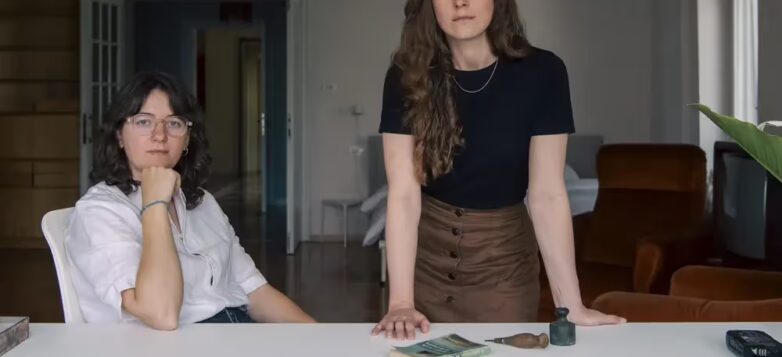
Diona Budima: Could you please start by stating your full names, where and when you were born, and then tell us a bit more about your background and how you came into your practice?
Okay, I start? my name is Erdiola Kanda Mustafaj and I was born in Elbasan in Albania. Then I moved since I was 8 years old to Italy, Bologonia where I lived all my life. And then recently I moved to Paris where I live actually. I’m an artist, visual artist working with photography and video and sound installation. yeah I pass the world to my colleague
Erdiola Kanda Mustafaj: Okay, I start? My name is Erdiola Kanda Mustafaj, and I was born in Elbasan, in Albania. Then I moved, since I was 8 years old, to Italy, Bologna, where I lived all my life. And then recently I moved to Paris, where I live actually. I’m an artist, a visual artist working with photography, video, and sound installation. Yeah, I pass the word to my colleague.
Anne Bourrassé: I’m Anne Bourrassé. I’m a curator and a writer. I am based in Paris, and I work internationally with [inaudible] Museum [inaudible]. I also co-founded an association called Contemporaines, which fights against gender inequalities in contemporary art in France.
Diona Budima: What kind of disciplines and methodologies do you both usually work with?
Erdiola Kanda Mustafaj: Well, I work a lot with histories, mostly oral histories, and my methodology is actually following these histories and transforming them into artworks that are made with photography and video, mostly. Then lately, I’m working a lot also with installation. But yeah, I’m working on the methodologies, like on the way of transforming these histories into something else, giving an interpretation of them.
Diona Budima: Thank you.
Anne Bourrassé: I’m working mainly on feminist, intersectional feminist issues and collective practices also. I like to relate my work with what’s happening in geopolitical matters. I’ve been working, when I do curation and when I’m programming, with many different kinds of artists, could be photography, could be visual arts, writing. So I have a multidisciplinary interest.
Diona Budima: Okay.
Anne Bourrassé: Yeah.
Diona Budima: And how did you two decide to work together? Have you known each other for a long time?
Erdiola Kanda Mustafaj: Yes, we met a few years before at a photography festival, and then we shared this common interest in the Balkans. I was already going back and forth from Paris to Tirana at that moment, and then we kept knowing each other and decided to do this project together.
Diona Budima: And what drew you to apply to this residency program?
Erdiola Kanda Mustafaj: We applied together with the main project that is part of my personal history, and the idea was to combine two different methodologies and also two different roles, that is, the artist and the researcher/curator, which is not so evident, that they work together since the beginning. And we wanted also to give a reflection about this way of giving birth to a new work by combining two different visions and methodologies. Yeah, that.
Diona Budima: Has your research question or your work changed or evolved during the residency, or was it kind of like the question that you started with when you applied?
Anne Bourrassé: Yes. The main project at the beginning, when we applied, was about language, language and transmission. Transmission stayed, but the language evolved a lot because first, I didn’t speak Albanian, so it was the first barrier for me going into the project. But also because we figured out pretty fast that there was not a lot of Çam language that really resisted or survived history. So we used other languages, we used the language of the body, we used the language of poetry, we used other sensitive languages to work on this project.
And the thing I didn’t realize when I applied was that working on Çamëria is a really important matter, a really important subject, and we had no idea about this in France. So for me, this research was also a way to better understand the context, and this is already a main work, to just understand what Çamëria is, what we are talking about, what’s the history there, what is this Çam minority. So it extended to a more historical context than just language.
Diona Budima: Could you describe, for the record, what the installation here consists of? Just, yeah, the different parts of it and what we had the chance to see this weekend?
Erdiola Kanda Mustafaj: Yeah, we have two main spaces. One is the swimming pool, in which there is installed a double-channel video that brings back an old and epic dance that has the name of the dance of Osman Taka, through the combination of two artists, one is the performer [6:32] and the other is the musician, and they both interpret the role of the dancer who performed this dance for the first time in front of the dictator in ‘78.
Then, going up from the swimming pool, there is the possibility to enter to see the video and then also to go up. There is three-form poetry in three languages, which I wrote, one in Albanian and the other two in French and English. Also because I think it was needed, the fact of giving meaning to this work when we’re speaking about the language of gesture, which is pretty international, while the written language faces some impossibilities when you don’t understand that language.
And then we have the second room, in which there is a chronology that is more, how can you say, sensitive, subjective.
Anne Bourrassé: The work, the research work, so what we did with Erdiola is we gathered a corpus body of work based on our experience. It’s really complete, like installation, video, poetry, publication, research, and songs, and all those works together form this project entitled Return from Çamëria.
The research part, so the subjective chronology I made, is more to bring it, more about the context and also to talk about the main history and the main events of the genocide, and this [inaudible] history through the history of art. So I gathered materials such as paintings, photographs, texts, and maps to better understand visually also the impact and the archive we have, and also to try to translate it for the public. Because as a curator, we work mainly in the backstage, we work mainly… hidden with our computers, and the idea about this chronology is also to make the research public and visible, to go through the process with the public.
And with this research, there are black papers, and they represent the blanks, the loss of memories, the loss of history. It’s a way to say, for me, that I don’t have the exhaustive knowledge, and I was here only for three months. So there’s still a lot to learn, a lot to hear, and a lot to understand.
And then there’s this publication that assembles texts I wrote when I came back from Çamëria, and it goes through the entire research, it goes through our work and collaboration, and also it raises all the questions we can have through this project. And finally, we have the songs, collecting materials and songs from elders, women elders who still, like, remember the songs of Çamëria.
Erdiola Kanda Mustafaj: Yeah, but still, in the songs there is the lack of remembering this under dialect of Albania, this Çam dialect. We begin from that, but we saw actually that there is a tension and a retention within the memory of these old people, and some of them, they are singing, like, let’s say, child songs, but in Greek also. They’re mixing, obviously, the language also because the territory they came from is multi-layered, and so what they remember, what was not assimilated to Albanian literary language, came up as a Greek that obviously is not pure Greek now, that is coming from what they remember of that… of that space and the territory.
And so we have all this material, we have the sound listening, we have the visual of this chronology, and you get into it and see and read the information that we found, since the earliest one in the 11th century to nowadays.
There is also an installation of a piece of wood that I found in the river Thyamis, Kalamata now named, that for me was really important to put also because of the name of this territory, that also, if you speak about it, becomes, yeah, tension within the territory. And it came from the river, and the river was the border.
And since we are speaking about this memory that lives through borders, through displacement, for me bringing back this piece of wood, this material that is natural, brought by the river, was really important.
And then we came back to the poetry and the video, and all arrived together, and yeah, they are not separated pieces, all gave strength to the main research that we did over these last three months with Anne.
Diona Budima: You mentioned borders, and you called the… the subtitle Cultural Heritage and Exile. Could you speak a bit about exile, and what you mean by it, and the role it plays in your research and practice?
Erdiola Kanda Mustafaj: So yeah, I have to say that the thematic of the exile is really present in my research, also because I live in this displacement, coming from Albania, went to Italy, and then now to France. The topic of the exile is really an emblematic figure in my research.
In this context, it’s also the history of my grandparents, so obviously I wanted to integrate, to search more on the thematic of how the memory can be preserved or passed in this movement and in this passage, in the fact of being not anymore able to come back. And what is, how is transforming in this inner, how is the space transforming all the things, and how we are, like, managing this, these changes within our ancestor generations. Yeah.
Anne Bourrassé: And what’s interesting in the Çam history is that all the material is in exile. The history is in exile because, even if the region of Çamëria is this region between Albania and Greece, the first texts written in Çam are actually now in the Vatican. Another dictionary, a Çam dictionary, is now in France, in Paris, at the Bibliothèque nationale de France.
The main events, one of the first main events or operations on Çam people and on Çam women, was the dance of the Zalongo events, and the main paintings relating to this event are in the Louvre, in France, too. And there are other materials in Greece or in Italy. So what is interesting is that even the archive itself of the Çam history is in exile, it doesn’t go in Çamëria. Çamëria doesn’t have a museum or a place to remember and to collect this.
This is why also we worked with many historians, Çam historians, and one of them, Monika Hasani, she’s working on the first museum archive of the project. But what was interesting is Erdiola herself is in exile. The entire Çam population is in exile because they had to leave their homeland. They were killed, and then they were displaced in refugee camps, so they couldn’t go back to their country.
But also because the dictator Enver Hoxha, he took off their passports, so they didn’t have their citizenship anymore. And even now, they cannot claim their own houses, their own land, and they cannot come back to their places. So the… it’s intimate, it’s collective, it’s art history, in every layer, there’s an exile question, an exile issue.
Diona Budima: Yeah. And this sort of distance of the exile is present in your work and your installation as well, because, as you mentioned, the chronology that you presented is a subjective chronology, and it has these gaps, these black pieces of paper. You start with a kind of ethnographic, linguistic research, but you seem to never, sort of, pretend to a complete objective knowledge. And I’m wondering a lot about the decision that you made, to present, to do an interpretation of the dance and not, say, just record the dancers and then present that. Could you speak a bit more about that interpretation?
Erdiola Kanda Mustafaj: Yeah, I have to say that it came really naturally. I didn’t know what to do before, I just found myself next to the border, in the city of Konispol, and I met the historian Petrit Ali Mulla. He was talk– he was explaining the history of the dance of Osman Taka, and obviously I had this dance in my own memory genetics because my grandfather used to dance it.
And then, when he explained the dance, naturally he told me that in the same city there was the first dancer that danced this dance in the ‘78, and I was really curious to meet him and immediately started a conversation about the symbolics that exist behind the movement in this dance. And also I was fascinated by the fact that we really don’t know where it came from, we don’t have dates, it has been called the dance of the men of Konispol before, so this legendary figure then changed the history of this dance.
But I was really interested at the beginning because, for me also, in an intimate part, this dance was also that glue that made my grandparents be in their own place. I don’t know how to explain it better, but when they danced this song, or when they sang some other Çam songs that they had, it was a sort of detachment from time and space, and they felt that they were in their own… like, they felt in a sort of newly rebuilt home outside of the place they were living.
And then, so I met this dancer, and he was explaining the difficulties of this dance and all the symbolism around this dance. And I was in Konispol with the performer Klara [inaudible], and immediately we understood that we had to keep this on the oral part. So we were listening, I was translating to her what the movement represents, how it has to be a sort of passage through words. And she was also asking questions to the dancer, “How I can do this, should I do it in this way or in the other way?”, and she had actually a background in martial arts, so she was very interested in giving a new… like, listening to the symbolic of these words and reactivating it.
So together, as we came back, we did the video here in the villa, in the same swimming pool where the installation, the video installation, is. And then we decided not to see the original dance, the video of the original dance, but to keep the memory I had of it. So I was guiding her, in a way, without music, just to, let’s say, liberate this gesture. It was a repetition, we have hours of just the same gesture that is repeating, and the fact of searching a sort of transformation of it. It’s a research within the body that interprets words.
And so yeah, it came really naturally, and we kept a sort of schedule in the dance because it’s a circular dance, and it has particular movements that are related to the history of it.
[Interruption]
Diona Budima: It’s a dance that, I mean, the original Osman Taka dance requires five people, right?
Erdiola Kanda Mustafaj: Yeah.
Diona Budima: Osman Taka and four other people. How could you translate that into one person?
Erdiola Kanda Mustafaj: Well, I focus more on the main personage, the main character, because actually, yes, the dance is all focused on the main dancer, the Osman Taka role, and then the other four sustain him. They are there to sustain this dancer, to do this choreography.
And obviously, I didn’t want to give an interpretation that could have been stuck to the popular one or could just repeat, because there is not an intention to create an archive of this dance, there is an intention to give another dimension of it, in another language.
And yeah, also the fact that the performer is a woman changes the rapport, because this is a dance that has been, I think, as I know, always played by men, it’s the dance of the men of Konispol. So there are a lot of differences from the main dance, but let’s say that the main movements are… we kept that, we kept this passage between the fact of, like, the gesture of hearing the starting point, the fact of turning around, the movement with feet, and then falling down the shoulder, this has been kept as much as fidel as possible, but always given another point of view.
Diona Budima: Yeah, fascinating. We’re staying in a building that is extremely historically charged and which triggers trauma for a lot of people. So I wanted to ask, how has being here affected your work, and, just more generally, how does the context of Tirana and Albania interact with your work?
well, I have to say I’m not so far from Tirana because I used to come here recently quite often. but it was the first time that I was in residency for longer than one month, so three months. and obviously the fact of being in the villa that is a building that has its own uh history and its own conflict and then insert in a city that has also its own transformation has been quite challenging I have to I have to say still for me that I’m Albanian and that… yeah I faced this difficulty in some ways to move…
Erdiola Kanda Mustafaj: Well, I have to say I’m not so far from Tirana because I used to come here recently quite often. But it was the first time that I was in a residency for longer than one month, so three months. And obviously, the fact of being in the villa, that is a building that has its own history and its own conflict, and then inserted in a city that also has its own transformation, has been quite challenging. I have to say, still, for me, that I’m Albanian and that… yeah, I faced this difficulty in some ways to move…
But the fact is that also, I think… yeah, no, I have to say it doesn’t affect so much the work because it was not really related to the villa. But also, when we [25:40] that also the Çam history is obviously happening in the ‘44, and the creation of the ideology of this house, made by the person that stayed in this house, changes what we are facing nowadays.
Obviously, it makes you reflect about how decisions were made, and obviously it’s not a… like, jail, how to say, yeah, a light situation, because you keep asking yourself what were the decisions made here, obviously, and how they affect also the maintaining of the identity of this community. That was the main research. But yeah, personally, I didn’t have some particular difficulties.
Diona Budima: What about you?
Anne Bourrassé: I will say it was pretty depressing at first because there are many political layers here. There’s the coming here, and you, as French, you’re destabilized [inaudible] by the context, which is really different. Then you go into the history, you learn about the communist ideology but also the Ottoman occupation, which is pretty odd [inaudible]. It led to a genocide, it led to, like, so many operations and executions.
And then you’re into a context of a genocide in Palestine, and then you work on a genocide with Çamëria. So the villa, Enver Hoxha, literature, the geopolitical context we are going through, then the Çamëria story, I have to say I went through really odd moments because it was hard to go through all of this at the same time, and it comes as a surprise, in a way, because when you enter and when you come and you apply for the residency, you never know what you will find on site. So for this, it was pretty intense. I would say it was intense.
Tirana is not an easy place, it has a lot of complexity. You can find a lot of resistance because of the history itself. Also, we had trouble finding materials, to access some documents. So it wasn’t as fluid as expected, for sure.
Diona Budima: Yeah. And in your text, you sort of don’t shy away from the first person, and you ask yourselves questions like, “What’s the relevance of a cultural worker accessing this history and writing about this history?” And then you speak immediately about Palestine. I find it very interesting how you sort of situate your work in the current geopolitical configuration.
Anne Bourrassé: You have to. You have to, because why working on this subject today? What is relevant, comparing to the contemporary society and issues?
Also, I mean, we watch every day these videos of Palestine, and you feel so powerless. So working on the Çam genocide is also a way, kind of, to be active in this kind of history. And you raise also questions like, now, working on the archive of a genocide that already passed and witnessing a genocide that’s still ongoing, what will be the role of art workers, our roles, in maintaining the history, in maintaining the archives, maintaining the visual materiality?
When you see the– it’s interesting, but when you see the Çam history, the way they depict the history through paintings, it has misunderstanding, there’s mistranslation, there’s conflict. The European painters, they took the eyes of the Greek states, so already Albanians, the Çam people, they were really under shadow, I’ll say. So it’s interesting to see what’s the– I mean, our responsibility, but also the responsibility of the painters and the creators before us in remaking the history.
So, of course, what are we going to do, is this, it was kind of a training, you know, in a way.
Diona Budima: Yeah, that’s very interesting, because when I was looking at that subjective chronology, and especially those paintings that were in the roof of all of these, like, Western museums, the story of the Çam women with their children jumping from the…
Anne Bourrassé: Cliff. [inaudible]
Diona Budima: It was so mythologized and romanticized, and it was almost like the oppression and the resistance took a second. Yeah. It was left in the shadows. It’s just, like, so romanticized.
Anne Bourrassé: Yes. And dramatic. But the real story is that the women are dancing and singing together, holding hands before jumping, because they didn’t want to be slaves of Ali Pasha, the Ottoman oppressor. And the first painting is made by Olander, a French guy, depicting this really dramatized scene where they’re all, like, crying and praying for, you know, you don’t know what, it’s not the real story at all.
And from this painting, other painters took it as a model. And then it’s interesting because, going through the paintings, at some point you have a cross, a Christian cross, in the painting, but those women, they were Orthodox. So they changed their religion, they changed the costumes. You can see the traditional costume of Çam people there, they have, like, many colors, many, like, pieces of jewelry. It’s really, it’s really [inaudible]… it’s really shiny. And here, they have, like, this white, Greek costume.
It’s like the whole story is kind of made up differently, to European, but also through Greek eyes. So there are many biases. So this event was really interesting for us to just understand it more and see, like, what do we actually really know about all these stories? Because what if, from the beginning, the representation of it is wrong? So…
Diona Budima: Yeah. Wow. How do you see the future of this project? Do you see it continuing, circulating in other places?
Anne Bourrassé: We had this interesting conversation with the elders in Konispol. We asked this question about, “What do you want for the future?” with the [inaudible], and one of them said, “The role of intellectuals, artists, poets is to bring this subject more international, to raise the subject.” So I guess the future of the project, I’m talking for me, but it’s also, it’s a duty now to just talk about it. And the future is also to spread it as much as I can, and seeing how France is related to the Çam history, it could be interesting to bring the subject back in France also.
Erdiola Kanda Mustafaj: I completely agree. Yeah, I think while we were speaking just before about exile, part of these elders living abroad and maintaining alive this history through their body, their memory, I think the possibility to make this work travel is the core of the work itself.
And obviously, I think it’s going to develop and evolve in this passage through countries. One of my dreams also is to bring it to Greece, because you will see also different resonance of the same history. Obviously, in Paris or elsewhere in Italy, people have different interpretations, while, yeah, the idea is to make it– bring this project on the road.
Anne Bourrassé: And as the story is in exile, the future of the history should stay in this constant replacement.
Ana Morina: I would like to ask a question to Erdiola, and maybe Anne can answer as well. So, you used a lot of oral history, but also you are a Çam yourself. So maybe you can tell us a bit about how your family told you these stories, and how they compare to the stories that you heard once you were there. And if you went as a child, how has the place changed, and how does the youth see the problem?
Erdiola Kanda Mustafaj: Well, the way I apprehend about the Çam community, it was since I was born, actually. Every moment was… like we were in the family, and maybe when you have ritual moments, you know, marriages or festivities, it comes out, this desire to just sing a song or to sit together, and in a moment someone dances. So I apprehended in this way.
Then also these dances and these songs maintain a lot of history, and it was in that moment that I was, since young, interested in it. So I apprehended by listening to my grandparents. I had– yeah, I had also the chance because in the ‘95 my parent, my father, went to Italy before me and my mother, and I spent a lot of time with my grandmother and my grandfather.
So immediately I was [inaudible] their own history. They were saying to me, “Okay, but you have to know that in Çamëria we were like this, we had this tradition.” So I think it was, yeah, pretty natural. I was the first woman of the family, and as really young, my grandmother and grandfather kept saying to me histories every moment. And then also the dancers took part of this…
Anne Bourrassé: Heritage.
Erdiola Kanda Mustafaj: Natural heritage. So I think the fact of listening was just the present, then the interest to maintain this– obviously, yeah, it came very naturally. But I forgot your question, I’m so sorry.
Ana Morina: I also asked, how did it then compare to the oral histories you did now with the project, and also how has the place changed since you were a child, since how you remember it?
Erdiola Kanda Mustafaj: But this place lived in my memory just as a fantasy since a few years ago, because nobody had the possibility to go. I think I’m the first person that went in my family. Neither my mother nor my father went there. My grandparents for sure didn’t have the possibility at any time to go back.
And so, in a way, it was a bit… the first trip I made to Çamëria, it was, I have to say, really strong for me because I was going there with a backpack that is not mine, and it was really heavy, emotionally it was really, yeah, heavy. And immediately you are there and you see, and you are physically touching that place that you heard [about] just by words or songs or dances, and you see it, and yeah, I have to say the first travel was pretty… I sort of, you know… you know when the reality has this thing of becoming mythology sometimes, because you put your own sensation on it. And for me, those days, the first moment I went, it was like that.
Then it’s a region actually that is really complex still now, on the way of speaking about this community. But yeah, I think… yeah, I was just interested about how to reactivate these oral histories, like, and I wanted to reactivate them, but I found it really difficult to do that.
Ana Morina: Maybe Anne can say a bit as well, what were her impressions of the place when you went?
Anne Bourrassé: Really beautiful. Çamëria is really beautiful. The colors. It was interesting because before going, I was working on this French painter, Dominique Papety. He went to Çamëria in 1944… 1844, sorry, so pretty early, and he depicts the mountains and the horizon of Çamëria. And the color is really yellow, it’s really… I don’t know, and when I arrived, I immediately recognized the color of the paintings and the watercolors he made there. So that was interesting also, to relate to the history of art.
And really beautiful, the people were really welcoming, and it was nice because we met the elders, the people we walked with, but we also met many people along the way that had stories. And you see how maybe shy in the story the elders can be, and how the youth are really direct on the story, talking about the genocide, where the older people talk about the massacre. So even in the language, they have different ways of explaining the history.
And when we went, it was a really special moment because on June 27, it’s the memorial day of the Çam genocide. So we went there while there was this huge gathering in Konispol, and they made songs and poetry, and you see they all come together. It was really emotional to be there at this moment and to be part, as a guest, in this moment.
Erdiola Kanda Mustafaj: Yeah. I have to add that it was really also poetic, this coming back to Çamëria. The first person I met in Konispol, Petrit, he started his discussion saying, “Just look at the horizon, the line of the hill, our border. But before, it didn’t exist.” So it was something that was not just like listening to information about history, but it was bringing you inside from the main core of it. And I will finish it, otherwise I don’t finish it.
Diona Budima: Maybe to conclude, could you just tell us what currently excites you, be it artistically, politically, or personally, and what you have on your horizon?
Anne Bourrassé: I’m finishing a book on gender inequality in art, so I’m pretty excited about the book being published at the end of the year, while also working on these feminist issues in France. It was really interesting to discover the existence of Musine Kokalari, the feminist Albanian writer. So in my mind right now, it’s more like maybe coming back to know more about this story and bringing more attention, taking more attention, to understand the feminist context of Albanian developments. Also, it’s really exciting for me.
Erdiola Kanda Mustafaj: Well, I think I am going to stay in this displacement between France and Albania, and keep going back to Albania and evolving this project, because I really think that what you saw in this exhibition was really the first chapter of this research. And I really would like to go deeper and experiment through many aspects of visual arts, and keep continuing to research this topic.
Diona Budima: Thank you so much.
Anne Bourrassé: Thank you.