Ana Morina: Maybe if we can start talking a little bit about where you’re from, about your childhood, how did you grow up? And then how did you really come to your artistic practice?
Amie Barouh: Okay. So my name is Amie Barouh. I’m born in Japan. My father is French. French with, Jewish, Turkish-Jewish origin, like my both grandparents are from Turkey. I’m not really French, but it’s– I have this French culture. I grew up with the French culture and the Japanese culture in a very artistic environment, because my father is– was a musician, singer, producer, and also filmmaker. And my mother, my Japanese mother is an artist, and–
(Laughs) She wants me to say something. And she had a gallery, so we were always with artists, musicians, yeah, surrounded by creative people. So, yeah, I mean, my father was always telling us to have a passion, and, “This is the most important thing.” So it was quite natural for me to be an artist. It was more weird to not be artists like… And my parents wanted me to be an artist. And same for my sister that is a musician. My brother is not an artist or musician, but well, he’s the weird [one], like in this family.
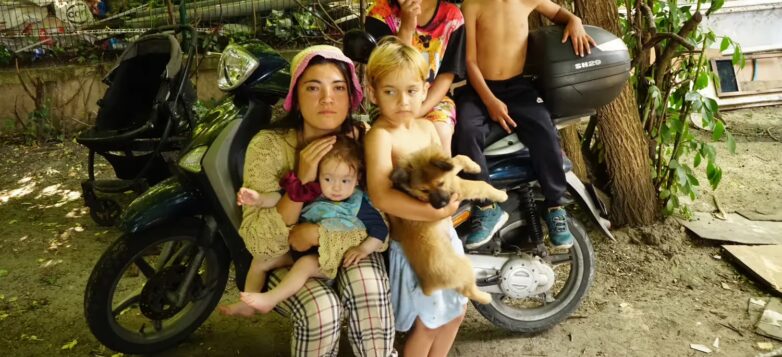
And I came in Paris when I was 17 years old. I wanted to do more artistic practice, and it was easier in France. And I was also very attracted by different cultures that I can meet because in Japan it’s only Japanese, and it’s really hard to meet people that live in the margins. And it’s a politic where we– everybody has to be the same. And so when I came to Paris, I was talking to every [kind of] people that was available for the conversation. And most of them, it was in the streets. So more homeless people or Roma people, but coming from Japan, I didn’t know about the Roma people, so I didn’t know that they were Roma. But, this is how I met the Roma culture.
Well, coming from Japan and being very naive, and just talking to all the people possible, in the street, to learn about other cultures, and also the other way of living. That is the, I would say, the shadow of this modern and capitalist world. So after, I started to stay much more, I– This Roma man that I met, Colin, he was very gay, he was homosexual. And it was really easy for me to stay with him because of this. Because he was very funny and not trying to… not looking for a special relation with me, or… It was just a friend. And he was very generous and bringing me everywhere in Paris. How he was…
Well, the suburb of Paris, and also the Roma camp where he was living. And I never saw a shanty town in my life at this time, so I was super shocked. But also, I was shocked because it was the whole family, families living in the shanty town, and it was a whole organization, and I was– I wanted to know more. Who are they and how they’re organized and… Yeah, what is happening, what is happening there. And I decided to stay in this shanty town and learn the language. So I stayed like, one year and a half with his family.
And actually, I was really in this approach of… At first I was more artistically interested, but after, I wanted to be like them, I wanted to live with them all my life, like, I was super– I don’t know, I think they’re free spirits. And families, I love kids and all the kids were not going to school, so it was really, really alive and I was very attracted by this… Yeah, by… By their being, I think. And yeah, this is how I learned the Romani language.
At the same time, I was in art school in Paris, in Beaux-Arts de Paris, but I didn’t– The first year, I couldn’t go at all, so I… Yeah. And I did again the first year. And at this time I start to film a bit, actually, they give me the camera. They asked me to film a wedding, so I start to film. And after this, I continued to film, and then start to make the editing. So the film wasn’t my first tool, artistic tool. At the time I was a painter, and at this time I started to film. And after this experience, I continued to meet other Roma people because they were… Once I had this language, as a passport, I could connect with all the Roma in the world because, as you know, it’s an international language. Their language.
Like, I went– when I went to Albania, even if I couldn’t speak Albanian, I could connect with the Roma, Albanian Roma, because I was speaking Romani with them. Yeah. So the project in Tirana, it was around… or Albanian Romani people…
Ana Morina: How did you find out about Villa 31 and what really drew you to be part of the residency?
Amie Barouh: It’s someone that… I don’t know, like few people sent me the call for… Yeah.
Ana Morina: And, we’ve been asking all artists a little bit about the house itself, and obviously it’s a bit politically charged, and a lot of people from Albania had negative, some had positive, reactions to it. How was it for you to be there and to sleep there and to kind of exist in this?
Amie Barouh: But to be honest, me, I understood that I was going to Hoxha’s villa like two weeks before I was going there. Like, I didn’t know that it was Enver Hoxha’s house, like, so… Yeah. Me– I sent this project about Roma. And I read an article and I was like, “Actually, it’s going to be in, like, Enver Hoxha’s villa.” And I was like, “Whoa.” I mean, I didn’t, I couldn’t imagine how it would be. We came with a caravan, our caravan, so I was with my dog, my cat, my husband. Yeah. And, we’re living like a family there, bringing all the– yeah, all the family. And the baby in the belly and, you know. And my cat stayed in the villa by the way.
Ana Morina: I met your cat.
Amie Barouh: Yeah.
Ana Morina: Yeah. So maybe if you could tell us the work that you applied with, and then how did it really develop while you were there, or how did it change? And did it affect, this fact that you were in Enver Hoxha’s house, the work itself?
Amie Barouh: Yeah. The project that I applied was about a research with Albanian Roma, because me, I know much more Romanian Roma, or I have some Belarusian Roma. But I never met Albanian Roma and I wanted to know how is the situation there. And actually it’s really interesting because in Albania it’s not at all the same…. the same relation. Like Albanian has other relation with Roma than other people in the world with the Roma. Like, in Romania [there is] is big racism, and and also a history of slavery there. And it’s still the same vision that they have about Roma in Albania. I realized that it was much more mixed. And all people have better image of the Roma, but with racism still, that is not visible. Not… it’s not– it’s a bit more hidden.
I also learned that Enver Hoxha, he was breastfed by a Roma woman. And in his library, in his books collection, he had a lot of books about the Roma. Actually, he was interested to know more about them, their persecution. And during the communism, he wasn’t really putting Roma away. Like all the Roma to whom I spoke, they were telling me that it was a good time, Hoxha’s time. And they were more with the family making a lot of music, help, a big help between the Albanians and the Roma people. Yeah.
So they had more kind of a nostalgia about this time. And the capitalism is more hard for them because all the kids went to other countries, and the culture is just disappearing super fast. Nobody is doing the work that they were doing at the time, nobody’s doing music anymore. So, yeah, it’s not just the… Yeah, it’s the whole Roma culture that is disappearing with the capitalism actually. It is the same– I mean, it’s not just an isolated case, but it’s really clear in this case in Albania.
Ana Morina: Yeah, it is very similar here in Kosovo. When I talk to some Roma people, they say that during Yugoslavia, for them it was way more freer and they didn’t really see the difference that much, or understand, or take notice, especially the kids. And then once the 90s hit here, then it was– they had to choose whether they were on the Albanian or the Serbian side, it was very much like, “You have to be one or the other.” And that’s not what they were really taught to do growing up. But maybe, can you tell us a little bit, like, what was your main focus when you were approaching them? Like, what did you want to learn mostly about? You said that you asked them about the difference on communist, post-communist time, but you also worked with Gimi Fortuna.
Amie Barouh: Yeah.
Ana Morina: Can you tell me a bit about that?
Amie Barouh: Yeah, yeah. So, when I arrived in Villa 31, I contacted the only name and contact that I had, it was this Gimi Fortuna. And he’s an activist, Roma activist with… He’s living in the suburb of Tirana, and he has this space that he calls “kindergarten,” where he’s making activities for Roma kids in the hood around his house. It’s a Roma and Egyptian quartier (neighborhood). And so he’s maybe 70 years old, something like this, or late 60, and a bit tired.
But at the time, in the early 2000… He was– it was really active and he gave education to maybe, like, when we talk to other Roma young people, kids that are now with a job or that is more in the society, they had their education at Gimi’sschool. So in the beginning of the 2000 years, his association Romani Baxt was super active and he had a lot of kids coming to learn Albanian, mathematics, and also Romani language. They were doing a lot of activities, a theater, or dance music. Actually, all the kids were coming and Gimi was saying, was asking them, “What do you want to do?” And he was doing what they wanted to do. Like, if they wanted to make more theater, they were doing theater, and it was a really free space of learning, and sharing, and transmission also of the culture.
And yeah. Me, when I met him, with Bogdan, my husband– My husband is also speaking Romanes, because he’s quarter Roma. He’s a musician. So he also really connected well with Gimi. And we did the whole residency together. So Gimi, he gave me, like, more than 100 cassettes, tapes, 100 tapes of MiniDV, archive of his activities that he was making at the time. And that’s why I know more, like…yeah, what kind of activities they were making, and so this became my project: to digitalize all his cassettes and make a film.
And Bogdan, he also met a lot of musicians, Roma musicians, with whom he made a concert performance at the Villa 31. We also organized the Roma Day, which was the 8th of April. It’s the day of the remembrance of the persecutions. And yeah, we could make it in Villa 31. So it was very important to make it there. And also for the Roma people, it was… Yeah, it was symbolically very beautiful for them to come into the Hoxha villa, and to perform, and to speak about the situation of the Roma in Albania. It was a lot of activists also there. So, yeah, this was our project in Albania, and I am continuing the project now with his archives.
Ana Morina: So for the people who weren’t there, there was a film being shown at the villa, and you did the day, the Roma day with the performances and the talks. Yeah?
Amie Barouh: Yeah. So the film that I showed in the villa, it was his archives, the archives of Gimi in… I didn’t make any editing. So it was just… Yeah, a fluid, like continued, how you call it?
Diona Budima: A loop.
Amie Barouh: It was an installation in the caravan with two old TVs because, yeah, it was this square format. And yeah, I chose some moments of the cassettes that were interesting, and… I didn’t have time to really get in the editing, like… Yeah. I’m still–
Ana Morina: Can you tell us a little bit about which parts did you choose, and what are they, like, what happened in the archives?
Amie Barouh: Okay. I chose… There was a part of transmission of knowledge. It was, how we– I don’t know how we call it, but this… Ah, if you can help me.
[The video was interrupted here]
Amie Barouh: Wicker basket? Like, it’s a basket, but made… A basket made by leaves, you know, these very long leaves, and they make baskets. I don’t know if you… But this is something that also the French Roma, they’re making it. And so I found this video where they were cutting the leaves, waiting to be dried, and then showing to kids how to make this basket. And he is speaking in Romanese to all the kids. And so I chose this moment. Also, I saw a lot of kids learning music and playing them very beautifully, and making, at the end, a festival. Some of them are singing, playing accordion, violin, others are dancing, like it was a whole really beautiful festival with, only with kids, all ages. And also, some moment it was the adults making a party, and like, I would say half of the cassette it’s party and music. Yeah.
And this kind of music that now is not the same, now it’s more tallava and, you know, it’s other, it changed a bit. And yeah, it’s really beautiful music that they have. I don’t know the name exactly, but, yeah, like typical Roma music, or maybe it’s also Albanian culture. But anyway. Yeah, the music is super beautiful, and yeah. I chose also some moment of when they were learning courses, different courses, and I also found the, how we call him, Edi Rama? Edi Rama, like 20 years ago with all the kids making, like, music. He was playing accordion with the Roma kids, and yeah.
Ana Morina: The caravan didn’t just stay in front of the villa, it also traveled through the villages, if I’m correct.
Amie Barouh: It was the idea, but we saw how the roads are, and it was a bit risky. So at the end, we didn’t really go with the caravan like we wanted to go, but we just took the car, like– and we– So Gimi, he– it was a real connection that we had with him. And he brought us everywhere, everywhere around Albania. More next to Tirana, but all the villages where he knew people that could be interesting for us. He was here for us every day, like, and taking this project very seriously. So it’s really a collaboration, even for the Roma day, for– Yeah. After we want to Durrës to make a performance. The whole project, it was me, Gimi, and Bogdan. Yeah.
Ana Morina: in these travels, did you also film? And did you do interviews, or…? There was a part in the statement where it says that you ask children about dreams and kind of to connect with these archives.
Amie Barouh: Yeah, it was the project, but this didn’t happen, actually. We wanted to, and we didn’t ask for dreams. We just did interviews with people, but it was adults that had more [to say] about the communism, and post communism, and yeah. In this part, of dreams, it was the idea, maybe we will make it later, but we couldn’t make it.
Ana Morina: So, that is maybe now the future of the project? It’s that you’re going to take these interviews and show them as well, because were they shown at Villa?
Amie Barouh: Yeah. I would like to work more on the archives and for the interviews, and see how– which form it will take because actually, I… When I make films, it’s always very impressionist, like experimental. I don’t know how to say, it’s… I don’t tell stories with a clear storyline and I don’t make this kind of documentary that are very… Yeah, easy storyline. I like to– it’s more impressionist. This is how I like to make editing because… Yeah, I try to be very honest with my feelings, what I felt when I was there, and what I saw and… Yeah. So yeah, it will take– I don’t know what form it will take, but I have to work more on the images and… Yeah.
Ana Morina: You were speaking a little bit about the fact that a lot of young people are moving out and that it’s not really the same with the singing, and the traditions, and the rituals that they have. Did you try and maybe film these things specifically so that they remain, and maybe is this your approach in general when you deal with minorities?
Amie Barouh: We went to a village where it was a lot of musicians, and this is the only time I saw young…
Diona Budima: [inaudible 30:57]
Amie Barouh: Yes, [inaudible 31:00] yeah, yeah. And… Yeah, so in this village, we met a lot of musicians, and they performed us really traditional Roma songs, like Albanian Roma songs. And we also met these young musicians, and I filmed them, and I also… Yeah, we wanted, actually, if we wanted to make a studio there, because this is what they said that they need. They need a place where they can play, meet, and show to more kids, in order to teach them music. After, I also– we went to a place near Durrës, and there was this mother that told me a lot of stories, like, how to say, like what their grandparents were telling when– At the time, before there was TVs and telephones, they were telling stories at night, around the fire. And this woman, she knew a lot of stories like this, which is also part of the culture.
And that is really disappearing. It is like the oral… yeah, oral stories. And we call it like this, no?
Ana Morina: Yeah.
Amie Barouh: Yeah. So it was really important because me, I always ask some Roma in Romania or in France, “Can you tell me some old stories that you heard from your grandmother?” and nobody knows. They forget it very, very quickly. And this woman, she really knew, like stories of one hour, and yeah. So it was very important for me to film her, and yeah.
Ana Morina: In oral history also, when kind of– through my experience, I understood that exactly when they talk about either their dreams, or their hopes, or these childhood stories, that that’s actually the cultural heritage that’s being preserved. So, yeah, I find a lot of importance. But here in Kosovo as well, I understood that Roma people from, even from different cities, they speak different dialects and they kind of feel very separated from each other, although we, maybe we see them very much, like, the same. Did you find that as well in Albania? That throughout Albania they had a lot of differences, or maybe even in comparison to France?
Amie Barouh: Yes. So what we realized is that some of them speak more Roma and some of them mix a lot of Albanian. And this is the… For us, this is the difference. Me, I learned Roma with Romanians, so there is a lot of Romanian words when I speak Romanes. And for example, Gimi, because he knows very well this language, he was speaking more pure Roma, and other people, they were mixing a lot of Albanian, actually. So it was another– like another language, but we could still understand each other. But it’s a bit hard, but yeah. Other than this, I don’t… I don’t know. Like in Romania also, it’s different depending [on] the cities, they will say differently the same thing and have a bit of accent, but, yeah, it’s still understandable I think.
When we want, we can understand, like… But if they’re already a bit separated, and like a clan, and they don’t want to understand each other, yeah, they won’t, but yeah, because we’re foreigners and all, and we don’t have any connection with one family or the other… Yeah.
Ana Morina: Okay. Maybe for the end, you can tell us, what do you have next going, now? You said you were going to go a bit deeper into these archives, but are you working on anything else or…?
Amie Barouh: Yeah, actually, this story of dreams, it’s really my– connected to all my work. This project, that I didn’t do, but I wanted to do in Albania with interviewing the kids about their dreams, it is really connected with my work now because I am… Look, all my work is about the invisible parts of the reality, and it’s about this border that we have between reality and imagination, or what is true, what is false, what we see, what we can’t see, what we call real, and… Yeah. So in…
Ana Morina: Do you see archives in these borders or more towards reality?
Amie Barouh: Archives, for me it’s interesting because it’s speaking about the past, and when I work with these dreams, the past is also the present. And I like to mix the time, the places. And that’s why, also, it’s not a story line that is very classic because I like to pass through all the… Yeah, different place and time, to get to somewhere that is actually in this border of reality, and imagination and… Yeah, what is finished, but, actually, it’s still here, and… Yeah, to not really make difference between past and present, or spiritual and, and… And reality, like…