Part Two
Ajet Duli: Let me return to when I started working. In ’76–’77 I was a teacher at the elementary school Zenel Hajdini in Topallë, and I worked there for one year, three months, and 25 days. That is the amount of work experience I had when I started in Topallë.
Anita Susuri: Did you travel continuously to Topallë from Pristina, or how was it?
Ajet Duli: No, I lived with my uncles in Topallë. I stayed with an aunt and an uncle. In the meantime, I was called up and went to the army. In ’78 I was a soldier in Ohrid, and after six months I went to Strumica. I held the rank of sailor. In Serbian they called it desetar; in Albanian, sailor. I served in Macedonia, and there I saw what injustices and what anti-Albanian policies were being carried out. At that time I was 26–27 years old, already mature enough to notice those phenomena. But any small gesture an Albanian made, they would, as the saying goes, turn a fly into a buffalo.
In Strumica, one time I served with Astrit Bardhi. Astrit had a master’s degree in mathematics. I kept company with him there in Strumica. As I said, I was a squad leader, and one day I took Astrit and went out with him into the city because I had the right to enter and leave; I had that permit. But as always, someone had informed the officer that I had gone into town with a soldier. They sent the military police, took both me and Astrit, and put us in jail. The first time I was ever in jail was in Strumica as a soldier. Why? Because I had taken a soldier into town. There was nothing wrong with it, but it was a way of expressing their chauvinism.
And there were military superiors who truly did not want to see us with their eyes; if they could, they would have erased us. There in ’78, it was as if my hatred toward Yugoslavia was born. As a soldier, I saw the injustices and the extreme discrimination against Albanians. After I finished the army, I returned to Pristina. It was summer, I had nothing to do, so I boarded a train through Belgrade and went to Zurich. When I arrived in Zurich, it was Friday evening. When I went out into the city, I met some fellow villagers of mine, one of them Rrahim Doda, and they found me a job. I worked in a café in Birmensdorf, about four kilometers from Zurich, for about two months.
Meanwhile, I had applied to the school Zenel Hajdini in Pristina. They informed me that I had been accepted, and on September 1, 1978, I began teaching at the Zenel Hajdini school in Pristina. It is not good for a person to speak highly of himself, but it is the reality: I was very, very dedicated and worked extraordinarily hard with the students, especially with the class where I was the homeroom teacher. We organized extra lessons in mathematics, physics, and chemistry outside regular school hours. We organized performances and various plays with my class.
I remember once the principal called me in. “Ajet, what are you doing?” “Well, we are doing some activities with the students.” “Hey,” he said, “what subject do you teach?” “Chemistry,” because at that time at Zenel Hajdini I taught only chemistry. There were eleven classes, and I taught chemistry to all eleven. We had two chemistry lessons per week. He said, “Why are you dealing with those things? The language teachers are responsible for organizing activities, not you.” I said, “What harm am I doing?” “No, no, you should focus on your own field.” I had caught their attention, you know (laughs). At the Zenel Hajdini school there were some teachers and staff members who were extraordinary. We simply worked, communicated among ourselves, and exchanged literature.
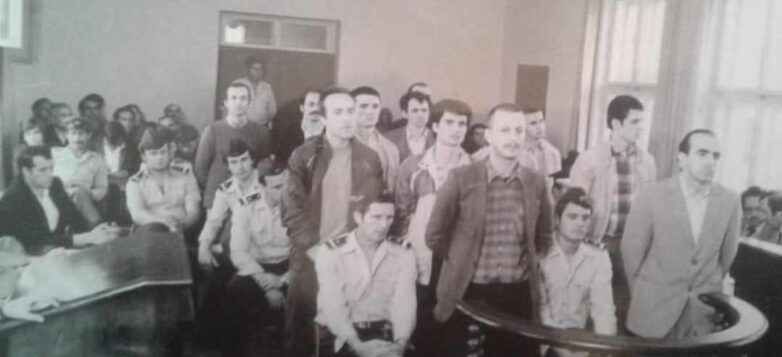
There was Xhevdet Syla, who also ended up in prison. Four years… in fact, I replaced him at Zenel Hajdini. When he was arrested, I took over his classes. I worked mornings and afternoons until a new teacher was hired. After him there was also Vehbi Bajrami, who taught biology. He too was imprisoned. I was the third person from the Zenel Hajdini school to be arrested, on January 18, 1984.
Anita Susuri: Was this the time when you had begun your activities?
Ajet Duli: I had begun my activities earlier. The organizing and meetings with friends took place during the 1980s, and especially after 1981 the movement took on much larger dimensions.
Anita Susuri: How did it begin for you, for example? Who guided you, or were you one of the organizers?
Ajet Duli: Well, in our group I had a neighbor and friend, Remzi Bunjaku. He knew Kadri, Kadri Mani. At that time he was called Kadri Osmani; later he became Kadri Mani and changed his surname a bit. He had been a political prisoner. When Kadri came to Remzi’s place, Remzi called me, and we went and met Kadri Osmani. Then, together with Kadri and Remzi, we began our activities. We had literature, we read, we created a kind of organization, and we took it as our duty to recruit new supporters into the organization.
Anita Susuri: How was it organized? Did you have a particular place where you met, or did you change locations?
Ajet Duli: We met in our homes, and we also arranged meetings in Taukbashçe, or in Germia, or up there at my house. We would meet and talk.
Anita Susuri: And how was the organization structured? Did you have any written text or rules?
Ajet Duli: Yes, we did. We had rules, we had a text, and we had an oath. We swore before the flag and before photographs, like that.
Anita Susuri: Which photographs, for example? Skanderbeg?
Ajet Duli: Yes, of Gjergj Kastrioti Skanderbeg. Some had photographs of Adem Demaçi, some of others, that’s it…
Anita Susuri: Of those who were active.
Ajet Duli: Yes, those who had been active, and also former political prisoners.
Anita Susuri: And these texts, for example, and the obligations—what kind of text was it, what sort of content did they have more specifically?
Ajet Duli: Well now, I do not remember the exact text of the oath, you know? But it was something like: “I swear that I will work, that I will dedicate myself, and if I betray, may our blood never forgive me,” something like that. I remember one occasion when Kadri Osmani, when I agreed to become a member of the organization, told me, “Do you know,” he said, “that you have to die seven times and rise an eighth time to become a member?” he said, “if you think it is easy to become one,” because he had experience. I said, “Even eight times, eight times I will be a member,” I said, “and I will work with dedication in this direction.”
Anita Susuri: And what were, for example, the criteria for being part of the organization? Did they investigate you?
Ajet Duli: Yes, certainly. For example, they would inquire, they would find out what kind of person he was, what he did, whether he was dedicated, that is how it was.
Anita Susuri: For example, how long would a person be observed before becoming part of it?
Ajet Duli: I do not know how long exactly, but mainly in meetings and through conversations with people they would ask, “What is he like? What kind of behavior does he have? Has he been problematic? Is he moral or immoral?” Especially questions of morality, we gave them great importance. I remember once Kadri asked me about someone, “What is the matter with so-and-so?” I said, “Well, he is a good, hardworking young man and everything, but he is a bit immoral.” “Ah,” he said, “if he is immoral, then we have nothing more to discuss,” he said, “because if he betrays his own family and his own wife,” he said, “he will betray us too.” That is how it was.
Anita Susuri: And these texts surely had content about the position of Albanians…
Ajet Duli: We had the newspapers Zëri i Kosovës [The Voice of Kosovo] and Çlirimi [Liberation] and two or three other illegal newspapers that came from abroad, and we distributed them to members and to the sympathizers we had.
Anita Susuri: Did they come from Albania or from somewhere else abroad?
Ajet Duli: No, from the West, from the West.
Anita Susuri: And how was that…
Ajet Duli: From Switzerland.
Anita Susuri: That network…were there people involved in a network?
Ajet Duli: All of them were people in a network who brought them, distributed them, read them, and passed them among themselves.
Anita Susuri: And who, for example, financed them, who printed them?
Ajet Duli: I do not know who in the West financed them. But here, for example, writings would be sent from Kosovo, people would take them, publish them, and then distribute them.
Anita Susuri: And in Kosovo itself, there was no printing of them?
Ajet Duli: The press at that time was only Rilindja as a newspaper.
Anita Susuri: I mean your texts, were they not printed?
Ajet Duli: Ah no, those were illegal. The entire activity was carried out illegally.
Anita Susuri: Did you have any writings yourself, for example? Because you told me that you were inclined toward writing…
Ajet Duli: No, I did not. I had no writings of my own.
Anita Susuri: Besides distributing these newspapers, was there any other activity?
Ajet Duli: As I mentioned earlier, our organization had formed headquarters, operational headquarters, and assigned each of us duties. As I told you before, for the first time they gave me the rank of captain. My task was to form a group of three people and continue the activity…
Anita Susuri: You also said that you were called the party of war…
Ajet Duli: Yes, because we formed those operational headquarters and regional headquarters. That is why they called us the party of war.
Anita Susuri: You were telling me about the party of war.
Ajet Duli: Yes, it was called the party of war because headquarters were formed for the first time, and a military organization was envisaged, because we were convinced that Kosovo could not be liberated except through a military organization. Then some of us were given ranks, while at that time we had proclaimed Adem Demaçi a marshal. He was in prison at that time, but our organization awarded him the rank of marshal.
Anita Susuri: You said that there were around fourteen people in groups?
Ajet Duli: Yes. In our group, at that time there were more than one hundred of us throughout Pristina, but we were divided into different groups. In our particular group there were fourteen people: Kadri Osmani, Enver Topalli, Ramë Buja, Raif Qelaj, Nexhmedin Gërguri, Abdullah Rrustolli, Remzi Bunjaku, Rrahim Rama, Agim Dishi, Ibush Dishi, and one Mahmut, his surname was Mahmuti, in fact he was later appointed ambassador in Switzerland and then in Macedonia after the war. Mahmut Ibrahimi, that is the name that just came to me now, Mahmut Ibrahimi.
Anita Susuri: And now, how did the party go about forming those headquarters? How was the organization carried out to establish them?
Ajet Duli: When I met Kadri Osmani, he told me, “We will extend the organization throughout all of Kosovo, and also outside Kosovo.” Since I was originally from Medvegja, he said, “We also need to include that area and have members of the movement there.” They assigned me the task of organizing and finding people from the municipality of Medvegja who were devoted to the national cause.
Anita Susuri: I asked you this earlier, but I am asking again so that it is documented…
Ajet Duli: Yes.
Anita Susuri: You said that only a small group remained, because there had been many people who were members…
Ajet Duli: In Medvegja there?
Anita Susuri: Yes, in Medvegja, in that area.
Ajet Duli: Yes, in those 12–13 villages that are Albanian there, there were more than eight thousand Albanians during the 1980s when I worked there. There were two fifth grades, two sixth grades, two seventh grades, and two eighth grades just in Topallë. The same was true in Banja e Sijarinës, but in Banja e Sijarinës there were both Serbs and Albanians. One class was Albanian, one class was Serbian. But the number of Albanian students kept increasing continuously, because in those villages where the Serbs had lived, they sold [their properties], and mostly Albanians bought them, while the Serbs went down to Niš, Kragujevac, and Smederevo.
But when the war in Kosovo began, the paramilitaries and military forces returned. They were mainly stationed around the border with Kosovo and began putting pressure on the Albanian population there. Most of them moved away. Today they are in Fushë Kosovë and in Pristina, some in Kamenica and some in Gjilan. Only in recent times, especially since 2015 onward, the deregistration of the Albanian population began. Even though they are there, there are people who never left, never moved away from their village or from Medvegja, and yet they were removed from the records with a specific purpose: to reduce the number of voters. In that context, Vučić said, “There are no more than four or five percent Albanians in the municipality of Medvegja.” But in reality, more than 35 percent of the municipality’s population had been Albanian.
In 2015 there were extraordinary elections in Medvegja on September 13. Through the club Trojet, of which I was a member, we organized ourselves, and in fact I was the initiator of unifying the political groups in the municipality of Medvegja. I called together all the representatives of the political parties that existed in Medvegja, spoke with them, and insisted that we create a unification of the Albanians of Medvegja. Although we did not succeed in creating that unification, the organization remained, and then a kind of competition emerged among them over who would win.
In 2015 we had eight Albanian municipal candidates in Medvegja, and even though in Mutivodë the police and gendarmerie came out and stopped the voters and did not allow them to go vote, there were ten buses organized from Kosovo to go to Topallë, Medvegja, and Svircë and vote. Nevertheless, if they had allowed people to go, we would have emerged as the party with the largest number of votes in the municipality of Medvegja.
Anita Susuri: Let me go back a bit. You said that you also had the task of organizing members or finding people in Medvegja…
Ajet Duli: Yes, yes.
Anita Susuri: Was it, I mean, a large group of these activists?
Ajet Duli: It was still in the process of being formed, and one had to be very careful, because working illegally and not being discovered… it only took, for example, one word leaking somewhere, or something similar, for the organization to be exposed. Then the security service also became active; it had people whom it infiltrated among the underground activists, and that is how we were discovered.
Anita Susuri: And was there a case when you personally either saw or heard that a person, so to speak, was a spy within your group?
Ajet Duli: Yes. At that time, I do not know if you remember, no, you are too young: in 1984, someone named Xhevdet, I do not remember his surname now, had penetrated the organization. It was suspected that he had been infiltrated. And Bajram Baftiri was a member of our movement. He went to that man’s house, Bajram killed him, and then fled. The police surrounded Kodra e Trimave and killed Bajram Baftiri as well…
Anita Susuri: What year was that?
Ajet Duli: 1984. Yes.
Anita Susuri: You surely had rules on how to protect yourselves, for example? To avoid falling into the hands of the police or attracting attention.
Ajet Duli: Yes, yes. Everyone knew his own methods, knew how to work and act, but the main thing was not to expose oneself. And I tried not to expose myself. But someone else, somewhere, words leaked out. What is important is that on January 16 [1984], Rrahim Rama was arrested; on January 17, Remzi Bunjaku was arrested; on January 18, I was arrested. With me, it stopped.
Anita Susuri: Are you saying that, for example, they talked?
Ajet Duli: Well, I cannot say for sure, I do not know how things happened. But I do know for myself that they put a lot of pressure on me afterward to make me reveal…
Anita Susuri: The others.
Ajet Duli: We worked according to the rule of threes. Under that rule, each person had to find two others, then those two would each find two more, and in that way the number would grow.
Anita Susuri: So, for example, you did not know who the other members were?
Ajet Duli: No, no… only… for example, I had meetings with Kadri Osmani and Remzi Bunjaku. Then, in order to increase the numbers…There were many people, I told many of them that at first we gave them those newspapers as a way to start a conversation, to talk, to explain things, to see their attitude, and that was the beginning of our work.
Anita Susuri: And then how did it continue?
Ajet Duli: It continued until we were discovered and ended up in prison. We were exposed, we were imprisoned. They sentenced us.
Anita Susuri: First, I would like to stop a little at 1981…
Ajet Duli: Yes.
Anita Susuri: At the demonstrations, because that is important…
Ajet Duli: Yes.
Anita Susuri: I do not know whether you were aware beforehand that the demonstrations would happen, whether you had heard anything, or how it was.
Ajet Duli: Listen, we took part in the demonstrations together with our brothers and sisters. Well, with one sister in particular. She was at the Faculty of Economics, and all of us participated. I remember one demonstration when they arrested my brother Ramiz and my nephew Rexhep, my brother’s son. They took them to jail, where the main police headquarters was, at the place they called the 92.
Anita Susuri: Yes.
Ajet Duli: They took them to jail. At that time, my friend Bajram Tmava was the Director of the Kosovo Police. During the questioning, when he saw my brother and my nephew, he quietly escorted them out and said, “Leave, and do not get involved in things like this again.” But the demonstrations were always very massive. The dissatisfaction of the people was very great. Yet there were, so to speak, two camps. Some people were satisfied with the government because they had certain privileges, had gained positions and benefits. But the broad masses were mainly dissatisfied. They joined the demonstrations.
Anita Susuri: Do you remember, for example, surely you do, the details, or what you yourself saw? What kind of violence was there?
Ajet Duli: Of course I remember. The violence consisted especially of tear gas; it was very intense. When they threw it at us, the crowd was so large that people had to jump over one another while running away because we could not breathe.
Anita Susuri: For example, did you see anyone being beaten there, or killed?
Ajet Duli: I did not see anyone killed, but beaten, of course. Every demonstration was accompanied by tear gas, beatings, and so on.
Anita Susuri: And what was the atmosphere in the city like at that time? I suppose it was very tense.
Ajet Duli: Yes.
Anita Susuri: What were the circumstances like? For example, was there any destruction of buildings in the city, or was it only the police and the population in conflict?
Ajet Duli: Mainly the police and the population, that is, the demonstrators. There was not much destruction during the demonstrations. They were mostly peaceful, but in the end they always turned into violent demonstrations because the police intervened and dispersed the demonstrators by force.
Anita Susuri: After these demonstrations there was also, so to speak, a political purge. Many people were removed from their jobs…
Ajet Duli: Yes, after 1981 the purge began. It took place in every organization, every school, every institution. Especially targeted were educational institutions, particularly the Albanological Institute and the Institute of History, and people who, to one degree or another, were nationally conscious. There was pressure and a purge unlike anything seen before.
Anita Susuri: Did it happen to you?
Ajet Duli: Not to me. But it did happen at our school, Zenel Hajdini. People from the Committee [of the league of Communists] came there to carry out the purge. They mentioned a few names, but nothing further happened.
Anita Susuri: You probably also tried not to stand out too much or attract attention because of your activities.
Ajet Duli: It is true that I was perhaps very reserved. I never exposed myself. I worked extraordinarily hard with students, and I remember that I always encouraged each graduating eighth-grade class to enroll in the Yugoslav Army. The reason was that they would receive training there, and whenever the opportunity arose, those who completed military schools later joined the Kosovo Liberation Army.
Anita Susuri: They gained expertise there…
Ajet Duli: Yes.
Anita Susuri: And then used it.
Ajet Duli: There was a man named Bilall Syla, from my native village of Gurboc. He had been a student at the Zenel Hajdini school, not my student, but he had been taught by Xhevdet Syla. Bilall went to military school, completed it, and later became one of the organizers of Operation Arrow [Shigjeta]. There were many others as well. Zymer Halimi, another fellow villager of mine, was also a military man. He served in the Shala Operational Zone, where he was commander of a brigade or something similar.
Anita Susuri: You told me that when you were arrested, you were the fourth or fifth person from the group.
Ajet Duli: The third.
Anita Susuri: The third.
Ajet Duli: Yes. The third one arrested.
Anita Susuri: Do you have any idea how they managed to discover you? Any suspicion?
Ajet Duli: Yes, they were certainly following Kadri [Osmani] and Kadri’s daughter [Hidajete], watching where they went and whom they contacted. I remember one time Kadri’s daughter came to visit. I left the house and went out onto the street. As soon as I stepped outside, there was the police. They asked me, “Do you have a match around here? Do you have a match?” There was no match at all. And also, about ten days before I was arrested, this was after Rexhep Malaand Nuhi Berisha had been killed on January 11, 1984, that was when the surveillance and monitoring of us began. I assume they had information that we were in contact with something.
In 1984 there was heavy snow and bitter cold during those days. People disguised and wrapped up in clothing constantly moved around near my house. I even remember my father saying, “Who are these people all wrapped up like this? What is going on?” I said, “Father, do not concern yourself with them. Do not concern yourself,” I said, “because you should not get involved with them.”
Anita Susuri: And your family surely knew that…
Ajet Duli: No, they did not know. My wife did not know until I was arrested. We even concealed things from our family so as not to put them in a difficult position. As I told you, my wife’s brother was in the police and at that time he was Director of the Kosovo Police. For security matters there was Rrahman Morina, while Bajram Tmava was responsible for public affairs in Kosovo.