By Anna Di Lellio, Korab Krasniqi, and Anita Susuri.
Last October, we sat down with Dušan Janjić in Belgrade to discuss his life as a Yugoslav intellectual and politician, his personal connection to Kosovo, where his father was born, and his involvement in Kosovo affairs. In 1990, he worked for the Federal Central Committee of the League of Communists, with Kosovo as part of his portfolio. We asked him about the infamous poisoning of Albanian schoolchildren that year, despite the fact that he had resigned from his position around the same time. More than three decades later, his view is blunt: “The Serbian authorities organized it; their intention was to encourage segregation.”
Janjić flatly rejects the official Serbian position, which holds that Albanian students either faked their symptoms in a stunt orchestrated by separatists, or at best suffered a case of “mass hysteria.” Albanians have always argued the poisonings were the result of a deliberate chemical attack by the Serbian state, a view recently reaffirmed in a book by Luljeta Pula-Beqiri, and at a forum organized by the Institute for Crimes Committed during the War in Kosovo (IKKL). Janjić told us that a chemical substance had indeed been used, explaining that “the substance had been placed in a classroom, smeared onto the curtains, and that its fumes then produced those unpleasant effects, irritation and vomiting.”
According to Janjić, he was told directly never to mention it when he raised the issue with members of the intelligence community during a visit to Israel. Instead, he committed to fighting against school segregation through his organization, the Forum on Ethnic Relations. Janjić rejects the core claims of both Serbian and Albanian narratives, disputing the assertions that the whole event was either staged or orchestrated as an attack by the state. He argues that the covert operation explains the incidents reported during the first two days. Subsequent cases are better understood as a psychological phenomenon. In his view, this interpretation does not minimize the significance of the event: rather, it draws attention to its social and political causes.
As oral historians, we took the challenge of investigating the hypothesis he puts forward very seriously, seeking to move beyond the two dominant, competing narratives surrounding the event. So entrenched and diverging were those interpretations, that on the eve of the 1998-1999 war, human rights scholar Julie Mertus labeled them the “two truths” underpinning the enmity between Serbs and Albanians. Since then, the framework of the “two truths” has become a dominant lens through which Kosovo’s historical memories are analyzed, reducing complex historical controversies to binary oppositions and freezing the debate.
Oral history is uniquely suited to moving past this impasse. Rather than claiming to reveal “the one truth” that must be accepted by everybody, it draws on a multiplicity of sources, particularly life-story interviews, to challenge binary interpretations, helps establish a plausible account of the event, and situates it within a broader temporal frame, recognizing that no event occurs in isolation. We began by talking with those directly involved.
In 1990, as a first-year student at the Mitrovica gymnasium, Mirlinda Idrizi Nuredini struggled to return to school after the winter break: “Before we could enter the school, without any warning, they locked it. Then, later, they changed the schedule: Serbs went in the morning, Albanians at midday.” One of eight children of a Trepca miner, she grew up in a large family crammed into a two-room company-apartment in Northern Mitrovica. During her primary school years, she had socialized with Serbian children, participating in sports activities and field trips to Serbia. She spoke fluent Serbian and could read Cyrillic.
By early 1990, however, Kosovo’s entire school system had been paralyzed by strikes. Serbian students, backed by the authorities, claimed they felt unsafe and demanded separate classes and dormitories. On March 5, following a visit to Belgrade by a delegation of 600 Serbian schoolchildren, Belgrade decided to move Serbo-Croatian classes to the morning shift.
At that time, Kosovo was under a regime of martial law, enforced by stationed federal troops as well as special police units. A widespread campaign of peaceful resistance against the revocation of Kosovo’s autonomy, led by striking miners of the Trepca enterprise, had been suppressed. The police had killed scores of Albanian protesters. Slobodan Milošević, then President of Serbia, announced that thousands of Serbs would soon move to Kosovo alongside the troops to alter its demographic balance.
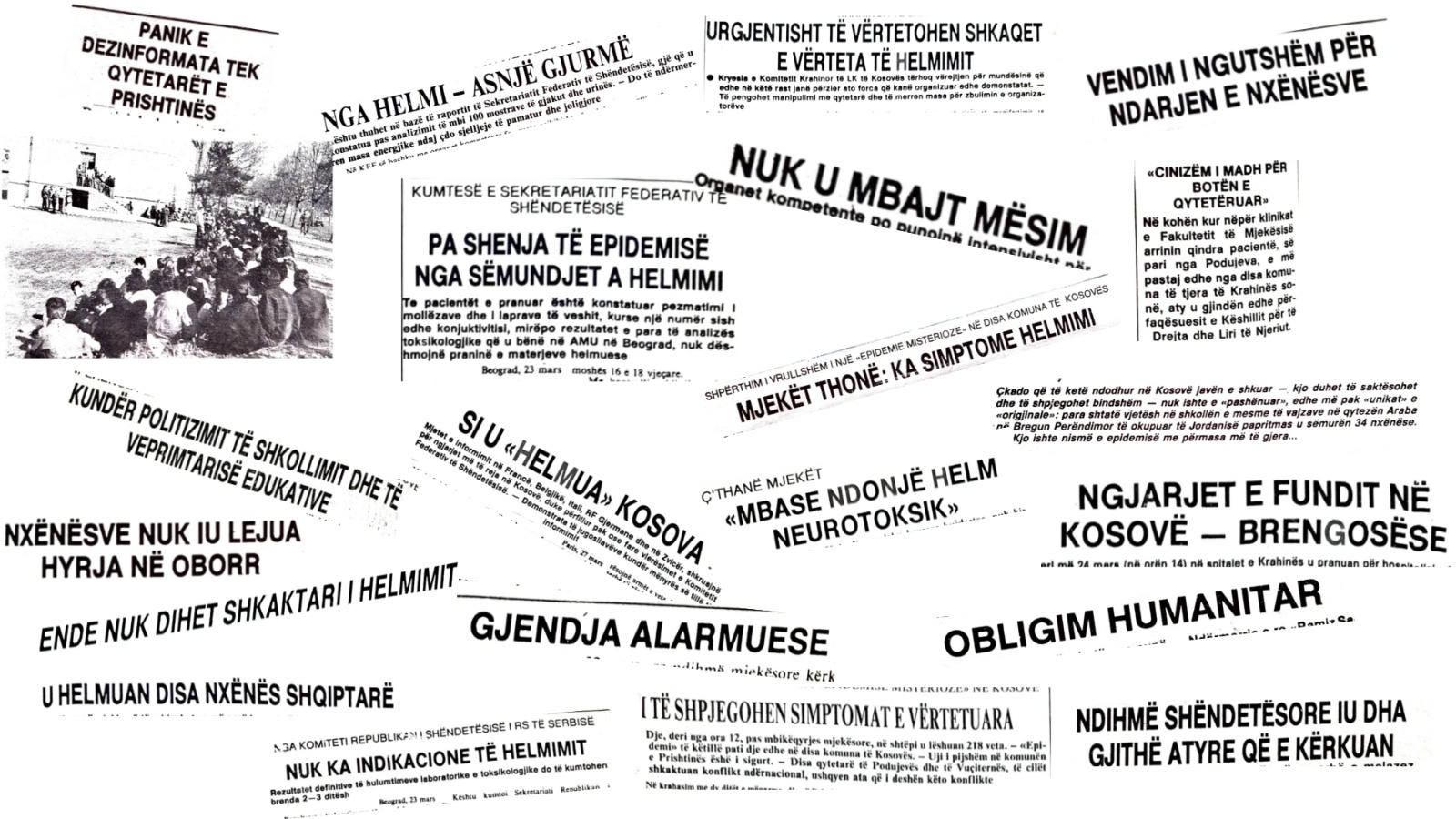
As an ordinary teenager, Mirlinda had little political awareness but was acutely sensitive to the anxiety of the adults around her. Her older sister Valdete Idrizi recalls a pervasive sense of fear: “You didn’t actually know where it was coming from, we were so confused, we simply didn’t know what was happening.” Against this backdrop, on March 19, news in the state media reported that some Albanian students in Podujevo had fallen sick after smelling an unpleasant odor. Similar symptoms were subsequently reported among thousands of students across Kosovo, and the story made the front page of the newspaper Rilindja.
In Mitrovica, Mirlinda saw scores of her classmates suddenly convulsing and screaming in the throes of seizures. Initially unaffected, she helped parents who had rushed to the school to take their children to the hospital, until she, too, began experiencing symptoms: “It was horrific because the pain was indescribable. It would begin in the toes, then the stomach, the eyes… until you lost consciousness and then you didn’t know anything anymore.” In Prishtina, Drita Simnica witnessed half of her class experience what she thought to be epileptic seizures.
Panic and chaos gripped the schools as teachers rushed to take affected students to the hospital. In Skenderaj, Xhafer Ismaili’s car “never stopped,” and Vehbi Xani earned the nickname “mule” for his incessant trips. In Gjilan, Gjylshen Doko Berisha laid ill students in the hallway: “I was not in the medical profession, but I tried to put my hand into their mouths so their tongues would not fall back and suffocate them.”
Panic and chaos also spread among parents, who suspected that the water had been poisoned and began withdrawing their children from school en masse. At home in Prishtina, “We watched the news on TV,” says Linda Gusia, who was twelve at that time, “and there was this constant fear that we might smell some kind of odor, that someone might not be feeling well that day.” Meanwhile, parents of affected children crowded the hospital halls and yards in panic, where they were confronted by police who tried to clear the premises of everyone, including the patients.
Doctors and nurses were perhaps the most bewildered of all. Dr. Mahir Morina, an ear, nose and throat specialist in Peja, felt overwhelmed by the sudden influx of patients flooding the hospital. At first all doctors participated in treating the affected students , but the Serbian doctors, with one exception, quickly distanced from their care. In one incident, Dr. Zoran Bošković, a neuropsychiatrist in Mitrovica, attempted to administer antipsychotic medication to the young patients and threatened to send them to the psychiatric institution in Shtime, prompting Dr. Faik Bllata to confront him publicly. More commonly, Serbian doctors dismissed patients’ symptoms as fabricated. Dr Morina disagreed: “It was clear that they were in a bad state, that they weren’t pretending.” But since neither he nor anybody else could determine the cause of their illness, they were left with administering intra venous fluids or sedatives for lack of a better idea.
On March 24, Serbian authorities established that no traces of chemical poisoning had been detected in water, food, or blood samples collected from Kosovo and examined by the Military Medical Academy in Belgrade. By mid-April, a Yugoslav Federal Commission investigating the crisis concluded that it had been a psychogenic phenomenon, or mass hysteria. According to the Serbian newspaper Politika, the incident was a provocation staged by Albanian separatists, constituting a “special form of warfare.” This interpretation was echoed across the Serbian press, including Borba and the local newspaper Jedinstvo, and was widely accepted by Serbian public opinion.
Borba referred to a similar episode involving schoolgirls in the West Bank in 1983, and that it was ruled “mass hysteria,” induced by panic. However, the article failed to say that the investigation had been conducted by the US-based Center for Disease Control and the World Health Organization, which found no evidence for the cause of poisoning. As in Serbia’s response to the events in Kosovo, Israeli authorities suspected that the poisoning was staged. Unlike the Serbian authorities, Israel permitted an independent investigation by international organizations trusted by the Palestinian population.
Selman Kelmendi still remembers how his father, a health technician in Gjakova, grew concerned as the police obstructed the work of foreign journalists, confiscated files, and prevented urine and blood samples from being sent to laboratories abroad. Hava Shala suspects that her friend Nurije Zeka was killed with Naser Veliu in a road accident deliberately orchestrated by state security services while traveling to Switzerland with samples collected from the affected students.
The Serbian state press published front-page articles accusing Albanian students of play-acting, Albanian medical staff of incompetence and corruption, separatists of inciting violence against Serbs and Montenegrins, and Albanian police officers of complicity with their fellow nationals. By March 28, Serbia’s ministry of Internal Affairs had assumed full operational control of policing Kosovo and had begun dismissing police station chiefs and officers. A purge of Albanian doctors began as well, and by July, none remained employed in the hospitals.
Facing a very similar crisis in 2022-23, amid the crackdown of the “Women Life Freedom” movement, Iranian authorities adopted tactics strikingly similar to those employed by Serbia. They deployed security forces to obstruct journalists, prevent filming in hospital emergency wards, silence medical professionals, and disperse protesting families. Official investigations produced contradictory and implausible conclusions, frequently attributing the incidents to foreign interference, while journalists and parents faced aggressive arrests and prosecution.
In 1990 Prishtina, journalist and activist Halil Matoshi was arrested in a group of five colleagues on charges of having staged mass illness. In Ferizaj, Serbian military officers shoved a rifle into Don Lush Gjergji’s mouth, a Catholic priest who had turned his church into an emergency center, accusing him of sheltering “actors.” Later, the authorities claimed that children had been poisoned in that very church.
Delivering samples to be tested by independent laboratories abroad became a daring enterprise. With the help of a Montenegrin driver, Gani Musolli, head of technical staff in Peja, managed to successfully deliver blood samples to Prishtina, from where they were transported to Ljubljana. Resmije Cana told us how her son, Lirak, managed somehow to circumvent all the surveillance and reach Zagreb with precious samples. Through Veton Surroi’s personal connection, Dr. Bernard Benedetti of Médecins du Monde visited Kosovo. Despite surveillance and the regime’s boycott of the investigation, he eventually evaluated blood samples in Geneva and concluded that the students had been poisoned by an organophosphate-type chemical agent. Belgian toxicologist, Dr. A. Heyndrickx, reached a similar conclusion, but attributed the cause to sarin agent.
In Zagreb, Dr. Franjo Plavšić, a Croatian biochemist, also identified organophosphate pesticide traces in six student urine samples from Podujevo, providing evidence that the poisoning had not been staged. State authorities put so much pressure on Dr. Plavšić, that he did not present his findings at the June 9, 1990, conference in Zagreb titled “Kosovo: A Trial of Medical Conscience.” Instead, it was Dr. Besnik Bardhi, an otorhinolaryngologist from Gjakova, who read Plavšić’s paper. Dr. Bardhi had been instrumental in putting together that large gathering of medical professionals and politicians, under the auspices of Dr. Slobodan Lang, a prominent figure in Croatia’s health sector.
Dr. Flora Brovina was also present in Zagreb. A pediatrician, she shuttled between clinics and homes to treat patients with a medical mobile team during subsequent waves of mass illness, later in 1990 and in 1996. Dr. Brovina also treated two Serbian girls who had Albanian friends and whom she suspected had fallen ill at the same time as their peers. Although she never doubted that some form of poisoning had occurred , she believed that psychological factors could explain certain cases. Metë Shala, a music teacher in Peja, recalled seeing girls who fell ill on two occasions , the second time shortly after witnessing their friends experience seizures.
Because those affected by the illness were predominantly, though not exclusively, young females, gender and age were frequently cited in support of a theory of “mass hysteria.” In fact, people of different ages and backgrounds fell ill across Kosovo. Xhejrane Lokaj, a nurse, remembers that similar symptoms were also reported at the gynecological ward of Prishtina Hospital. Nerimane Kamberi, a journalist covering the events for Zëri, was on her way back to the office when she suffered a seizure and lost consciousness.
Preschoolers were also affected, as Dr. Bardhi pointed out at the Zagreb conference, challenging the theory of “mass hysteria” advanced by Dr. Ljubomir Erić, a renowned Belgrade psychiatrist and member of the Serbian Academy of Sciences and Arts (SANU), whose explanation rested on assumptions about the supposed instability of young women. Subsequently, Dr. Erić asked a Serbian colleague, the epidemiologist Dr. Zoran Radovanović, for a scientific assessment of what happened in Kosovo. But in 1990 Dr. Radovanović was a professor in Kuwait and could not conduct any research, as he told us in a phone interview. He was sent by Dr. Eric only reports and documentation, and on that basis he published an article six years later, concluding it had been an episode of “mass sociogenic illness.”
Talking about “mass hysteria” offered a convenient way to divert the attention from the possible use of a chemical agent to ignite the crisis, despite findings by independent experts who reported detecting traces of such substances in some samples. As an outdated psychiatric label, “mass hysteria” was deployed also to frame those who may have experienced collective somatic responses to the intense anxiety, shared by the community living under military occupation. It was used to shift responsibility away from violent state actions and onto the victims themselves. Contemporary researchers, including medical sociologist Robert Bartholomew, have reframed this phenomenon as “collective anxiety attack,” recognizing that fainting, convulsions, nausea and difficulty breathing were real, somatic manifestations of an overwhelming collective panic.
In other words, while students and others who suffered from a sudden illness in Kosovo in 1990 were exposed to a chemical agent and poisoned, all were affected by the poisonous policy of Milošević’s Serbia.
The research for this article was conducted in partnership between the Kosovo Oral History Initiative (KOHI) and Pro Peace Kosovo, supported by the Heinrich Böll Stiftung (HBS) and the Federal Ministry for Economic Cooperation and Development (BMZ).