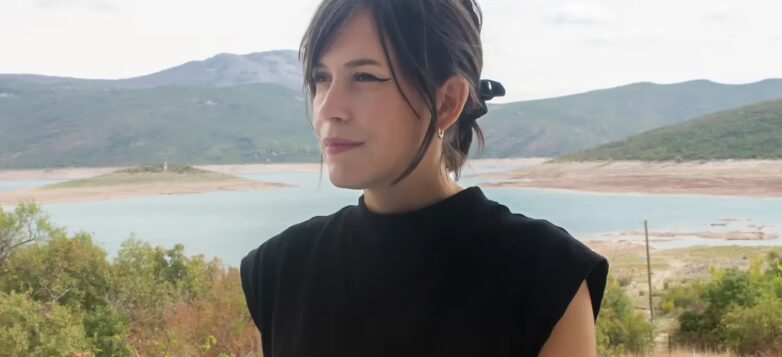
Diona Budima: Tell us your name, where and when you were born, and just speak a bit about your background and how you came into your current artistic practice.
Adriana Ramić: So, my name is Adriana Ramić. I was born in Chicago, United States, 1989. And I’ve kind of always been making art since I was a child. It’s a bit one of these stories like taking my mother’s lipstick and using it to draw frogs all across the walls. But I was also at the same time around a lot of computation. My father was a computer scientist and I kind of learned to use computers and play games at a young age. Now this is not a new thing anymore, I know that we are all surrounded by computers but I very much grew up kind of alongside these worlds of making art and and being around computation and that influenced my practice heavily.
I studied interdisciplinary computing in the arts at UC San Diego, in California. And after that I started making work that was very much like visual arts, fine arts but kind of drawn from these ideas that I had gleaned from computation like wondering about what it is to, like, materialize a system of thought or a of system information or what it means to teach something, to think. So I started working kind of from this background.
I was quite interested in machine learning from an early point in time and making works with this kind of material, like, how can we, like, reimagine sets of information as it becomes abstracted or rendered abstruse by machine generation, and from there I started to step away especially as AI became more and more ubiquitous, I was really thinking, like, what’s a way that I can focus on these details in my work, these sort of, what are to me mysterious vignettes that I wanted to focus on.
So I started thinking, like, what would be, like, making work with computation but without computation at all. So I stopped working with programming and I started working with video and for the past few years I’ve been filming and making video installations and that has been a lot of what I’ve been doing since I’ve been in the villa.
Diona Budima: And what are these mysterious vignettes?
Adriana Ramić: Kind of like these… I mean I work very intuitively and it’s these just very poetic strange moments that happen when you’re looking at something or thinking about something, something that touches me in an unusual sort of way that I want to maybe share.
Diona Budima: And what drew you to apply to the villa?
Adriana Ramić: I was really interested, I mean, first and foremost, in visiting Albania. I have never been here before. My father is from former Yugoslavia, Bosnia and Herzegovina, and I have been around the other western Balkan countries but I’ve never been here and I was very curious and very interested. So that was the first part, and then of course to stay in a site like this is beyond extraordinary, and very bizarre, and strange, and humbling, and it is also because of that that I applied.
Diona Budima: How has it felt to be in this…?
Adriana Ramić: Very surreal, very, very surreal. Like you will be wrapped up in these everyday sort of moments like, “Oh I have to do the dishes. I have to do the laundry,” and then you remember where you are doing them, in this, like, horrifying house. It’s very surreal. I mean many people talk about our view of, like, what lingers here or what has transformed here. I cannot say concretely that I’ve experienced something myself but I’m also not negating any sort of possibilities.
Diona Budima: Yeah, people have been talking about having these very vivid dreams and nightmares, not being able to sleep. And…
Adriana Ramić: Yeah.
Diona Budima: Yeah, the paranormal has been something that artists seem to be in conversation with when it comes to their sort of experiences in this house. But we’re also seeing that these experiences are changing from session to session. We see that in, like, the first sessions this was more intense and then I think people are… I mean the local community as well is getting more used to it. So the artists aren’t maybe… are not in contact with those reactions of the community in quite the same way as those in the first session were. Yeah.
So to return to your project, could you describe your research here and then the, yeah, the form that it took, what you showed during the open studios?
Adriana Ramić: At first I started researching, like, probably I was curious and visiting archaeological sites, getting to know Tirana, going around the city. I tend to work quite spontaneously and my work kind of emerges from being in a place and thinking about things rather than having a, like, pre-thought concept and executing it according to the plan.
So as I was researching and going around, I was also thinking about this very question, “What does it mean to be in this house especially as a foreigner, as an artist?” It’s a beyond delicate topic that I also don’t feel qualified, really, to speak on. And I kept thinking, like, what is it to be in this house and I was seeing Ursa, the cat, always walking around, and I film animals as part of my work, so I thought let’s start filming Ursa and see what happens. And I ended up filming her on a daily basis. Where she goes about, her routines, like, every day or every other day she will bring some sort of animal like a lizard into the house and torment it, and play with it, and then leave it frozen in one of the ground floor rooms or something.
Diona Budima: Ursa is the cat for the record.
Adriana Ramić: Ursa is the catsorry if that wasn’t clear. But, I was really stunned by this. There is also something very uncanny about the fact that they’re, of course, this is what cats do wherever they are. They bring in smaller prey and torment them. But for that to happen here is also very uncanny, very strange. So I filmed her doing this. I filmed her walking around, prowling around. There were times that, like, and maybe I experienced the paranormal through Ursa. There was a time at 3:00 a.m. I came home and she was on that grand staircase. And she had her ears completely back, and she was very afraid, and she was tiptoeing around, looking for something but nothing could be seen. And she was there for like hours just like tiptoeing and staring like she was seeing something. I don’t know.
Other times I’ve seen her beneath that staircase, staring at a fly for hours. So, who knows? But it was really then through her that I started to experience the house, and with the videos of her which I installed as sight specific projections in my studio which was in Ilir Hoxha’s apartment. There was a fireplace and a cabinet. I projected it into the concave areas and then made a mirror extruding from there. And that mirror would then reflect Ursa’s projection back onto us, in a way that I wanted us to think, like, “What are we also doing here while this cat is exploring?” And it’s a question, it’s open-ended for me.
Diona Budima: Yeah. So, you’re interested in nonhuman consciousness as well, right?
Adriana Ramić: Yes.
Diona Budima: Is that something that you explore throughout your work?
Adriana Ramić: Yeah, I was interested like how… like what does it mean? What does it mean to think? What does it mean to think as a human? What does it mean to teach a machine to think as a human or to, like, create a sort of like structure? What are, like, the parameters for thinking and being as human? But also as non-human, as animal, as something else. So I’m always looking at these computer science and behavioral science papers, looking at how they sort of distill these different intervals or behaviors of existence and what they are, and then how that gets, like, fed into some sort of program and then repeated back to us.
So also when I’m filming now, I’m, like, thinking about that, like, filming these sort of, like, instances or these moments of behavior. And of course, not everything can or should be categorized. And I think that by thinking about those categories, we also think about what they exclude in terms of the breadth or complexity of perception and behavior. So I like that as a sort of starting point, because just having a set of categories or a set of moments, we think about what is not there.
Diona Budima: And you… I mean you obviously met Ursa when you came here. Did you have a previous idea of what your work here was going to be, or were you really open to whatever…
Adriana Ramić: I was very open.
Diona Budima: …to whatever you would encounter.
Adriana Ramić: Yeah. I was very open because I didn’t really know what to expect and I wanted to just try to absorb.
Diona Budima: And how has… we– you spoke about the house, but how has being a Albania, in Tirana, impacted your thinking in this time, especially since, as you mentioned, your father is from ex-Yugoslavia, and how is this sort of return to the Balkans been?
Adriana Ramić: It’s been very… I mean, it’s been very interesting. I don’t know how yet to specifically answer that question. I think, like, maybe since I still feel like I’m in it. I will have a better understanding as I reflect on this after some time has passed.
Diona Budima: Are there any specific texts or thinkers, or just references that inform and inspire your work?
Adriana Ramić: I really like Clarice Lispector, Italo Calvino. I get a lot of inspiration from literature actually, and also, I mean I really like some of these very metaphysical Sufi texts, like, by Ibn Arabi. I like, like, these computer science papers. I like looking at these weird poetries that are mentioned there as well. I mean there’s many books, it’s hard to distill. I saw someone brought a book of Forugh Farrokhzad’s poetry here which was a beautiful addition to observe. I like to read a lot but somehow since I was here I was not reading so much, but that’s also, kind of, something that started happening in the last few months.
Diona Budima: Why do you think that is?
Adriana Ramić: I’ve been very overwhelmed personally outside of my practice, but I’ve been reading these Italo Calvino short stories, this t zero book that has been very beautiful.
Diona Budima: Yeah. How would you situate your work in a broader sort of artistic and sociopolitical context? Because you mentioned the emergence of AI and what a huge impact that’s having and I kind of wanted to hear more about how you position your work against that.
Adriana Ramić: I think that… I think that I’ve always felt very resistant to this idea of technology as a novelty, and I don’t want my work to be defined by the use of one specific technology or another. I want my work to be for everyone in a way. And that was a big shift for me in starting to work with video, because before I was making these computationally driven installations that were very conceptual, very abstruse, very text based and ephemeral. But with a video, you can feel a temporality, an effect, and emotion that is simply not there when you’re looking at text or diagrams. It’s something that makes that more immediate. So I started really thinking about using that as a vehicle for exploring these categories of expression and being.
Diona Budima: How do you see this work developing, or if– do you see this work developing further your research that you did here?
Adriana Ramić: I do. I’m not sure how yet. I will have an exhibition in a few months in February. So, I’m planning on extending the work that I have done here into that. But I’m not sure quite yet exactly how it might become, like, focused on Ursa as one of several cats, ‘cause I have followed other cats in Bosnia and Herzegovina and in Portugal. It might be about that. I’ve also been doing research and filming at Neolithic sites in Bosnia and Herzegovina, but… that, I’m really not sure where it’s going. It’s very mysterious to me.
I’m interested in these like different spans of time and how these very, very ancient, like, unimaginable sites, like, how they exist today and how, like, we exist alongside different temporalities. But so far I don’t know where it is going so I can’t say.
Diona Budima: Besides cats, what other animals have you filmed?
Adriana Ramić: I filmed chickens, beetles, as a child, fish. We had porcupine fish. And I mean, I was… really since I got this camera, I’ve been filming, like, all sorts of things. And I find myself drawn to just observing animals the most.
Diona Budima: How do they… I don’t know, how do they change from one another, these animals? Have you sort of, I don’t know… Have you found something particular that defines each of them? I don’t know how to frame this question, but I’m trying to understand more about your choices of animals and sort of like what their particular way of being gives to the work.
Adriana Ramić: For me, I was working with chickens first. I was thinking about the chicken and the egg, and this idea of aporia, not knowing when an event begins or ends. And the chickens were also– they were wild chickens, and many of them were very light in color, and against, like, these dark wilderness backgrounds. So then they would sort of glow in the frame of the camera and I wanted to find a way to hold that glow, or that silhouette of the chicken inside a glass. This, like, ephemerality of beginning or ending, but inside a very common object of a drinking glass.
And the beetle, I actually had a very vivid dream that I was sleeping at my mother’s and I opened a box, the kind that usually has cookies but there are no cookies inside, and these tropical beetles flew out, and they were landing on the wall, and I couldn’t get these beetles back inside. They were like super bright in color and astonishing, and I woke up from the dream, and I really felt compelled that I should make an artwork with this, and I couldn’t think how yet.
And then I came across that Wittgenstein has the idea of a beetle in a box, that we all have a beetle in a box, and I know what mine looks like, and I know that you have one, but not what yours looks like because that beetle in the box is a private language and it’s pain. So I thought, like, “Hm, very coincidental that I would also dream about beetles escaping out of boxes,” but I also didn’t want to illustrate directly, like, the Wittgenstein thought.
And then when I was taking care of my mother while she was going through chemotherapy, outside of her apartment were these white flowers, and beetles were drawn to them. These very bright green beetles. This was in California. So I started to film those every day. It’s very much something that happens in my daily life, family encounter.
Diona Budima: They also flew to the wall a bit like the frogs that you drew with your mom.
Adriana Ramić: Yes. And these beetles, they were like grasping and mumbling. They seemed, like, blinded by light almost. They couldn’t see very well and they were bumping into things all the time. So I started to film that and I presented them in these half-open glass, sort of latrines in a way, to nod at this opened box that these beetles are now flying outside of, and what happens to a private language when it becomes open, when there’s different beetles talking to each other, pollinating and so on.
Ana Morina: I have a question. So your filming process is very intuitive, unexpected. What about your editing process?
Adriana Ramić: It’s also kind of like… it’s also kind of intuitive, but a bit programmatic, like just selecting for these moments that feel like they will go together. Like, sometimes I will cut the footage very categorically. Like, okay for the chickens I did all of the scenes of them pecking and searching, all of the scenes of them leaving the frame, all of the scenes of them staring at the camera and that became three separate cuts. For these last two, there were two projectors in each. I did it a bit more loosely, but for the beetles, one of them they were super active, moving around a lot, and the other they were very still.
Here for the installation at Vila 31, I worked with the architecture, the space, and I thought about, like, the green marble of the fireplace, and the warm wood of the cabinet, and which sort of scenes, or the sound, would fit best there. So I diverged from that system to go more by a coloring mood.
Ana Morina: Did you have a lot of footage of Ursa?
Adriana Ramić: Yeah, many hours.
Diona Budima: And how long was the footage that you showed for the installation?
Adriana Ramić: About like 30 or 40 minutes.
Diona Budima: Okay, to end, can you tell us what you’re currently excited about? Be it personally, or socially, artistically, politically, even though…
Adriana Ramić: Oh my goodness. I don’t know. I really don’t know. I mean, I feel incredibly grateful to have been here. I feel very, very appreciative. It has been, like, this is not really an answer, but I feel very appreciative. It has been such a tremendous luxury and privilege for me to be able to stay in this space, and I’m still kind of reeling from that, and what that means. I’m always curious and excited what will happen next. So maybe I’m excited for the unknown in that way.
Diona Budima: Where are you going after this?
Adriana Ramić: I will go to California to support my mother through surgery and after that I’m not sure. So we’ll see.
Diona Budima: Thank you so much.