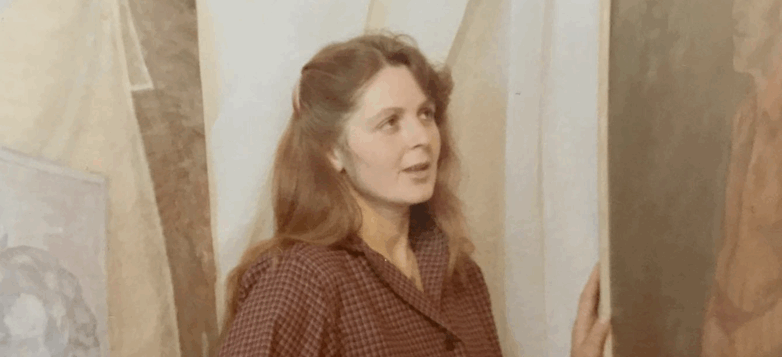
Nobody knew I was from a village. When I came to Pristina, they thought I was the daughter of some official, that I was either from Pristina, or from Peja, or from Gjakova. What did I have to do with them? And later, you know, because they had that idea about me, they didn’t really say anything to me after that, but then later they would ask me, ‘Wait, aren’t you from Gjakova?’ I would say, ‘Why do I have to be?’ And Professor Ramiz said, ‘Hold on, girl, I want to ask you something.’ Just like that, you know. In the courtyard, after I went outside. I said, ‘Yes, professor?’ He said, ‘May I know where you’re from?’ I said, ‘Yes, professor.’ He said, ‘Are you from Peja?’ I said, ‘No, I’m not from Peja.’ ‘From Pristina?’ ‘No.’ ‘Where are you from then?’ I said, ‘I’m the complete opposite. I’m from Pozheran. Do you know where Pozheran is? I’m from the village. I’m a civilized redneck’ Exactly like that. I don’t know, I had these kinds of notions that would come to me on the spot, when people imposed them on me, and then I gave myself those labels. I would say, ‘I’m a redneck, but a civilized one.’ He said, ‘Right, because I can tell you apart, I keep seeing you in these clothes, you stand out completely. You know? And you have a completely different kind of upbringing, in the way you walk, the way you move, the way you socialize, I see it. You carry yourself differently.’ I said, ‘Alright, professor.’ Then he says to me, ‘Good. And who makes your clothes? Who is your designer?’ I said, ‘What–’ I didn’t even know what a designer was. I said, ‘Professor.’ He said, ‘Yes? Are you going to tell me?’ I said, ‘Yes, professor. You have her right in front of you. She is standing before you.’ He said, ‘Where? What?’ I said, ‘Here, here.’ I was pointing at myself with my hand, just like that. I said, ‘It’s me.’ He said, ‘How is it that you, a village girl, know how to do all this?’ I said, ‘Professor, excuse me, where are you from?’ He said, ‘I’m from Peja.’ I said, ‘That’s not true. You’re from Rugova.’ He said, ‘Yes, I’m from Rugova.’ Because later he told us what he had gone through when he went to secondary school in Peja, what he experienced, how they looked at him as a redneck and all that. And I said, ‘Professor, compared to where you’re from, Pozheran is flatland. It is a town with a very developed culture. There are also people who–’ Intellectual is a big word, in my opinion, because to call yourself an intellectual, you have to be informed in many different areas.
Miradije Ramiqi was born in 1953 in Pozheran, Viti. Her artistic ideas are expressed through painting and poetry. In 1978, she graduated from the Academy of Fine Arts, Department of Painting, in the class of professors Rexhep Ferri and Muslim Mulliqi. A year later, she completed a specialization in Paris, France. In 1997, she received her master’s degree in Painting from the University of Prishtina with the thesis “Art on a Journey Around Its Re-meaning.” From 1978 to 2017, she participated in a total of 27 national and international exhibitions. She is the author of four poetry collections: Drithërim ngjyrash [A Tremor of Colors] (1981), Shi në pasqyrë [Rain in the Mirror] (1990), Pëshpërimë mbretërie [Whisper of a Kingdom] (2000), and Hirësi përrallore [Fairytale Grace] (2010). Among other affiliations, she is a regular member of the Association of Visual and Applied Artists of Kosovo, the European Academy of Arts in Brussels, and the Writers’ Association of Kosovo.