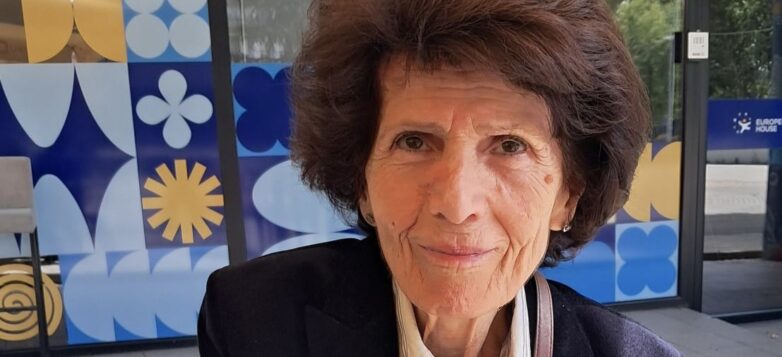
Milajete Shala Mehmeti

Pristina | Date: September 25, 2024 | Duration: 79 minutes

Two or three teachers were killed in the first school that was opened. I remember we went there with Fehmi Agani. It was somewhere in Dukagjin, I don’t remember which village, where they made a house available and immediately they killed them – the owner and two or three others, the teachers…Surely the names are somewhere. But I know that the first killings happened immediately. Because they tried to stop the momentum. They had no possibility to stop parallel education…There was an initiative and we once even held discussions in the faculties to try to return to the university. I remember that we went [to a meeting] in Mitrovica. It was that former leadership, together with Minir Dushi, I think, or I don’t know who it was, but without success. We knew that it was only a formality, just so it couldn’t be said that we hadn’t held talks.


Anita Susuri (Interviewer), Ana Morina (Camera)

Milajete Shala Mehmeti was born in 1952 in Mitrovica. She earned a degree from the Faculty of Technology at the University of Prishtina, conducted research at the University of Zagreb and the Military Academy of Zagreb, Croatia, and defended her PhD in 1991 at the Faculty in Mitrovica. She completed a specialization in corrosion at the Freiberg Academy in Germany and a further specialized program at the John Hopkins University in the United States. She has been a long-term faculty member at the Faculty of Technology in Mitrovica, where she has taught Electrochemistry until her retirement. Milajete Shala Mehmeti was active in the parallel education system, in the blood feud reconciliation campaign, and  in the Women’s Forum of the LDK.

Milajete Shala Mehmeti

Part One

Anita Susuri: Ms. Milajete, could you please introduce yourself and tell us something about your background and your family?

Milajete Shala Mehmeti: I am Milajete Shala. I was born in Mitrovica. I was a professor at the Faculty of Mining and Metallurgy, as it was called in Mitrovica. My family also comes from the Shala family, who lived in Saritër, as it was called then, where Trepça1 is located today. My family, my ancestors, owned the land where the Trepça Mine is today. They sold the land for the first time, or rather the English bought it from them, and the mine was built there. So the English paid them a lot of money, and they asked that their children be educated. But my grandfather’s children were very young, and he could not send them abroad. Still, he educated them a little, as much as he could locally.

My oldest uncle reached the level of an engineer and worked at Trepça. So my family decided that I, or one of us, since we were seven children, should study one of the fields that was suitable for Trepça. It fell to me. It was unusual at that time for women to study engineering. There were very few women in engineering. Still, I completed my studies and continued working at the faculty, not at Trepça, even though I had had a scholarship from Trepça since secondary school. The secondary school was the technical school, which today is separated, meaning only Serbs attend it. At that time, it was the technical school for all of Kosovo, for the mines or factories of that kind.

From there, I immediately went on to university studies. The Faculty of Technology opened in Kosovo for the first time, mainly because of the Trepça Mine and the power plants, as they were called at the time, KEK.2 At one point, Trepça and KEK needed this kind of professional staff so much that they took the lists of students. Since some time had passed before the faculty opened, it was close to the New Year. Let’s say we started in November. Both Trepça and KEK took the lists and divided the students according to who wanted to receive a scholarship from the power plant and who wanted one from Trepça, based on preference. The power plants, today’s KEK, offered slightly larger scholarships, though the difference was very small. I decided to take the KEK scholarship. Since I had received my secondary school scholarship from Trepça, I wanted to change things a little.

When I finished the faculty, I was still supposed to work there. I wanted to be in Mitrovica; the faculty was in Mitrovica. Around that time, shortly before graduating, I worked at the secondary school as an engineer. From there, I moved to the faculty. Since I did not go to work at KEK, I had to return the scholarship. I returned it, I paid it back. At that time, it was not a small amount. I continued from the secondary school to the faculty. I worked at the faculty all my life. I retired from there.

Anita Susuri: Ms. Milajete, I would like to go back a little with some questions, first about your childhood. You told me that your family sold that land and settled in Mitrovica. How do you remember that time, growing up in Mitrovica?

Milajete Shala Mehmeti: What can I say about Mitrovica? At that time, in the 1950s, it was a different time, but you could say that when I went there, it was the beginning of the development of our society. Very early on. Meaning, just like a child taking its first steps, Kosovo also began to move forward a little. Still, it was a difficult time until ‘68. After ‘68, when I was in secondary school, Kosovar society and Kosovo began to move forward more quickly.

Anita Susuri: When you were in Mitrovica, I mean, which neighborhood did your family live in?

Milajete Shala Mehmeti: My family lived in the center, near the market in Mitrovica.

Anita Susuri: Qysh t’u kanë dokë shtëpitë në atë kohë? Rrugët? A kanë qenë shumë ma ndryshe?

Anita Susuri: What did the houses look like to you at that time? The streets? Were they very different?

Milajete Shala Mehmeti: They were. There was a, let’s say, river. Compared to the Ibër, it was a branch of the river, but still, it was called the Luzhda. A little above my house, the Luzhda passed through that area, toward the market. The riverbed of the Luzhda was so unregulated, so poor, that there were floods very often. The floods did not reach my house, but they came very close, very close. I remember that. Still, in that river there were beavers, and it is a shame they covered it up. I remember there were many geese there, and they were all white. At that time, they saw covering the river as the solution, so that it would not flood. It would have been much easier to fix the riverbed, and there would not have been any problems.

People usually built their houses near the river. So there are two parties at fault: the mayor, who did not think that the river and its bed needed to be regulated, and those who built their houses nearby. It was covered up. That is why I feel very sorry about it.

Anita Susuri: What did your parents do?

Milajete Shala Mehmeti: My parents had, my father had a lot of property, which he inherited from his father. They had to work it. Later, my father completed secondary school, or whatever was possible at that time. Later, he opened a shop, giving up part of his property near the house, and he dealt with that, with shops. As for another profession… my father’s brother died early because the whole family had a certain, they were more on the right-wing side. During the war, after the Second World War, when the communists won… in Mitrovica, there was an execution of a group of right-wingers who had been with Balli Kombëtar.3 That is how I remember it. At the house of one of our neighbors, who was also my father’s cousin, or my grandmother’s cousin, because my father called them his maternal uncles, the ones from Prekaz. One of them was in that group that was executed.

My parents, and my father too, came from that family. The right-wingers. They were persecuted, so in that system, as it was then, they did not have any kind of access. My father was among the best students in Mitrovica. The Serbs, the Serbs… at that time it was very difficult. They expelled him from school, “Go.” After that, he no longer had the right to continue his education. Still, he had some friends, including Serbs, who continued their schooling. He even had some doctor friends across the street, Serbs. And he got along well with them. My father did not have a problem. But he did not have access to education.

Anita Susuri: Was there any confiscation of property after the Second World War?

Milajete Shala Mehmeti: No. But on my maternal uncles’ side, my grandfather was very wealthy, and there they confiscated his property. They gave him a condition, either you, because he had so much property, they told him, “You will choose: either you keep this and we take that, or you go there and we take what property you have here.” My grandfather owned that prison that is around…

Anita Susuri: The prison in Mitrovica.

Milajete Shala Mehmeti: They took the prison in Mitrovica from him, and they confiscated some shops as well. He chose to live on the outskirts, because the air was better there. My grandfather went there, and they confiscated it. Later, or during the period when the return of property was allowed, my maternal uncle got it back. My grandfather was no longer alive, but my uncle got it back. Some of it, not all. Some of the properties. But from my father, no, there was no confiscation.

Anita Susuri: And was your mother a housewife? Did your mother work?

Milajete Shala Mehmeti: My mother was a housewife. They got married, my father and my mother, because they came from two emblematic families.

Anita Susuri: And what family did your mother belong to?

Milajete Shala Mehmeti: To my grandfather’s family.

Anita Susuri: What surname did they have?

Milajete Shala Mehmeti: Dubella. My grandfather’s family, or my mother’s family, came from Mirdita, as far as I know.

Anita Susuri: And what was cultural life like at that time?

Milajete Shala Mehmeti: In Mitrovica, there was not any particularly notable cultural life. After ‘68, it began to come alive. Although preparations for it had been made even before then. What I mean is that the problem was that the population was not allowed to breathe freely. Especially in Mitrovica, there was always a greater struggle, just as you see now. All the other cities in Kosovo are freer than Mitrovica. So the struggle was always taking place there. Then, in the 1970s, you can see the economy and culture flourishing. Many things in Mitrovica. It was an industrial city. I only remember one small house of culture. But in the 1950s, there were no houses of culture in other cities either. It seems to me that Mitrovica was more developed at that time than Prishtina, because the industry was there. Albanians moved from many places and came to Trepça to find work and to live. That is how it was.

Anita Susuri: In secondary school, you were at the secondary school in Mitrovica? What was it like? Were there many girls?

Milajete Shala Mehmeti: In all the republics of Yugoslavia at that time, there was one secondary school of this kind. Because in the nineteenth century, industry in these fields was more developed. Technology, chemistry, these belonged to that century. In every republic, there was one secondary school of this kind, a technical school. In Kosovo, it was this one in Mitrovica. People came here from all over to study. I completed this secondary school. My goal, or my family’s goal as well, was for me to complete this secondary school so that I would become professional staff for Trepça. This secondary school trained staff for laboratories. At that time, laboratories were the places that prepared raw materials and conducted research. There were many of them.

There were two professions. The normal secondary school, which trained teachers, and this one, which opened to train lab technicians for Trepça. There were many women here because they could find work immediately, and being a lab technician was something very suitable for women. We worked with those instruments that were more sophisticated. The hands were trained. Different analyses, and so on. So, being a lab technician, like being a teacher, was one of the two professions that were very important for women. That is why there were quite a lot of women in that school, quite a lot.

Anita Susuri: Did you have Albanian professors, or how was it?

Milajete Shala Mehmeti: At the beginning, we did not have Albanian professors, except maybe for some language classes. Because they brought teachers from the gymnasium4 and other vocational schools. There were Albanian mathematicians. By my time, the number had changed; there were more Albanians than Serbs. There were very few Serbs. But the more specialized subject, which was called technological operations, was very professional. There were no Albanians for that. Later, they were replaced by Albanians, later on.

Anita Susuri: You must have also had practical work?

Milajete Shala Mehmeti: Yes, after, when the school year ended, during the summer break, we did what was called summer practical training. We would go to Trepça’s departments, or wherever people lived. Because there were students there from Suhareka, from Rahovec. They had their own factories there. They could do it there. During the year, they had laboratories. You could say that, at that time, the secondary school laboratories were better equipped than those at the faculty. Because this school was built with industry funds, and the laboratory… you cannot be an engineer without doing practical work. The laboratories were well equipped. The faculty was established with the basic preparations in place. But it was interrupted very quickly. Just as it was established. I enrolled at the faculty around the 1970s, and they had only produced some professional staff. Initial laboratories. When the faculty was supposed to develop, that was when the attacks from Serbia began. It remained halfway done.

Anita Susuri: I would like to talk a little about the social life during your secondary school years. There were some balls, some dances that were held, but how much did you attend them?

Milajete Shala Mehmeti: I told you that in Mitrovica there was a very beautiful house of culture. As much as it could hold, some balls were organized there, but I did not manage to attend them. At some point during my studies, they first began in Prishtina, then returned to Mitrovica, and so on and so on. I had other things to do. But there was, one could say, a modest social life.

Anita Susuri: You mentioned your secondary school years and told me a little about what cultural life was like. But I am interested in hearing more, whether there were any theater performances you went to?

Milajete Shala Mehmeti: No, there were not. Not in Albanian. There were none in Mitrovica. Maybe there were in Prishtina, at that time we had other problems. But there were none. There was no social life. Not that I can speak of. Maybe older generations could.

Anita Susuri: Then you enrolled at the faculty in Mitrovica?

Milajete Shala Mehmeti: It started in Prishtina, and then we returned to Mitrovica. Some parts happened again in Prishtina. But finally, it was in Mitrovica. Because, I mean, because of Trepça.

Anita Susuri: You told me that you also went to Trepça to do practical training. Did you ever have to go into the mine shaft?

Milajete Shala Mehmeti: No. Because we were in the field of technology; the miners… there was technology, mining, and metallurgy. We did our practical training mostly in laboratories. I did my practical training mainly in the factory, in zinc electrolysis. Sometimes in the battery factory. In the end, I did my diploma thesis in zinc electrolysis, in the department. The professor, my diploma thesis mentor, was the late Professor Fatmir Rakolli. He was one of the directors of Trepça. But he taught us a very important technology course, which was… I did my diploma thesis with him. We chose our diploma thesis topics according to our own preference. I worked on it, and he arranged it for me in zinc electrolysis. Every day, I would take electrolyte from the factory and study it. I set up a small laboratory.

Anita Susuri: Were the laboratories well equipped at that time? Did they have the necessary things?

Milajete Shala Mehmeti: In the factory, yes, certainly. The factories worked at one hundred percent capacity. There were no delays there. Because Trepça was among the important factories, the mines, in former Yugoslavia. Several branches in Kosovo received their raw material from Trepça, from Mitrovica.

Anita Susuri: When did you then start working at the faculty?

Milajete Shala Mehmeti: At first, after two years, meaning when I completed the first two years, I went to work at the technical school. Immediately after graduating from the faculty.

Anita Susuri: In which year did you graduate?

Milajete Shala Mehmeti: I graduated in ‘75, ‘74, ‘75.

Anita Susuri: What was the experience at the faculty like? There must have been many students? Perhaps mostly from Mitrovica?

Milajete Shala Mehmeti: There were many students. From all the cities of Kosovo. There was a need to open this faculty because the industry, the factories that existed in Kosovo, were, so to speak, a continuation of Trepça. They always received their raw material from Trepça, and a factory would be opened somewhere, along with employment. Processing factories. It was not only raw material that was sold; it was processed everywhere. As a result of this, we came to the faculty from many places in Kosovo. So, our department had the most students. Technology had the most students. The other departments had fewer. I remember that at the time they would say, “We are supplying you too, the other departments.” Because there were the most of us. But there were few women, two or three. Like that. Very few women.

The condition was that we work at the faculty, but also think about our own education. The faculty alone was not enough. At that time, you needed what they now call a master’s degree. It was not a master’s, or rather, there was no one-year master’s degree, but the master’s degree was a higher level. The faculty was four plus one, almost five years. Then you needed a master’s degree. At first, we went, many of our staff completed both the faculty and the masters degree in Belgrade. Later, when things became very tense, they began going to Zagreb. I completed my master’s degree in Zagreb. Then I continued with my doctorate, which was also a condition for working at the faculty, also in Zagreb. It was a practice for the doctoral defense to take place at the faculty where you worked. It was called a [inaudible] doctorate, that is what it was called.

The defense would take place where you worked so that the practice could be transferred. So the other students could see it. Meaning, after you complete the research, the defense should not happen without anyone seeing anything. That, too, is part of the lecture. I defended it in 1991, when there were many problems. Everything had become tense. I defended my doctorate in Mitrovica at that time. After the Miners’ Strike, when we began to expose ourselves more, things became more tense. There was… we were given the condition of whether we supported the strike or not. I defended it. My mentor from Zagreb, who was Croatian, very old, the most well-known in my field in former Yugoslavia, could not come. But, as a member of the committee, he requested a Serb who was also part of the staff of the institute where I was. It was called the Military Academy of Zagreb. He was a Serb, but very correct.

Then there was a Serb from Belgrade, a colleague of my professor. He called him and told him, “You have to go to my place.” He was the first member of the committee. And another one from Bor, who taught at our faculty. They were all very correct. I defended my doctoral dissertation during the most difficult time in Kosovo. Or when the difficult time began. In ‘91. But to return to the question you asked. There were so many students that the amphitheater, as it was usually called, a large hall where lectures were held for groups that were very large, was completely full. On both sides, people had even begun standing on their feet. It was also a time of homogenization of the population. At that time, any gathering that was ours, you would see it full. That was how it was. It went very well for me; they were correct. It was a difficult time. I had to concentrate in order to answer as well as possible.


1 Trepça is a large mining and industrial complex near Mitrovica, Kosovo, historically known for its lead, zinc, and silver deposits. It was one of the most important industrial enterprises in socialist Yugoslavia and, at its peak in the 1970s and 1980s, employed over 22,000 workers.

2 KEK (Korporata Energjetike e Kosovës/Kosovo Energy Corporation) is Kosovo’s public energy company, responsible mainly for coal production and electricity generation.

3 Balli Kombëtar, meaning “National Front,” was an Albanian nationalist and anti-communist organization founded during the Second World War. It initially opposed Italian and later German occupation, but parts of the movement also came into conflict with the communist-led partisan forces. After the war, communist authorities in Albania and Yugoslavia treated Balli Kombëtar members and sympathizers as political enemies.

4 A gymnasium is a type of academically oriented secondary school that prepares students for university education. In Kosovo and the wider former Yugoslav context, gymnasiums offered general education, unlike vocational or technical schools, which trained students for specific professions.

Part Two

Anita Susuri: Did you start as a professor at the faculty after graduating, or?

Milajete Shala Mehmeti: Yes, after graduating from the faculty.

Anita Susuri: So, after ‘91.

Milajete Shala Mehmeti: No, no.

Anita Susuri: After ‘75.

Milajete Shala Mehmeti: I finished the faculty and started working. Because you cannot work at the faculty without graduating, but the master’s degree and doctorate were part of the qualifications needed for the faculty. A university degree alone was not enough. Five or six months after I defended my doctorate, we were dismissed from work. I defended my doctorate in March, that is exactly when it was. By September, we no longer had work; they cut us off in June.

Anita Susuri: In ‘91?

Milajete Shala Mehmeti: In ‘91.

Anita Susuri: I would like to go back to ‘81 for a moment.

Milajete Shala Mehmeti: So, there was ‘81, and then in ‘85 something was set up. You could say that by ‘85 we were almost dismissed from work. In ‘81 there were large demonstrations.1 The demonstrations were broken up very brutally. Then differentiation2 began immediately. That is what it was called. There were three women working at the faculty: Afërdita Nura, Luljeta Pula, and me. At that time, we were among the youngest, or the youngest. The students looked to us. We were so closely connected to the students that we did not understand the danger. Neither they nor we did.

After the demonstrations, which as I said were crushed brutally, with a great deal of violence, many students were taken to the hospital. They were beaten so badly, I mean, force was used against them to the point that they ended up in the hospital. Soon after that came differentiation, to see whether we approved of it or not. The three of us were the first to go through this. They came to the committee, as they used to do at the time. I remember they sat down, and now supposedly we were discussing how, whether we approved of the violence. We did not approve of the violence, and we stood up; all three of us were outspoken. Maybe one or two of the men here and there, I don’t know. The next day, the Serbian newspapers wrote as much as they could. I remember the headline: “Three female professors in the positions of Albanian nationalism and irredentism.” So, “Three female professors,” I don’t know if you understand Serbian?

Anita Susuri: Yes.

Milajete Shala Mehmeti: “In the positions,” and that is where the campaign against us began. Still, they did not remove us the way they removed others. But the pressure became increasingly harsh after ‘81. All of my colleagues and I taught both in Albanian and Serbian wherever that was possible. After ‘81, decisions were issued, or whatever they were called, stating that Albanians were not allowed to teach Serbian-language classes. Only Albanian ones. We could no longer teach Serbian students. They brought in some assistants. I had a Serbian colleague as my assistant, with whom I had a proper working relationship, and they gave the lectures to her. She taught in Serbian. She took all the instructions she needed for the lectures from me, as well as the books I used. She was very correct. I did not have a problem. Still, that is where the campaign began.

Anita Susuri: You also told me about a Montenegrin student you had?

Milajete Shala Mehmeti: Yes. At that time, when I was also teaching in Serbian, I had students, as I told you, from all over Yugoslavia there at the faculty. My subject was very specific: electrochemistry. The theory and practice of electrochemistry. The practical part involved methods for producing different metals. One method that was very specific was the production of aluminum, which is still very important today. All metals. The method for producing aluminum is very specific. Aluminum was not produced in Kosovo because we did not have aluminum. The raw material extracted from Trepça did not include anything for aluminum. The only factory at that time, among those our students had access to, was in Podgorica. Aluminum was produced in Podgorica using that method, the one I lectured on, which was part of my subject.

Precisely because I had a student from Podgorica in the Serbian-language group, she decided to take that as the topic of her diploma thesis. At that time, people usually considered where they were taking the topic from, so they could do the practical part in the factory. She was from Podgorica and wanted to take that thesis topic so she could work on it there. There was nothing wrong with that. Around that time, I got married and gave birth. Maternity leave then lasted nine months. In the meantime, the deadline came for her diploma defense. What could I do? I was on leave. In my place, my colleague, my husband, became a member of that committee because he said, “She did not want to change.” They must have asked her, of course. It was very… she was the only one from the Serbian-language group who did her diploma thesis with me. And she defended it, she completed it.

Anita Susuri: And were you colleagues with your husband?

Milajete Shala Mehmeti: Colleagues.

Anita Susuri: Is that how you met?

Milajete Shala Mehmeti: Yes. We met in secondary school.

Anita Susuri: You said that you worked until ‘91, and then in September they were removed…

Milajete Shala Mehmeti: Yes, they removed us in June. In September, it became final. There was the strike in September.

Anita Susuri: I want to go back and ask you about the Miners’ Strike, which you mentioned briefly. What was the situation like during that time?

Milajete Shala Mehmeti: The Miners’ Strike was a consequence of what happened after ‘81. Serbia began making constitutional changes to our constitution, the well-known Constitution of 1974,3 through which we had gained those rights. But there was still a connection to Serbia, because Kosovo was supposedly a province of the Republic of Serbia. Serbia saw that we had begun to develop as a people. Immediately after ‘81, after Tito’s4 death, the degradation began. It finally started with the constitutional changes, and the Miners’ Strike was a protest against those constitutional changes. That was it. Then a very large-scale process of differentiation began.

Anita Susuri: Then, in 1991, after you were removed from work,5 how did the organizing continue?

Milajete Shala Mehmeti: In 1991, before I was removed from work, the organizing of the population began. The LDK6was formed. Within the LDK, there was also the LDK Women’s Forum. These were formed in different cities, both for the LDK and for the forum. I was the chair of the LDK Women’s Forum, the branch in Mitrovica. Then the first electoral assembly was organized soon after, and I took part in that LDK assembly. There, a central council, as it was called, was elected. It was done through voting, in a democratic way, one could say. I was elected a member of the central council. From there, I was elected chair of the forum and continued as chair of the Women’s Forum.

Anita Susuri: What was your role? What did you do?

Milajete Shala Mehmeti: We did not have any major role. Still, there was a purpose. The purpose was for women to have their own organization as well. So we did what we could. I cannot say that, but always within the LDK. A better form of organizing.

Anita Susuri: How difficult was it to hold meetings like that?

Milajete Shala Mehmeti: We met once a week, just like the LDK. Once a week, all the branches. But there were also some activities on different days, on days related to Kosovo. It was not easy to go to different branches at that time. Still, we tried not to have meetings with too many people. The leadership had eleven members then, I think. We tried not to organize large gatherings, because we were not exactly spared when it came to larger aims. Whenever we organized large gatherings, the police would immediately be alerted.

Anita Susuri: Did the police come inside the meetings?

Milajete Shala Mehmeti: When the longer meetings began, those were larger gatherings then. But, as I said, we kept the meetings with the branches smaller. But on the way, for example, when we went to Peja or Gjakova sometimes, the police would stop us briefly. But we managed… we did not have too many problems.

Anita Susuri: In meetings of the Women’s Forum, for example, at that time, since it was still the beginning of the 1990s, were any decisions made about what to work on, or how to work, or how to organize the forum?

Milajete Shala Mehmeti: Certainly, yes. When we were formed as a forum, we were, let’s say, a branch, part of the LDK. In those meetings that we held once a week with President Rugova,7 or when he was not there, Agani8 led them. We received advice on how we should work, what we should work on. It often happened that we were given certain tasks there, which the women carried out honorably.

Anita Susuri: What kind of tasks, for example? Could you tell us?

Milajete Shala Mehmeti: For example, when the schools were closed, the children were left outside school buildings. We had to concern ourselves with what to do about the children. Until the private schools were organized, as they were called, in houses. Until then, we as mothers had to take care of the children, that was it. Everyone in her own way.

Anita Susuri: Were you part of the organizing when the house-schools were set up?

Milajete Shala Mehmeti: Well, I was not directly involved, let’s say, but at first they tried to obstruct it. Two or three teachers were killed, they killed them. The first school that was set up, the first house that was opened. I remember that we went there with Agani. It was somewhere in Dukagjin, I don’t remember which village, where they had made the house available, and they killed them immediately. The owner and two or three others, the teachers.

Anita Susuri: Was it the police who killed them?

Milajete Shala Mehmeti: The police, yes.

Anita Susuri: You do not remember who they were?

Milajete Shala Mehmeti: No, no. Their names must be somewhere, certainly. But I know that those were among the first killings, right away. Because they tried to stop the momentum. They could not stop parallel education. There were some talks, supposedly, about going back to the schools… but without success. There was also an initiative at the faculties, at one point, to hold talks and try to return. I remember that we went in Mitrovica. The former leadership, as it was called, together with Emin Dushi, I think, or I do not know who else was there. But without success. Without success. We knew it was only a formality. But it was so they could not say that we had not held talks. That is how it was.

Anita Susuri: Did they refuse you directly?

Milajete Shala Mehmeti: Well, he listened to us, in a somewhat forceful way. He listened to us, but the decision came from above. “There is nothing,” he said, and nothing happened. Then we held some lectures in different spaces like that.

Anita Susuri: Were you also involved as a professor in the house-schools?

Milajete Shala Mehmeti: Yes, yes.

Anita Susuri: In which places were you?

Milajete Shala Mehmeti: We were first in an eight-year school on the outskirts of Mitrovica. Then we taught there the whole time, until they removed us.

Anita Susuri: Do you remember the name of that school?

Milajete Shala Mehmeti: No, I do not remember what the school was called, but it was somewhere on the outskirts. An eight-year village school.

Anita Susuri: So the faculty lectures were held there?

Milajete Shala Mehmeti: Yes, there.

Anita Susuri: At the same time, surely, the primary school students also attended classes there.

Milajete Shala Mehmeti: Certainly. Later, they were more liberal; they left the children alone.

Anita Susuri: And were you ever in private homes like that?

Milajete Shala Mehmeti: No, not me.

Anita Susuri: And the faculty…

Milajete Shala Mehmeti: Later, we made an effort for the faculty to move to Prishtina. The rectorate was set up in a private house in Velania. Across from it, we taught there for about a year, let’s say. Yes, yes. Then, no. We could not make the decision for the faculty to move to Prishtina, so we returned to Mitrovica again.

Anita Susuri: And here in Prishtina, in that house, what was it like? Were there proper conditions? What were the conditions like?

Milajete Shala Mehmeti: Only teaching; there were no laboratories. Our faculty cannot function without equipment. But I taught there. Before that, before that situation, I had gone to Germany and came back to teach. Then we taught for one year in Velania, that much.

Anita Susuri: Which year was this?

Milajete Shala Mehmeti: In ‘95.

Anita Susuri: Were there still many students who were interested?

Milajete Shala Mehmeti: Yes, but not that many. Not like we had in Mitrovica. The road was very long, and many were in prison. There were many students who took part in the demonstrations, many. They either fled or were in prison when they were caught.

Anita Susuri: But there were also those in ‘89, ‘90, ‘97.

Milajete Shala Mehmeti: That is when it began. ‘81 was no longer anything.

Anita Susuri: Do you remember, for example, what kind of atmosphere prevailed despite everything? What was the students’ enthusiasm like? Surely it must have taken a great deal of will to study under such conditions.

Milajete Shala Mehmeti: Yes, the enthusiasm was very good, before ‘81. It was a new faculty, and at first, in the first generation, we were 20 or 30 students, but then the number kept growing.

Anita Susuri: I mean in the 1990s.

Milajete Shala Mehmeti: In the 1990s, no, then the students began to get involved in other work as well, because they were the young people leading the movement. Interest kept declining. Many students came after the 1990s and continued the faculty, because they had been left halfway through. As for enrolling, there were more or less a few.

Anita Susuri: What else do you remember from the activities of the 1990s that you think is important?

Milajete Shala Mehmeti: The reconciliation of blood feuds.

Anita Susuri: Did you take part?

Milajete Shala Mehmeti: Yes, of course. As chair of the Mitrovica branch of the forum, I was also a member of the LDK branch in Mitrovica. When… it was mainly our students who were involved in the movement, together with the chairs of the LDK branches. Wherever the chair went, they would call me as well, for the reconciliation of blood feuds. I remember how many times we went to different villages for reconciliations.

Anita Susuri: Could you describe to us how these meetings and gatherings went, and whether there was any particular case that perhaps moved you?

Milajete Shala Mehmeti: Certainly, every process had its difficulties, and in some places it went more easily. It depended on the case. For example, Latif Berisha was the chair of the branch in Mitrovica. He developed a strategy similar to Anton Çetta’s9: to speak very slowly and calmly, in a soothing way, to see whether reconciliation could be reached. The way he would open the conversation was, “We need to come together, to be united.” There were cases where we achieved it more easily, but the more difficult cases were the ones Anton Çetta took part in. Those were more… our cases were easier. People reconciled. They did reconcile; several reconciliations were achieved.

Anita Susuri: What were the cases, perhaps, if you remember? Why did most of those killings happen?

Milajete Shala Mehmeti: The killings were of many different kinds. Because it happened… I do not remember the details.

Anita Susuri: I think you went to Germany in 1996?

Milajete Shala Mehmeti: In ‘92.

Anita Susuri: In ‘93?

Milajete Shala Mehmeti: In ‘92.

Anita Susuri: Then you returned?

Milajete Shala Mehmeti: Then I returned.

Anita Susuri: Could you tell me about your work in Germany?

Milajete Shala Mehmeti: In Germany, we went to a university that was known for certain fields, as is the case everywhere, similar to our faculty. It was an academy known around the world, 800 years old. There, besides the fact that my colleague and husband was completing his doctorate and doing research, I completed several specializations in the field of corrosion. Because every metal undergoes corrosion. I completed that specialization. It lasted quite a long time. I wrote the textbook on corrosion there.

Anita Susuri: I know you told me that you also served as an interpreter for refugees?

Milajete Shala Mehmeti: At the time when I was in Germany, when the war began, I remember that after a while they called me to go and interpret for the women who were arriving. I remember one case from the village of Poklek, in the municipality of Drenas, I think. Two sisters. The older sister was around 50, and the other one was 25. They could not speak, so they asked for a woman to help them. They were trembling. What had been done to them, how they had managed to get out, I do not know. But I remember that that case shook us deeply.

Anita Susuri: You said you returned in ‘96, but then again…

Milajete Shala Mehmeti: Yes, I went back there again, because I had left my specialization unfinished. I continued it. In 2000, I returned for good.

Anita Susuri: And during the war, were you in contact with your family here?

Milajete Shala Mehmeti: Always, always. It was very bad. I had one contact; telephones were rare then. There were no mobile phones at first. I had telephone contact with my brother, and I would wait for morning to come so I could speak to him. Whatever had happened during the whole day, I would call him again the next day. I had my entire family here. My father, my mother, my brothers, my sisters, my nephews and nieces. Everyone was here.

Anita Susuri: Did they stay in Mitrovica, or did they leave?

Milajete Shala Mehmeti: At that time, they left a little at the very last moment, but they all came back again. None of them are abroad.

Anita Susuri: You said that you returned in 2000 and then had a very important role.

Milajete Shala Mehmeti: I returned in 2000, and first my colleague and husband and I came back with a multi-year project, a very large project. We worked on it a lot before coming back. Through that project, we supplied the laboratories, which was very necessary, and we sent around 200 students to that faculty where we had been, so they could work on their diploma theses, master’s theses, and doctoral dissertations.

Anita Susuri: Which faculty was it? Do you perhaps remember the name?

Milajete Shala Mehmeti: It was the Freiberg Academy.

Anita Susuri: Were you able to carry it out?

Milajete Shala Mehmeti: We came with the project very, very quickly, before the war had fully ended. People were, let’s say, not in a good state. Some had lost family members, some… people were under all kinds of stress. Like in wartime. It was not exactly easy to push through with a project like that. First of all, it was difficult to find a building, because we, as a faculty, had no premises. After the war, our faculty building had been occupied. It was not a very large building to begin with. We were left without premises. The equipment, which the Germans brought very quickly, was not a problem; they had the equipment ready. Only the procedures had to be completed.

By the time they brought it, we had not managed to solve the question of where to put it. We held some talks at the Faculty of Engineering in Prishtina. In the end, we sent it to the Faculty of Philosophy, which is central. From there, it went to the Faculty of Engineering. We had many difficulties, many. We tried to do something. Still, because of these kinds of difficulties, the project could not be carried out one hundred percent. Their idea in giving us the project was to create a central laboratory that would serve as a laboratory for all the regions. That was their idea. We were not able to do it that way. We divided the laboratory. One part was placed here at the Faculty of Engineering. Then Trepça gave us a building, and another part was placed there. So that idea was not realized, but many students went and completed their diploma theses there, many of them. Around 200 to 300 people.

Anita Susuri: Did you work a lot after the war?

Milajete Shala Mehmeti: Yes. For seven years… I worked until then.

Anita Susuri: After retiring, did you continue with any activities?

Milajete Shala Mehmeti: No. I was chair of the board of a center for the rehabilitation of survivors of violence called KRCT. That is where I was involved. I continued that activity until about a year ago.

Anita Susuri: Was it difficult work?

Milajete Shala Mehmeti: No. I was only on the board. We met once every six months. But I did take part in activities several times. It was not difficult work.

Anita Susuri: Ms. Milajete, would you like to add anything else, in case I have forgotten to mention something?

Milajete Shala Mehmeti: During my work at the faculty, I had a scholarship, so I went to America twice. The first time was in 2003, through something called the Hope Fellowship. Women leaders, that was the project, and it was organized directly by USAID. Women from different sectors took part. There were eleven women there. It lasted about two or three months. It was meant to prepare women leaders. After that, when I came back, I worked for a short time at the Ministry of Education, and then I went back to the faculty. That was it. I was not interested in leadership as much as in education. The second time, in 2006, I applied for a scholarship called the Fulbright scholarship, and they gave it to me for four months. I also went to America, to Johns Hopkins University. I completed a specialization there and returned.

Anita Susuri: What kind of specialization was it? Was it in your field, or…

Milajete Shala Mehmeti: Yes, in my field.

Anita Susuri: How did you notice, for example, the difference between the laboratories or conditions there and in America?

Milajete Shala Mehmeti: At first, we did not have a laboratory. At that time, we were trying to set up a laboratory, that was all. When we returned from Germany. It could not be compared. Besides, we were still a society emerging from war, especially in 2003 and 2006.

Anita Susuri: Ms. Milajete, thank you very much!

Milajete Shala Mehmeti: You’re welcome.

1 The 1981 demonstrations in Kosovo began as student protests in Prishtina and soon expanded into wider demonstrations across Kosovo. Protesters demanded better living conditions, greater political rights, and republican status for Kosovo within Yugoslavia. The Yugoslav authorities responded with police and military force, arrests, dismissals, and a broader campaign of political “differentiation” against those accused of Albanian nationalism or irredentism.

2 “Differentiation” was the official term used in socialist Yugoslavia, especially after the 1981 demonstrations in Kosovo, for the political vetting and disciplining of people suspected of supporting Albanian nationalism or irredentism. In practice, it often involved public denunciations, pressure to distance oneself from the protests, dismissals from work, expulsions from educational institutions, and other forms of political punishment.

3 The 1974 Yugoslav Constitution granted Kosovo broad autonomy within the Socialist Republic of Serbia, including its own assembly, government, judiciary, and direct representation in Yugoslav federal institutions. Although Kosovo remained formally a province of Serbia, the constitution gave it many powers similar to those of the Yugoslav republics.

4 Josip Broz Tito was the leader of socialist Yugoslavia from the Second World War until his death in 1980. Under his leadership, Yugoslavia was organized as a socialist federal state made up of six republics and two autonomous provinces, including Kosovo. His death was followed by growing political and economic instability across Yugoslavia.

5 In the early 1990s, after Serbia revoked Kosovo’s autonomy and imposed direct control over its institutions, many Kosovo Albanian employees were dismissed or forced out of public-sector jobs, including in education, healthcare, administration, and industry. These removals were part of a broader campaign of political repression and institutional exclusion.

6 LDK, the Democratic League of Kosovo, was founded in 1989 as the main political movement of Kosovo Albanians during the period of Serbian repression in the 1990s. Led by Ibrahim Rugova, it advocated nonviolent resistance, the creation of parallel institutions in education, healthcare, and politics, and Kosovo’s independence.

7 Ibrahim Rugova was the founder and long-time leader of the Democratic League of Kosovo (LDK). He became the central political figure of Kosovo Albanian nonviolent resistance in the 1990s, advocating the creation of parallel institutions and Kosovo’s independence. He later served as President of Kosovo until his death in 2006.

8 Fehmi Agani was a Kosovar sociologist, university professor, and senior figure in the Democratic League of Kosovo (LDK). In the 1990s, he was one of Ibrahim Rugova’s closest associates and a key political strategist of Kosovo Albanian nonviolent resistance. He was killed in May 1999 during the Kosovo War.

9 Anton Çetta was a Kosovar Albanian folklorist, academic, and university professor, best known for leading the campaign for the reconciliation of blood feuds in Kosovo in 1990–1991. The campaign mobilized students, intellectuals, and activists to persuade families to forgive blood feuds and other conflicts as part of a broader effort toward social unity during the period of political repression.

Download PDF