Agim Gjakova

Pristina | Date: March 5 and 6, 2024 | Duration: 233 minutes

That shaping of ours, and especially since I might have been the kind of guy we call bold, more advanced, or however you want to put it. […] The idea came to me to establish the Association of Albanian Students in Belgrade.


This wasn’t simply a cultural-literary association. It was, in a legal sense, an organization through which we would then carry out our underground activities. But we needed this legal aspect of the organization as a shield, not the underground one. You might say that I thought it through well. At first, I discussed it with the most loyal and devoted friends. They agreed. They accepted the idea of establishing it. A meeting was held, it was during a literary session. I stood up and presented the concept, the idea, and the proposal to create the association. It was approved by everyone.


To avoid it seeming like we were just a group, we formalized it on paper and had everyone sign their agreement for the establishment of the association. Additionally, Setki Imami was there, an experienced worker in Belgrade. I’m not sure if Anton Çetta was there, I don’t quite remember. Dančetović, who was the head of the department, did not sign it.


Anita Susuri (Interviewer), Ana Morina (Camera)

Agim Gjakova was born in 1935 in Gjakova. In 1966, he graduated from the Faculty of History and Philology, majoring in English, in Tirana. In 1960, he was extradited to Albania due to his political activity within the association “Përpjekja,” which he himself founded. From 1966 to 1970, he worked as an editor at the Albanian Telegraphic Agency, and from 1988 to 1990, he worked as a screenwriter at the film studio “Shqipëria e Re.” In 1999, he returned to Kosovo, where he began working as a culture editor for the newspaper Bota Sot. He is now retired and lives with his family in Prishtina.

Agim Gjakova

Part One

Anita Susuri: Mr. Agim, can you first introduce yourself, and tell us your year of birth, and something about your family and your origin?

Agim Gjakova: I am Agim Gjakova, originally from Gjakova with parents and everybody [from Gjakova]. Born in 1935, on July 11.

Anita Susuri: What kind of family did you grow up in?

Agim Gjakova: My family was a family of educators. There’s a special story which I will tell, but before I say that I want to say, since you want [to know] a part from my life, my life has consisted in keeping my integrity completely until this day and age. I have not accepted to be dependent on anyone, but I have also not tried to make anyone be dependent on me. I grew up in Gjakova where I started first grade in 1941 and then finished elementary school in Gjakova during the Second World War, that is ’41–’45, ’44. The war ended in ’45 but Gjakova was liberated in ’44.

My family… My father had three brothers as well, who within three and a half years were all eliminated. The first brother died in 1942, my father died in 1943. He was the Chairman of the first National Liberation Council during the war, founded in the winter of 1941 in Gjakova, when in no other Albanian region had National Liberation Councils begun to be formed. He was arrested by the Italian fascists. A powerful demonstration took place where all the people participated and all the shops were closed, the market didn’t work, nothing was working, for his release.

This demonstration was suppressed with violence. One of the demonstrators in the front [of the street protest] was killed, some others were wounded. The Italians beat whomever they caught as demonstrators, whether they caught them or not, the army was also sent in. They were forced to release him. But since they had tortured him and kept him badly in prison, and my father’s health was weak, he died at home. My mother continued teaching. My father, it should be said, had set out in 1919 with nothing but an apple in his pocket, together with Bajram Curri.1 He went to Albania at that time to help build and establish the Albanian state.

He worked there as a teacher. That’s why I was born in Kavaja. He worked in Albania together with my mother. Both of them were teachers. In ’41, when Kosovo was joined to that Albanian state which was then under fascist Italy, we too returned to Kosovo. So, as I said, my mother continued teaching. My maternal uncle Haki Taha,2 also a teacher, in 1945, on March 8 I think, or February 8, March 12, March 13, I don’t remember the date well, killed Miladin Popović, the First Secretary of the Committee of the Communist Party of Yugoslavia at that time. Because all those Albanian nationalists wanted Kosovo to unite with Albania after the war. And this did not happen. [Popović] was responsible especially for the massacres that were committed in Kosovo in ’44–’45, where over 35,000–40,000 Albanians were massacred.

Anita Susuri: Do you know any more details about this killing? Do you know any more details regarding the killing of Miladin Popović?

Agim Gjakova: Yes. Enver Hoxha,3 who was his friend, so that all his filth regarding the formation of the party and so on would not come out, which later did come out into the open through those who were still alive, said, “These two [Taha and Popović] were killed by the UDB,”4 which is not true. Apart from the people who were still alive, who knew them and had been comrades at that time, I will mention only two cases.

In 1993, Luan Gashi, the son of Ahmet Gashi, came. Ahmet Gashi had been the director of the high school in Pristina during the Second World War ’41–’44. We met, but he called me later because there were crowds of people. He called me later to inform me. “Everything they say about the killing of Miladin by Haki Taha, your uncle,” he said, “is nonsense. We,” he said, “were friends. He took on this task himself because it wasn’t known whether he would come out alive, and naturally he didn’t come out alive, and we were about 12–15 people waiting in Germia,” he said, “for him to carry out the assassination and join us so we could leave Kosovo. He,” he said, “did it, was detected. In order not to fall into the hands of the enemies,” he said, “he killed himself.” This was also told to me by Hysen Tërpeza, who was in that group. I mean, these two.

There is also another figure, another person, Vula from Gjakova, who had been imprisoned here and also imprisoned in Albania. He too confirmed that Haki did the killing. The official version is known, the killing was done. There are some suppositions that… after the breakup of Yugoslavia, Montenegrins also had conflicts with Serbia. Not the pro-Serb wing, the Montenegrin wing. But if it had happened that the UDB had killed him, many, many factors would have emerged later about what the UDBA carried out. There was no word at all about this, because the official version is such and it truly is this.

Anita Susuri: I wanted to go back a bit to your close family, to…

Agim Gjakova: My family was four people. Father and mother, both teachers. My sister, older than me, also finished school and worked as a clerk in the publishing enterprise Rilindja,5 in the bookstore until she retired. She married an Albanian from Kosovo who worked mainly in tourism. For a period he was also a director of tourism. That was my family.

Anita Susuri: What origin does your mother have? What family did she belong to?

Agim Gjakova: My mother was the eighth child out of eight children in the Shehdula family. Her father was a sheh6 but he was a sheh who was also a patriot and an educated man, not a closed-minded religious figure. My mother used to say, “When I went to do some work because I was the youngest, he would say, ‘Go, go, take the book and go over there.’” Which means that at that time for a religious man to tell you, “Go take the book and study,” was very… My mother finished a protore7 school in Gjakova in 1910 and at the same time was the first Muslim female teacher in Kosovo. At that time, although young, very young, only 15–16 years old, she became a teacher, a volunteer teacher, not with a salary and so on, teaching others. In Albania later she was appointed a teacher.

Anita Susuri: What is her name?

Agim Gjakova: Emine, Emine Shehdula or Gjakova. My father’s name is Demush. You might have it in the book, I may have told you before.

Anita Susuri: Yes.

Agim Gjakova: That was more or less about the family. And now I should say here, this was a big family: four brothers and four sisters. The third brother, named Musa Shehdula, was a jurist. When the flag was raised in Vlora in 1928,8 on November 4 or December 2, he raised the flag in Gjakova. When the Balkan War began and the Montenegrins entered Gjakova, meaning Yugoslavia at that time,he was forced to flee and left for Albania. While the fourth brother, Hajdar Shehdula, also known as Hajdar Berisha, was first a teacher in Peja and elsewhere. And the two other brothers, the eldest had finished the madrasa in Skopje, was a teacher somewhere near Gjilan, Vitia, I don’t know exactly where he taught. He also took part in the 1910 uprising that took place in Kosovo at that time, 1910–1912.

Anita Susuri: Your family, the Gjakova family, has it always been from Gjakova or do you have some other origin?

Agim Gjakova: No, no, always in Gjakova. There were only movements between Albania and Gjakova.

Anita Susuri: I’m interested a bit in your childhood, because it was a very difficult time, I mean, it was the Second World War…

Agim Gjakova: Yes, listen, in the beginning the Italians did not interfere, they did not meddle in the economy. All of Kosovo’s production remained in Kosovo because there was nowhere for it to go, there was no circulation, the war was ongoing everywhere, exports had stopped. Except to Albania, of course, since there were no borders anymore, products came in from there as well. My childhood wasn’t difficult because my parents’ economic situation was good. Both teachers with salaries, and the salaries weren’t bad, I mean…

But the hardship came later, after ’44–’45 when, as I said, the assassination happened and my uncle killed Miladin Popović, and Fadil Hoxha,9 who was known to be a teacher… My father was the first Chairman of the National Liberation Council and the school principal in Gjakova and Didactic Director of three sub-prefectures. Because the Ministry of Education of that time had divided Kosovo into three sub-prefectures, and this Didactic Director was in the role of education inspector, inspecting schools in these three sub-prefectures. So what I mean is that I went two or three times with my father into villages to check.

After ’45, then came the hardship. First the economic hardship. I don’t know if others have emphasized it or not, but in 1944, ’45, ’46, especially ’45, they collected all the grain in Kosovo and flour, everything there was.10 They left nothing. Even those kneading troughs, now they don’t exist, where the dough was made and the flour was sifted, the flour dust that gathered around the edges, they took even that, which no one had eaten or baked. There was an extraordinary bread crisis.

So, the population was faced with famine, faced with famine. You’d go for a kilo of corn if you could find it somewhere on the black market, because if they caught you, you’d be imprisoned. Almost a third of a worker’s salary would go for one kilo of corn. People ate roots, ate leaves, mixed everything together, whatever they could find, just to survive until the spring and summer of that winter.

Anita Susuri: Did you have any property that was confiscated?

Agim Gjakova: No, we didn’t have property. We weren’t a rich family. We were a normal family. A family of employees, wage earners, with salaries, I mean. Not with anything like… but my father was known throughout all of Gjakova, also as a Chairman and so on. And when his funeral was held, the entire market completely shut down, all the shops closed, and the whole population, not just hundreds but thousands of people, took part in his funeral.

Anita Susuri: Do you remember those details…?

Agim Gjakova: Yes, I was eight years old, young. The body was placed in the yard, up high. Then the body was taken. My cousin, who was older, took me by the hand. Because they had instructed them not to leave me alone, you understand? And we went. As far as I know, Selman Riza, Ibrahim Fehmiu, and Gjergj Martini spoke at his funeral. Gjergj Martini had been my first-grade teacher. At first, they didn’t send me to first grade at six years old, saying, “Let him get a bit stronger.” Now, I don’t know if it was the new year or something, but I had already learned all the letters on the typewriter long before.

He took me on his lap, asking me, and I showed him the letters. He told my mother, “Mrs. Emine,” he said, “I’ll take Agim, because we still haven’t learned half of the letters, and he knows them all.” So he took me into the first grade and sat me at the first desk. They had just reached the letter “L”; we had to write the letter “L.” My hand had never held a pencil, pen, nothing by hand. There was no way my hand could write the letter “L.” Out of embarrassment, I started crying, He came, put his hand on my head, made a couple of scribbles, and said, “Fill the notebook.” Two or three days later, I got stronger.

That’s how it was… and, as I say, the difficulties then began, especially when… Well, we began being a targeted family because we were considered a reactionary family, so to speak. Nevertheless, the population, instead of lowering our authority, actually raised it because of that. They saw us as real people of the nation, patriots, people of the land. So I enjoyed respect, especially in my father’s name. I mean not only like that, but once at a meeting, I call it a meeting, I’ll describe it because it was a special case, truly, I was a 16-year-old boy…My mother arranged, so to speak, a meeting so that a boy and girl would meet and get engaged. As was the custom back then, the matchmaker had to go.

They told my mother, she said, “I don’t have my husband.” “Well, you have your son.” They took me [as the matchmaker] and sent me there. When I arrived, there were five men waiting for my word. These five men were all the age I am today, 80-something or 90 years old. They sat me at the head of the table, and these elders stood up to speak to me, to converse, to serve me, while I was just a 16-year-old boy. I felt like I was in a movie, it was truly fantastic. In the middle of this, someone asked, “Can we have a glass of raki?”11 “Yes, yes,” I said, “let’s drink.” Imagine, I was 16 years old, and they would stand up for me. I mean, this was also in my father’s name. My father was well-known, this kind of respect.

Or when I had to take part, in my father’s name, in weddings and such. I was young. Once, at 12 years old, I sat there with all the elderly men aged 70 or 80. My friends were playing outside in the yard; I wanted to join them, but I had to stay there. However, this was a school in itself, listening to how these men talked. Once, the father of Ali Musa came, Ali Musa is a poet, now deceased. He asked, “Whose son is this boy?” They told him. “Oh,” he said, putting his hand on my head, “May you never grow old.” I took that a bit wrongly, like, “May you never grow old.” I thought, “I don’t want to end up like these old men.” Later, I understood what it meant, “May you never grow old” in spirit.

So… the difficulty then increased when my mother was dismissed from her job as unsuitable for education, with nationalist sentiments, and so on. That created difficulties for us economically. I finished the Shkolla Normale.12 At 16 years old…

Anita Susuri: You finished it in Gjakova?

Agim Gjakova: Huh?

Anita Susuri: You continued school in Gjakova?

Agim Gjakova: In Gjakova, in Gjakova. At 17 years old, in the four-year school, the first four-year cycle was introduced. Before, it had been two years; you’d finish two years and become a teacher. This was the first four-year cycle. They appointed me somewhere, as a reactionary child, I don’t even know where , in a village in Llapi. I didn’t intend to go because I wanted to be a bit closer to my family to help with that salary.

When I went to the education director to change the appointment, because there were plenty of villages near Gjakova in need of teachers, though not the city, they didn’t listen to me at all, you understand? In other words, “Go to hell.”

Traveling from Pristina to Gjakova, back then there was no direct road like today, you had to pass through Prizren, and from Prizren then to Gjakova. The bus stopped in Lipjan. I met a policeman, the brother of one of our schoolmates, a young guy. He told me, “Here in Lipjan there’s not a single Albanian.” Year 1952. “What do you mean, not a single Albanian?” “Absolutely not a single Albanian.” There were also two other teacher friends of mine who had been appointed there. It was called the Sitnica District back then. They told me, “Stay here.”

Anita Susuri: You mean no Albanian teachers?

Agim Gjakova: Huh?

Anita Susuri: You mean no Albanian teachers?

Agim Gjakova: No, no, no Albanian residents. In Lipjan, absolutely no Albanians. The surrounding villages were Albanian, but in Lipjan as a center there weren’t any. It wasn’t even much of a big center at that time. So I said I would stay. There, the eight-year school started from the fifth grade because there was no primary school, there were no residents, no people, no children. I stayed there for a year, then a year in Mitrovica, and then I went to study in Belgrade.

Anita Susuri: Before we continue with Belgrade, I’m interested a bit in the city’s infrastructure. What was the place like in your childhood and youth?

Agim Gjakova: I knew my city, every alley, I’m not saying every street, but every alley. Starting from what was called Çarshia, the market, which began where today’s University Rectorate is in Gjakova, the market head, as it was called, down to the lower neighborhoods, the street was paved with cobblestones. The cobblestones had a slight arch; in the middle there were some larger stones in a row. The arch was so that water would run off. All the shopkeepers, whether anyone told them or not, would conscientiously clean the space in front of their shop up to the middle, to the large stones, and the one opposite would clean their half. So the market was very clean.

I even knew at night, running around as a child playing, where a big stone was missing in a certain spot. I mean, I knew them all. Gjakova, as they used to say at the time, had twelve neighborhoods. We lived in the neighborhood near Çabrat, the hill of Gjakova. I knew the vineyards there by heart. Even the guard would sometimes yell because we would sneak in when the grapes first started ripening in June. He’d shout, “What do you want?” But we didn’t cause damage, we had a different kind of upbringing back then. It wasn’t like today’s children. We conscientiously protected everything that was someone’s property or worth protecting.

Anita Susuri: For example, how about…?

Agim Gjakova: There was the Erenik River and the Krena. At first we swam in the Krena, there in the river inside Gjakova, and later in the Erenik. Later, as youths, we even went to swim in the Drin.

Anita Susuri: What kind of people lived in Gjakova? What was the population like at the time? What did people do for a living?

Agim Gjakova: It’s said that Gjakova had about 17,000 inhabitants at the time. The economy depended on agriculture and crafts, and trade. There was no industry. There was a brick and tile factory, they called it the brick factory, more of a workshop than a real factory. No other industry. Mostly agriculture, crafts, and of course trade.

As for how the population fed itself, in the morning they would eat something better, lunch was very modest because people had to work. Only those who worked in the fields, the farm laborers, the people, had a good, full lunch because, like it or not… Shopkeepers and others would have just a glass of buttermilk and a piece of bread for lunch. Dinner, though, was abundant, especially in the years 1941–1944, before the partisans came, before the Yugoslav army arrived. Dinners were plentiful, because there was abundance, truly. Everything.

Produce was plentiful, the market was full of all kinds of fruits and vegetables. Nothing was missing…beans, nothing at all was lacking at that time. The Italians didn’t… Well, at that time, Italy had rations because of the war, but here, to keep the population content and “win them over,” they left things free. Especially in Kosovo, they left it free. They didn’t interfere much. So people were eating better. Of course, it varied from family to family.


1 Bajram Curri (1862-1925) was an Albanian chieftain, politician and activist who struggled for the independence of Albania, later fighting for Kosovo’s unification with Albania, following the 1913 Treaty of London.

2 Haki Taha (1913-1945) was a Kosovar Albanian teacher and nationalist from Gjakova who assassinated Miladin Popović, a senior Yugoslav Communist official, in Pristina on 13 March 1945, during the tense post-war political reorganization of Kosovo. He was killed immediately after the attack. His act has been interpreted variously as nationalist resistance to Yugoslav rule or as part of broader political conflict at the end of the Second World War.

3 Enver Hoxha (1908-1985) was the leader of the Albanian Communist Party who ruled Albania as a dictator until his death.

4 Uprava državne bezbednosti [Directorate for State Security] was the secret police organization of Communist Yugoslavia. It was at all times best known as UDBA (pronounced as a single word and not an acronym), and was the most common colloquial name for the organization throughout its history. Also known by the Serbian acronym SDB.

5 Rilindja, the first newspaper in the Albanian language in Yugoslavia, initially printed in 1945 as a weekly newspaper.

6 Sheh is the religious leader of a Sufi sect.

7 Protore school in the historical Albanian context refers to a primary-level school for the preparation of teachers.

The term comes from the word “preparator” (from the Italian scuola preparatoria), meaning a preparatory school where students were trained in the basics of teaching, usually after several years of primary education, to become teachers in villages or small towns.

8 The speaker meant 1912.

9 Fadil Hoxha (1916-2001), Albanian Communist partisan leader from Gjakova, who held a number of high posts in Kosovo and Yugoslavia, including the rotating post of Vice President of the Federal Presidency, the highest leadership post in Yugoslavia under Tito, in 1978-79. He retired in 1986, but was expelled from the League of Communist on charges of nationalism.

10 This refers to the system of compulsory grain requisitions implemented by the new Yugoslav communist authorities after 1944. Under the policy of mandatory deliveries (known as “otkup”), peasants in Kosovo were required to surrender fixed quotas of grain and other agricultural products to the state to support the army, urban centers, and post-war reconstruction. In 1945-1946, these measures contributed to severe food shortages in many parts of Kosovo.

11 Raki (also spelled rakia) is a traditional fruit brandy widely produced and consumed in the Balkans and parts of Southeast Europe. It is typically distilled from fermented fruits such as grapes, plums, apricots, or quince, and usually contains 40–50% alcohol by volume, though homemade varieties can be stronger. Rakia is commonly served in small glasses, often as a gesture of hospitality, and holds an important place in social and ceremonial life across the region.

12 Shkolla Normale refers to a teacher training institution, a school specifically established to educate and prepare future teachers in pedagogy and curriculum. The term comes from the French école normale, originally created to set standards or “norms” for teaching and was widely used historically in Europe and elsewhere for teacher training colleges. In Kosovo and Albanian-language regions during the Second World War era, Shkolla Normale “Sami Frashëri” in Prishtina was established in 1941 to train Albanian-speaking teachers and operated until its closure in 1944, with later continuations after the war.

Part Two

Anita Susuri: And in the neighborhood where you lived, what was the sense of community like? Who lived near you? Were they all Albanians or were there other ethnic groups?

Agim Gjakova: In Gjakova, there was only one street with a few Serbian families who hadn’t moved away, some had left. Absolutely everyone else was Albanian. Of course, there were also the “jerxhi,”1 the “magjup,2 call them what you want, I don’t even know tod ay who’s considered Ashkali3 and who’s not. We used to call them all magjup back then. But the truth is, the population treated these people well. There was no oppression, no suppression, no great discrimination.

As for religion, there were Muslims and Catholics. Nothing else. Relations between Muslims and Catholics were excellent, except for marriage, people hesitated there. Otherwise, absolutely everything else was fine. Religious customs were observed by both sides, Bajram and Ramadan were also celebrated by Catholics, Christmas and Easter were observed by Muslims as well. There was an extraordinary relationship.

I’ll give you just one example: I had a classmate, a girl named Vera. She later left school, I don’t know why. Her brother was older, he didn’t finish school either, just a bit, he was a silversmith. When we wanted to celebrate during high school, like November 28th, we’d celebrate at Gjergj’s house to avoid suspicion. Sometimes we even celebrated it on the 27th. And never did a word leak out, because if word got out, we could be arrested. So, trust between both communities was absolute. In our society, it was unthinkable to make distinctions or to feel that “this one’s Catholic, this one’s Muslim.” No, no, we were equal friends, nothing more.

Anita Susuri: Were there any Jews, for example?

Agim Gjakova: Excuse me?

Anita Susuri: Were there any Jews in Gjakova?

Agim Gjakova: No, no. Do you want an anecdote about Gjakovars and Jews?

Anita Susuri: Yes, yes, why not.

Agim Gjakova: They say a Jew, a cifut4 came to Gjakova once to do business. He went to the market to look around. When he saw eggs being sold by weight, he said, “Oh! They don’t sell eggs by weight anywhere else.” Another had made a mold, if the egg fell through the mold, it was cheaper, and so on. The Jew said, “This is no place for me,” and left (laughs).

Anita Susuri: (laughs) I’ve heard that one. I wanted to ask you about your house. You said it was in that neighborhood, what were the houses like back then?

Agim Gjakova: Listen, as an uncle of a friend of mine once said when he came to Gjakova from Albania, “When I first arrived in Gjakova, I saw small houses with round tiles, not new tiles, and I had a very bad impression. But once I went inside, it was completely different.” So, the houses, some were made of mudbrick, some of brick. A few were of stone, but rarely, and not big stone, smaller ones. We didn’t have our own house because when my father left in 1919, as I mentioned, to go to Albania, my uncle also went to Albania, and the house we had was used for other needs, as there was no work, and so on.

At first, my aunt’s husband let us stay in two rooms upstairs, and we lived there until we fixed up the house. We lived in my maternal grandfather’s house, not in my father’s house. There we had four rooms. So it was a fairly large house, with a yard and a garden in the back, with a basement on two levels, because the terrain sloped slightly and they had built it on two levels. Two rooms upstairs, and two basement rooms below. I grew up there. The streets were paved with cobblestones almost everywhere, even the city streets were connected through stone-paved roads. The small alleys as well. Some small alleys might not have been paved with cobblestone, but the others were.

The houses were mostly one-story, here and there a two-story one. There were some more characteristic houses that even today are considered notable for their architecture and construction. But we lived in a normal house, without any particular distinction.

Anita Susuri: During your schooling, at first your primary school years, that was during the Second World War when you began. How did it change afterward according to the post-war system? What was different?

Agim Gjakova: The change afterward was that with the new curricula came the Serbian programs, let’s be clear. They introduced Russian, they introduced Serbian. These languages were also in secondary school. Russian was later removed, but Serbian remained. From the way it was taught, we from Gjakova did not really learn Serbian until we went to university, where we were forced to learn it. [We knew] very little at first. There was a Serbian teacher who taught us. We would often make her leave the classroom in tears, abandoning the lesson, because we did not listen to her, we did not cooperate.

It was a kind of naivety. Because learning a foreign language in itself is not a problem, and later we did learn it, out of obligation and necessity when we were students. But at that time, no. At first the situation was somewhat different, there was still strong resistance among the population, an internal opposition, so to speak. The teachers afterward were mostly good. We had teachers who… at the time I was in secondary school, we did not yet have university-trained teachers. Only later, in the years ‘51–’52 and afterward, those who first finished school went to higher pedagogical schools for two years and then returned with higher pedagogical education, and later also with university degrees, meaning they then began to teach with higher qualifications.

Otherwise, all of our teachers were graduates of secondary school. Most of them had completed part of the Elbasan Shkolla Normale. Mostly they had studied there. Here and there, some might have graduated from the Shkodra Gymnasium, something like that. But all the teachers had secondary education. And even when the curricula changed, that same, so to speak, national integrity of teaching and education was preserved by the teachers. Nothing managed to penetrate in the form of an assimilation program or anything like that, absolutely not.

Anita Susuri: Was it difficult for you to finish the Shkolla Normale?

Agim Gjakova: No, it was not difficult. Not to boast, but I was a good student. I was an ace in mathematics. The principal and the math teacher, when they gave written assignments to everyone, would not allow me to do the test. Because he knew that I would solve it and then give the answers to my classmates (laughs). And one time he forgot to tell me, “Agim, go outside.” He gave the first problem, and I solved it very quickly. Then he remembered and said, “Agim, go outside.” But I had already solved the third one. By allowing others to copy [the solutions to the problems], I supported myself also later as a student.

I had decided to study mathematics, but in 1951, before graduation, in the third year of school, one day I somehow became drawn to literature. Do you know how that happened? I wrote an essay. The essay was something like, “Oh youth, spring of life, oh spring, youth of life and of the year.” It was a topic as lyrical as it was philosophical, sociological, in fact. I turned it in, and I was given a Four plus, meaning a Five.5 Everyone else had Twos, one Three, and so on. Because, as they say in the south, they had not managed to produce anything worthwhile. That somehow shifted me.

Then I wrote another one… I had several magazines, our literature. They were left from before the war. How they had come, I don’t know, whether through my parents or otherwise. Our literature. Through reading, I used words that were not commonly used in our environment at that time. And the professor said to me, “Did you copy this?” “No,” I said, “I didn’t copy, but I have read it,” this and that. That’s how it came to be.

The third thing was that in 1951 the Turkish nationality was officially declared in Kosovo. Which meant that in Kosovo there were also Turks. We opposed this strongly. I knew the people from Prizren well who did not really speak Turkish properly, because my uncles lived in Prizren and I spent my summers there, but they were Albanians. It could not be said that they were Turks. By customs, by origin, by roots and everything else, they were Albanians.

That provoked me, so to speak… organization began as well, a feeling of organization for resistance began already in secondary school, at the age of 16–17. I was among the youngest then, because I also had friends who were 19, 20 years old. There were even 22-year-olds. I was among the youngest. That feeling of organization began. That feeling of organization, so to speak, made me realize that one must speak to the people. And speaking to the people goes through writing, and through writing, not through newspapers, but through writing, essays, and so on. Perhaps that too was an impulse that pushed me to study literature. To study language and literature, of course.

Because naturally there was a kind of naivety, in the narrow sense of the word, that literature is what shapes people to create resistance and to fight the enemy. It does help, but it is not the decisive factor. But anyway, at that time, that was how we saw it.

Anita Susuri: I am also interested, before we continue to the university, in the cultural life that existed in Gjakova during the time when you were in secondary school.

Agim Gjakova: There was one cinema in Gjakova. Occasionally some performance would be shown. We organized some choir celebrations and the like. Some dances, and so on. But there was no real cultural life. Our cultural life during the winter was that every Saturday we gathered in circles of friends, ten, twelve, depending on how many made up the group. We gathered in circles at each other’s houses and spent the night with conversations, with some songs, with games, with different discussions. That was our cultural life.

In 1943, as things turned out, in our entire neighborhood, in our whole quarter, there were only four radios. Imagine what the situation was like. What could you do with four radios? We had one radio, of course. The Rizvanolli family had one, Beqiri had another, and one more I don’t know where it was. Four radios in the entire neighborhood that could be listened to. Then they took those radios away from us. From someone they took it, from someone else… and after six or seven months they returned them again. With that radio we somehow followed what was happening in the world. Then the press began to arrive, Rilindja. Naturally, also the Serbian press, Borba and Politika, the two national newspapers. There really was no cultural life, strictly speaking.

I remember once when the people from Gjakova went to give a performance in Prizren. It was during the partisan war with the Germans and they had heard that maneuver cartridges do not kill. But from a close distance they are wooden and they can lodge into the body. They had taken such cartridges and bang, bang, bang (onomatopoeia). Two of them got lodged into one man. He was shouting, “Oh,” he said, “I’ve really been wounded.” The audience was applauding because they thought it was part of the play… while he was telling the truth, “Oh, I am wounded” (laughs). These were the kinds of things that happened; there was nothing else.

Sports were well developed. We were involved even as children, when we were very young. Then in secondary school, our school team formed the city’s volleyball team. Not football, because there were others better at football. Also basketball. Because there was nothing else. So to speak, the Vëllaznimi team that you read about, there was another group, us secondary school students. I even remember that once, after we graduated, they sent us to a work action;6 there were eleven brigades, and we were one brigade from Kosovo from the Gjakova secondary school. They said, let’s play, since we played volleyball.

They challenged us to play against them, the students. But in their student team, among those eleven brigades, among the Serbian teams, there were also two volleyball players who were part of the Yugoslav national team. “Come on, let’s play, let’s play.” We thought, “We’ll beat these easily.” And do you know that we won the match? They went crazy. Do you know what “went crazy” means? Because they had never really heard of Gjakova like that. They demanded another match, we beat them again. They left with their heads down, as they say. So yes, we were sportsmen.

Anita Susuri: And when you decided to go to Belgrade, did you go with your own funding or…?

Agim Gjakova: First, I must say that until 1954, the Executive Committee had to give permission for you to study. You could not just go on your own. They had to approve it and send you to study. If the permission was not issued, so to speak, the path would not be opened for young people. But then Moša Pijade, at that time a member of the Politburo, came out and spoke. It was in March, I think, or I don’t know exactly. He spoke on the radio, actually, at that time it was television, not radio, and said that youth had been suppressed and that they would be given free rights and so on. Anyone who had completed secondary school could enroll at the university.

Then we went, many students from Kosovo went. We went, about twenty of us from Gjakova. At that time, at the University of Belgrade there were around 50–60 students from Kosovo, no more. Let me give you one figure: in 1958, so I went in 1954, in 1958 the whole of Kosovo had 512 students. This is an official statistic of the Directorate of Education, as it was called at the time. Out of those 512 students, Albanians were 128, no more than that. Imagine, in 1958, Albanians in all the universities of Yugoslavia numbered only 128, from first year to fourth or fifth year.

About 60 were in Belgrade, ten to twelve in Sarajevo, two or three, I don’t know exactly, in Zagreb, about 20 in Skopje. In higher pedagogical schools in Niš and Novi Sad there were two or three, I’m not sure. These were the students at that time. Later it opened up: university branches began in Pristina, first around 1957 or 1958, I don’t remember exactly. Later, the university itself was established. So, calculate this: the first high-school graduating class in Kosovo, if I’m not mistaken, was in 1949 in Prishtina. A four-year secondary graduation. The second one was us in Gjakova in 1952. Then in 1953 there were classes in Peja, in Mitrovica, in Prizren in 1953, I don’t recall exactly. And so on.

So calculate: if we take 1952 as the reference, seven years later, yes, from 1945 to 1952, seven years later, there were still no graduating classes in the cities of Kosovo. That was the state of education. When I went as a teacher to the Lipjan district, which was called the Sitnica District, the entire district had only eleven teachers with a proper high-school diploma. Out of these eleven teachers, three of us had regular diplomas, we three who had come from the Shkolla Normale of Gjakova. All the others were trained through short courses. Courses had been opened in Prizren; they would go for two months, then a year, then another two months the following year, and it was considered that you had “finished” the Shkolla Normale so to speak. That was the state of education at that time.

Anita Susuri: And then you were given the right to go to Belgrade?

Agim Gjakova: Then I was in Mitrovica, I was a dormitory educator and was teaching about twelve hours of mathematics at the Mathematics Gymnasium at that time. When the right was granted, then I went, just as I told you, I too went to Belgrade. I enrolled in the Faculty of Philosophy, in the department of French language and literature.

Anita Susuri: What was it like traveling to Belgrade at that time? What was it like? How did Belgrade look? The road, the journey?

Agim Gjakova: It was a big city. In truth, it did not make any particular impression on me personally, I don’t know for the others. Perhaps there was also that prejudice that this was “the city,” the city of the shkije7 as we used to say, the city of the Serbs, and it did not warm us, it did not attract us. Nevertheless, we were compelled to go. I had started to learn a bit of Serbian through the newspaper Politika. I was interested, interested in knowing what was happening in the world and so on. We did not have our own press. Rilindja was not really… it had no correspondents. They had correspondents, Politika. Through it, more or less, I learned something.

Then in Mitrovica, as a dormitory educator, there were about 17–18 Albanians and about 40-plus Serbs, Serbian boys and girls who came to the dormitory to attend the gymnasium. They attended the Serbian gymnasium, while the others attended the Albanian one. In communication with the Serbs, willingly or unwillingly, I had to speak Serbian.

At that time, I should mention that in 2004 the anniversary of the Shkolla Normale was celebrated in Gjakova. We four-year graduates had not been included in the program to speak; they had taken some of the older ones. I said to the coordinator and to her, “I want to speak.”

They gave me the floor. I said, “We are,” I said, “a generation that went to school, acquired knowledge, but also learned to take responsibility for this country, tried to take responsibility for it. We are,” I said, “the first who organized a strike in Serbia, if not in all of Yugoslavia, in schools. We did not go to school for eleven days,” we boycotted classes. Because they deprived us of a right that all graduating students and all schools in Yugoslavia had, us Albanians, they deprived us of that right. They did not allow us to go on the educational excursion across Yugoslavia. A big problem arose in the Directorate, perhaps even higher up, who knows. Willingly or unwillingly, they were forced to give us that right too, and we won. But that was the first strike.

I also have photographs from that strike and so on. That molded us, so to speak, it tied us together. We were all connected to one another regardless of where we came from. We had students from Pristina, from Suhareka, from the district of Peja as well. We were all unanimous. There was no withdrawal, no division. These organizations, so to speak, that society I told you about in the evenings, those evening gatherings, among other things, we also discussed how, even as students, we were the ones who had to take up the baton of resistance.

Because resistance did happen, many were executed, both guilty and innocent. People who had had nothing to do with politics at all. More than 35,000, over 40,000 Albanian men were executed throughout Kosovo; more than 200 in Gjakova alone. Thus, the awareness was created that we were the ones who had to defend ourselves, had to resist, had to create resistance for this nation. First and foremost for freedom, and then also for unification with Albania, as the slogan was at that time. With these dreams, with these wishes, I went to study as a student.


1 Jerxhi (also spelled gjerxhi/jerxhinj) is a regional term historically used in Kosovo and parts of northern Albania to refer to Roma communities. It is not an official ethnonym and, like magjup, is considered outdated and derogatory.

2 Magjup is a derogatory term used across various Balkan languages to refer to Roma, Ashkali, or Egyptian communities.

3 Ashkali are an Albanian-speaking ethnic community primarily living in Kosovo, who identify as distinct from Roma and Egyptians despite historical and social links among the three groups. The Ashkali began publicly asserting a separate ethnic identity in the late 20th century, particularly during and after the 1990s, and are officially recognized as a minority community in Kosovo. Most Ashkali are Muslim and have traditionally lived in urban areas.

4 Çifut is a historically used term in Albanian for a Jew. The word derives from Ottoman Turkish (çifut) and ultimately from Arabic (yahūd), and has often carried pejorative or derogatory connotations in Balkan usage. Today, the neutral and appropriate term is Hebre (Jew).

5 A grade of 5 is equivalent to an A.

6 “Work action” refers to the youth labor campaigns (radne akcije) organized in socialist Yugoslavia, in which students and young people volunteered in brigades to build infrastructure such as railways, roads, and public facilities as part of post-war reconstruction.

7 Shka (m.); shkinë (f.), plural shkijet, is a derogatory term in Albanian used for Serbs.

Part Three

Anita Susuri: We were talking about your studies. At first, when you went there, were you in an apartment or in a dormitory?

Agim Gjakova: In a dormitory, in a dormitory, in the student dormitory. Let’s be clear, we hadn’t learned foreign languages, we hadn’t. French only a bit, just like that. The other students there had done eight years, they had studied it. In other words, they had a base. Even so, I managed to pass the first-year and second-year exams. I had literature, but I chose French and I chose world literature. For world literature, I was a student who did not attend lectures, I did not go. I considered it, so to speak, a waste of time. Whatever the professor would say, instead of him covering 80 pages, I would read 30 pages in those two hours myself. And going from Belgrade, you would lose the whole morning just to attend lectures at the university.

In the third year of world literature, around the middle, it was December it was, they told us the professor would be giving signatures. Because the professor had to sign your index to confirm that you had “attended” that semester so you could register for the next one. That was the rule. But that was formal; it wasn’t really like that, no one was actually checking who came and who didn’t. I wanted to go back to Gjakova, to come to Gjakova for New Year. I went to ask the professor to please give me the signature in my index.

I went to the department. I see, in an anteroom, the secretary, a woman, his cabinet chief, a woman about 55 years old, talking to a man. A man of about 55 was looking at the shelves, checking the books to find something. I thought, “He must be some assistant,” since professors had assistants. I approached him, “Is Professor So-and-so here?” I had been attending his lectures for two and a half years. “Is the professor here?” He said, “Yes, what do you need?” I said, “I wanted to ask him for a signature.” “Where’s your index?” “Here you go.” He said, “You haven’t even written my name.” He turned out to be the professor (laughs).

Anita Susuri: (Laughs) You didn’t even recognize him.

Agim Gjakova: I had gone a couple of times, but his assistant, one Rashko Dimitrijević, had come instead. This one was Boislav, I can’t recall the surname. I was hurt, to tell the truth, it felt bad. As if: for two and a half years I didn’t know my professor. He started laughing, smiling. He didn’t get upset about it. I said, “Because I want to go home for New Year.” He asked, “What are you? Šta si ti, Crnogorac [What are you, a Montenegrin]?” Because the way I spoke wasn’t like the Belgrade Serbian dialect. “No,” I said, “Albanian.” “Alright,” he said, “Happy New Year and go.” Very fine, very correct. And that’s how it went.

He remembered me; he’d never had such a case before either (laughs). He remembered me very well. When I went to the exam he said, “Listen, if you’re not able to express yourself freely in Serbian, I can listen to you in English, French, German, Italian. Four languages.” “No,” I said, “I’m studying French, but I have mastered Serbian better.” “Alright, speak,” he said. The first question, I remember it like today, was: the features of Romanticism in literature. “Where did you read these things?” he asked. Some things that weren’t in the lectures at all. I said, “I read them in French literature, in French books.” “Very good, bravo, bravo, very good.”

The second question was The Brothers Karamazov, Dostoevsky’s novel. I said, “I’ve read Crime and Punishment, I haven’t managed to read this one, because we didn’t have the book. But if you want, I can speak about it based on the critics.” “Listen,” he said, “you didn’t lie to me, and I won’t lie to you. Move on to the third question.” In other words, the critics were as if you’d read the book. The third question was Byron’s Childe Harold, I don’t know if you know that literature?

Anita Susuri: Yes, yes.

Agim Gjakova: I made a comparison. I said, “Byron came to the Balkans like those hajjs1 who go to the Kaaba2 to see what’s there and what’s not.” “Bravo, bravo, bravo.” He gave me… he said, “Go to the department,” gave me a slip, “tell the secretary or the cabinet chief to give you a book from my private library.” I went out and asked, “Hey, who is this guy?” Because we had professors who were heavily loaded with chauvinism. This kind of behavior, such a democratic type, it surprised me. I asked an assistant I knew there a bit. “The professor,” he said, “is very capable. He’s not with the regime. But since he’s very capable, they can’t touch him, and he doesn’t get involved in any political nonsense either, and they keep him. In other words, he’s a democrat, not a communist.”

There was another one, Pavlović, a woman. Fetije Bishaka, a fellow student from Peja, used to call her Pavloviçka teasingly. I thought, “Let me go to her once.” She said, “Explain to me the connotations, the meanings that a word can have, different meanings.” “Explain to me the connotations of the word réflexion.” I said, “Reflection, mirroring, thought, refraction,” the meanings that come from light and so on. “Another one, another one.” Even a French person, if you asked him their own words, might not know them all. She wanted… she was spiteful; I knew this.

That’s all,” I said. “Where did you learn the foreign language?” she asked. I said, “In my town, my birthplace.” “What foreign language did you learn?” “A foreign language?” I said, “I learned Serbian.” As if she’d been bitten by a snake or a scorpion. She went mad with rage in front of all the students, 60–70 students. I told her, “The foreign language I learned is Serbian.” Serbian as a foreign language. She went crazy, crazy with anger. She trembled. For ten, fifteen seconds she didn’t say anything, just turned her back to me. Then she said to someone, “Continue.” I walked out; I never saw her face again (laughs). Anyway, there was a commotion afterwards and I ran away from the university. The exams…

Anita Susuri: When did the activity begin?

Agim Gjakova: Huh?

Anita Susuri: You were going to say something more, please go ahead.

Agim Gjakova: No, the exams were normal, like everyone else’s. There was literature, there was Latin. Latin, she gave me a Seven.3 We hadn’t had any Latin, or French, or anything at all. With a foreign language, no matter how talented you are, you cannot master it if you don’t have time. It has to “sleep in,” as they say. If it doesn’t sink in, you can’t learn a foreign language. It’s not like history: you get one lesson, three lessons, you memorize them, and good night, you know them. But in foreign languages, well, if you haven’t fully learned the noun properly, if you haven’t fully learned the adjective, it comes out with something that doesn’t connect. But overall, it was good.

There wasn’t really any activity. What I mentioned to you… not activity but… we started literary evenings in what Selman Riza used to call the Albanian language seminar. He wouldn’t call it a “chair” but a “seminar” (laughs). Nothing much happened there; that seminar was weak, but anyway. We held literary evenings. Once every two months, I think, or something like that. We would read, discuss each other’s work and so on. Adem Demaçi4 was also there for the first two years, then he went back. Something was read, a piece of prose, a short story. Someone stood up and criticized it a bit. Adem got heated, because by nature he was fiery. He got a bit upset and said, “Why didn’t you defend me from him?” “Adem,” I said, “what should we do about him? He expressed some opinions, no big deal. Take them or leave them.” Anyway.

So we held literary evenings, that was it. I had student friends who went to balls, to what they called igranke in Serbian. I rarely went, only when they more or less dragged me by force, “Come on, come on, come on.” I was a student with no stipend, no scholarship. I got two thousand and two hundred dinars; the scholarship was five or six thousand dinars. I got two thousand and two hundred dinars as a child supplement to my mother’s pension. My mother’s pension was three thousand dinars, no more. In other words, we were in a difficult situation. With those two thousand and two hundred dinars I paid eight hundred for the dorm, one thousand and two hundred for lunch. For dinner and breakfast, you eat wherever you can. You know, in the narrow sense, with those two hundred dinars left. Anyway.

Once, with three friends, we went and unloaded a truck full of planks at the train station. We worked for about seven hours, honestly, we couldn’t straighten our backs for three days afterward. He gave us eight hundred dinars each. Eight hundred dinars, enough to cover the room cost. I published a short story in Rilindja and received an honorarium. Two short stories. Because I’d started scratching around a bit, so to speak, writing. There was a student festival in Šabac. I had translated a short story of mine, a story called Hiri (The Ash). After the student performances there, I read it. Besides the jury that awarded the prizes, there was also a public prize.

Everyone in the audience had a sheet on which they could write the title of the piece, the story, the poem they liked best. Most of them had written the title of my story. I was given two thousand dinars there. So that’s how it went. Until my sister started working, in the third year things got a bit better, that situation improved. In other words, I didn’t really know what it meant to eat breakfast as a student. That’s how it was. I had friends who didn’t let me suffer in the strict sense. “Come on,” they’d say. Some small help here and there. Or when we rented together, or so on. That was student life economically. Mine in particular, not necessarily everyone’s.

Anita Susuri: You told me, and I also read, that you formed an association called Përpjekja.

Agim Gjakova: Yes. As I said, our upbringing, and maybe I was the kind of guy, as we say, more of a leader type, more advanced, I don’t know how to put it. I couldn’t help it; my family, that political and social education from my father, my mother, and so on… I had known Emin Duraku,5 the secretary, and others. I knew them because my father was Chairman. But there was this feeling that we had to stand up for this country, we had to do something. I got the idea to form the Albanian Students’ Association in Belgrade.

This wasn’t simply a cultural-literary association, it was a legal front behind which we would later develop our illegal activities. The legal side would serve as a shield. Smart idea, right? At first, I spoke with my most loyal, most dedicated friends. They agreed. I presented the concept and the request to create the association at a meeting, it was a literary evening, and everyone approved.

So it wouldn’t just remain a verbal agreement, we wrote it down on paper and everyone signed that they agreed to form the association. Even Setki Imami was there, an older worker in Belgrade, and maybe Anton Çetta,6 I’m not sure. Dančetović, who was the head of the department, didn’t sign. We went and asked Mehmet Hoxha, he was a deputy minister in Serbia for something, to give us some funding as an association. We met with the vice president of the Republic of Serbia, and he gave us 50,000 dinars, which was a decent sum back then.

The Student City dormitory administration was then obliged to give us a front room and another room for our use. It caused quite a stir, a real ruckus, but at the same time it enraged the Yugoslav security service, the UDB. Neither the Serbs, Montenegrins, Croats, nor Slovenes had any foreign-affiliated associations. We Albanians were the only ones, a group, an association, right in the wolf’s mouth, in the heart of Serbia, in Belgrade. We bought a radio and put it there. Students started coming to listen to Radio Tirana.

I told them, “Only music, no news or anything like that, otherwise we’ll get targeted.” Music was fine. I asked Syrja Popovci, who was a jurist, “Syrja, make us a statute for the association, we already have the program.” He did, and then we went to Mika Tripalo, the General Secretary of all Yugoslav Youth. He received us well. We told him we wanted to publish a magazine. This magazine, in our plan, would also be sent to those members we would recruit into our resistance organization.

We had a distribution code: for example, numbers ending in 7, 7, 17, 27, 37, would be members of the organization, and so on. Tripalo said, “Fine, fine, make a cost estimate.” We told him, “It’s about three million dinars.” He said, “That’s too much, there’s no money for that.” Kind words, but nothing came of it. Soon it spread everywhere and caused a big stir.

They certainly told Fadil Hoxha to come and talk to us. He came, bringing Kolë Shiroka and another person, I think maybe Sinan Hasani, but I’ll check with a friend to be sure. Fadil said, “There’s no possibility to give you money for a magazine, but we’ll tell Zëri i Rinisë7 to give you space in their pages to publish.” I wasn’t mainly concerned with publishing, they could publish my things anyway, except when it was something problematic. So that’s how it ended. Then they arrested Adem here in Pristina…

Anita Susuri: Adem Demaçi?

Agim Gjakova: Adem Demaçi, in ’58. An UDBa officer named Čanović, who had been in Drenica, came to Belgrade with Adem’s file. He called in all the Albanian students, one by one, starting with the more neutral ones. Two of my fellow townsmen were shaken just because the UDB had summoned them. I told them, “Don’t be afraid, you’ve done nothing, you’re not involved in this.” On Tuesday they called in one group, the ones who had been involved in some discussions here in Pristina. On Wednesday, another group. On Thursday, they left me and Ali Aliu, the professor.

They called Ali for 10:00 a.m., me for 1:00 p.m. I told Ali, “They’re going to arrest us.” He said, “No way, they released the others.” “Get ready, they’ll arrest the two of us,” I said. Ali went in. Then I went in at 1:00. “Come on,” they said, “tell us what you’ve done against Yugoslavia.” “I haven’t done anything, nor will I.” “No point talking like that, you’re going to prison.” They tortured me thoroughly for five days. I had also gone to the Albanian Embassy.

They had received me politely but coldly, relations between Albania and Yugoslavia were at their worst. I had prepared my answer: “Why did you go to the Embassy?” They knew, because the Embassy had passed on everything. I said, “I went to ask for my father’s pension because you don’t give it to me.” “You,” they said, “are the child of a reactionary. Your uncle killed Miladin Popović.” I replied, “And my father, who was Chairman of the National Liberation Council, why don’t you take that into account?” They said, “We’re not giving you a scholarship.” At that point they didn’t know what to say.

I told them, “I’m not against the peoples of Yugoslavia, I’m against this kind of regime policy toward people. Everyone should have equal rights to scholarships, and so on.” I didn’t sign anything. After five days, they either had to release me or keep me for longer according to the law. They released me. The second time, I was held for seven weeks together with Ali. We were already targeted. I was trying to prepare to finish my last exams for my degree.

Anita Susuri: And the second time, why did they take you? Did you do any activity or…?

Agim Gjakova: No, no, we were already under surveillance. I was about to start preparing, almost getting ready for that. But now I had to prepare first to take the final exams in order to finish the faculty. My second arrest was interesting. As I said, I missed Gjakova. We had six discounted train trips per year, 75% off , so a ticket from Belgrade to Peja cost two thousand and two hundred dinars, but I paid only five hundred and fifty. I’d used all my discounts and I also used my friends’ unused ones.

I resembled Imer Jaka8 a bit, just slightly, a little here and there. They didn’t spend them, I don’t know. I used to miss my homeland like that, in that way. When I would go out in the morning into the Drin Valley, and when it was spring and the first rays of sunlight fell on that water, that reflection was breathtaking, that landscape. I came to Gjakova. With my friends, all of whom have passed away now, we were having a drink at a café. My cousin, who has also died, was there. He had the first motorcycle in Gjakova, back in ’56. He’d gone to the post office to call a friend in Belgrade to find a spare tire.

He was late. At that time, there was no phone and you had to go to the post office to talk to someone and they to the post office as well. When he came back, he lowered himself to me and tapped me, bam, bam, bam, {onomatopoeia} and whispered in my ear, “Tonight they arrested Ali Aliu.” They came looking for me too, but I wasn’t there. We finished the game. There was Qazim Lleshi, Avni Lama, Kadri Kusari, Abdurrahman Koshi, and me. We were close friends, one for all and all for one, we were like that.

We escorted Qazim home, he was older and not part of our core group. I told them, “Not tonight, they’ll arrest me tomorrow.” My friends knew what came after the arrest. Kadri Kusari asked, “Agim, should we do something? Should we escort you to the border so you can escape to Albania, to save your life?” He was a brave guy. I said, “No. Whatever happens, you must understand, they can’t break us. They can’t break me. I’ve decided.” My cousin said, “I want to come and sleep at your place tonight.” I said, “Why? So they can arrest you too? Go home.” I went home. My mother wasn’t there, she was with an aunt elsewhere. I told my aunt, “Go to bed, auntie.”


1 Pilgrimage to Mecca, and a mandatory pillar of Islam

2 A stone building at the center of Islam’s most important mosque and holiest site, the Masjid al-Haram in Mecca. It is considered by Muslims to be the House of God and determines the direction of prayer for Muslims around the world.

3 University grades range from 6 to 10, with 6 as the minimum passing grade and 10 as the highest.

4 Adem Demaçi (1936-2018) was an Albanian writer and politician and longtime political prisoner who spent a total of 27 years in prison for his nationalist beliefs and political activities. In 1998 he became the head of the political wing of the Kosovo Liberation Army, from which he resigned in 1999.

5 Albanian partisan from Gjakova killed in 1942 by fascist forces.

6 Anton Çetta (1920–1995) was an Albanian folklorist, university professor, and prominent figure in the reconciliation movement in Kosovo during the 1990s. He led efforts to resolve blood feuds among Albanians, promoting peace and unity through traditional methods of conflict resolution. His work significantly contributed to reducing violence and fostering social cohesion in Kosovo during a tumultuous period.

7 Zëri i Rinisë (“The Voice of Youth”) was a youth newspaper published in Pristina beginning in 1945 as the organ of the Socialist Youth Union of Kosovo. It functioned as an official publication within the socialist system, addressing political, cultural, and social issues relevant to young people.

8 Imer Jaka was a Kosovo Albanian official who served as Secretary for Education in Kosovo during the late 1970s within the Yugoslav provincial administration. He was involved in educational policy and public discussions concerning schooling and curriculum in Kosovo during that period.

Part Four

Agim Gjakova: I get up the next day, nothing is moving. I go out there and call my paternal aunt’s son, the aunt with a husband who had been executed. So, our family’s males were totally wiped out. We don’t even know his grave to this day. With five children, without any kind of profession, with a loom, you know, with a loom as we say, she raised these children with the nails of her hands. The oldest son she was left with was 14 years old. Now, he had grown up. They were playing, gathered with friends. I called him, I said this and that, I told him, “They are going to arrest me.” His face froze like this {shows with hands half a palm’s width}. He couldn’t get a word out, couldn’t get a word out. He was… I touched him.

What would he tell his mother, that I’m the only nephew from eight brothers? Our family relationships were different, they were much closer, maybe today they might not be. He said, “I’ll come with you.” I said, “No, you don’t need to come.” You know, in case you go home. But I see, there was a disabled man, he had a disabled person’s vehicle. Vërr {onomatopoeia}, he’s coming. Wherever I went, he also came. He was an agent, we knew. “Eh,” I said, “so the order has come for you.” Meaning, this matter was already known.

I go home, my maternal aunt… my mother was in Pristina at my sister’s, as I said, who had started [work]. And she had made burjan, as we call it, meat with rice and spinach. I ate one or two spoonfuls. To tell the truth, I had no appetite under that psychological pressure. When the UDB chief came into the yard, he said, “Agim, we’ve come for you.” I wanted to say “I know” but I didn’t (laughs). Coincidence. But he didn’t let them tie me like this. “Where do you keep those books, those writings?” There was this Stanoja, the deputy chief, a first-class criminal who had tortured my friend Avni Lama in prison, don’t even ask.

He saw in a book, “Šta je ovo, [what is this] red and black here?” This other one said, “Come on, don’t you see it’s a reading book?” A third-grade reading book, Asdreni’s poem for Kosovo, red and black. Anyway. He didn’t let them tie me, and I’ll explain why. Nothing. In other words, he said, “Belgrade is looking for you, I have no say,” and he washed his hands, he was the UDB chief himself. Then it began. And why did he keep this attitude? In 1956 they closed the gymnasium. In Gjakova, the cradle of education with the Shkolla Normale and others, they closed the high school with a specific purpose. A population of 20 thousand inhabitants didn’t have [it] at that time.

At a literary event in Gjakova, I read the good poem of the carpenter with the motif, “I am the son of a carpenter and I want to remain so, but my son will not be a carpenter.” I read it in the evening, the next morning at 07:00, bam, bam {onomatopoeia}, the door, police, militia, “Come on, Laza is calling you,” the UDB chief. Who knows what the party committee and the others had told Laza. When I go there, he starts shouting, “What have you written like that?” He shouts and shouts. I look at him calmly, like I’m looking at you. He starts lowering, lowering his tone, he lowers, he lowers. Silence. He stops. He’s looking at me and I’m looking at him.

He’s looking at me with eyes like this. I said, “I don’t know what they’ve told you, but this is a poem for a population, for some structure which tomorrow, with the development of Yugoslavia, will find its place in industry, etc., etc. In fact,” I said, “it’s even been translated into Serbian. It could be published in a magazine in Belgrade or in Delo.”1 “Agim,” he said, “I don’t understand those literary things. But,” he said, “I don’t want to have troubles here in Gjakova. Do we agree?” “We agree.” “Alright, good day.” “Good day.”

But he had told an Albanian UDBa man, “What is that boy? I left nothing unsaid to him, and he just looked at me, sat silent, nothing. I’ve developed respect.” That’s why he didn’t let them tie me. Later in Belgrade those tortures began. Just one torture, t’s not torture but torment. After they had broken my other teeth, I won’t go into describing that. There was a UDB lieutenant colonel and a captain, both interrogating me. He said, “You,” he said, “physical beating is no use with you. We need to destroy your nervous system, and then,” he said, “you’ll give in.” I didn’t answer. You can talk all you want, I wouldn’t give an answer. “Say what you’ve done?” I wouldn’t give an answer. Like that, like that, I stayed silent as the grave.

Sign here.” “No, I won’t sign.” “Oh, you won’t sign? We’ll fix that.” They took me to an underground cell. The guard came and said, “You’ll go even further down.” They pushed me into a corridor and put me in a cell about two meters long. The door sealed airtight with rubber so no air could come in or out, like a grave. Concrete walls, metal door, no light, no window. I was already dazed from previous torture. After some time, I don’t know how long, moisture started dripping, not rain but damp condensation. I started to lose the sense of my body, as if I wasn’t myself, as if I were taller, shorter, one leg bigger than the other. My perception of space began to distort. My consciousness began to fade. Whether they had pumped gas or drugs in, I don’t know. I fainted.

When I came to, I was lying flat on my back in the interrogation room. I tried to get up but my head hurt badly in the back. They must have dragged me by the legs, over stairs or a doorway, who knows. Then one of them got on top of me. I pushed him off my back. Sarcastically, he asked, “So, how are you feeling?” My friends used to say, “You’re not just crazy, you’re super crazy.” I replied, “Never better” (laughs). He went berserk. Do you know what that means? Completely lost it. Shaking with rage. To avoid showing it, he walked out and left the captain there.

That was one kind of torture. The others were obvious, when you’re half-fainting, nose bleeding, and so on. Once they called a doctor because I fainted from the beatings. The doctor said, “Nothing wrong, it’s just from the stress of not wanting to confess.” But I never signed anything, absolutely nothing.

Anita Susuri: How long did the interrogation last?

Agim Gjakova: Huh?

Anita Susuri: How long were you interrogated for?

Agim Gjakova: About six or seven weeks. On April 29, I was arrested twice. On April 29, they released me at the end of May, four or five weeks later. Maybe the end of May, beginning of June, I don’t remember exactly, I didn’t keep track of dates. I’ve written it down somewhere.

While I was in prison, a prosecutor from Belgrade came. He opened the cell door without coming inside, and read me three main charges. He said, “What do you have to say?” I replied, “According to the first charge you just read, which carries the death penalty, you’re going to execute me. According to the second charge, which also carries the death penalty, you’re going to revive me from the first execution and shoot me again. According to the third charge, which carries 20 years in prison, you’re going to revive me from those two executions and then give me 20 years in prison.” I was being ironic where it was needed, not for the sake of it. He started swearing at my mother and father and stormed out.

The first prison taught me this: whether you’re a coward or brave, they have you in their hands and can do whatever they want. So, if it comes to dying, die as a man. And that’s it. I never signed anything, absolutely nothing.

Anita Susuri: What were those three charges?

Agim Gjakova: Those [charges] never even came out because they released me; I didn’t go to trial. There hadn’t been grounds for a trial.

Anita Susuri: You didn’t have a trial at all?

Agim Gjakova: No, no. They had no grounds, they didn’t. But my arrest, and Ali’s that I mentioned, shook public opinion, not only here, but word had also gone to Albania. Over there too, my name had come out, that Albanian students were being arrested in Belgrade. This was a very sharp knife. Meaning, for what? For what? Without activity. They couldn’t find any activity. They didn’t… My friends, this group of five of mine, didn’t talk about shooting a gun, they didn’t talk, nor did I about them, nor they about me, let’s be clear. Despite the tortures they did to Ali and to me the same way, we didn’t talk.

My mother goes, they didn’t know in Gjakova that I had been arrested, as I said. That aunt of mine I mentioned who stayed at home, she froze, poor thing. She almost fainted when they came to take me that day. She even told me that the women in the neighborhood had said, “Oh dear, he left whistling, he doesn’t care at all that they’re putting him in prison” (laughs). My mother went to Fadil Hoxha, a fellow teacher. He received her. She said, “Fadil, they’ve caught Agim.” Not that they’ve arrested him, “they’ve caught him.” My mother later told me, “He went pale,” she said, “it hit him very, very, very hard. Very badly. And I don’t know where he is, whether he’s alive or not, because they’re not telling me a word.”

Mrs. Emine, go to the UDB,” he said, “and ask for the boy,” he said, “even in my name,” a strong statement. Fadil was the head of the Government of Kosovo at that time. “Go to the UDB and ask for the boy, even in my name,” meaning not just in your own name but also in mine. But for the head of the government to tell you, about an enemy of the state, to go ask in his name, that was a strong statement. “Because, Fadil,” she said, “we built the haystack during the war,” meaning we fought, “but we didn’t tie its top and the haystack rotted.” “No,” he said, “Mrs. Emine, we achieved what we wanted. ” You know, Fadil was a bit like that.

Mother,” I said, “what kind of talk did you have? How did you say it?” I said, “Do you realize they’ve heard everything?” “Of course,” she said, “they were all shouting there at the UDB, ‘Come on, what did you talk about with Fadil’” (laughs). The poor old woman didn’t know those things were listened to and recorded, and even Fadil was monitored for what he said. So now, about Fadil, since I said it and cut off there, I’ll go back again. Fadil came. They had decided this, when I created the association, I told Latif, the second was Latif Berisha,2 who was massacred in Mitrovica. Maybe you’ve gotten information about him. Take this one, what was his name, from Mitrovica and some association, I don’t know what. She had taken some information from me about Latif. A good man, massacred in Mitrovica during the war now.

I told him… I was two or three years older. I had even published a volume of poetry. He said, “You should be president.” “No, I’m to be political. You, president, the nephew of Haki, who killed Miladin.” I said, “You will be president.” Latif never did anything on his own without speaking and consulting with us, etc. Latif spoke first, Ali Aliu second, I third. Because I was the one with political stains. These spoke, those spoke. I was seated, I had Fadil on my right, Kolë Shiroka here, Ali here, Latif there. That one I’m talking about, who I don’t know who he was from the party, and I don’t know if it was Zekerija Cana,3 I think maybe it was him too. As secretary they had chosen him, not of the group, but of the association.

When I took the floor, Fadil grabbed my hand and said, “You, Agim, don’t speak.” He knew me, the family. I “If you say so, it’s no big deal,” you know. He squeezed my hand again, “You, Agim,” he said, “don’t speak.” Latif nodded to me, “Don’t speak,” and Ali said, “Don’t speak,” so I didn’t speak. Do you realize that if I had spoken, I would have gone immediately? I knew it. So, they released me together with Ali. While I was in prison, they had summoned my mother to the Secretariat of Internal Affairs in Gjakova, from the UDB, the security, and told her, “Sign here to make a request for review of citizenship.” I was born in Albania, and they would have used this occasion. He was not born within the territory of Yugoslavia.

When the registrations were done in 1923, my mother and father were not registered as such. Even though they were later registered in the cadastre and so on, in Gjakova that wasn’t recognized. They took away my citizenship. They took it from us. Since they took away my citizenship, they declared me an undesirable person and sent me to a concentration camp: “You will leave Yugoslavia. You will no longer set foot free on Yugoslav soil.” “I haven’t missed Yugoslav soil at all,” I said, “I’ve missed Kosovo.” They sent me to a concentration camp in the mountains of Croatia. This was the third time I was arrested.

Laza, the head of the UDB, came. He took me and put me, by order, into what you could call a chicken coop under the stairs. In Gjakova, in the Secretariat building, there are stairs like this, and under them was the coop. It might have been about 1.20 m high, maybe 1.30 m, and a bit arched, about a meter wide, the width of the stairs. In other words, I couldn’t stand up straight there, nor sit properly, nor lie down. When they pulled me out after five days, I couldn’t straighten my back. I’ve experienced that kind of torture, may God spare anyone from it.

A terrible cold set in. It was April 29… when we arrived in Belgrade, hands tied, and so on, it was the first of May coming up. On April 29, with May 1 ahead. In Fushë Kosovë, the train was packed, people even hanging from the steps, holding onto the rails, traveling somewhere. I was in the compartment with three policemen and two UDB officers, one on each side, to keep me from escaping or causing trouble. There was a schoolmate of mine, still alive today. Out of 35 in our graduating class, only three of us are alive. Ismet. “Hey Agim, do you have a seat?” The poor guy didn’t know I’d been arrested. “Yes,” I said, “Ismet, I even have one reserved” (laughs).

I went into the compartment, leaned back, and tried to sleep, God knows when they’d let me sleep again. I had been underground, as I told you, with no idea of the time, whether it was night or day, no sunlight, not even allowed out for a walk. Ismet somehow managed, in that crowd, to come over and peek in, looking at me with sadness, poor guy, my classmate, my graduation mate, years together. He got off somewhere. When we got to Zagreb, or rather Vinkovci, after my second prison term, I had been left with insomnia.

For two and a half, three and a half months, I had barely slept at all, maybe half an hour, because of the torture. I used to keep a few sugar cubes, you know, like those lumps of sugar, not powdered. They give you quick energy. I was handcuffed. In the compartment, they were taking me to the camp, no more torture now, just the cold. And with short sleeves. The cold in the train was near zero degrees; people were wrapped up. I asked a woman sitting across from me, “Could you take two sugar cubes from my pocket for me?” I couldn’t do it myself with my hands tied.

The policemen were on either side, and she asked, “Can I?” They said yes. She took the cubes out of my pocket. She stayed there for about ten minutes, but apparently she couldn’t bear it, seeing a young man in that condition, so she left and went to another carriage. She couldn’t bear the sight. When we reached Delnice, at 4:00 in the morning, high in the Dinaric Alps, the north wind was blowing, the temperature was minus 10, minus 12, maybe minus 15 degrees, I don’t know. I was in short sleeves.

They put me in a police basement about the size of this room {gestures}, with windows but no bars, no glass, windows without glass, and a door leading to the basement. Below, there was a layer of water about a hand-span deep. The north wind blew in through the window openings, making a terrible noise. I rubbed myself, tried to keep warm. At 4:00 a.m., they put me there. I would put one leg in the cold water, then take it out, like a stork. But I saw it was better to keep them in the water than take them out, because if I took them out, they’d freeze instantly. My pants froze solid.

How I survived that until about 7:50 a.m., almost four hours, is beyond me. When they pulled me out, they put me in a small bus. Everyone else was bundled in coats and hoods, snow all around, and I was in short sleeves. They looked at me like, “What kind of animal is this? Crazy.” They had no idea. I survived that too. They took me to the concentration camp. There they said, “Do you want us to send you to Italy or somewhere in Yugoslavia? You will not be free on Yugoslav soil.” “No need,” I said, “I’m not longing for either.” I made a request, I had told my mother to go and ask to have me returned to Albania. They delayed it a bit, kept me there.

At first, I found a family, refugees who had fled, from Has. Their son had worked with my sister at Rilindja, so they hosted me for two nights until I got settled. Eventually, they sent me to Gjakova; they didn’t let me stay more than two hours there. Only my aunt was allowed to see me. My friends, nothing. They stood 30, 50, 60 meters away, gathered in a line, watching like a movie. Because when the rally happened, the poetry reading, the first secretary of the district party committee, the secretary of the municipal committee, and so on, had left no insult unsaid: calling me a nationalist, a chauvinist, and so on.

They “exposed” me in the neighborhoods, in various blocks in Gjakova. Instead of ruining my reputation, they actually raised my standing. People, when they saw me, would nod their heads {bows head}. So, thank you (laughs). Word spread that they were sending me to Albania, expelling me. People had gathered on both sides. Where Hotel Liria is in Gjakova, there was a square then; here was a park, it’s still a park now but different back then. People had gathered on both sides. The UDB chief deliberately parked the jeep there, watching. No one dared come close; they wouldn’t let them.

Only Kadri Kusari came to the jeep. They left me with an officer while they went to have coffee, deliberately leaving me there to see what would happen. Kadri Kusari came and said, “So you’re trying this too?” I said, “Yes, I’m trying this too.” “Go on,” I said, “why do you want to be seen by all these people?” “Go on, big deal.” He was a brave man, brave, but sometimes with a bit of naivety, because he shouldn’t have done that, but anyway. They sent me to Albania. And that’s another story, the Albania story.

Anita Susuri: And how long did you stay in the camp?

Agim Gjakova: Listen… What?

Anita Susuri: How long did you stay in the camp?

Agim Gjakova: From April 29 to May 27, I didn’t stay even a month, not even a full month. On the 27th they escorted me to Albania. They didn’t let me stay in Gjakova for even two hours. The only one they allowed to meet me was my paternal aunt. The aunt I told you about, with her husband executed, who raised her children alone. Do you know what she brought me as a gift?

Anita Susuri: What?

Agim Gjakova: She brought me a spoon. A spoon that we eat with. She said… the only nephew of four brothers. She said, “Every time you eat,” she said, “remember me.” Symbolic, very symbolic like that. “Every time you eat,” she said, “remember me.”


1 Slovenian daily newspaper.

2 Latif Berisha was a Kosovar Albanian civic activist from Mitrovica who was killed during the 1998-1999 Kosovo war. He is remembered locally as one of the civilian victims of the violence in the Mitrovica region during the conflict.

3 Zekerija Cana (1934-2009) was a prominent Kosovar Albanian historian, publicist, and human rights activist. He was a member of the Council for the Defense of Human Rights and Freedoms and played a leading role in the Reconciliation of Blood Feuds Campaign. Cana was known for his extensive research on Albanian history and his contributions to the academic and cultural understanding of the region.

Part Five

Anita Susuri: Mr. Agim, we talked about the period up to the 1960s, and you also told me about all the circumstances that led to your expulsion and your departure to Albania. But first, you told me you wanted to explain the origin of your surname, why you have the surname Gjakova.

Agim Gjakova: Yes, we talked up to the 1960s. Of course, I made some summaries, a summary with some aspects, because to speak longer it would take much more time, but the main points. The surname, of course, was originally held by my uncle who killed Miladin Popović, Taha. It is certainly from the name Ethem or Tahir. There must have been two brothers, my grandfathers, or who knows, I never met them, never saw them, because… it must have also been shortened to Taha, Tahir Taha, and it remained shortened as Taha.

As I said, my father “stuck an apple in his ear” at the age of 17, in the year 1919 he joined a group with Bajram Curri and went to help make Albania. Albania had declared independence in 1912, the First World War ended, the first government was formed within the borders that the world determined at that time, which have remained to this day. He was the youngest in that military group, so to speak. According to the custom of that time, he did all the errands,going to buy cigarettes, filling water, who knows what else. Bajram Curri was appointed at that time as commander of the gendarmerie and at the same time deputy minister of war. They did not call it minister of defense, but minister of war.

He went to get that boy who had completed a full six-year school in Gjakova, to send him to a school in Durrës for military education that had opened. He did not find him there; some of his friends had sent him to buy cigarettes, who knows. And he said, “Where is that Demush from Gjakova?” Demush was my father’s name. He didn’t find him and he wrote down, “Demush Gjakova,” and thus registered Demush Gjakova and sent him to military school. My father went to military school, finished one year. He graduated with the rank of aspirant, second lieutenant, and served in the army of Fan Noli’s government. He did not change his surname. Thus the surname Gjakova remained with us.

When Zog came to power, Ahmet Zog,1 since my father was an officer and had opposed him, he took him and put him in prison. After some time he called him for an audience and said, “You,” he said, “you have been an officer, you have not been deeply involved in politics, you have done your military duty,” he said. “I need,” he said, as Zog was building the army, “I need,” he said, “for you to stay with the rank of captain in my army.” My father took advantage of this opportunity. Zog had not yet become king, he was still ‘His Excellency,’ that is, the prime minister. He said, “Your Excellency, if you want to do me a favor, send me to the Shkolla Normale of Elbasan.” He fulfilled his wish, and he went to the Shkolla Normale. The rest I have explained later, he completed two years and was appointed a teacher in Shkodra and elsewhere. And that is how the surname remained.

Anita Susuri: And precisely for this reason, because you were also born in Kavaja, you were born in Kavaja, that is why they sent you back in those years, in the 1960s. But I want to ask you to tell us from the beginning the reason why you were expelled specifically to Albania?

Agim Gjakova: Well, to Albania, not exactly, they could… when they sent me to the concentration camp they told me, “If you want, we can take you to Austria or Italy,” they would take them secretly and bring them to the border, “Go, leave.” “No,” I told them, “I don’t want to, I don’t want to.” I chose to be sent to Albania. It has been a question even among my friends, my friends also asked me, “Why did you choose Albania?” Or, “Why did you go? Did you know?” At that time even the buffalos were said to be flying, meaning people imagined Albania was a garden of flowers, because there was no real communication, you didn’t know what was inside. Through the radio, speeches, all the embellishments, the songs and dances, people thought it was a garden of flowers.

In the concentration camp I met some fugitives there, and they more or less gave me a picture, a reflection of what Albania was like. Nevertheless, nevertheless I chose it. Some Albanians had proposed that I go to America. I told them, “I have no base in America. What do we have there? Do we have our people?” Anyway, I didn’t accept. I didn’t accept it because I could not find myself in a completely foreign world without Albanians. Even though I later learned that Albania is, yes, of course not one hundred percent but about seventy percent familiar. So I decided to return to Albania, that is, to be repatriated, as they called it.

Anita Susuri: Yesterday you told us that meeting with your aunt, that only she was allowed to come close to you, and then they took you to the border, certainly?

Agim Gjakova: Yes, then they put me in a jeep and took me to the border and said, “Get out,” they said, “go now.” It was a neutral zone, a strip, it is a border strip, here is the Yugoslav post, there is the Albanian military post guarding the border. It is a neutral zone of a few meters, so to speak, and I don’t even know how many. I went in there. Of course they sent me off with a single bullet like that, without letting me stay in Gjakova even one hour so that I wouldn’t meet my friends and the others. My mother and an aunt who lived with us were brought the next day; they didn’t bother them since the old woman was involved.

When I entered the border, the Albanian guard said, “Stop.” I stopped in the middle of that neutral zone and I sat down and was thinking how beautiful it would be if there were no authority at all, just like that zone was, neither here nor there (laughs). If you didn’t have anyone ruling over you. I stayed about 20 minutes there until he called me. He said, “Where to?” I said, “I’m entering Albania.” “Come,” he said. I entered there; they put me into the military post. “Sit,” he said, “here.” Now, after some time, about half an hour, an officer, a captain, came with about five or six soldiers of his. They all sat down. My friends had given me a bag, they had sent it through my aunt that I mentioned. They had filled it with candies, with chocolates, who knows what. They had given it to me, “Take it with you,” the only thing like that.

Then he came and said, “Welcome.” They opened about three cans. “Oh men,” I said, “why are you opening these cans,” cans of meat. “I,” I said, “am coming from a concentration camp,” and under what conditions they fed us, it is known, I won’t describe it there. “I,” I said, “can’t even eat a quarter of a can.” You know, for hospitality. I told those soldiers, about five or six who were there listening, those poor ones, they had never seen a Kosovar with their own eyes, a man coming from another state. I said, “Take them.” God protect us, not one of them stretched out a hand. I said, “Please,” I said, “tell them to take them and not to be ashamed of anything.” “All right,” he said, “take them, take them. Take them,” he said, “there is enough, because I can’t eat these, they gave them to me,” I said.

Anyway, I move on. Just casual talk, general conversation. Then they put me to sleep. “Listen,” he said, “if you need to go out at night, tell the guard,” he said, “don’t go out without telling,” he said, “because the guard might shoot, thinking who you are.” The next day a lieutenant colonel came with a car, and my mother and my aunt arrived the next day as well with some personal belongings; we took nothing else. They took us to Kukës. In Kukës they kept us for one week. A man from security came, a lieutenant colonel of the state security. At that time they still had ranks. Together with another officer, a captain as that one was. Other talk. “Where would you like,” he said, “to go?” I said, “I would like to go to Tirana and continue my studies,” I said. He took notes and said nothing.

They left, and then, “Come on, let’s go. Where will you go? You will go to Kavaja.” Kavaja, to Kavaja. The security would send me there. By truck and so on they took me and brought me to Kavaja. I had a cousin (my uncle’s daughter) in Shkodra. I went to the phone and called her… but before that, a security officer in Kukës called me into his office. He had left a chair for me by the door. This was like an interrogation form now. I had already gone through damned interrogations, you understand? Instead of asking me how I was, how my health was, after camps, torture, and so on, he started asking me who knows what.

I said, “Why,” I said, “should I tell you these things?” He froze. It had never happened that someone spoke like that to this officer with “authority,” in quotation marks. He said, “Well, you,” he said, “will tell them at headquarters.” “Whether I tell them or not at headquarters is my business. Do you have anything else?” “No.” “All right, goodbye.” I went out. Off I went. My first contact with state security, in quotation marks. I called my cousin in Shkodra. “Hello,” “Hello,” “Shërin, how are you?” Her name was Shërin. “Fine. Excuse me, who are you?” I said, “I’ll tell you, but be careful not to faint,” I said, “you.” “I,” I said, “am Aunt Mina’s son.” She was my aunt, that is, my father’s sister.

She screamed loudly. “Where are you? In Kosovo?” “No, no, not in Kosovo, in Albania,” I said, “I am in Kukës.” Bang! She dropped the phone (laughs), the poor thing. She couldn’t breathe. “Where are you, who are you with, how are you?” She thought I had escaped. “No, no,” I said, “I am with my mother and my aunt.” She screamed and cried. She stopped both of them in Shkodra, my aunt, actually both aunts. I then went to Kavaja.

Anita Susuri: And did your mother come willingly with you, or did they also remove her? Your mother, as you said.

Agim Gjakova: No, of course they also took away her citizenship because it was like that. As for my aunt, they didn’t say anything about her. My mother would have come with me wherever I went, to the end of the world, to the end of the world. And my aunt is the one who truly raised me. My mother was at school, she was at home, illiterate, with nothing. I don’t want to tell her whole story, but it has been a very painful story and so on. She gave birth to two children, healthy as light, but she had a negative Rh factor. With an injection today the children and the woman are all saved. Her small children died, some after weeks, some after days. She gave birth to children healthy as light.

And her husband remarried and told her, “You are a great lady, I am only marrying for children, not for anything else,” as was the custom at the time. He told her, “No, I cannot stay.” And she did not find shelter either with her brothers or with her sisters, but with this younger sister of hers. My father was cold-blooded, he didn’t worry about anything in the narrow sense. Then he also died. Her sister, who was married here, told her, “Aunt,” she said, “stay. We will keep you in the palm of our hand. What you eat, what you spend, God forbid, nothing at all.” “No.” I told her, “Aunt,” because I had found out that Albania was not very good. “Aunt,” I said, “I don’t know what the situation is like there.” “If,” she said, “you don’t have bread to eat, then I will not eat either and I will come.”

She had raised me, as a child she made my breakfast. My mother went to work as a teacher. Later, when I grew up, she stayed with us, so she came with us. In Kavaja they sent me. They gave us three thousand lek when we were in Kukës. Two thousand four hundred lek had to be paid for the hotel for one week. They cooked with a kind of soy oil. That aunt ate only a little bread with yogurt the whole week. She couldn’t stand that food, that smell, God forbid. She was used to completely different cooking. She cried out, “Poor Mina,” Emine was my mother. “Poor Mina, the smell killed me, let alone the food,” (laughs). The poor thing. That’s how they sent me to Kavaja.

There they left me, on May 27, 1960 I crossed the border and they threw me out. Until September 18, when I received my first salary, they left us with the three thousand lek that they had given us in Kukës. Three thousand lek was half an average salary. The average salary was somewhere around six thousand lek. Three people in a hotel with three thousand lek, what could you do? But my aunt ate only bread with yogurt. If she had eaten anything else, the price would have gone, who knows how high. My mother also did not eat. And then they gave us another three thousand lek and nothing more. So they started to wage a nerve war with me, to see how I would react now. Whether I was for Albania, whether I was with Albania or how and so on. It happened that after the camp and the other things there were days when I passed the day with a piece of bread and a glass of buttermilk.

I told them, “Until you decide where you will send me, put me to work anywhere. As a laborer, to work, whatever, doesn’t matter. I don’t have any profession.” “No, no, no, no, we will decide.” In the end they appointed me as a teacher. A teacher of the Albanian language, of course. According to the chief, he wasn’t exactly a chief, he was the education inspector, he was from the highlands. The highlands of Shkodra, and he was related by marriage to Zekerija Rexha, so he knew a bit about the Kosovars and such. When the discussion was held in the Executive Committee of Durrës about where to send me and what to do with me, he was present in the leadership and told me, “It was discussed, yes,” he said, “‘how can we send him as a teacher,’ one of them said, ‘when he does not know the Albanian language, he does not know Albanian grammar.’” You understand what kind of opinions they had.

He said to him: “All right, man,” he said, “let’s suppose that he doesn’t know Albanian grammar. But this one,” he said, “as a student in Belgrade he passed the exam in French grammar,” he said, “he will also learn Albanian.” At that point they were left speechless, they didn’t know what to say (laughs). Meaning, he passed the grammar of a foreign language and still they say he doesn’t know the grammar of his own language. I was appointed immediately as a teacher there in Kavaja.

They passed Kavaja. I submitted a request to continue my studies to the Ministry of Education and the Executive Committee of Durrës. The committee had to approve it, because if the Executive Committee of the Durrës district,where Kavaja was included, did not approve it, you could not go to studies. As it was, as I said, even here they were released in ’53.

I submitted the request again the second year to the Ministry of Education and the Executive Committee. Absolutely, the system treated Kosovars like “the graves of the Slavs,” no one is recognized alive. We received no answer to our request at all, neither this way nor that, nothing. Those few Kosovars who had escaped and had been brought to Kavaja told me, “Listen,” they said, “we are in the hands of the Ministry of Internal Affairs. These other institutions decide what that one tells them.” “All right,” I said. “But there is a man there in the Ministry of Internal Affairs who does not lie. He says yes or no,” I said. “All right, I just want to know yes or no. Either I will study or I won’t study. So I can settle it in my mind and not ask anyone anything anymore.”

I went. It was the month of April and I asked for him. His name was Skender Backa, from a very powerful family from Skrapar, the Skrapar region. With one brother a general, two others in state security, one involved with the youth organization. Five brothers. So a very powerful family, as I told you. He had weight in the Ministry of the Interior; he was also a member of the collegium of the Ministry of the Interior. I asked for him at the guard officer there. The guard officer told me, “Wait, he will come.” He came out and we went into the ministry club. In the ministry club there were only officers. But since I was accompanied by him, the guards said nothing.

Conversation, he ordered coffee. A discussion about Kosovo, about the situation and so on. At some point, after about 20 minutes, I asked him, “Do you think,” I said, “the political bureau thinks about Kosovo?” Later my friends, when I told them, said, “What, man,” they said, “you put the political bureau in doubt? The political bureau is thinking about the world revolution and not about Kosovo. How could you doubt it?” He leaned back in his chair and looked at me like that for about 15–20 seconds, we were looking each other in the eyes. “You know,” he said, “that if I didn’t know you,” he said, “I would now put the handcuffs on you and send you to prison?” He could have done it; he had power, he was a member of the collegium. “But I too,” I said, “if I had not been told what kind of man you are and what kind of man you are, I would never have asked you this question.” “Get up,” he said.

He had a jeep and we went faithfully from ten to twenty to ten (9:40 p.m.), from when we sat down for coffee, until 2:00 after midnight, going from one place to another, drinking like that and clashing over Kosovo, over everything, about the treatment, about this, about that.
“Why don’t you give us education?” I said. “Isn’t Yugoslav revisionism better fought in the teachings of the Party,” of course, “with people without education or with education?”
“Not with education.” “So why haven’t you given us education?”
“You’re right.”

You know, I understood that he was truly a man. Later he himself told me. The other locations were like that too, it was Tirana, I’m speaking of the year ’62, 1962, so 62 years ago there was really nothing in Tirana. “No,” he said, “I can’t. When you are with me,” in quotation marks… when we returned, “Listen,” he said, “I,” he said, “will turn my back to you, if you want to kill me, kill me.” Since we were drunk, we had gone to the officers’ club. He had called the orchestra, “Come to the Separe,” and took the orchestra from there. No one dared to answer him; he had weight. “Come,” he said, “play music for this Kosovar because he has come to us from Kosovo.” He sang one song, I told him, “Thank you,” and he went to play music there. And so on and so on, I won’t go into itm ust chaos like that. And since the places closed at 11:00, we ended up at Dajt. Dajt was only for foreigners; no Albanian dared set foot there because immediately security would call them and who knows what they would do to them.

He said, “I,” he said, “turn my back to you, if you want to kill me, kill me. We have investigated you from America, from Europe, from Kosovo, we have investigated you in Albania,” meaning who you are, what you are. “Did I come out,” I said, “clear?” Meaning, do you trust me? He said, “We have investigated you,” from here, from there. He said, “We do not kill from behind the back. We kill straight in the middle of the forehead,” I said. “My uncle killed Miladin Popović,” I said. But he was not of Enver Hoxha’s variant, these were specialists. “We know, we know,” he said, “but don’t mention it, don’t speak.”


1 Ahmet Zogu (1895-1961) was an Albanian political leader who served as Prime Minister (1922-1924) and later as President of Albania (1925-1928) before proclaiming himself King Zog I of the Albanians in 1928. He ruled until 1939, when Italy invaded Albania and he went into exile. His period in power was marked by efforts to centralize state authority and modernize the country, alongside increasing political repression and dependence on Fascist Italy.

Part Six

Agim Gjakova: That day he arranged it, and one of our friends also wrote a letter to the prime minister. Twenty Kosovars came to the university, with education, without education. Some poor ones had left school ten years earlier, when they had escaped. They came just like that. As for me, well, I was the one who says, “I have done 25 years of school” (laughs). Here and there and so on. They came, then.

But a connection remained between us and that officer. He had seen my file, he had seen… that conversation we had. I confronted him, I told him everything, if he had gone to report what I said, I would have eaten life imprisonment or who knows what. But no, he was a man. I saw that he was a man who talked not for ulterior purposes but simply to value one another’s thoughts.

There were students in the first year who did not pass some exams. When I went, three of them had their suitcases ready: “We’re leaving because school is not for us, we left it a long time ago.” “School is for whom? Exactly for you,” I said. “Who do you have an exam with?” With so-and-so. “And you?” With so-and-so. “And you?” With so-and-so. “I,” I said, “will arrange it for you, even if you don’t answer, you will pass the exam.” I knew those professors; I knew their names, and then I would hint to them a bit, as I already told you in a couple of other cases.

You,” I said, “if you want to help Kosovo, you must also make Kosovars educated, period. That’s why you will pass this. This one just entered and had stopped school twelve years ago and still has not yet entered,” as we say, “into the track of studies. The truth comes slowly and he finishes his studies.” You come to the first year having not read for ten years, not studied science, now, whether you want to or not, you cannot immediately enter into such… With this officer, after that, a friendship and a connection remained between us. He knew… then a difficult situation was created. The 1968 demonstrations broke out in Kosovo.

I finished my studies. There I got to know quite a few people, friends, professors. But in a special way I became friends and close companions with a man who was about my age as I am today, and with my professor Skender Luarasi. With the two of them, two or three times a week, we drank coffee together, sat in cafés, with my professor. Because while being in Kavaja, I sent some poems to the magazine Nëntori. A certain editor there called Razi Ibrahimi took them from me, nothing. He didn’t say anything to me, not even thank you. We chatted like that. But later one of my friends, who has since died, from Kosovo, from Llugaxhia, who had finished school together with this editor in Tirana, at the university, told me about it.

He told him that I had taken my wife Nexhmije and told her that a talented poet from Kosovo had come and had brought him a bundle of poems, what should he do? Nexhmije had told him not to publish them but to keep him close. Those poems were not published in Nëntori. But this man later moved on as an editor to the publishing house. He told me, “Do you know what? Prepare a book, a volume, and son,” he said, “let’s publish it.” I prepared the book. I gave it the title And They Say There Is Peace in the World. Because there is also the poem And They Say There Is Peace in the World, it connected with me. And in reality, what was happening in Kosovo? Massacres, suffering, and so on.

This book had an extraordinary resonance for two reasons. The first reason was its content, against this and that, with the national theme of Kosovo, with suffering and so on. And the second was that it was a kind of poetry written differently from how poetry was written at that time in Albania. It was written with rhyme. “The partisan goes, the wind flies,” and I don’t know, that sort of thing. In fact, news spread among the students, the literary group, that a new Migjeni had arrived, for me. That’s how it was. I was immediately accepted into… the plenum of young writers was held. A certain Panota, who has since died, the poor man, stood up. He said, “But Agim Gjakova, why isn’t he here?” “No,” said the chairman, “Agim Gjakova enters with the old writers.” Meaning I was…

Skender Luarasi took it and read it and was amazed by it. “Where is he, so I can meet him? Where is he?” he said. They told him, “You have him as a student.” “How do I have him as a student?” “You have him as a student of the English department.” He was the dean of the English department. They told him then, as he was coming out of the faculty building into the courtyard square. I was entering the courtyard to go into the faculty. We saw each other, we stopped. He began to look at me the way one looks at a horse before buying it, from the tips of my shoes, my heels, all the way up like that. He asked, “Why aren’t you 50 years old?” Because he had thought I was much older, me, a young man (laughs). I told him, “Because I don’t want to be.” From there our friendship with the professor remained, and afterward we had all kinds of conversations and so on. He told special stories, but those are not needed here.

It was because of a lack of information that 90% of the population, especially the young, did not know, because the old ones did know. It was different with the old ones, because there had been contacts during the war and so on, but the young didn’t know, they had no information. The history of Kosovo was summarized in three lines: in Kosovo there were uprisings in 1910 and 1912, and that was it. There was no more history of Kosovo. They knew nothing, nor was Kosovo spoken of in geography. And so on. Even one professor, while speaking, said, “The Plain of Serbia,” referring to Kosovo. Two students stood up and told him, “What are you saying, professor?” They clashed there, things got tangled. Afterward the professor was forced to revise it, because he had taken the texts ready-made from Yugoslavia.

In my first year the faculty secretary told me, “Agim,” he said, “you will go to the rectorate, to the central building.” “Why?” I said. “I don’t know, they told me you have been called to go there.” When I went, “What is it?” “Come out for a photograph.” “Why do you need my photograph?” “You will be,” he said, “among the 17 outstanding students of the University of Tirana.” “Alright,” I said. I went out. My photograph was there at the front of the rectorate among the 17 students. I used to tell them, “You who know nothing,” and afterward they began to come to their senses a bit through contacts and such, “you who know nothing,” I said, “we are not only for the long rifle, as they say, but we are also for science” (laughs). With humor like that.

I finished the faculty and I became engaged to this bride of mine. She came one year later. Together with one of her friends they had escaped with the aim of coming to train, to be qualified here in Albania, to become fighters and to return to Kosovo to fight for Kosovo. But thankfully they took them into interrogation for about twenty-some days and then immediately brought them to school. Because they had also taken… we had not yet come when they brought them. I knew her brother, I also knew these people from afar like that. She had been a high school student at that time. They had spoken to me about her.

But with her brother we had been friends, not just casual acquaintances but friends of the resistance, as I call it. Of the Daci family. Her older brother was imprisoned together with Adem Demaçi and others and was sentenced to six, seven, eight years in prison, I don’t know. But when they released these people in 1966–67, when Ranković fell, they had been kept in prison three to four years. Those who had been sentenced in 1964. Her other brother, no, he was a lawyer. Both of them have died, the poor men. And I told them when I met them… then a security officer I knew there told me, “Two Kosovars have arrived,” he said. “For one of them,” I said, “I know, she is so-and-so.” Because they had described to me what kind of mindset she had. Because she went to school wearing a red blouse and a black skirt, meaning the signs of our flag.

Even the Serbian-language professor had taken a dislike to her and wanted to fail her, even though she was an excellent student, he wanted to keep her back in the class and make her lose her graduation certificate. Anyway, I won’t go into explaining that. When I met her, I told her, excuse the expression, with that rude word, with respect I say, “Have you come to Albania?” Knowing that… “And you,” she said, “why did you come?” But her friend answered for her. I said, “No, I didn’t come, I was brought by force,” I said, “I was expelled,” I said, “I didn’t come on my own.” Anyway. Then after some time I told her, I called her and told her, “Thank you for coming for me,” I said to her. “No,” she said, “I didn’t come for you.” “No,” I said, “you came for me, I know this matter.”

Anyway, we became connected to each other and we got married and so on. She finished earlier than me. They appointed her outside Tirana, in Berat. Naturally, I followed her there. I was still a student because she was sent to her post immediately in ’61, while I was sent in ’62, as I said, after two years. Then came the matter of my appointment. My appointment became a problem. What should they do with this man? The Albanian Telegraphic Agency had requested me by name. They had great need for Serbo-Croatian. I knew French, I also knew English. With three languages you were rare. In the agency there was no one with three languages, either with one language or one and a half. That’s how it was. Russian, until late, Russian had been dominant.

But no one dared to sign for me to send me to the Albanian Telegraphic Agency. As I mentioned to you, I told you about Tanjug. Then the matter went to the Ministry of Internal Affairs, the request. My friend whom I mentioned, Skender Backa, called me. “The request for you has arrived,” he said. “I have friends,” he said, “the secretary of the bureau of the party committee.” Since the ministry had many party members, there wasn’t just one organization but several, and there was a bureau of them that directed them. He said, “I have friends and I will tell them.” So I was appointed, the only Albanian, with the signature of the Ministry of Internal Affairs to go to work at the Telegraphic Agency.

From the year 1966 until the year 1970 I worked at the Albanian Telegraphic Agency. Editor–translator, that was the title. Now it sounds like I’m praising myself, but sometimes I worked with two typists. I often worked in two languages at once. I dictated to one like this, and while she was writing I dictated to the other like that, parallel. When the Arab–Israeli war broke out, in two hours they wrote 27 pages that I dictated to them. That is, I took reports and the news that came from the world and made summaries of them.

The director gave me, not the opportunity but the assignment, to use the Yugoslav press to find what they were saying, where things stood, what anomalies they had, what contradictions there were among the republics, and so on and so on. They even asked me for Zëri i Popullit, the newspaper, at the Ministry of Internal Affairs, to go and extract some documents, some things and so on. Like that. We remained friends, as I told you, with this man. He would come and take me and so on and so on. We became close friends. He would tell me, “Listen, don’t trust the collar of your shirt,” you know, the collar {touches his shirt collar}, “don’t speak anywhere, not even in your own house,” because he knew that I was being listened to, but it was not his sector, it was another sector. There were different sectors. “Only,” and nowhere else of course, “only here in my house do we talk,” as they say, we talk, “because here they do not listen to me.” He was an officer.

We spoke openly with each other, frankly. Not to destroy Albania, but about the shortcomings and the anomalies that were being done inside the Party, in security, in the state, about the treatment of Kosovars, many things. One day he told me, “Hey,” he said, “do you know that if security hears us,” he himself was a member of the collegium, he said, “they would skin me alive,” he said, “and they would also shoot you.” He told me his own story of how he entered. “I,” he said, “did not enter for an ideological ideal, as I told you. I was a 17-year-old boy working on the road for the Italians, breaking stones with a hammer while the Italians were building a road. Then,” he said, “that Italian supervisor came,” he said, “and did not give me my full wage. I hit him on the head with the hammer and I became a partisan. That’s how I came out, I did not come out for ideals or for anything.”

But he was a capable man; he had fought and had lost one eye in the war. They knew him with great respect, not only inside there. But the demonstrations of ’68 for Kosovo as a Republic happened. Suspicion arose, suspicion arose. What will happen when Kosovo becomes a Republic? Two states are being created. Kosovo is one, Albania another, and so on and so on. The idea arose: we don’t need two republics, we don’t need two film studios, we don’t need two academies, we don’t need it like that. It is enough that there is one in Albania. Naturally, I opposed this. Then, anyway, after the agency, which I mentioned, I finished there, I stayed four years, but I quarreled with the director; a new director came.

The old director had been very good. A very good man. I quarreled, and he dismissed me from work. He could not actually fire me. Security told me, “Whenever you want, we’ll return you.” “No, I will not return there anymore. I will not work with that thief, with that fool,” a Tirana man, crude. They sent me into education, very good. They sent me as a teacher. And as a teacher afterward they called me because I wrote about three film scripts that were filmed. Kinostudio then took me, the screenwriters there. I worked there too for about three years. As I said, with this… but when the demonstrations happened, this man was not… but he told me, “A discussion took place,” he said, “in the collegium,” he would tell me. And I said, “Even if some Kosovar makes a small mistake, we should not arrest him because of our policy that we must maintain with Kosovo, to keep it open, to approach it.”

But Enver Hoxha did not want this at all. They removed him from security in 1969, one year after the demonstrations. The Ministry of the Interior began to shake all the files, where they were and where they were not, to find Kosovars now, who they were all over Albania. Since the man I mentioned who had expressed this view became unsuitable to work anymore with Kosovars. They took him and appointed him as a school director, with a good salary, with a car, and all that. But they removed him from power, he no longer had power. This man told me, among other things, I’ll take one example: “There exists,” he said, “a list in the Ministry of the Interior of prisoners who should never be released from prison.”

I want to take just one case, because there are many cases. A man sentenced to 20 years in prison as an opponent of the socialist regime, meaning an opponent of the communist regime. He served the full 20 years day by day. He said goodbye to his fellow prisoners, now he is finally being released. As soon as he was about 70 meters out after he left the gate where the prisons were, I know where the prisons were because I had been there, two security officers approached him and said, “You are so-and-so?” “Yes.” “Enemy of the people, return,” and another ten years. Thus, these were people who were not supposed to ever leave prison. Osman Kazazi served 44 years in prison. And Adem boasts of 28. I said, “Let Osman Kazazi surpass you.” That poor man served 44 years in prison, from ’44 until ’90.

So that is to say, they removed him from power. Then the hunt against Kosovars began. They put one in, then another, then another, then another. Over seventy and more Kosovars were put in, all completely without guilt. A great anxiety was created, something like that. You didn’t know where night would catch you or where day would find you. There was one with the surname Mërtiri, an assistant state prosecutor. After serving Enver Hoxha for 20 years, Enver himself also put him in prison. For what reason, God knows. He had told those Kosovars who were in prison, “Oh, we knew that you are innocent, but we had orders to arrest you.”

We would go out to cafés, “Uuu, look where Agim is, he has gone to drink coffee.” That night they would go and arrest someone. I want to tell you about another arrest as well. That’s how it was, they were arrested without guilt. And in that way a great, great anxiety was created against Kosovars. Not all of them, there were also Kosovars whom security turned into collaborators. That was another matter. But we who were not collaborators, just like that. I want to tell you one case that is very touching. It was a Sunday. I… the surveillance began 24 hours. You know what I mean by 24 hours, you are followed by security agents. You have it in my file, which I will speak about later.

My wife, it was Sunday, the children had not yet started school. One was four years old, the boy was six. They were playing in the yard outside. She was setting the table for lunch. Just like the sound when you place a knife on a plate, clink clink {onomatopoeia}, or something, and even silence draws your attention. There came a silence, I could no longer hear my wife. When I stood up, she was on her feet with a loaf of bread like a brick, a knife in her hand, tears running from both eyes. She said, “Get up and cut the bread,” she said, “because I have no strength.” That is, that anxiety. She said, “And if it is a matter of arresting us, may they arrest me, because you are stronger, and somehow these children…” For us, our life was no longer our life; it was what would happen to the children. Fine, they would put us in prison, but what would happen to the children?

All the worry, all of it, and this anxiety had eaten away at my wife, had worn her down terribly. The anxiety over what would happen to the children. For whole years being followed. I go out here, two officers are waiting for me there and they follow me wherever I go, in order to instill that fear in you, meaning, to make you see that we are following you, that tomorrow we will arrest you. One poet friend of mine, who has since died, at ten minutes to ten was getting ready to go to sleep because he would go to work the next day. Bang, bang {onomatopoeia}, someone knocks on the door. He opens the door: two security officers. “Come with us.” Straight into the jeep, straight to prison. They open the cell door for him: “Either you sign, or you enter here. Either you sign what we have written, or you go in here.” He had two children. What would you do? Huh? In that situation?

Anita Susuri: Meaning either to become a collaborator or to…

Agim Gjakova: It wasn’t exactly collaboration, but various statements. “Either you sign or you go in.” All of us thought that as long as we were outside, we all thought about the children, our own life no longer mattered, our life was finished. Such a heavy, heavy atmosphere was created that you can’t imagine it. People went into prison without guilt. “What have you done?” “Nothing.” I’ll tell you about two more Kosovars as well, how tragic-comic the interrogations were, and such things. By uneducated people with some experience, and by criminals. The poor man, what could he do, he signed. After about six weeks he drank poison. But we caught it quickly and saved him. “Let it be, we know.” My close friend. We had all kinds of conversations.

It was a statement against one of our friends who was in prison. They had no evidence against him. I tell this man, Skender, “You know him,” I said, “Myrtezan,” he died two years ago in Belgium, in Brussels. “You know him,” I said, “did he do it?” “I know, I know,” he said, “but I no longer have any power.” They had removed him. He said, “But by coincidence his case has been taken by a judge who is my friend. I will speak with him.” He called me after two days. “Come,” he said. “I spoke with the judge and he saw his file,” he said, “‘he has no guilt at all, no documents at all, but I have no way not to sentence him, because they will sentence me; if I don’t sentence him, they will sentence me. But I will give him three years,’” he said.

The minimum was three years, because all the others had received ten years, nine or ten. They sentenced him to three years. This was, this was his friend’s statement. He came out, our friend was passing by. He said to the one who had given the statement, “Come here, come here, come here.” To the one who had given the statement. “Come here.” Because I had told him how it truly was. “Oh you, my friend, oh you, my friend, we are friends as we were. Thankfully you were saved, because I had it written that I would go to prison. No matter,” he said, “these statements and such have no value at all, because that matter was already known. I was completely innocent and I would have been convicted anyway.”

The Teme Sejko trial took place, and they took two Kosovars, poor men, half illiterate. Supposedly collaborators of his, yes, a plot, as they called it, which they said the UDBA had sent. And a tragicomedy. To one of them the investigator, the prosecutor said, “You,” he said, “the UDBA sent you by submarine through the Drin River.” Just imagine, by submarine through the Drin, just to fabricate such things. Oh God Almighty. The one was questioned, those who told me themselves said it is also in written form in the files, in the trial records. He said, “Speak,” he said, “what do you know about Teme Sejko.” Teme Sejko was a Çam, an admiral who was put in prison, the plot is known. It was with Greek politics, the Greeks put him in. Anyway.

This one said, “By God, Comrade Investigator, I have never been in that city.” He had never even heard the name Teme Sejko, do you understand? So these are tragicomedies, you have no idea. But what can one say… they questioned my friend who came to meet me, who knew that Kosovar who died before the pandemic. He died here in Kosovo, he was buried in Kosovo, because in fact he died in Tirana. The investigator did nothing at all to him. As soon as the investigator took him, “Yes, yes, as you command,” the investigation ended, eight years in prison. They produced one witness for him. Supposedly this man had done agitation to win him over to work against the state. He said, “Alright, man, but,” he said, “we have never even seen each other,” to that witness. “I know,” he said, “we have never seen each other, but I know that you are an enemy” (laughs). Do you understand? And so on.

One of them, one of them said… these are tragicomedies, you have no idea. He said, “This one,” he said, “killed my son.” “But how did you find out?” they asked him. He said, “My son told me.” The murdered son had told him. So I mean, it was an extraordinarily heavy situation. I was a very dangerous enemy of the Party and the state, kept under surveillance for over twenty years. Later the authority for handling the security files was created, and I requested my file, this was four years ago, three years and something before the pandemic. They prepared it and gave it to me. I asked… the man who prepared it told me, “You must request it,” he said, “from the director…” she is the director of that institute. He said, “She wants to meet you.” “Why, man,” I told him, “has the director become curious?” because I had already told you these things, but I’m repeating them. I don’t know. We went out, we embraced, and so on.

She said, “How is it possible,” she said, “what you have in your file, people for such things, for such evidence, for such words,” she said, “have either been executed or sentenced to life imprisonment. You,” she said, “have not been put in prison even for one day,” she said, “it is an enigma for us how you survived. How is this possible? When people,” she said, “if they entered a café and there was no coffee, there is no coffee today, if they complained, they were put in prison for ten years. For agitation and propaganda against the Party and the state.”

I told her, “Madam Director, God did not save me, because I do not believe in that. Nor did some powerful person save me, to say ‘let us forgive this one.’ I was saved,” I said, “by your brothers and mine,” I said, “in Kosovo. I,” I said, “the son of Demush Gjakova. Chairman of the first council of the National Liberation Council, sentenced in the winter of the year ’41–’42 in Gjakova. Arrested by Fascist Italy and imprisoned, and with demonstrations,” did I tell you these?

Anita Susuri: No, no.

Agim Gjakova: I didn’t tell her.

Anita Susuri: You told me.

Agim Gjakova: And demonstrations were held for his release, the whole city closed its shops, everything. The Italians found themselves in a very difficult position and brought the army out of the barracks; weapons were used, they fired and killed Sani Nushi and wounded several others, they beat and seized whom they could. But they were forced to release him because it spread throughout all of Albania in public opinion at that time. The Italians were forced to release him. After keeping him badly in prison, his health also became poor and he died at home.

So, “The son of this man and the nephew of Haki Taha,” I said, “who killed Miladin Popović. Arrested and tortured three times in Belgrade for his stance and for his activity in creating the association of Albanian students where there were neither Serbs nor Montenegrins nor anyone else. Only Albanians had an extra-state association. I want to ask a question: will those brothers, both yours and mine, who are professors, who are doctors of science, who are rectors, who are faculty deans, who take part in international symposiums, will they believe that Agim Gjakova came to destroy Albania? No,” I said, “they will not believe it.”

Whoever came either met me or sent me regards, those people. Even unknown people were taking my name as an address and so on and were looking for me. I did not ask for permission from security and I still went out and met people, meaning right in front of security officers, who would argue among themselves how it was possible that this one was defying us. It was a challenge, a challenge to state security. Because no one dared, without permission, to go meet foreigners, and especially Kosovars. A problem arose… the door had to be opened a little, because they had no other choice.

It was discussed with all the first secretaries of the district party committees that Kosovars are “infected” by revolutionary, bourgeois ideology. Therefore, when they come, they will spread this kind of ideology. Therefore, you secretaries must be very careful, be vigilant, watch this matter closely. And so on and so forth, what can I tell you. Today many things have come out, I will not go into repeating them.

Part Seven

Agim Gjakova: As I said, total surveillance began. As I told you, I requested my file and I received it. My file was 1,128 pages, I have it. I was together with a former prisoner, a friend of mine who had served ten years in prison. He was sentenced to ten years but they did not release him after ten years, they kept him an additional 60 days. They did not release him when he completed his term. I joked with him, I told him, “These are yours, those 60 days are interest for those ten prison years,” (laughs). He said, “Do you know whose file is the biggest among you? Agim’s,” he said, “he has the biggest one even though he has never been in prison.”

In the file it says that Albania left Kosovo in the year 1944 in the hands of the ‘Shka’ (the Slavs). That Enver Hoxha did not take care of the people of Kosovo. That Kosovars are not treated well in Albania. That even if we Kosovars undertake something, Albania does not help us but leaves us alone, and so on and so forth. I will not now go into listing what I have in the file. The first question they asked was, “How did you have such courage? What kind of fool were you that you signed with your own handwriting this letter sent to the Party?” It was a letter that had been sent. I told them, “There comes a time when everything becomes flat to me, the whole world. I no longer saw hills, mountains, nothing at all. Let them turn rifles into cannons if they want. I will tell the truths.”

Naturally, they did not arrest me. As I told you, it was public opinion. At the poetry meeting that was held in Gjakova, people came year after year… the door was opened from the year ’70 onward. The first team came with the secretary for literature, Lazar Seviqi. It was the first time they were coming from Albania. Fadil Hoxha was present, Xhevdet Hamza, the secretary of internal affairs. All the authorities of the place. In the hall there a female student stood up. I met her here later. She said, “Comrade Lazar,” she said, “we must know,” she said, “how is our fellow citizen Agim Gjakova?” A bomb went off, she said, boooum {onomatopoeia}. A great silence fell.

These authorities, Fadil was different, but these officials looked at themselves: how did the name of this man come up, the one who was marked by the Yugoslav red bulletin as an enemy. So, the courage of that girl. They did nothing to her. Lazar was left stunned. He had not expected that someone might ask a question about this dangerous enemy of Yugoslavia. He said, “He is well and in good health.” He found an answer just to get past the moment. And when Xhevahir Spahiu came, my close friend, also from Skrapar, he had gone to my house where I had lived in Gjakova, had taken a piece of roof tile, a ceramic tile and I don’t know what else, and brought them to me. “A souvenir from your house,” he said, “here you have them.”

I was sitting there, and he was looking at me. “Speak, man, Xhevahir,” nothing, nothing. “Speak, man.” He spent about a minute just looking at me, just staring at me. “Speak, man, what’s wrong?” “Why aren’t you,” he said, “a prophet?” “Why,” I said, “a prophet?” “Yes,” he said, “your friends kept calling you a prophet,” he said, “I don’t know what. There was no one,” he said, “who didn’t mention you. All your friends held you in the palm of their hand.” Now all of these people were required to report everything they had heard, everything they had seen in Kosovo, and the assessment they had made of me.

I will take another example, because there are plenty of examples. We would get up in the morning at 4:00 a.m. to go and stand in line to get two liters of milk, and whether we got it or not depended on how much milk arrived and how long the line was. We went out and there was a geology professor from the faculty. “Oh,” he said, “Agim,” he said, “I have been in Kosovo and while we were there,” he said, “I want to tell you something.” “Alright.” I took the milk and came out. “Listen,” he said, “I was in Kosovo, I gave the lecture, and when I came out,” he said, “a girl approached me,” and said, “Professor,” she said, “do you perhaps know Agim Gjakova?”

I turned back. “And you,” he said, “how do you know him?” Those were her words. “All of Kosovo knows Agim Gjakova” in those years. Meaning, the youth… now they are old, they are now about 50–60 years old. This made an impression on him. All of this, these people were forced like that… that’s why my friends tell me, “You survived without being arrested because you were totally known. Not just as a family, not only in power with Fadil Hoxha and the others, all these power structures. But you were also known in the social environment. You even had friends like Dervish Rozhaja, the rector,” not the first rector, “the rector of the University of Prishtina.”

We were friends in Belgrade; he was working on his doctorate. We would go and collect frogs for him because he had been assigned the topic to do his dissertation on frog nerves. Who knows what. But now the rector, my close friend, comes there and we meet. These things remained… and he says, “You only survived because you were known, because otherwise you too would have paid the price.” And the fact that I was known means exactly that. I sent the volume of poems The Roots Are Spreading, and they returned it to me as unpublishable with four or five very serious accusations. Those accusations would have sent you to life imprisonment or to 25 years in prison for sure.

First, the volume is against the ideology of the Party, against the policy of the Party, you also have that there. Against the construction of hermetic socialism and war-inciting. The discussion was held, I myself did not yet know exactly. The discussion was held in the Writers’ Union and it was led by Dritëro Agolli, the chairman, a Party member, a communist. He did not hesitate, if it was about Tirana, heads would fall. The publishing house that had sent this report also took part. I don’t know if it had been discussed in the plenum of the Party committee that I was spoken of as a reactionary, God knows what, I had not heard it, but later they did tell me that it had been spoken about me, though they did not tell me what exactly. Together with three editors and another one from the Ministry of Culture.

On this side was Dardan Shapllo, secretary, sorry, Lazar Seliçi was the secretary for literature, Dardan Shapllo the secretary of the Party organization, I myself, I was near the director, and Vehbi Bala, a professor in Shkodra who had written a super-positive review of the volume, not just good but extremely good. Than Nosi, the director, read out five accusations. When he said, “War-inciting,” “Why,” I said, “to whom did I want to declare war,” I said, “to Anzio or Bari?” My language had become such, the whole world was flat to me, I no longer cared. “No,” he said, “you wanted to drag us into conflict with Yugoslavia.” “Why,” I said, “am I so powerful that I can drag two states into a conflict?” I said, “are you in your right mind or not?” Anyway.

It was discussed there and I did not accept anything. Then he got up and said to the director, “You,” he said, “here you have the mother, the poem for the mother is taken as if we are guardians even for Kosovo, and in politics this is not allowed.” “Oh you, Dritëro,” I said, “I do not make my mother from your village, man, from Kula where you are from. I have mine from Gjakova,” I said, “and from Gjakova I will leave her in poetry and in writing everywhere.” No, yes, no, yes. Anyway, it was not done. Two days later Dardan Shapllo called me. He was a good man, we also talked outside protocol. “Agim,” he said, “we were called,” he said, “by Ramiz Alia,” a member of the Bureau responsible for the ideological sector in the Political Bureau. And he told us, “Take it and criticize it,” he said, “you, the Writers’ Union, but do not forget that he has his place in literature.”

That is why I said that Dritëro was moderate, because as a communist he could send you to the grave, in quotation marks. People praise him now because they did not know what people were really like. I mean that it was, it was some kind of situation there in the Bureau and so on that they never told me directly, but from conjecture and conversations with friends they said, “They had it a bit difficult with you,” they said, “it was not very easy to arrest you,” they said, “because it would have made an extraordinarily bad impression in Kosovo, that matter. Because everyone knew you.” We were 60 students, and I created the association. I have the photograph, I should have it here on my phone.

Anita Susuri: You can look at it later.

Agim Gjakova: The photograph from when I displayed those for the creation of the association, I don’t know if it is in the book there.

Anita Susuri: We can look at it later.

Agim Gjakova: Huh?

Anita Susuri: We can look later.

Agim Gjakova: Alright, I will send the photographs anyway. And so, that is what I meant there when he said, “You were saved…” What isn’t in that file, 104 names of officers, directors, security officers, operational security agents who were involved directly or indirectly. When I say indirectly, they had asked the one from Korça, the Korça security, and he gave the answer, “Here we don’t have any data on this person,” for Agim Gjakova. The treatment, as they called it, A2. A2 were those considered the most dangerous, who had to be watched. “Agim Gjakova,” as I said, “left the house,” at such-and-such a time. They even described my dreams. “He left the house at 07:21. He passed along this street, met Anita, spoke a little, went to work, returned home at 09:32.” I said, they even described my dreams, because all day long in the file it is like this.

Therefore, what I described about my wife, they were also describing her. I have asked for her file, they are not giving it to me, they are not giving it to me. I will go and ask again. Around 50, 40 and I don’t know how many security collaborators were assigned to keep watch on me, that is, to see me, to surveil me, to talk to me, to extract words, and so on. But there were also honest people among them. One day I go out in Tirana and I look for a Kosovar from Durrës. I see him a little from his face like this. “Hey man,” I said, “do you have some problem? What’s wrong?” “No, no,” he said, “no. Come, let’s drink a coffee.” “What’s wrong?” I said. “No, no,” he said, “come, let’s drink a coffee.” We go in over here. “Security called me,” he said, “and told me to come and stay with you and to extract words from you. Now you tell me, what should I say, man?”

What should I tell him, no, how could he say no? What does it mean, you don’t fulfill the task that the Party assigns you and so on and so on? God knows, then you too might end up in prison. “What should I say,” he said, “now you tell me?” I told him, “Tell them that we talked about women, about sports,” (laughs) because he refused to go into politics that way. So there were also such people. There were also those. There were also those whom they forced, whether they wanted to or not. There are two who are in there, listed, but they have nothing, they gave no statements at all. There is also another one whom I helped with everything, materially and otherwise… I found out in the end, but I did not know that he was that low, so to speak. There are 84 denunciations in my file, you have no idea, and so on and so forth.

Anita Susuri: And you said that you also worked in Kinostudio? You had some works afterward…

Agim Gjakova: Before I went to Kinostudio with the directors, I wrote three scripts; films were made. I went to Kinostudio, they took me as a screenwriter. I made two or three scripts, but they were not accepted to be filmed. One script was rejected as unsuitable. When we finished, Piro Milkani, the director, a good director, approached me. “Agim,” he said, privately, “we cannot film these scripts,” he said. In other words, they touched a little on Party politics, on that order. I made lyrical scripts, truly human scripts, scripts with the human soul, not with {raises fist} hurrah forward (laughs). They had no value for them. I could not make such scripts. Anyway, afterward I left Kinostudio. I went into freelance work for about three years and then into retirement from the years ’91–’92, into retirement.

My wife, Naime Daci, from the Daci family. Her father was a hoxha, but also a patriot and an ardent nationalist, executed in the winter of ’44–’45. We do not know where he was executed, nor where his grave is, nor where they took him, nor how. Left an orphan at four years old, born in ’41, so four years old. Raised, as they say, “by the nails of the fingers,” by people who contributed. An excellent student. A child, a young woman who was brave, who did not hesitate at all, she always wore symbols and the national flag. Perhaps the only one in the high school in Peja who always wore a black skirt and a red blouse. She went to study in Sarajevo for two years.

Together with a friend, as a committed patriot convinced that they must become capable in order to fight for Kosovo, they escaped to Albania with the aim of being trained, of learning how to organize resistance and then to return to Kosovo. We met. I knew her brother well, as I said. I knew her from afar. We had not had any particular meetings like that; we had spoken once or twice casually. But they had described her to me as, what I would jokingly say, “where are you, my little revolutionary,” because she was very firm in her stance for the national cause. Surely the execution of her father and the fate of her family also had an influence.

We got married, we met and we married, of course. We had a relationship that was more social and brotherly, as two members of one part of a nation. So, more as two Kosovars than as husband and wife, in the narrow meaning of the word. Our conversations were not about what is at home and how things are, and so on, but about how things are done, how one can help, what we can contribute for Kosovo, what we can do for the national cause, what the situation is in Albania, what it is like… and so on and so forth. When the Trepça miners were locked in, she heard this news and burst into tears, her tears flowed. That is to say, physically we were there, but in our minds and in our souls we were here.

I even wrote a poem about that and I said, “Take the tears of my wife to quench your thirst there in the gallery where you are,” meaning it in that sense. So, a very capable person when it comes to language. In fact, on one occasion she asked Professor Selman Riza a question that no one had ever asked him. Selman Riza had been a friend of my father, and I used to sit with him from time to time, and he told me, “That fiancée,” because we were still engaged as students, “your fiancée,” he said, “has backed me against the wall,” he said, “she asked me a question,” he said, “that I could not answer on the spot and I told her I would give her the answer tomorrow. And I went and studied it very thoroughly and then I gave her the answer, of course.” So, very capable in language.

She finished university, as I said, she remained without work for a year and then she was appointed a teacher. She did not like education, she disliked correcting essays and such things. She wanted a job… “I work within the eight-hour shift and afterward I want to deal with my household matters, the children, and so on.” She was appointed an editor at the Naim Frashëri Publishing House. Albania had only one publishing house at that time. Naturally centralized as the system was, and it had seven editors. She was one of those seven editors. But she was, as I said, very skilled with language. However, the general opinion and a large part of the intellectuals were that we Kosovars did not know the language. As I told you about the grammar, that I did not know the grammar of Albanian and so on. There was such a suspicion.

Her first editing was with a translator from the French language. She had worked in French for about two years, she knew it more or less. She took the translation and read it and called her. That woman, with a kind of arrogance, because she was Kosovar, this one did not hold back her words. She told her, “This paragraph you have translated with Albanian words, but you have preserved the French structure. We want the structure to be according to the syntax of the Albanian language. That is how the translation must be.” This like this, that like that. The woman was a small woman, she said, “She came shrinking, shrinking, almost shrank completely, totally shriveled,” because she had never expected that no editor had ever made such remarks to her. “Therefore,” she said, “take it,” she returned the translation to her, “take it and correct it, look at it again, because I want it to be Albanian and not just to have Albanian words and to speak to me in French.”

After that Enver Fico, also a translator… when they finished translating a book they would ask her to edit it, because their name would appear as translators, while she was listed as the editor. And the environment began, “How is it that this editor came in here? This Kosovar woman as editor?” But there was not a man born of a mother who could find fault with her, because she was among the best, not among the best, she was the best. So that they could tell her to leave or go somewhere else, I don’t know. She remained there. Do you know how they removed her from there? They found a pretext that she had a writer as a husband and that when the husband submitted works for publication she would favor him there, so let’s send her to the School Textbook Publishing House. They transferred her from there and sent her to the School Textbooks.

When she went there, they gave her medical books to edit. This is interesting, a coincidence. She liked medicine very much. She even told me, “If I had studied medicine, I would have become a very excellent doctor because I am very humane. Not a doctor just for medicines.” She edited them there. A brilliant professor of anatomy at the university took a book… he was speaking… and she was telling him this and that. He told her, “Oh Naime,” that was her name, “why don’t you come,” he said, “to give the exams with us? You know it better,” he said, “than our students.”

So, she was rigorous. When we returned here, I will also take this example, she was taken by the magazine Revista Ekskluzive. And here too by these chauvinist men that Kosovo has in abundance, so to speak. “Ohh, this woman from Albania,” and so on. They took her with a salary of 600 marks. As a proofreader. But they did not know who she had been… only one knew, Ramush Tahiri, may he rest in peace. He had been in Albania, he knew. He proposed her and she was taken, because otherwise they would not have taken her. He knew who she was, that is why he took her. But the others did not know. The rector, God protect us. She began not only to proofread those works but she took these editors one by one. She checkmated them, you know, like checkmate in chess, they did not know how to edit. “You,” she said, “do not know how to edit, let alone the rest.” They were left speechless, they did not know what to say.

Even the magazine’s editor-in-chief called her one day. “Naime,” he said, “you are interfering too much with the text,” he said, “they have complained.” “I,” she said, “do not interfere, nor do I even think about interfering in the text,” she said, “the language interferes, I have nothing to do with it,” she said, “the language interferes, not me.” “But no,” he said, and so on. “Comrade editor-in-chief,” she said, “what you are saying is a Serbian calque,” because she also knew Serbian, as I said she had studied two years in Sarajevo. “It is a Serbian calque. We have the Albanian word. We do not say and similar but we say and others. Similar means this and another one that resembles this. Whereas and others means another besides this. And the meaning is wrong,” she said, “the way you are using it.”

He had written a text about a page and a quarter long, this editor-in-chief. He said, “What should I do?” He asked me. “Black it out,” I said, “write it as proper Albanian should be written.” He took it and blacked it all out and rewrote it a second time. He never opened his mouth again, he shut up. But her fate was that she fell ill with cancer and died. I wrote a book with the title Heresy. The first sentence begins, “I am sick with cancer.” I visited her and said to her… and then our life afterward is there. It is an autobiographical novel.

Anita Susuri: In which year did she pass away?

Agim Gjakova: Huh?

Anita Susuri: In which year did she pass away?

Agim Gjakova: She died in 2005. How many years is that? 19 years. And she did not die from, cancer did not affect the vital organs, as they are called: neither the brain, nor the heart, nor the lungs, nor the liver, nor the kidneys. Those that… meaning, no. She died from anorexia. Anorexia is when one does not eat and wastes away. She did not want to. She started chemotherapy and experienced it heavily and said, “I will not do it anymore. I do not want to die,” she said, “several times, I want to die only once.” I tried to keep her alive. “Listen,” I would say… “Do not think that I will persuade you so that you keep me alive for two or three more years or however long I may have to live. If you can heal me, yes. But sick, I do not want to live this life as a sick person for even one day, nor one year,” and she stopped.

She died of anorexia, she did not eat at all. She did not accept even infusions. “I don’t want to.” At the moment when she became worse, I called the daughter. The daughter is married in Tirana. “Come,” I said, “because it is serious.” The son was here with me. I told them, “I agree that we should not help her anymore with anything. To keep her alive, how long will you keep her, another month? Three weeks? Five weeks? Six weeks? Two months? I take this as an example because she might go sooner,” I said, “therefore you, the children, must decide. This is my proposal.” “Alright, father,” they said, “we will see.”

She… my grandson was twelve years old. I went downstairs, the daughter was upstairs, we lived in a two-story house in Sofali. Then the little girl, four years old, came. “Oh grandpa, come grandpa,” she said, “Edon is crying.” He had been sitting by the bed near her, watching her; she was in a stupor. But she had raised him in Tirana when we were in Tirana. The married daughter. The daughter at work and so on, she had raised the child. We did not send him to kindergarten or nursery, she raised him herself, after she retired, the two of us. So he was extraordinarily attached to his grandmother. I went. “Come, Edon,” I said, “go downstairs.” So she lived another five days after that and then died, she gave her last breath, she had no life left.

Part Eight

Anita Susuri: I also wanted to ask you a little about the period when, for example, the 1981 demonstrations happened in Kosovo, or the events like that which took place in Kosovo, how were they transmitted there?

Agim Gjakova: ’81 did not have any kind of reaction, nothing special. Anyway, since the military regime was established in Kosovo after ’81, there were those things, opposition and so on and so forth. But there were also such fools, this officer I told you about, “Come on,” he said, “come on,” he said, “what’s wrong?” He said, “What kind of officers we have here in the ministry.” “Hey man, what kind of officers do you have?” I said, “you took them.” “No,” he said, “I didn’t take them.” Do you know what one of them told me? “Alright, alright,” he said, “it’s good that the demonstrations happened,” he said, “but the Yugoslav proletariat’s celebration was ruined.” What an idiot (laughs). “It was ruined,” he said, “the celebration. The Albanians were demonstrating for that…”

The truth is that many of them did not speak much, because the assessment came from logical people and those who care, not from those who did it, because they still continue to say they did right. In history it is called a mistake. Why is it called a mistake? Because the demands were made in a completely premature way and in such a manner… it was perhaps prepared, I say this for myself. A friend from Peja comes to me, he had even taken his school-leaving exam together with my wife. “Uncle Agim,” he said, “a group of students has come from,” December, December ’80, “a group of students from the University of Prishtina,” he said, “and I don’t know how to answer them, so come you.”

I go. “Hey boys, what do you want?” He said, “Uncle Agim,” he said, “you will hear what we are going to do.” “So what are you going to do?” “We will,” he said, “we will shake it.” “Listen,” I told them… I understood that it was politically motivated, because ’68 had happened, there were court processes of Marxist-Leninist groups that were uncovered and so on and so forth. “I will tell you,” I said, “boys, an Arab proverb that says: before you enter somewhere, think how you will get out, because you may enter easily, but how will you get out, will you be able to get out? Therefore, before doing anything, think about what consequences it will have and how it will turn out.”

With those I knew, I don’t know if you have heard of him or might know him, Shaqir Shaqiri, professor of English, he finished English and did his doctorate with Edi Durami. He was telling me this and that. “Shaqir,” I would tell him, “when you return you will end up in prison.” “How, Uncle Agim, will I end up in prison?” He said, “Everything you told me, the UDBA already knows.” “No, prepare yourself,” I said, “because you will go to prison.” Shaqiri returned and they threw him into prison, clap {onomatopoeia}. I knew these tricks because they were done… I had even told another one in Germany, but they could not put him in prison because he was in Germany.

He said this and that. “Uuuu,” {onomatopoeia} I said, “you are sleeping uncovered, naked at night.” “How,” he said, “can you say that, Uncle Agim?” “These things,” I said, “that you are telling me,” because he was one of those who organized demonstrations at that time in the ’70s throughout Germany and throughout Europe. After six months they sent me word, “Well, you were completely right, because everything…” So when we met Shaqiri later, “Hey, Shaqir?” He came later in the ’90s, he had accompanied Ibrahim Rugova when he went to America as an English translator. “So,” I said, “Shaqir,” “Yes, they did put me in prison.” They had sentenced him about one year and I don’t know how much, who knows, at that time. Because when the ’90s began it was somewhat different.

So, as for ’81, since state security was also involved because they had inserted Marxist-Leninists and so on… at a time when in ’68 they opposed the republic, in ’81 Albania came out to demand the republic. When it was known that international politics was totally unfavorable, when the situation was totally unfavorable… but why precisely, precisely through the demand for a republic, to deny it, to erase this issue from the agenda. Therefore, we were against it, against this movement. I am not saying… in 2004 there was chaos here. The people who took part, 99% of them, against the Slavs, do you understand? As for who organized it, why they opposed, it is another matter. So that too.

And about ’81, I do not say that many among the youth were enthusiastic, most of them were, you understand, but at that time. If Kosovo had continued for another ten years as in the ’70s, today we would have had a state without problems, without such issues and without bringing in foreign security agents, whether French or God knows whose. So, they responded in Albania like that… they began to publish what the world was saying, not what the Albanians were saying. Three or four books were published, I don’t know, with different writings from articles that were written around the world about the events.

Anita Susuri: Mr. Agim, now I’m also interested in the death of Enver, Enver Hoxha…

Agim Gjakova: Yes.

Anita Susuri: And the changes that you noticed and that affected social life?

Agim Gjakova: With Enver’s death, that dictatorship which had been established like iron loosened a little. That is to say, it became a bit freer. There were no longer those arrests of people for agitation and propaganda and so on and so forth. The arrests were for theft and such things, corpus delicti as they say, things that happen all over the world, not only with us. A bit of a different, more democratic spirit was created, as they say, lighter. People began to breathe a little more freely. Nevertheless, it was not removed, because they were still there as before…

Ramiz Alia went to New York to the United Nations organization at the head of the Albanian delegation. What happened there in America, there are many suppositions. He may have met the Americans, he may have reached an understanding with them, because later he held a speech in the Bureau there and said that we were obliged to let go, to open the door to political pluralism. The bust of Enver was also toppled. There was no… here and there some kind of reaction, no, no, no counter-reaction, no arrests, no. Maybe some acted on their own account, but not like that. But even that, as they say, the documents should be made public now, but they still have not come to light, those things that were done even with his approval, you know. In other words, silence.

Because if the authorities had not wanted Enver’s bust to be toppled, they would not even have allowed people to approach it, they would not have let them near it; he was still in control, still in power. Anyway, it was toppled and democracy was established, and then one of the democrats came to me. He said, “Agim,” he said, “do you want me to tell you something?” he said. “You,” he said, “together with 28 people, were on the state security list to be executed here in the square as opponents of the regime.” I told him, “I don’t know about that list,” I told him, “but I know the other accounts that I’ve seen and experienced,” (laughs). So, they had prepared it… Simon Stefani was also among them, these were against it and against Ramiz, against this atmosphere that he loosened a little. Surely also Nexhmije, Nexhmije… once I told a Kosovar whom I just mentioned now, “Lady Macbeth,” a criminal, a criminal.

Then democracy came, in quotation marks as I call it, yes. Democracy came as it came. The Democratic Party was created. With Sali Berisha I drank coffee about 50 times when he was a medical student and a doctor. The Highlands of Gjakova, Gjakova, this somehow brought us closer… and he called me. The chaos began, they fled on ships and on those, the toppling of the bust and those December events. Arben Broci was killed in Shkodra, four people were killed, the security killed them. He said, “Agim, come, come,” he said, “we are creating a party.” I did not go. “We are creating the party,” he said. And for the second time, “Come on, come on.” Fine, I said, I’ll go once.

When I went, there were four or five people. I found two people, one of them had burdened us to death with the aesthetics of Enver Hoxha through his writings, the other was the son of a deputy state prosecutor and the deputy minister of this or that, overnight he had become a university professor and a party member, a democrat. Where are the real democrats, those who have suffered, who have taken beatings, who have gone to prison, who have borne all that? I told Sala, I said, “I’m not coming.” “Come on, come on,” as if inviting me to a wedding. When you speak about a party, I have created a party, but I went with concrete programs, this, this, this.

I told him, “I have Kosovo.” Until ’90–’91, you know what was happening in Kosovo, children were being killed and devastation was happening, destruction here, a very heavy situation. I said, “I will devote my energies to Kosovo. Albania,” I said, “has an independence, good or bad, but it has it,” I said, “Kosovo is very bad, very grave. Therefore, I will devote my energies to it.” I did not go.

Then one came and told me that they had proposed me as a deputy in the Has region. I told him, “No, I’m not going, I don’t want to.” After some time another came, “Why, Uncle Agim, didn’t you come? They always used to send us some Vangjel, some Papapavli, I don’t know who. Now one came,” he said, “from our area, you had 99% of the votes.” “No,” I said, “I am not for that, and also I was not in good health.” I did not accept to enter a political structure.

Anita Susuri: And in the ’90s, were you afraid to come to Kosovo?

Agim Gjakova: Huh?

Anita Susuri: In the 1990s, were you afraid to come to Kosovo?

Agim Gjakova: No, the system was still there, and it was even worse than before. Then Milošević took it into his hands. But the KLA emerged, it emerged like that… in 1998, when it became like a pre-offensive and hundreds, not to say thousands of young men fled, about 200 young men from Gjakova came. I organized them into a brigade; five young men from that brigade were killed. That remains a question mark as to how they were killed, where they were killed. Whether it was the mistake of the leaders, supposedly the clashes that took place up there at the front. Or even through betrayal, God knows, those things need to be investigated, but {shrugs}.

So I began organizing this. We held discussions, about 15–16 men from Gjakova, the others were like this, these were more like leaders, so to speak. “Do you want to enter Gjakova? I want to cross the border,” the power was still strong. There were 204,000 soldiers and police in Kosovo at that time. There was a very good young man, he was killed. He had come as a student, with the surname Qymyri. I asked him, “Do you know what a weapon is?” “No,” he said. He had never held a weapon in his hand. “How will you enter,” I said, “without knowing what a weapon is, without knowing how to use it properly? Without having one? Without being trained with the weapon? How will you enter Kosovo?” I strongly opposed it. “In no way.” “All right,” he said, “we’ll go but we’ll stay.”

There, someone mocked them, “Coward, chicken,” and so on. They were killed there and an ambush was set for about 50 people. They sat down to rest somewhere all night until morning. When they sat down to rest, they had about three guides, as they call them, local highlanders. They separated in one corner off to the side somehow. And just as they were resting, suddenly they were illuminated with a projector, pëm {onomatopoeia}. It turned everything into light and the machine gun opened fire. There, 12 or 13 people were killed. The others got up and fled. There was a Hasan Krasniqi who had a bus company in Gjakova. He had been hit by a bullet here {above the head}. I thought my foolish boys had all been killed. Thirteen people, because that was the number, 14–15. But no, others had also entered. Five from Gjakova were killed, not three. Two others were killed later.

I said… Hasan came, they had bandaged him here {at the head}, but it had not touched the bone, it had only torn the skin, that bullet. “Hasan,” I said, “thank God you survived.” “Uncle Agim,” he said, “your words came back to us,” he said, “but it was too late,” (laughs), “it was too late,” he said, “after the machine gun opened fire, your words came back to us,” he said, “the ones you told us. We entered,” he said, “into a pool of water,” it was March, no, early April, still cold in the Highlands, snow, you know, like that in the mountains. “We stayed in a pool of water all day, we froze, we froze, and we agreed to leave because we could not endure that cold in the water. But we endured as much as we could until night fell so that we could withdraw, to move away so they would not see us,” he said. And like that.

Anita Susuri: And when…

Agim Gjakova: Ahmet Krasniqi, whom they killed. He had called me twice. They had told him that I was… we spoke at great length. He agreed completely with that. I told him, “Ahmet, with this organization like this, even in ten years we will not defeat Serbia. Therefore, we must keep this in mind. Do we need to fight, do we need to prepare, here I completely agree, but not with adventures.” “I agree with you, Uncle Agim, I completely agree.” He did not want… “We will do,” he said, “what needs to be done now.” And in order not to leave undone what needed to be done now, they killed him as well, they killed him for many reasons.

I have personally seen the Americans with my own eyes, as I am speaking to you. They came to Albania. One of them was a little younger than me. He asked us, “Can Macedonia shelter 200 to 300 thousand Albanians?” To us, that seemed like nonsense, this question. When in Bosnia 200,000 were killed, in Kosovo they would have killed 500,000, why, are Milošević’s cousins and nephews our sons? But politics works with long-range shots, with those cannons, with those drones that fly. They had thought things through, they knew these things. Even the exodus that happened, when the Albanians were expelled, they had planned all those calculations. But they did not want the creation of a real army of Kosovo. Absolutely none of the Western states.

I realized that, or you recorded this or is it being recorded? Anyway, it doesn’t matter because I’ve said it even elsewhere… I realized that they did not want an army, because this army would cause them trouble today. They would not allow Thaçi to come to power in that way, or to be in power and act as he should. They did not want it. I am not speaking only about France and those who were against it, but not even the Americans. If you remember… I am neither pro-American nor anti-American. I told that American, no, another one. “Kosovo is a European country, but if we must choose an ally, I choose the United States of America. But there is one thing,” I said, “do not think that I can act more for America and love America more than Kosovo, no.”

These friends told me, “That’s why the Americans don’t approach you,” and to close the matter, “I don’t need them,” I said, “nor do I intend to go to America.” My daughter has been three or four times to America with her husband. And one day they were telling me, “Oh father,” she said, “you said this…” because I have said, I have written: Sarajevo, the nail of Nasreddin, and I criticized America, the American forces who left Sarajevo surrounded for one thousand days and people died for bread and other things, and America did not go. When Mitterrand went, only then did they remember and say stop, stop, because of the graves like that. The Americans went after one thousand days. Why did they leave Sarajevo like that for one thousand days?

In 1990 there was an article by the Military Institute of London, which is the most specialized institute in the world on military matters. I remember only three variants for Yugoslavia; I remember the third variant, which interested me the most. These were people like that… Western policy would let the nations of Yugoslavia clash with each other and fight and do whatever, and from these clashes, from this, the new borders of the former Yugoslav Federation would be structured. This truly happened, did it happen that way? It did happen that way. Slovenia fought… well, the Slovenians did not fight much, it happened quickly. Croatia fought, Vukovar was burned, destroyed, turned into devastation. Have you been to Croatia? [addressing Ana Morina] Anyway, were you young then or not involved at all?

Ana Morina: No, I wasn’t.

Agim Gjakova: How old are you?

Ana Morina: 25.

Agim Gjakova: She wasn’t even a child then. But you heard it from your parents. And so on with Vukovar and the rest. And Bosnia, don’t even ask what happened there, and so on. But with Kosovo the realization was different. Bush Sr. in 1992 came out and said he drew a red line for Milošević. In other words, do not commit genocide and such tricks in Kosovo because they will not be tolerated. Some say, “Ah, Milošević was an American agent.” He may have been, because he worked in America for several years in a bank and so on. He worked there. Who knows now. And the expulsions and so on… the expulsion, as a test, to test population movement, was also a test, a test. A tactical test, not to say a strategic one. A strategic test of the world.

Anita Susuri: I’m interested, after the end of the war, when you returned, what was that like for you?

Agim Gjakova: In Albania or here?

Anita Susuri: When you returned here in 1999.

Agim Gjakova: You’ve seen that book, Kosovo and the Written Word is Noble. That’s where the return begins. When I returned, I saw that no party was capable of forming a proper government as it should be. Do you understand me? Ibrahim Rugova convened the Assembly of Kosovo that had been elected during the war, during the 1990s. Jack Coughlin, Kushner’s deputy, sent an ultimatum: “By tomorrow at 4:00 p.m. the Assembly must be abolished,” the Assembly must be dissolved, “the post of President of Kosovo must be abolished,” which Ibrahim Rugova had been elected to. Ibrahim had no choice; that’s how it was done.

The GPA was created, the General Administrative Council. Among its members was also Rexhep Qosja, there were two people in the party (laughs). He didn’t even have a party. Why did he participate? Anyway. Rambouillet. Rambouillet had several very significant concessions and strategic mistakes. At Rambouillet, when those delegations were discussing matters there, they should also have discussed borders, the natural borders of the Albanians, and said that we Albanians extended as far as near Niš and that those were our lands. This was not even mentioned at all. That was a mistake.

The first question is: would it have been accepted? No, it was known. We discussed this in Tirana with the people who needed to know. It would not be accepted because politics would not allow it, but things would remain as they are now, with this Vučić coming out and presenting this and that. Things would remain like this and you would also tell international politics, “this is how it is.” That did not happen. Then there is another fact. Preševo, Bujanovac, and Medveđa until 1946 were within Kosovo. I don’t know if you know this. Serbia removed them, transferred them to Serbia, detached them and attached Leposavić with Serbs in order to change Kosovo’s national structure. So what I’m saying is… anyway, these are…

Secondly, with my political intuition, in Kosovo the power of the servants of foreign intelligence services was installed. At first, my friends did not accept this. Later, seeing the developments, they told me, “You were absolutely right.” The power of the servants of foreign intelligence services. Can this be heard in this room or not? Do you have anyone here from SHIK?

Anita Susuri: It’s our secret (laughs).

Agim Gjakova: Your secret? Anyway, I’ll say it regardless.

Anita Susuri: No, no.

Agim Gjakova: What is our intelligence here in Kosovo?

Anita Susuri: State intelligence?

Agim Gjakova: Yes, the secret service, what is it, how is it? Do you know?

Anita Susuri: No.

Agim Gjakova: No, you don’t know. Our intelligence is in five parts: the Americans, the British, the French, the Germans, and the Turks.

Anita Susuri: And why is it like that?

Agim Gjakova: In the early 2000s, I don’t remember the exact year now, it doesn’t matter, there were wiretappings in Kosovo. There were 60,000 wiretaps. Did you know that? No. Sixty thousand wiretaps, and of course I was among them too. Not just by one service but by several. I even caught one of them tapping my phone and confronted him. “What are you doing?” I said. “You’re tapping me?” “Yes, I am, it’s my duty.” I caught him red-handed, cornered him. He was Albanian; God knows what they had ordered him.

I said, “I am a public figure. Take the press, the newspaper where I worked, Bota Sot. You’ll find, starting with Thaçi, two articles: Hashim Thaçi in the whirlpool, Hashim Thaçi again in the political whirlpool.” Whirlpool meaning political vortex. I have never insulted or sworn at anyone. I have over 900 pages of political, cultural, and social analysis, telling truths. They once told me, “Write an article as if Faik Konica were alive,” with that title, and I quoted Faik Konica: “If Albania ever dies, then on the stone of her grave it should be written: idealists revived her, chance saved her, and politicians killed her.”

Does this also apply to Kosovo? And without insulting anyone. The late Ali Podrimja was alive then and came to me very concerned. At that time there were political killings. Over 600 political murders occurred. I don’t know whether you know this or not. Anyway, very worried. I told him, “Ali, I have lived through periods where I saw death with my own eyes several times.” My wife was there then. “So,” I said, pardon the expression, “for those dogs I don’t care at all.” I said it. I said that. Politicians are killing Kosovo little by little. If that so-called Association had not been signed, created, today Kosovo would not have these troubles. Vučić could demand whatever he wanted, it wouldn’t matter. You corner him.

Do you see Borrell,1 anti-Kosovo; Lajčák,2 anti-Kosovo; regardless of how liberal they present themselves? Their behavior, their stances… I am not saying American policy is not also caressing Serbia for certain interests, to pull it away from Russia. All of this is about cutting Serbia off from Russia. And to us they say, “Yes, yes, we are with you, but now Serbia is like this.” Meaning, they provoke Serbia, until Serbia provokes you in Banjska. And tomorrow again.

Anita Susuri: Mr. Agim, thank you…

Agim Gjakova: I tried to form, started to form, a party, but I saw it was impossible. I went to Dan Evers of the OSCE in the 2000s. He “enlightened” Albania, came to “enlighten” Kosovo, to put it in a well. I was one of his assistants. We argued; he couldn’t handle me. He said, “These things are not in my hands, Dan Evers controls them.” I told a young man who worked at the OSCE, “Come on, you must know these things.” He said, “Uncle Agim, I am here not to know.” In other words, they didn’t allow me to get involved at all. As I told you… what time is it now? (looks at watch) I’ve gone on too long.

As I told you, the politics of servants of foreign services… I know several cases. Since I was both an object and a subject of the state security, some of the security people later formed an idea about my integrity and dependency and told me some things. They said to me, “Do you know,” so-and-so? “Yes.” “He signed cooperation with the UDB in Montenegro,” they said, “in Andrijevica.” This one like this, that one like that, I knew some things. Then I also asked those who had belonged to the UDB of the Kosovo Secretariat of Internal Affairs. They had no choice but to tell me. They had no choice because I had known them since then.

Muharrem Dana, may he rest in peace, died. I asked him about three people. “Agim,” he said, “don’t ask me about them. Ask about someone else,” because there had been a service in Belgrade to which we had no access. He said, “Go ask them; they know where they sent these people around the world to stir up waters, to cause chaos.” So then I began working at the newspaper Bota Sot. They didn’t even know what editorial work meant. That foolish businessman called me and said, “Do you want to become director?” “Fine,” I said, “I’ll be director.”

I didn’t like it. For about eight months I was the director of the newspaper here. I organized some things, some sections, and so on. Then I fell out with him. He would publish everything blindly, without understanding what the press was. I told him, “Get lost, this can’t be done like this.” I left and retired. I founded PEN, as I told you.

Anita Susuri: All right, Mr. Agim, thank you very much for the interview and for your time, it was a pleasure.

Agim Gjakova: I drowned you with stories.

Anita Susuri: No, not at all.

Agim Gjakova: Eh?

Anita Susuri: No, no.

Agim Gjakova: All right.
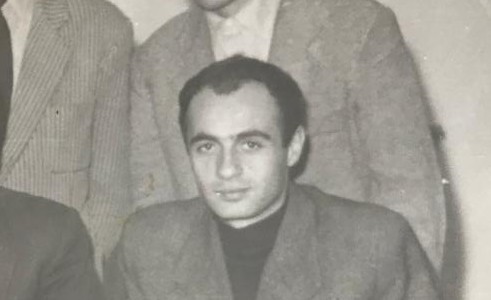

1 Josep Borrell (1947) is a Spanish politician who served as the European Union’s High Representative for Foreign Affairs and Security Policy from 2019 to 2024. In this role, he represented the EU in foreign policy matters and oversaw the EU-facilitated dialogue between Kosovo and Serbia.

2 Miroslav Lajčák (1963) is a Slovak diplomat and politician who served as the European Union’s Special Representative for the Belgrade-Pristina Dialogue from 2020 to 2024. He was appointed to facilitate negotiations between Kosovo and Serbia as part of the EU-led normalization process.

Download PDF