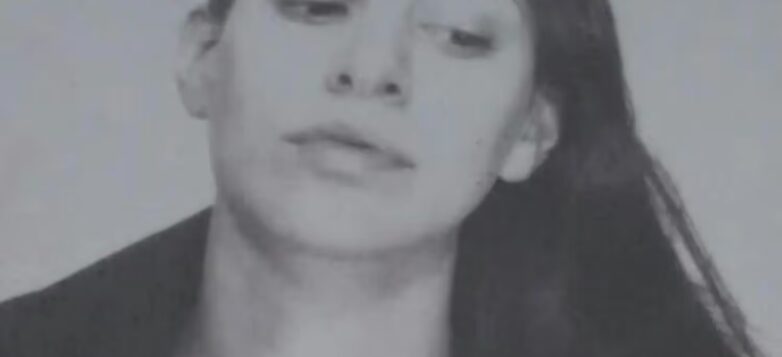
Ana Morina: If you could first just state your full name and where you are from.
Genny Petrotta: I’m Genny Petrotta. I’m from Piana Albanesi, an Albanian village in Sicily.
Ana Morina: And if you could maybe tell us a little bit about your background, how did you grow up, your childhood, and how did you really come to your artistic practice?
Genny Petrotta: Okay. Okay. I’m a visual artist working across film and performance. Okay. During my childhood, since I grew up in a very small village, without any cinema or theater or art gallery. Basically, this happened once: an Albanian director came in my village, and he just asked me, I was 15, he asked me to help for some research, people, location, and everything. I was super happy, like, “Okay, let’s work together.” But it was summer.
So then I was very curious. I studied, basically, Latin and Greek, then in the city, in Palermo. And then, when I started university, I start to study history of cinema and philosophy. But meanwhile I was studying, I was working, and I was working in cinema production as an assistant director sometimes, sometimes as a camera operator. Then I start to study also, to learn editing. And then, I mean, so I had this very theoretical education about cinema and art. But meanwhile I was studying, I was practicing more, more and more.
So then, when I– it was 2016, I founded a collective of four persons, and we were doing mainly video installation, and we were working for festivals, biennials. We were working Manifesta, or art spaces in Italy and around. And then, meanwhile, I was working still for the cinema production, and also specifically for other artists from Italy, from abroad. I was taking care of the production part, research, and then, in the last four, no, five years, I decide to work also about my project, and so I start looking for funds, for possibilities.
And so we are– this is very– it’s always strange, you know, when someone ask you when all of this happened, you know, probably I decide to produce image cause I was, when I was a child, I was writing poem. So this is, maybe, the honest answer to you.
Ana Morina: And then, what drew you to Villa 31, and how did that come about? And then, if you can also just say, for those who haven’t been to the opening, what the exhibition…
so um I wrote an abstract of this project few a years ago. Then last year I said okay let’s try to build it. Let’s try to build it. And soa friend of mine that also was working in the the production of the project sent me the application and cause to me it the only I mean maybe let’s start from the project
Genny Petrotta: So, um, I wrote an abstract of this project a few years ago. Then, last year, I said, “Okay, let’s try to build it. Let’s try to build it.” And so, a friend of mine that also was working in the production of the project sent me the application. And, cause to me it– the only– I mean, maybe let’s start from the project.
Since I grew up in Piana Degli Albanesi, that is an Albanian community, when a few years ago I start to read the Kanun, so I came across the figure of the Burrnesha, and I was really impressed by this reading. But then, when I start to do some research, it was very clear to me that this topic was very abused from the Western media and from the Western culture.
And the first time I realized that okay maybe let’s not focus about about this topic but then even in a stronger way I said okay so maybe there is something still to do it about it I mean in order also to change the gates at least mine about this topic.
And the first time I realized that, okay, maybe, let’s not focus about this topic. But then, even in a stronger way, I said, “Okay, so maybe there is something still to do about it,” I mean, in order also to change the gaze, at least mine, about this topic.
So for this I was thinking that it was very important to go to Albania and here before I spent like two months in Prizren in Kosovo I mean Prizren in Autostrada Biennale for another project and so I mean I was always looking at the mountain at the border between Albania and Kosova, I was like okay I should move I should start again this project.
So for this, I was thinking that it was very important to go to Albania. And here, before, I spent, like, two months in Prizren, in Kosovo. I mean, Prizren in Autostrada Biennale for another project. And so, I mean, I was always looking at the mountain, at the border between Albania and Kosova. I was like, “Okay, I should move, I should start again this project.”
So then, suddenly, this friend of mine sent me the application, and then I apply also in Italy for a fund, for a grant for performing art, and I got it. So it was perfect, because somehow I had this long residency in Albania, plus a support, plus funds from Italy for the performative part, and some festival for the– for bringing the show.
So first, I mean, Villa 31 is just not a residency in Tirana. It was a super strong and a heavy place to be. Somehow it was a perfect place for my project, cause my project was related about power, authority, gender, death also, because the framework, the poetic framework I chose for the project was Hamlet, and the former house of Enver Hoxha was an incredible place for that also.
Also, you know, when you arrive there, and the house, it was closed for many years, you realize that you are living in the former house of a killer. So everything is very heavy. But then, I have to say that, thanks to also the other residents and the people who were working there, somehow we built a beautiful community, and it was also very interesting to be part of the transformation of the villa. So we were supporting each other in a beautiful way, and I’m glad that I found such a beautiful person.
And so, about me, I decide to– for the open studio, to install in my room, in my studio, that it was Pranvera’s room. And basically, it was a three-channel video installation. It was a big projection on the wall, and then a vertical screen.
And, okay, I took this poem from Amelia Rosselli that is– was, because she suicided in 1996. And she rewrote the monologue of Hamlet, and we were working with Ledia Dushi, that is a– she’s a poet, an academician, and translator from Shkodra. And first, I contact her because she made a beautiful and strong, very intense research about the gjama e burrave, The Lament of the Men.
And to me, it was like, okay, since I work also with performing arts, how to embody this masculine gestural score. And so, I invited two performers to work first, during the work, at the villa it was just one, where we were working basically about the Gjama. So, thanks to Ledia, that she made a very intense research on the field in the past years about the Gjama, we did it, and we did it in the basement of the villa. It was very intense also because this ritual was also forbidden during the communist regime.
And then, also with Ledia, we translated this poem from Amelia Rosselli. And meanwhile, I was going often to Lezhë, because in Lezhë, because in Lezhë it was Drande, that is a burrnesha from Lezhë. We had a conversation that I presented just, it’s a written conversation, but she’s in the video that I present in the villa. And then it was this vertical screen with three channels of gjama e burrave, and then projection on the ceiling. So this was the space. I can send you, because it’s always difficult to– because it was an immersive installation. So maybe better to share some pictures, some videos, to understand better..
Then, after the opening, when I came back to Italy, I had to present the performance in Santarcangelo dei Teatri Festival. That is a place for performing art in Italy. And so we performed nine times in Santarcangelo, then in Centrale Fies, and then– so the project is still going on. We have to repeat it also next year in Triennale of Milano, and also I’m working about the film part of the project. So this is still an ongoing project.
This– the residency was perfect for many reasons. For many reasons, I have to say. Yeah.
Ana Morina: I want to go a little bit back again to living in the villa. And I understand that, for a lot of local people, this was a place that still has a lot of memory and trauma. And maybe– did this affect your process, or did this affect the work of how you imagined it in the beginning, and then how it turned out? I think what I understand is that you engage a lot with these historical narratives, but then, what is the process of putting them in this contemporary realm and local realm?
Genny Petrotta: I mean, for sure that– I mean, it’s not, for sure, it’s not a natural space. It was also, you know, strange, you know, once you arrive, you are living in the same space of the Hoxha family, and you have to deal with that. And for sure, you have to deal also with a lot of feelings.
I was dreaming a lot there. For instance, the first dream I had, it was about being poisoned. That probably is the trauma of every dictator, I guess. But I realized just after a few weeks. But every morning, I was writing all my dreams. I have to say, they were very vivid. I don’t have such vivid dreams, at least in the last time, but I’m used to have– I mean, to remember my dreams in general.
And for sure, I mean, it changed at least the first step of the project. Cause since, I mean, that place to me is related, is totally related to the power, the authority, the death. And, I mean, then how you can translate this into a work, it’s– I mean, you have many, many– every person has so many possibilities. To me, it was like, I think that I end up to work about the gjama e burrave, because it was something totally and, like, related to the death somehow, and with the legacy of the villa, because it was forbidden during that– at that time.
And then it was also adding something to my work, because it was like, okay, since I don’t want to speak about– I mean, I want to take space from all the sensationalistic, exotic topics about burrnesha in the Western culture. It was also a very, to me, at least, a straight way to engage, an embodying, [to] embody the discussion, living this through the body and through the poetry.
And especially in those kinds of places, you have to… I mean, again, when you realize you are living in the house of a former killer, I mean, even your gaze is a bit damaged about that. Because you are out from your balcony, I had such a beautiful view, like, a beautiful terrace, but, I mean… and also…
Since, I mean, I was talking a lot also with the people in Tirana, also about that place, what kind of symbol it was in the city, how they react also to a French institution coming in and transforming it– so there are many topics that are very delicate, I mean. So it was– but in the end, I think that the opening was a very important moment also.
I mean, cause something that was very forbidden to the public was finally for the public, and it was involving the public. So, let’s see. I’m very curious how this is going to change also the perspective of the people there, also somehow, how this can add something in the personal research of the artists that will live there. So, yeah.
Ana Morina: If you could also tell us a little bit about just the historical research part, and how these rituals and traditions were seen during communist Albania, and what you learned. Because we know they were banned, and a lot of things were… tried to still exist through very secret ways. So, if you can tell us a little bit, just the historical context of the two traditions, the burrnesha and the gjama e burrave.
Genny Petrotta: Okay. About the gjama, it was– I told you, it was very important to work with Ledia Dushi, because, I mean, she’s an academician, and she made such a long research in the field. And… I think I saw the first time thegjamaduring a lesson of Olsi from the Institute of Anthropology in Tirana. He was– we were having this lecture in the villa, and I realized it was something that was speaking to me in terms of… in terms of being included in the work.
And what I discovered is that it’s very interesting how this gestual score, that is very specific from Albania, but somehow, it’s something that belongs also to other traditions, and this very elementary gesture, it was also very interesting, because then I had to work also with another performer for the… in Italy. And it was very interesting how they– I mean, two performers, a very simple gesture, how they were embodying this in a very radically opposite way. So this is why.
because also speaking about burrnesha it’s something from the western gaze I mean it’s very empty because first then being a burrnesha you are Drande, Jeta [20:43] and everything I engage also this conversation with Jeta Luboteni that is a research clinician and she was a burrnesha since she was 18 until she was 28. She’s living she’s from Kosovo but she’s living in America. And it was very important to me to speak with her.
Because also, speaking about burrnesha, it’s something from the Western gaze. I mean, it’s very empty. Because, first, then being a burrnesha, you are Drande, Jeta, and everything. I engaged also this conversation with Jeta Luboteni, that is a research clinician, and she was a burrnesha since she was 18 until she was 28. She’s living– she’s from Kosovo but she’s living in America. And it was very important to me to speak with her.
And finally, when I sent her the shots, after we had many, many conversations about it, it was, to me, very important that somehow we were going under the skin of the topic. And so, yeah, I mean, I hope also to continue the project, and to… and to go deeper and deeper about it.
Ana Morina: Yeah. Just to talk about this idea of rituals a little bit, and I think I heard somewhere, in an interview, you said that the idea is to understand how we create rituals. But also, for me, it’s maybe to ask you, how do you see these rituals being reinterpreted in artist spaces? And is there this idea that maybe we are remaking the ritual, and it is binding the community back together? But then, maybe we are just kind of reimagining, and it’s more temporal, or maybe more in an intellectual, reflective tone. But how do you see it?
Genny Petrotta: I grew up in Sicily. There is a place where still rituals and that kind of– I mean, being touched to the rituals is still going on somehow. But, I mean, how to build a ritual and how to reenact a ritual is, you know, it’s– I mean, it’s very… it’s very difficult to answer. Because, I mean, somehow, the ritual is something that belongs to everybody, something collective, but can be also something very individual.
And first, when I was thinking about how to become a burrnesha, and still this is a ritual, because basically, in the rite of passage, you know, you just cut the hair, you dress up like a man, and then, when you are buried, when you die, you are buried as a man. You are [inaudible 23:42] as a man in the society.
So this is still something that, I mean, happens. We are used to think that rituals are something old– and we are, I mean– but it’s still something that is going on. And maybe less than in the last century, for sure, but still it’s something about identity, and about also– it’s not about just the identity of a country, it’s about the identity of the world.
Because I was always impressed when I was reading James Frazer, he was an anthropologist from the last century, that the same ritual about the fire, the same fucking ritual, were the same in Scotland and in Congo, 1,000 years ago.
So, I mean, we are more close than we think always, and that’s why– and again, why I was very sad about reading all the, I mean, all the Western interviews about burrnesha. Because it was always like, “Oh, it’s a very old country, being still touched with old rituals, it’s like something…” But, I mean, no, it’s not bad. I mean, and still…
So, again, going, maybe, trying to use Hamlet, that it was poetic framework, but that is not from Shakespeare. Hamlet is from everywhere. Hamlet is from the legend of the North, in many, many, many years ago. There is also a Hamlet from Persia. There is a Hamlet of Amelia Rosselli.
So it’s something that still, again, belongs to everybody, and is a rite of passage that talks about revenge, about gender, about death. So I think using the body is the possibility to work in a universal way.
Ana Morina: Yeah. To talk a little bit– I think you speak about gender a lot, and especially with burrnesha, it’s very obvious this is what it means to be a man and what it means to be a woman. But I find it, even in gjama e burrave, I feel like the ritual itself is so expressive and so emotional, and it didn’t really fall into this form of what maybe a modern communist man should be. How do you engage it with gender theories today, maybe, or gender topics today, in your work?
Genny Petrotta: I mean, I think both in a theoretical and in a very practical way. Because, using the gjama and the gestural score of the gjama, and working with a female performer embodying that kind of a gesture, it’s already something that, I mean, it’s not just related– I mean, I think all of us, since we are all women, speaking about, we embodied male physicality, I mean, some… we embody also the male physicality and the male, I mean, in our ways.
So it was a way to understand how… sorry, I lost the plot.
Ana Morina: How we embody the masculinity?
Genny Petrotta: How we embody the masculinity, yes. In the work, in… I mean, it’s something that, again, belongs to everybody, and… so this was the idea. I don’t know, what– in your experience, you ever embodied the male, a male way to be, in the work, in family, or…?
Ana Morina: Yeah.
Genny Petrotta: I think we all have this kind of…
yeah it is for me it’s more about this idea of femininity and masculinity and how we embody both and then how culture and how through history that changes I think today it’s a bit more easier to express both but…
Ana Morina: Yeah, it is– For me, it’s more about this idea of femininity and masculinity, and how we embody both, and then how culture, and how, through history, that changes. I think today it’s a bit easier to express both, but…
Yeah, but still not everywhere not for all of us so maybe that’s why still we have to [inaudible 29:17] something with our work like every kind of job in order to understand also you know in Greece in the theater in the tragedy where it was a female character Men were performing the female characters. So it was also kind of understand you know how this works in life in performance in art in everywhere I think
Genny Petrotta: Yeah, but still not everywhere, not for all of us. So maybe that’s why still, we have to want something with our work, like every kind of job, in order to understand also, you know, in Greece, in the theater, in the tragedy, where it was a female character, men were performing the female characters. So it was also kind of to understand, you know, how this works in life, in performance, in art, in everywhere, I think.
Ana Morina: You talked a little bit about how maybe the West sees burrnesha in this exoticized way, almost. But how was it for you to meet Drande, you said, in Lezhë? How did you explain to her what you’re doing and what you’re trying to achieve? Maybe, what was that relationship like?
I mean, first we start to– I mean, I start to drink raki at 9:00 in the morning. She does amazing raki, but she is no more drinking since 15 years. And nothing, I explain [to] her about the project, and I can also send you this conversation we had, that it was more about the rite of passage, and about her personal experience, about dreams, about…
I mean, to me, the way of the Western media to approach this topic, it was very paternalistic. And it is, because it’s very judging in a… I don’t want to say– saying it in a “stupid” way is true, but it’s also stupid to say in a stupid way, because it’s not stupid, it’s very, it’s intentionally, and it’s intentional, so…
And so, I mean, it was super important to me to speak with her, to understand also how she decided to embody that kind of role in the society. And all this complaining of the Western culture about “poor girl, they have to [inaudible 31:49] about sex, biri biri bi [blah blah blah].” She was super straight, she was super strong, probably one of the strongest person I met in my life.
And yeah… I mean… what I can say, I want to just meet her again. I’m going deeper and deeper and deeper, and we had beautiful days together, and… and it was like also she told– I mean, she told me also how generally, the troop, like the cinema troop, or they came and they just, like, “We have to do this, this, and this.” And then, like, okay, it’s a totally unconstructive way to use a topic without building any connection.
And this is also why it’s very stupid what you can read about it, most of the time at least. So I think, in general, we are full and overwhelmed about information, and this in all the topics, so it’s always– it means we lost the deeper part of the… of the people, of the… of everything.
Diona Budima: I was curious about how you’re connecting these multiple channels together, the burrnesha, the gjama, and Hamlet. There is this thread of gender switching, right? The burrnesha cross-dressing, and then a woman performing the gjama, which is traditionally male, and then engaging with Amelia Rosselli’s interpretation, in a way, of Hamlet. But why did you choose these particular corpuses? In a way, they’re very canonical, right? In Albanian folklore, the burrneshaand the gjama are very canonical, and Hamlet is as well, you know, maybe the most canonical work. Why these particular phenomena?
Because my feeling was and still it is that all of this was a dialogue in a good way in a deep way about the process about the project about also I mean in Tirana Villa 31 it was just the video installation. then in Italy we had the show and it was the live music, the video installation, the performer inside the space and it was I mean it was also and to me it was also okay now I’m going to Italy to and the audience it will be the the western gaze I mean it will be not like Balkans audience. I mean there are it was also someone from Balkans but I mean it was an international audience and especially from Italy. so to me it was okay let’s give an immersive space to understand let’s work under the skin of this topic. Let’s be [inaudible 35:43] let’s be accessible to everybody somehow and… I mean for me it was not to write an essay about burrnesha or about gjama e burrave I’m not experiencing that but since I like to work with identity and poetry and it was to me it was the and film it was the way to connect all of these
Genny Petrotta: Because my feeling was, and still is, that all of this was a dialogue, in a good way, in a deep way, about the process, about the project, about also… I mean, in Tirana at Villa 31, it was just the video installation. Then, in Italy, we had the show, and it was the live music, the video installation, the performer inside the space.
And it was, I mean, it was also, and to me it was also, okay, now I’m going to Italy, and the audience will be the Western gaze. I mean, it will not be like a Balkans audience, I mean, there was also someone from the Balkans, but, I mean, it was an international audience, and especially from Italy. So, to me, it was, okay, let’s give an immersive space to understand; let’s work under the skin of this topic. Let’s be oneiric], let’s be accessible to everybody somehow.
And… I mean, for me, it was not to write an essay about burrnesha or about gjama e burrave, I’m not experiencing that, but since I like to work with identity and poetry, and… it was, to me, the way, and film, it was the way to connect all of these. Then, to me, it’s also– I don’t know if you have seen anything, like any image or video because it’s always, you know, I’m speaking, but I think it’s also part of the experience to be inside, or at least, to see a bit.
Ana Morina: You talked to us already a little bit about the future of the project, and that it’s still going on and it’s going to be shown, but you said as well you want to make a film, if–
Genny Petrotta: Yeah. Yeah. Yeah. Yeah. Yeah. Yeah.
Ana Morina: About the whole thing, or just burrnesha? I don’t know if I…
Genny Petrotta: It’s a– I mean, it’s still, it’s… it’s, yeah, it’s a movie. It’s about all the things we already did. But, yeah, I want to develop more in terms also of the poetic framework of Hamlet. So, yeah, I’m writing about it, and, yeah, I hope to come back soon to Albania and Kosovo to develop the next stage of the project. But, yeah.
Ana Morina: And Diona, if you don’t have any more questions, we asked– Diona asked a very nice question at the end, which is, “What are you excited about in the future, be it socially or artistically or just personally?”
Genny Petrotta: But there is no division in between the socially, artistically, and personal. I mean, it’s all connected. And yeah, now I’m working about this– we have a performance in Palermo during this festival, Mercurio Festival, with a group of people. It’s a collective creation about this woman that… yes, 400 years ago was selling poison to the ladies who were very in a shit marriage, and were so… and then she was killed in the square of Palermo, cause, I mean… so now we are working about this.
And it’s a transnational project because we are Italian, French, Iranian people, working about this subject, and it will be a video and performance about 20 minutes, and we have the presentation at the end of September.
Then, since I’m a freelancer, I’m working also about a movie of two artists that I’ve been working with since 10 years, Masbedo, and we are working about a movie between Iceland and Stromboli, a small island in Sicily, a volcano, basically. So we are working about that, and now I wish to, I mean, get funds to continue, also to bring my [inaudible 39:39] project, I’m going on with that. And also, I’m working, and this is long-term work, it’s all life work, about an arbëreshëarchive of my community, visual archive and sound archive. So I started last year, and I think I will end when I die. So, yeah, it excites me a lot.
Ana Morina: Thank you. I will ask one more additional question. Is it– how was it showing this particular work in Tirana, and then in other places? Did it have a different feeling for you?
I was thinking yes for sure It was in the beginning when I was in Tirana but it was I have to say the audience and also the operators were very happy with the work but yeah in the end it was very same to have also the same kind of reaction also abroad like in Italy that it was okay to me it was something good because it somehow… yeah let’s see I’m still curious because we have another moment in Triennale Milano but I want to propose an extension of the work and let’s see yeah let’s see
Genny Petrotta: I was thinking yes, for sure, it was in the beginning, when I was in Tirana– but I have to say the audience and also the operators were very happy with the work. But yeah, in the end, it was very same, to have also the same kind of reaction abroad, like in Italy. That was okay, to me it was something good because it somehow… yeah, let’s see. I’m still curious because we have another moment in Triennale Milano, but I want to propose an extension of the work, and let’s see, yeah, let’s see.
Ana Morina: Okay. Well, thank you so much for taking your time to talk to us.
Genny Petrotta: Thank you.
Diona Budima: Yeah, it was so nice meeting you.