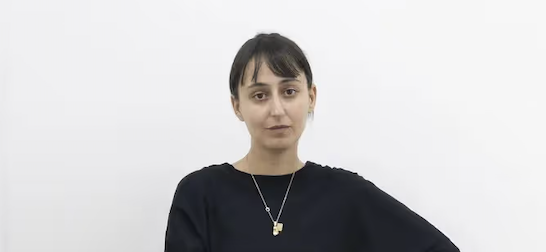
Diona Budima: Could you just state for the record your name and when and where you were born?
Stanislava Pinchuk: Stanislava Pinchuk, and I was born in Kharkiv in Ukraine. And now we’re talking in Sarajevo, where I live.
Diona Budima: Can you tell us a bit about your background and how you came to your current artistic practice?
Stanislava Pinchuk: Yeah, yeah. I think I… I mean, I studied philosophy first of all. And as a teenager, I kind of fell into a lot of, like, punk rock culture, and zines, DIY, skating, graffiti, street art. And that was a really big part of my life. And I think maybe from there I kind of found that there was an art world, there was a bigger art world. And I met, you know, a lot of older people who were doing things. And I ended up studying philosophy, I kind of didn’t want to go to art school. I thought maybe I would do it for my masters or something, and I never did.
But I thought I kind of wanted to learn… I don’t know what to paint about rather than how to paint, necessarily. And I’m glad I did, because I think it informed my practice since then. And I think, since then, I’d say it’s been kind of informed, perhaps by just following curiosity. So you know, my work, it’s kind of now a very much about finding the right medium for the right idea and kind of very naturally, kind of first went to kind of more gallery work and data mapping conflict zones.
And, you know, a big part of that is the situation of Ukraine for the last eleven years. And then kind of, yeah, maybe breaking out a bit more into sculpture and architecture, installation, film, coding and you know, so I, I kind of, as an artist, kind of like to surprise myself. And then I like to surprise others. And I think maybe that’s kind of what’s guided, the artwork to kind of what it is now. Yeah.
Diona Budima: What kind of philosophies were you interested in when you were studying philosophy?
Stanislava Pinchuk: I really loved the Greeks. I really loved the Greeks. And I think you can see it in my work now, you know, to make, you know, I just made these two quite big works side by side of that, you know, one about Homer’s Odyssey and one about the Iliad. And I think it’s still kind of, yeah, I think it’s still coming through in a lot of ways, and the next works that are coming up. So I think it’s never left me. But I’ve always really loved the world of the classics, and phenomenologists, I really loved and in fact, this last body of work I made was very, very indebted to the writings of Georges Didi-Huberman, who I mean, for me is such a phenomenologist. So, yeah, I think it really did actually shape what I do very, very much.
Diona Budima: Are there any recurring themes in your work? In the body of work?
Stanislava Pinchuk: Yeah. Yes, I think so. I think it’s been very much… Maybe one very, very big thread is this kind of negotiation of conflict, of war, of post-war space, of the political space. Yeah. Which I think is quite autobiographical. And then more recently, which I think was very much about kind of ground and geography, and maybe to kind of speak of the ancient Greeks, you know, as kind of, you could say this idea of, you know, geometries, Earth measurements, it’s kind of quite always been quite radical to me.
And I think since I kind of had a lapse in doing field work in the pandemic, because I could no longer work to make data maps of sites of conflict. I think that data, that interest in data and kind of Earth measurements very much kind of entered the space of language and translation. And I think also very, very influenced by having moved to Bosnia and Herzegovina and kind of being in a new language and learning a new language and being between language and translation.
And also kind of this era of conflict we live in now, which is so shaped by language and the power and interpretation of the world, which also I think goes so full circle to ancient Greeks and the kind of idea of debate and discourse and just distilling kind of concept and meaning and practical action. So I think that’s also been maybe the big thread of the work, increasingly, it’s also the way that language and literature and translation kind of enter that through [a] line of conflict, I would say. So I think, yeah, it’s very autobiographical in this way. And, yeah, whatever medium that it’s expressed in, yeah.
Diona Budima: To switch our attention to the work in Tirana, what drew you to apply for the residency?
Stanislava Pinchuk: I think at first, I would say that it was kind of a way for me to maybe close my own personal understanding of European communism, you know, because I was born still under the Soviet occupation of Ukraine, you know, and so I grew up in the fall of communism and the years after the fall of communism. I live now in the former Yugoslavia, which is also a very, very different history. And so for me Albania was this kind of very… just maybe my own sphere of understanding, this last piece of the puzzle, you know, and I think because of the the kind of politics of the Soviet Union, now in the rhetoric of Putin and the, you know, Russian invasion of Ukraine, it’s this kind of ideology which refuses to die, this totalitarianism that refuses to die.
And, you know, you see it in the tanks that, you know, the hammer and sickle spray painted on the tanks that entered Ukraine. It’s the hammer and sickle spray painted and communist slogans. “USSR number two,” you know, 2.0, whatever. You know, leftist graffiti by occupation soldiers. And so, yeah, I kind of also began to think about this idea of this kind of communism and kind of refusal of an ideology to die and also kind of palette. It kind of lingers as a sort of undead, you know, kind of, in this kind of zombie that’s also very real, you know. And so, yeah, I suppose that was a kind of really big question for me personally and intellectually, that I felt…
I don’t know, Albania was somehow a part of that research, or that kind of wider framework. And I think there was also a second part, which, you know, I mean, it’s just such an extraordinary kind of idea and opportunity and… I guess, you know, kind of having been born in like I said, in this, you know, quite ordinary communist occupation setting, you know, and like really not any… and no special story, you know, just another shitty apartment block and, you know, with not much going on. And then, I don’t know, I think there was this idea that, you know, you never know what the future brings, that you could live in the house of a communist dictator, you know, and how crazy the future is, you know.
And what a thing when you grow up, you know, kind of… In circumstances that kind of robbed
your future, what the future can be, you know, and I guess I was also kind of quite fascinated by that. To experience that. I mean, what a privilege. You know. Also, you know, it’s heavy work. It was heavy work, it was a heavy place to be. But also it’s real like a dream, you know. Yeah.
Diona Budima: Yeah, I wanted to ask about the heaviness of it because obviously that site is a site of trauma for many people in Albania, and you know, people have had such a mixed response to the opening of the Vila and turning it to an artist residence. And I guess, I mean, you spoke a bit about it, so I just wanted to know more about your experience of living there and how… and especially because your work is so closely tied to the space as well. Yeah, how that felt for you.
Stanislava Pinchuk: Yeah. Look, I think there are no easy answers, you know, and I have a lot of thoughts in a lot of directions about this. It’s a really heavy place, you know, it’s a really heavy, heavy house. It occupies such a heavy place in the city, you know, like, it’s just, you know, kind of [an] island, but it’s almost like a black hole, you know, in the city, like it’s… And the way that when you’re inside and people don’t look, you know, they walk past and they don’t even look at the house, it’s… And you feel it, like it’s… And you feel it inside the house. You know, I didn’t sleep for three months, my God, you know. And the dreams and everything, it’s really, really heavy. Really heavy.
Diona Budima: We’ve been hearing this a lot from the residents, saying that they had trouble sleeping.
Stanislava Pinchuk: Yeah, yeah. But I think at the same time, you know, we’re not here to do easy work, or convenient work, or ideologically convenient work. You know, you take your one experience of being an artist on this planet and you do it right. And I think this is a place with no easy answers, you know, and I try in my work and my kind of teaching, it’s something that I try to do is really not be didactic, nor do I try to be solutionist, you know, and I’m not sure this is a house with an easy solution, you know.
And I think what appeals to me about the idea of a residency is maybe this isn’t the solution forever. Maybe it’s not the right thing for it to be forever, but maybe it needs to pass through these ten years, or, you know, maybe then it can become a museum, or be demolished or whatever happens. But maybe what I’m kind of interested in are ideas of transition and kind of transitional justice. And, you know, these kinds of frameworks within wider restorative justice, you know, and I think it’s very, very difficult because I think there is so much to grapple with.
I think in Albania, on the whole, culturally, I think there’s still a lot, a lot, a lot to grapple with. And I often do question whether Albania is also really ready for a project like this. You know. And even doing some of my research and trying to kind of find information and seeing other artists as well, I did find a lot of obstruction, you know, and people still trying to kind of cover the history or apologize for history and the kind of other tension and suspicion of also what’s happening in the villa.
And also you just kind of seeing how many of this kind of zombie communism is still around, was, you know, really… I mean, it’s nothing, I don’t know from Ukraine, you know, but I suppose, will kind of change that a lot as well. You know. Ukraine is kind of… yeah, post-Soviet mentalities. So, yeah, I guess I was kind of very interested in the potential of the residency to be a place of transition, of questioning and not giving answers, but actually being there not because we have answers, but because we have questions.
And I do think that the criticism that the project got, which I do understand, and you know, we were the first group in so we also didn’t know how a lot of it functioned. Nobody did. We were sort of figuring it out on the spot and, you know, we didn’t come to an established way of working, or being, or communicating and something that I think would have been really… could have been handled in a different way is maybe the kind of press releases and public communications of this project.
Instead of kind of putting artists and arts workers on the firing line, is, I think to call it a residency in a city that doesn’t have existing residencies, for example. So you can’t point to something else and say, like, “It’s going to be like that,” you know? So when people kind of saw it as a party place and the way that the first kind of fliers and things, kind of, I think didn’t acknowledge the heaviness and that the show that was put on, we kind of had to figure out where we showed the works ourselves.
We didn’t have a curator or somebody who thought about it more holistically or structurally, about how people feel when they walk in and how trauma, and tension, and pain mediated, you know, which are all really, really real and also really heavy. So I do think it could have maybe benefited from maybe communication, or maybe even just some different phrasing, like to call it like a “living museum,” or “temporary, transitional,” you know, “space,” or “project,” or you know, or maybe kind of soft launch it to the people that are also kind of…
Ready or have a bit more of a say or, you know, because I do think it came from kind of a very elite level of… kind of, I don’t know, government and international cooperation with France, who I would say didn’t always understand the heaviness of the place, which was in my experience of kind of having gone through the process and being part of it. Yeah.
Diona Budima: And then your work sort of had to carry that heaviness that people brought, but in the first session, it was like the first time that some people were seeing the Vila, majority of the people were seeing…
Stanislava Pinchuk: Yes, yes.
Diona Budima: Yeah. And so I feel like the works also received all of that baggage. But in a way, it wasn’t sort of yours.
Stanislava Pinchuk: They did. But also, to be honest, sometimes the baggage was also not received, you know, and I kind of thought I made work that was quite, for me, vulnerable in a lot of ways. And, I also found, like, yeah, I don’t know, some of the reaction, you know, especially when you make a work as a woman about humiliation. You know, I was also, like, sexually harassed, you know, for the work that I put out there because it had my nudity, you know. We had people stealing our things, you know, like, from our studios from, you know, I had people posing with my props, which were really heavy. And, you know, it was a work about genocide of Ukrainians and Holodomor.
This, you know, which my grandparents survived. And it was, you know, it was a really heavy work that I made in this space, which, yeah, I think also in turn, wasn’t always respected either, which also made it very difficult, you know, and I think this is what I say when I researched this kind of… You know, I mean, this is what we do. This is our job, this is our life. But it is the kind of, you’re in a very, very interesting kind of mediation as a creative between a lot of very, very different forces, you know? Yeah. But I mean, this is what we do, you know. This is the life and yeah, again, it’s not always been answers, but the questions, it’s you know…
And I don’t mean to say it in, you know, it’s, I’m not saying it like a value judgment per se. I’m just kind of describing it, if that makes sense. It’s not a it’s not a complaint.
Diona Budima: No, of course.
Stanislava Pinchuk: It’s just an assessment, I suppose. Yeah.
Diona Budima: Could you describe your work? Because we’ve been just skirting around it, so.
Stanislava Pinchuk: Yeah, of course.
Diona Budima: If we can really dive into, if you could just describe the work, the installation, and then which you also showed in your studio and the reason behind it.
Stanislava Pinchuk: Did you see it?
Diona Budima: Yes, I was there.
Stanislava Pinchuk: Were you there? Ah, very cool. Okay. Amazing. I… Yeah, it’s kind of a hard question to answer in a way, because the project is not finished, you know, and I actually need a little bit of time now because I think everything was so intense, you know, with the villa, the making, the opening. And I really made this film for the space that it was shown in, and the space that it was filmed in. So it was kind of this, you know, film that was like a meta architectural view onto where it was shot. And now that, you know, it won’t be shown ever again in that space, I have to kind of think about it more, with a bit more distance, you know, which I haven’t kind of yet been able to… find, I think. Yeah.
Everything was so intense that I think I need to actually leave it physically away from me for a little while. But basically, the first cut, which was shown in Tirana. And the basis of the work is a three channel video installation, which is kind of a half performance work, half kind of vampire film in which I undergo hypnosis in this kind of vampiric sense to… and kind of the way I’ve been speaking about this kind of idea of the monsters, and accusations of the monstrous and undead ideology, and the kind of fundamental violence of a totalitarian society in which these accusations are leveled in every possible direction.
Elites to workers, to neighbors, within families and so forth. It’s work in which I undergo hypnosis to forget Russian and to kind of become a post-colonial body to… or whether it’s possible, whether it’s possible to get rid of the tongue in this very vampiric, you know, Bram Stoker’s Dracula way, where your tongue is severed from your throat, you know, and all this kind of ideological basis for why Bram Stoker and this whole Vampire fiction of the 19th century was kind of an ostracization of the kind of Eastern European Balkan body. So yeah, it was kind of filmed and shot in the villa, which just features me undergoing hypnosis.
It’s in kind of three different settings. And now it’s become a little bit bigger. I think it’ll actually be a series of paintings. And I’ve been working on a book of Hoxha’s private library inventory, which I found and kind of realized was quite incomplete. And so I have actually finished the second draft of the manuscript yesterday. And that’s also a kind of, I think a part of it, because it started as trying to find the vampire books he was reading and kind of going to sort of figure it out. And then it became a much bigger project because also, you know, he was reading The Greeks, the Philosophers, the Odyssey, Iliad, and he didn’t have the Iliad part, and he did have the Odyssey, but I found…
And a lot of like the ancient materialists, he really read a lot of that. So I think I started to, again to find these kind of threads of data, and conflict, and literature translation, because he was reading mostly in French. And I think through doing this really intensive cataloging process and making a book of that, is somehow, I think the project is still growing and resolving, you know, like very fresh, you know. So actually, I think that probably the final work from the villa is to be very honest, maybe about a year and a half away from actually being shown. Yeah. Yeah. So I think it kind of started a bigger thing than I expected, actually, to make a concise work in three months.
It’s just become, it’s kind of exploded without an answer yet, but yeah.
Diona Budima: That’s amazing. The initial questions for fertile ground.
Stanislava Pinchuk: Yes.
Diona Budima: But I’m also intrigued by your inspiration from this excavation of the body of a woman in Poland who is thought to be a vampire, who was buried with the sickle around her throat and the padlock on her toe. Could you say a bit more about that and how you transformed it? Because in your work, then, there’s, I mean there’s a materiality of these tools.
Stanislava Pinchuk: Mm-hm, mm-hm.
Diona Budima: But also there’s symbols of communism. But could you speak a bit about that inspiration?
Stanislava Pinchuk: Yeah, yeah. I, this woman was found only recently, maybe like two or three years ago. And so the work is still kind of ongoing about her. And she was the genesis for this project, reading the news articles and whatever I could find that was available from the universities. But basically, you know, she was found, she was buried 400 years ago, and I think she was in her early 20s, is what they think. And, you know, very much like the vampire or kind of undead stories that I grew up with, that there were always these almost tricks that people, that the undead would die again if they woke up, you know.
So they would have, like, a padlock or like a little bell on their foot in case, you know, that it would kind of alert the people that they had woken up and that if she, I guess the idea here was that if she woke up again, that she would cut her own head against the sickle, you know, and when when I read that, I thought, what an apt symbol for communism’s kind of totalitarianism with: one wrong move against the symbol and your head is cut off, you know. And it’s so true of this, like, fundamental political structure, communism, where, you know, one wrong laugh, one wrong eye roll, one wrong smile gets you, you know, killed or sent to prison or the gulag or whatever, you know, and condemn your home, whole family, you know, and so you’re always kind of keeping watch for the monster as well, because you’re kind of, you know, one wrong move.
You know, it’s like a horror film. You snap one twig when you’re walking in the forest and, you know, you’re found out, you know, it’s like this. And I thought, what a powerful symbol, especially, you know, the Holodomor and Communist occupation, when the people’s tools, you know, the sickle of agriculture, Ukrainian agriculture and wheat was also used against people to, kind of also sever this, that, you know, people and, don’t get to eat, you know. And, you know, exactly what’s going on with Gaza now, you know. And I refuse to call it famine, you know, because it’s not, it’s… A famine is when the crops fail, here it’s, you know, very deliberate starvation and denial of delivery and distribution of food. It’s completely manmade, you know. And so I suppose these things have been on my mind in a big way, in multiple ways and again, in full scale invasion of Ukraine and the kind of wheat and food security politics and…
So I think that was kind of, the symbol of this woman was kind of apt on multiple levels. And also the fact that she herself, in this kind of really amazing way, was also sort of rescued from the dead, you know, in that, she was buried for 400 years until they found her. And now she has a name, they call her Zosia because they felt weird to call her, like a number or specimen. So they gave her a name and they reconstructed her from her DNA and kind of made… Now she has a face, like a 3D model of what they think her face could have looked like. And so in this kind of extraordinary way, she also really came back from the dead, like she really is a vampire.
Diona Budima: Yeah, I think one of the archeologists was saying that they did everything to make sure that she doesn’t rise. And now we’re doing everything to bring her back to life with the reconstruction.
Stanislava Pinchuk: Yes.
Diona Budima: Yeah.
Stanislava Pinchuk: Yes. So that was kind of the big genesis of the project. And I think why I put all my notes and research out there was because I knew this wasn’t the final version of the film. I knew this was a draft, but I think what’s really interesting about communism, what I really noticed in Albania is so much of it is not written, you know, and there is so much that is just oral history or urban legend. And there were so many things that I found out very late in the residency or the making process. Just because you are in the right time and right place to talk to somebody, you know. And that’s… The big reason that I wanted to show the film as a first draft and put my notes on the wall, which I never do as an artist. It’s… This is never my process. I always put like a very resolved, finished, polished work out there.
Also because I wanted to kind of cast everything out to see what would come back in just speaking to people. And people telling me what I should look at, or go and read, or who to talk to, and that it was still like a kind of one part of this sort of generative process of this work. And it really did happen like that, you know, and I’m still following up a lot. So I think that that’s where also these kind of sites of trauma and ambivalence and transition are also, for me also kind of really interesting. And what they’re able to generate, you know, and kind of centralize these sort of decentralized things and kind of redistribute them again, you know, this kind of contamination point. So I suppose, yeah.
Diona Budima: To stay a bit longer with this image of the body [inaudible 30:21]. In your talk with Jacob Mikanowskiyou mentioned the notion of ketman.
Stanislava Pinchuk: Ah, yes. Yeah.
Diona Budima: You know, which roughly translates as dissimulation, concealment. It’s actually a Farsi term.
Stanislava Pinchuk: Yes.
Diona Budima: Czesław Miłosz was inspired by this term to speak of subjects under totalitarianism, very much on to the Hannah Arendt’s notion that totalitarianism creates these subjects that are incapable of critical thought. Miłosz was kind of saying the opposite, that they actually become very dexterous. They develop these mechanisms and create these sort of private sanctuaries, when there’s exterior, yeah, exterior coercion. Could you speak a bit more about that? About this notion?
Stanislava Pinchuk: Yeah, yeah. I mean, it was extraordinary how Jacob talked about it because it’s his PhD thesis, you know? So I also I also feel a little bit inadequate compared to, you know, his world with Miłosz, at the moment. But, I guess if I had to kind of make my own assessment, I would say that kind of both things are true somehow, you know, at the same time, I think both of these kinds of assessments are true. And I think about one of my big heroes on this creative life was, kind of very dissident Serbian architect called Bogdan Bogdanović, who was a really big, kind of first big critic of Milošević, actually. And was kind of sent into exile into first Paris, then Vienna.
And he writes… he has this amazing book called The Green Box and he writes how, yeah, like he was he, he found these ways around it like he was the ketman, you know, and he found these sort of ways around it. And until he found that it affected him, like he became then the kind of Hannah Arendt idea, like he actually did become completely kind of… He noticed that the censorship was actually kind of killing him on the inside, even though he’d been fighting it. And so he started this project called The Green Box with his students, where he would, it had no answer, like it was like The Green Box, and every dream, every thought, every idea that he and his students had, they would just write it and put it in the box.
Just so they would be like, free, like they would, like, let go of these ideas and they would like, wash them through and not internalize them, and that they actually had to kind of almost fight to be the ketman, you know. And when it kind of got really hairy for him and he had to flee, they sent people to his house, he smashed the box and took all the little notes with him and hid them, like, just everywhere, because the border police would be too stupid to figure it out. It wasn’t like a manuscript. And then it was the last book he published, where all the notes of this green box. And it’s like this, it’s the most like, I have like goosebumps just to talk about it.
It’s the most kind of, I don’t know, incredible project. This is a bit of a sidebar, but, I don’t know, maybe I think these two things are true at the same time. I don’t know. I always felt like he embodied it in this moment, you know. And, yeah, like what it takes to stay a free thinker. Yeah.
Diona Budima: I feel that’s another important line of thought in your work which responds, I don’t know if this responds, maybe this idea of the vampire as a way of thinking, the post-communism and the body in this post condition. And yeah, the figure of the ghost as the ghost, and vampire as this thing that refuses to die. When you were talking to Jacob, I was reminded a lot of Derrida, and like his book Specters of Marx.
Stanislava Pinchuk: Yes, yes.
Diona Budima: His very, like, cheeky response to Marx’s language first of all. Marx’s, like, dialectical materialist parts along…
Stanislava Pinchuk: Yes, yes, yes.
Diona Budima: Parts of his book. The first noun of the Communist Manifesto is “spectre.” Like in, materialism sneaks in through metaphors, through language. Yeah. And then secondly, Derrida wrote that after the fall of the Berlin Wall…
Stanislava Pinchuk: Yeah.
Diona Budima: And there was a lot of talk about the end of history, and how…
Stanislava Pinchuk: Oh yeah. That old thing. Yeah, yeah.
Diona Budima: And how, well the end of communism and the triumph of the free market was sort of the fulfillment of human history. And Derrida was saying how injustice and inequality remain as the specters of capitalism, like communism might have fallen, but Marxism still returns. So could you speak a bit more about the post, about this post communism, and the body and… How can we be post?
Stanislava Pinchuk: Yeah, yeah, yeah. I guess that was the big question, “Can we?” you know? “Can we” and when I say like, accusations of the monstrous exist in a kind of violent society on every level, you know, colonial societies, totalitarian societies, you know, this violence is kind of at every, it’s aimed in every direction, you know, not just within, you know, government and the people, but government at work, government, you know, people within their own families. And I’m not exempt, you know, in the film. I think that’s why I’m also, I’m also the monster, you know, because there’s this kind of I don’t know, really interesting psychology in my generation, I guess, because you still have this kind of, somehow by having been somehow this sphere of communism is somehow the monster within you, is the apologist, is the, you know, the colonial language is still somehow within you, you know.
And I use some, is it somehow the monster is also deep in there somewhere that you don’t even know, you know, on a very subconscious level. So I think this is what I mean. I don’t mean to make like a kind of didactic or denunciatory work. I think it’s a very, really complicated work about who the monster is, you know, because it’s like, you know, the, the party leadership calls a lot of, you know, common people and, you know, traitors and so on, the monster. The people call the leadership the monsters, you know, and it’s kind of this, you know, neighbors call each other monsters, families call each other monsters, you know, report on each other. I mean, this this is the kind of violence in this society. But I think I have to say, I don’t think I was thinking a lot about Deleuze… Sorry, I wasn’t thinking like about Derrida, but I was thinking a lot about Deleuze, actually, and his kind of idea that the symbol is not really the symbol.
The symbol is actually this kind of much more elastic and kind of, I don’t know, fluid hieroglyph or something, you know, because I was, you know, very nervous to use, and I’m still very, very nervous to use the star, the hammer, the sickle, even against themselves because, you know, legally in Ukraine, it’s also, these are now, like, the equivalent of a swastika in Germany. We can use them for educational purposes, but you know, anything else is, you know, outside of the law now. So, you know, they’re really heavy, they’re really, really heavy symbols. And I think kind of thinking about this in, yeah, more this kind of, I don’t know, maybe kind of dialogue between Deleuze and post-communism and the kind of, dilution of the symbol and it maybe transitional also point of the symbol.
Was maybe what I was thinking about. But yeah, I think something that Jacob wrote in his book, which was a really big reference for me, and it was so extraordinary to speak to him in person about it. And he wrote also about this, about Yugoslavia, you know, and, and kind of also communism, that these were all based on acts of, like, mutual forgetting, you know? Like, “Nobody was a Nazi, nobody was a Četnik, we were all partisans. We were…” you know, like everything’s gravy. And then there was a time when, like, those corpses could no longer be buried, you know, that they kind of, almost like the ground expunged them, like the ground almost, like, rejected them, you know, and these, we had to kind of deal with these corpses, you know, and communism was very much…
That as well. And these kind of, yeah, zombie communist, early proto-capitalist cowboy years, this was a kind of a really interesting time to grow up and you know, and more interesting now in the kind of rearview image of history and, yeah. So I think maybe this is also, kind of has a very interesting relationship with the undead, that the dead could no longer stay dead in the way that they were dead in this time, you know? And, and… Yeah, and I think it’s really true now in the kind of contemporary, you know, context of what it is, I think, to be in the Balkans now as well, and to kind of find, you know, like the position of Bosnia, the position of Kosovo, you know, like, these kind… like how impossible these acts of forgetting are, you know?
How like, truly impossible, you know. And maybe it’s really necessary that it is impossible, you know. Like, and not to do this thing again. So, yeah, I don’t know. Maybe this is what I’ve been thinking about a lot as well, kind of how it pertains to these kind… Yeah, I don’t know, regions of my life I suppose. Does that answer the– Sorry, does that answer the question?
Diona Budima: It does.
Stanislava Pinchuk: Yeah.
Ana Morina: I want to ask a question, a bit to touch again on the symbolism and how it sort of changes through time. But then I feel in today’s time there’s a lot of revival through aestheticism, and maybe how do you interact with it, or how do you see it, or how it affects your process?
Stanislava Pinchuk: Yeah. I mean, it’s kind of a pretty broad question, I suppose, in that way. And I think I’ve seen a few things… I’ve seen a few artworks recently from kind of former communist countries, like Romania, Bulgaria, that I found a little bit objectionable personally, like, I did find them a little bit nostalgic and a little bit maybe contrived a little bit, I suppose, in kind of really understanding the past. And it’s something I’m… yeah, still really sensitive about this work of mine, and I’m trying to work out, but I suppose maybe a larger question about kind of revivals. It’s very hard to answer because I think it’s so circumstantial to what is revived and why, you know, and by which country or which subculture, which genre or whatever.
But I think that generally always speaks to the kind of a cultural need, you know, the way that we talk about the past often doesn’t speak a lot, as much about the past as it speaks about the present, you know, and like any, you know, historical adaptation, let’s say in film or whatever. Like it’s so impossible to make a period piece because it’s so rarely accurate, because it’s always kind of filtered through like a beauty standard, or architectural standard, or material availability of like the time that it’s made in, you know, and like, why, you know, why it was like, why were the, you know, 80s so kind of obsessed with the 50s, and the 70s obsessed with the 30s. And now, like, kids are obsessed with, you know, Y2K and, you know, so on.
It’s like, I think because it… I think the most interesting thing is always about what it… What does that fascination, or uncovering, or investigation, or appropriation kind of say about the needs of the current moment, you know? Yeah. Whether it’s a kind of reclamation of like anti-colonial history or, you know, to something like, I don’t know, a pair of low rise pants, right? I’m not sure if I… Did I understand correctly, or?
Diona Budima: Yeah, it always seems to be symptomatic in a way. The possibilities of the present. And I’m thinking of Mark Fisher’s term, cancellation of the future, where it’s saying, you know, we keep returning to the past because creativity is no longer possible under this form of late capitalism.
Stanislava Pinchuk: Yeah. But I was thinking a lot about the end of history. I mean, the previous film I made before this one, The Theater of War, that was about Homer’s Iliad, was, kind of, yeah, completely about this sort of idea of like… That there were, at some point, there was a kind of an “end of history,” you know, and the marbles and… Yeah, I’ve been thinking about it a lot because I think we’d really… I’ve been trying to figure out personally whether it’s like… Is this just growing up or is the world insane? You know, am I burdened and overwhelmed by the world because this is what it’s just like to be in your mid 30s, you know, and kind of ascend to some level of like, yeah, responsibility? Or is the world just particularly, especially insane right now? You know, and it’s really helped to speak to older people to understand that the world is fucking insane, and that there also was a period that we thought, yeah, there was a kind of “end of history.”
And, you know, Francis Fukuyama, da da da, that we were moving to kind of liberal global democracies, and that was the end of that. And we don’t invade each other and kind of how… And I don’t even think it was a correct assessment at the time, you know. Especially not from, you know, the perception of the Balkans by any fucking means, you know, and Kosovo and Bosnia and, I mean Georgia, and Ukraine, anything. You know, history was not ending by any means, like maybe…
Diona Budima: Yeah, it was always a big promise. Now it feels like that promise has shattered, that neoliberal promise, and we’re just sort of living in its shards.
Stanislava Pinchuk: Oh, I think maybe it was just also, yeah, neoliberal ideological lying for the West. You know, that kind of suited the military economic kind of circumstances of the West at that point. You know. For whom it suited to not– to have a dissolved Soviet Union, and a dissolved Yugoslavia, you know, as well. Yeah.
Diona Budima: Yeah, well, you already told us a bit about the future of the project. We’re very excited to see how it’s going to develop. And even though the world is pretty insane right now, would like to maybe end on a more cheerful note and ask what you’re excited about currently? Be it artistic, personal, yeah, socially?
Stanislava Pinchuk: That’s a very good question. I like that. I don’t know, you have me on a tough day. My bathroom flooded, the two neighbors under me. So today I am, ah. But I, yeah. Look, I don’t know from my perspective, I think things are not feeling great in Ukraine right now. And it’s been very difficult. I was optimistic, for the first nine years I was quite optimistic and it’s not like me not to be, you know? So, I mean, it is a struggle. The last two years have been a struggle in that way.
But I am…. I don’t know, and I feel… I feel quite alienated by my generation a lot of the time. I think where, like, I don’t know, when I was younger, I thought we were all kind– We were going to sort of– the world was going to change that we would vote more, you know, in a more democratic and freethinking way. And I’ve kind of come to this point where my, it feels like my generation is kind of massively conservative and massively part of the problem, you know.
So what I’m optimistic about are young people. I think, I really feel so much more, I don’t know, attuned to, and kind of more, I don’t know, sympathetic with young people, and what they’re thinking about, and how they’re making work. And how they’re kind of dealing with the position of the world in 2025. So I feel really energized by that. I really, really do. You know. And I think the kids are all right. I think they’re going to do some great stuff. So I feel really, really energized by, yeah, young artists, young musicians, a lot. A lot.
And I don’t know, I feel also kind of optimistic within myself that I think I’m making better and better work than I ever made. And I can see it kind of deepening in my own relationship with it, and the things that I’m thinking about and pushing through, too. I do feel kind of optimistic and excited about that, because that’s how I want to feel, about the work, about my work, about what I do with this one life. So I think that’s probably the best I can answer right now.
Diona Budima: That’s an amazing answer. Thank you so much.
Stanislava Pinchuk: Despite it all.
Diona Budima: Thank you so much.
Stanislava Pinchuk: Thank you. Thank you for your extraordinary questions. You guys, you guys are incredible.