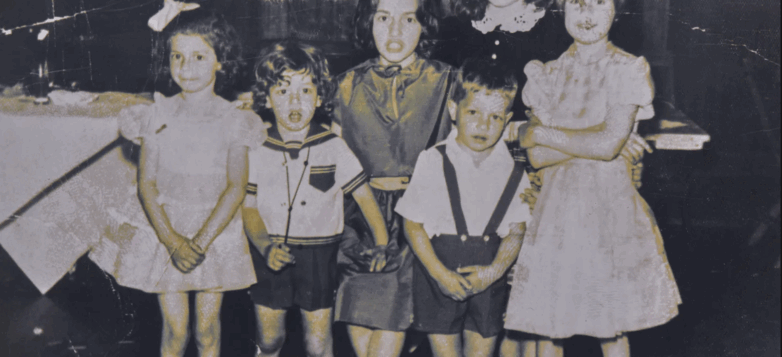
Part Three
Kimete Mitrovica Basha: I can talk about that…There is so much to tell…you don’t really kind of go down one alley…
Anna DI Lellio: Yes, of course you were telling me that your mother lived in Greece for a long time.
Kimete Mitrovica Basha: Yes, she did.
Anna Di Lellio: How come?
Kimete Mitrovica Basha: My grandfather, Sadik Mulla, he was a kind of businessman, he was living in Greece and they were working in Greece. And Greece is so close to the border, when you think about it! They lived in Thessaloniki for 17 years but then if you asked my mother about this she would not give the details. “It is the past,” she would say, “it is the past.” But she spoke Greek beautifully. In fact I had Greek friends at the university, when I was at the university, in fact one of my friends was George Papandreu, Papandreu’s son who then went back to Greece but George and my mother spoke Greek and he used to say how beautifully she spoke, she spoke Italian, German fluently. My mother spoke…she was multilingual, and she was an extraordinarily intelligent woman too, analytical about things, but, you know, but, but she…yeah, she lived in Greece.
She’s, she… she had a great fondness for Greek things, but she was definitely not Greek. In fact, my…we had the visit of my father’s sister, Kimet; in ‘72, I think it was. That was a disaster for many reasons, but her biggest mistake was to say to my mother that…that she was Greek. That was like, that was like she just didn’t know that she had just crucified herself, you know? (laughs) And my mother said, “Greek? Who told you I’m Greek?” you know? “I’m Albanian!” And so, you know, but she had great fondness, she… she was imbued with, with some of the rituals of Greek life.
Like, I remember at Easter time, she was from the Bektashi sect, right, so a very liberal Muslim sect. And, but at Easter, we celebrated Easter with red eggs and things. And when, and sometimes she would light candles and things like that. She was… she had this, I think my mother was deeply spiritual in some ways. She believed in angels… She believed in… in… it’s very interesting, she kind of had this need for, for something more, you know. And I think she had found that, I think, in this world of ritual that she brought with her from Greece.
It was very foreign to us. We would look at it with some amazement and, you know, love the eggs, but didn’t get the candles, you know (chuckles). But let her, you know, that was her way of, of being who she was. And we allowed… we, we allowed it. That’s not clear. We, we respected, that’s who she was. But we found it very odd, you know. But she, my mother, in typical of my mother, she didn’t care. She did what she wanted, you know. Anyway, yeah.
Anna Di Lellio: Do you have a religious education?
Kimete Mitrovica Basha: I beg your pardon?
Anna Di Lellio: You have a religious education?
Kimete Mitrovica Basha: We had exactly the same education that I’d given my daughters. I think my father and my mother, my father was, they were both Muslim, you know. But we, but we, we were, I think what we were educated in was values.
We were taught…We were given, I think, an education that…that would provide us with a moral compass. There were things that were important. Honesty. Oh my gosh, honesty and humility. These were the, I don’t know how many times my father said these were the two principles that should guide us. Honesty and humility.
Anna Di Lellio: But not necessarily connected to the Quran or Islam?
Kimete Mitrovica Basha: No, no, completely separate. I don’t think they were either of them, you know, members of any kind of organized religious order. But we had a deep sense.
We were given this idea, you know, I mean, if somebody stole or something like that, that would have been the, you know. No, it was a moral compass. You know, it was the idea that these are the values by which you should live your life if you want to live a good life. And a good life is a moral life. And so, they demanded… they demanded honesty. They demanded loyalty. They demanded generosity. It was very important to share. Yeah, these were the things that I think marked us and became part of who we are.
And also, and it became a theme in our life that came from my father, but it was also embodied in my mother, the underdog, you know, those who are excluded, those who need help. You know, my parents didn’t have a lot of money, but I remember every time there was somebody who was in difficulty, my mother would find us to help them. You know, you had to, you had, you know, you had to give of yourself.
This was… that was my religious education. And my daughters…I studied with Northrop Frye, who was Minister of the United Church of Canada, but was the major, one of the major literary critics of the 20th century. And I studied with him two things, one of them, foundations of Western culture. So, I studied mythology and the Bible with him. And I also studied the course he gave, Bible as Literature. And I understood from those, that course, how man has searched for meaning, you know, the patterns, the lessons that recur and are reinterpreted from myth to biblical setting, and so on.
And basically, the search for meaning in a way itself is a value. And so I have tried to…what I tried to do with my daughters was to give them access to those patterns. So, I encourage them to know the biblical stories, they still ask me, tell me what’s what, you know, tell us the story, because they don’t, they haven’t yet invested in that, my younger one, maybe a bit more.
But the myths, you know, knowing the myths, understanding what they’re teaching us. So it was more through a literary education that I was engaging with, with this same teaching about, again: What is a good life? How do you fulfill your potential as a human being? How do you become a moral person? My husband was more influenced by Jesuit teaching, you know, action, hope and action. But both of us were giving them the idea that action is necessary, you know, I just didn’t think of it as a Jesuit model, I thought of it as something else.
But ultimately, we’re teaching the same things. And yeah, I’ve never been a member of any organization, never been a member of a political party, although my views are very strong. And never been a member, never go to a church, never been a member of a church or any organized religious thing. I just don’t trust them. I just don’t feel I can fit into it. Because everything… I just…I have too many independent thoughts about things. I can’t do it. I can’t, I can’t sort of reconcile myself to belonging to something so structured.
Anna Di Lellio:I was about to ask, and you were talking about your ethical education. I was about to ask you about your intellectual education. You began a little bit mentioning Northrop Frye. But is there anything else you can add about that? What was your strongest intellectual influence in your life? Obviously, maybe, you know, that’s also what’s out of the family when you went to university, you know, reading.
Kimete Mitrovica Basha: I think that I’m a literature student, you know, and I think that my reading, intellectual education, I studied also with Bloom, you know, The Closing of the American…
Anna Di Lellio: Harold Bloom?
Kimete Mitrovica Basha: Harold Bloom. Yeah, I, you know, I was…I was lucky. I think I was very lucky. I had very challenging professors at the university. But also my father, my father wouldn’t, my father read, you know, John Stuart Mill with me, you know, because I couldn’t understand it. I was reading, I was only 16, I think, and I had to read On Liberty, and I couldn’t get it. So I went to him and I said, I don’t get it. He said, read it with me. And he, and he clarified, he was a very good teacher, you know. I don’t know my intellect…just a lot of things.
I think reading has always been something I’ve loved. And I’ve read everything and anything I can get my hands on. I’m reading less now than I was before, I think, for a lot of reasons. But I, I, I was fascinated by the mythology. I read a lot growing up. I love fairy tales. I love them. Yeah, I read a lot. I don’t know.
That’s a good question. I think I’ve slow, I think, as a child, I think the myths, this wonderful world of, of wondrous things that can happen, transformations, you know, the metamorphoses and so on. That gave me a lot of hope, actually, because, you know, things can change, things can become magical, you know. And then encountering Northrop Frye, the challenge of being able to keep up with some of the things that…
Anna Di Lellio: Lucky you with these professors.
Kimete Mitrovica Basha: Yeah, it’s incredible. He was, and then what was interesting about him, he was so gentle. So, he would blush. He was such a gentle man. That also teaches you something about humility and, and how, you know, knowledge and status does not necessarily mean, you know, arrogance and all of that.
So that too, the lessons of humility. But I think I’m thinking, you know, I have to say that I…Virginia Woolf was one of the main influences for me. I think she made me think a lot about me, myself as a woman, what I need to exist, how to exist, her struggles, not only psychological, but, you know, creative struggles, devotion to something.
But I think I said, you know, A Room of One’s Own that trap that was like a lightning bolt in my life, you know, I, I felt that she told me she was telling me something about what I needed to do to really exist. Pfuhhh! You know, I had never lived, I had never had, no one had given me the right to privacy. You know, so suddenly, I was claiming it.
And I was searching in my own way for things that may, you know, were maybe going to be difficult to reconcile with my Albanian identity, you know – how to be free, how to express. So she, she was, she was influential. But my reading, my literature was, you know, I read, I read Plato, and I was trying to figure all these things out, you know, and I read… I’m trying to think, you know, like there was so much.
I remember reading Madame Bovary and being overwhelmed, you know, by this woman in this dissatisfaction, you know? And I thought, “well, why are so many women that I’m around dissatisfied?” you know? all these things were happening at the same time, there was a kind of questioning. And then I think that… when I came away from the intellectual world, married, entered into the Albanian world, then all that was being tested. Then it took on a real meaning, it wasn’t just abstract thinking about dissatisfaction, privacy, the right to exist as you decide your relationship with truth.
And then I think that when I came back to the Albanian world, there was a kind of real meaning to all this. All these things began to mean, to be battlegrounds. And I had to stand up for myself.
I had to fight. And I didn’t ever want to abandon my… my femininity, to be honest. I wanted to remain a woman, not an angry woman, a woman, all the strength that remains. But to confront some of these things, it wasn’t always easy. But I did it. I think I did it fairly well.
And I’ve raised two daughters that are independent minded, strong, willful, and generous. I’ve succeeded because I think I modeled for them something else. And I think that that’s important to me. So my intellectual journey began with fairy tales and myths, and ended with, well, it didn’t end, it’s a constant, isn’t it? I mean, you’re always becoming, uh, but I still continue, you know, now I don’t read so much fiction. I used to read a lot of fiction. Now I read, I read a lot of philosophy now, you know, I’m reading a lot about identity now, a lot about identity now. But I think it’s just, yeah, I think I’ve wandered a bit too much on that answer, because I haven’t worked it out myself, I think.
Anna Di Lellio: That’s, that’s great. It’s just, sometimes we think as we speak.
Kimete Mitrovica Basha: Yes.
Anna Di Lellio: And it’s very interesting, because from what you said, you know, previous conversation, but also you hinted that you had an encounter with your husband, and it was love, right? This romantic love. But then you talk about all the things you mentioned, things you did together. So there was also friendship and, and collaboration. Can you tell me, tell us a little bit more about this? Why were you in New York? How was this…when you met your husband? You were in Toronto, we left in Toronto, you were in Melbourne, then in Toronto, then now in New York.
Kimete Mitrovica Basha: Well, how it was, it was, it was, you know, look, my, again, my father’s influence on my life is really profound. But I think that in a way, he led me to Ydriz. Okay, so my father dies in 1974, in November 1974. I’m… I have begun teaching, and I finally have a little bit of money.
So I decide with my brother, in the summer of 1977, that we’re going to do something fun. And so he and I, my brother Dervish and I, decide to backpack around England, Wales and Scotland. So we leave. And I have grieved my father, I’m still grieving my father. I’d also had a platonic, I have to stipulate, but a very meaningful relationship with one of my friends at the university. And that had not worked out. And so I was also grieving that. And so we go on this trip through, you know, backpacking and, and then I return.
In August of 1977, I’m back in Toronto with my brother. I’ve…I’m strong, I’m healthy, because we walk so much. And I’m feeling, I actually wrote in my journal that it was, I was going back like at the end of a Fellini movie, you know, everything had worked out, there was harmony, you know (smile), I felt good.
And then I hear that there is a meeting of the Legaliteti Party in New York in November. And I realized that it will be important, I felt it was important that a member of the family be there, although I have no monarchist tendencies whatsoever, absolutely none. But I just thought the presence, the Mitrovicas should be there. So I told my mother that and she’s not keen about this, because she knew that it was really a man’s world. And it was going to be, you know, like 300 men, and what…you’re going to be the only woman there, you know? So, I insist and argue that my godfather, Abaz Kupi’s son, Petrit Kupi, would be there, and I’d be with him. And finally, she agrees a bit, kind of just said, “Oh, go!” you know.
So, I go. And on the 27th of November 1977, I’m sitting with my godfather waiting. I’ve just arrived 15 minutes before because I didn’t really want to hear all the speeches. And then it’s time to get up for lunch, get up. And this man, I’ve been hearing he’s speaking French, sitting in front of me smoking a cigar. And he gets up. And my godfather says, “I’d like to introduce you.” And he introduces me to Ydriz Basha. Ydriz Basha says to me, “Oh, I’m sorry,” you know, in a very funny…(chuckels) “I’m sorry, I no speak English.”
And I said, “That’s okay, I speak Albanian.” But I said, “S’ka problem, folim skip.” [correct Albanian: S’ka problem. Unë flas shqip] (chuckels) So, he, he kind of went like this {mimics being startled}, you know, and, and the moment he shook my hand, I cannot explain it to you. I knew he was going to marry me. I knew I was going to marry him.
I went out of that room with my godfather. And I said, “Who is he?” And he said, “He’s a doctor. He’s a doctor.” He said, “He studies in France.” It was all wrong. He was not that at all. He had studied medicine, but he was a psychoanalyst and he was in France. I call my mother. I go to a phone and I call my mom.
And I say, “You have to come to New York.” And she said, “Why?” I said, “Because I have met the man I’m going to marry. But I won’t marry him unless you give me your permission.” And she said, “Are you crazy?” And she really, you know, absolutely. She came down and he, on that Monday, asked me to marry him. And I accepted.