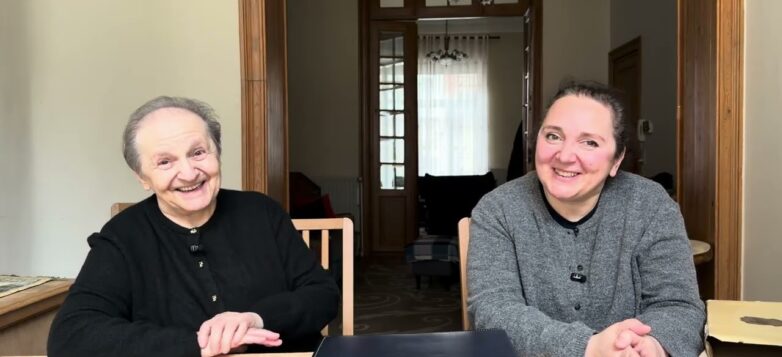
Ajshe Kastrati Hadri: “We went together to enroll at the university. I went with her and said, ‘I want to see that you really enroll.’ So I see a lady, older than me, looking at the board. She saw her name, that she had passed, and she started jumping and shouting. I said, ‘Teuta, what is this lady doing, has she passed her year, her exam?’ And I said, ‘Well then, I’m coming too, I’m going to enroll as well.’ You see, I really like studying. I got married at 18, then I had children, responsibilities, I came here, I didn’t know the language well. Now people come and they go to information centers, they learn the language and all that; I had to work, and I stayed like this. Otherwise, with pleasure, I would have gone to university. I liked studying, yes, yes.”
Teuta Hadri: “As for the trial itself, I decided to spare my brothers and my sister this heavy burden. I told myself, ‘This is my moment. I’m the one who will handle this.’ I was determined to say, ‘I will only speak with my lawyer. I won’t let any information slip, not to my brother, not to my mother, not to anyone. I’ll keep this completely under my control until the very end.’ That was the first thing. The second thing was that I also wanted to reclaim this part of history, which will forever be part of my father’s story. Because obviously there were others who tried to appropriate it, political appropriation, or simply claiming the story by saying, ‘We were by his side. We were there. We did this, we did that.’ …For me, the trial was a way of mastering something in the present, because I couldn’t control what my father was doing when I was little. Even now I still struggle to explain it.”
Teuta Hadri was born in 1976 in Brussels. She holds a Master’s degree in Sociology from the Université libre de Bruxelles and works as a federal civil servant in Belgium in the field of asylum and international protection.
Ajshe Kastrati Hadri was born in Pejë in 1945. In 1973, she emigrated to Brussels to follow her husband Enver Hadri, who fled to escape police persecution and was a leader of the Albanians of Kosovo in Belgium. A mother of four, Ajshe worked in the service sector all her life and is now retired in Brussels.