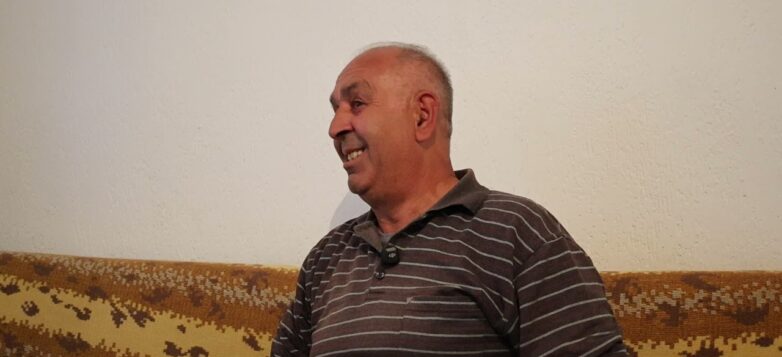
Sinan Ramić

Plemetina | Date: October 8, 2025 | Duration: 54 minutes

Live, work and be fair and honest, honesty wins over everything. Earn the money with your sweat, not with lies. If someone hires you, go, take your pay, but do your work fairly, so they can come another time and hire you again. I have the case of a former secretary at the Utility Company, now she lives in Niš. Every year she would call me to go and mow her lawn in Prilužje. Aren’t there others that can do it? Yes. But she saw an honest person in me and she would only hire me. Price was never an issue. When she would ask me, ‘How much?’ I would tell her, ‘As much as you want to give me.’


Nenad Andrić (Interviewer / Camera)

Sinan Ramić was born in Čaglavica on March 3, 1966. He worked for a local utility company and extensively as a wage earner. Although he had all A grades in primary school, he dropped out of high school due to poverty. Ramić is a musician who plays the tarabuka and is noted for his remarkable dedication to voluntary blood donation, having done so 120 times.

Sinan Ramić

Part One

Nenad Andrić: Can you tell us something about yourself, your family and about the place where you grew up?

Sinan Ramić: My name is Sinan Ramić, born in Čaglavica in the Ramić family. I lived there for 30 years, then I came to Plemetina where I lived in the workers’ barracks close to the power plant. There were workers’ barracks given by the municipality as an alternative accommodation. I had one room there where I lived with my wife and my children. I was married before I came to Plemetina. In 1991, in 1995 I left Čaglavica. I couldn’t live in Čaglavica anymore, we had a small house and the family was big, then I came and stayed with my in-laws here for two weeks until local Serbian representatives found for me some alternative accommodation and gave me one room in the workers barracks. Right after that, I started working for the local utility company and with it I worked in the powerplant. I was also a wage earner after my full time work. I worked in the fields of corn, we were taking our kids to the inlaws to take care of them and me and my wife were wage earners as well.

Nenad Andrić: How else would you describe your life before the war in Kosovo?

Sinan Ramić: Fino.1 In the beginning I had a family, I had my aunt and her children, I was visiting her before as well with my wife and children. Life as life, Roma at work, everyone is taking care of their lives, their homes, to provide food for their children. We didn’t have a fortune, we couldn’t be rich. Before, I was working at the powerplant plus I was a wage earner as well, enough to have for food. When I got a room at the barracks I didn’t have anything, it was an empty room. My mother-in-law gave us one mattress, two carpets, one blanket, two plates and three-four spoons, that’s all I had.

Later my boss at work lent me a truck so I could go back to Čaglavica and get my things from my family house, some beds, some duvets, some more dishes. It was one room only and it was in the barracks. I didn’t have other possibilities, for example, to build a house, at that time it was hard, now it’s easy to build a house. Now I can take out a loan and build a house and before I couldn’t do it. You would need three or four years to build a house. I also couldn’t buy land where to build a house. Salaries were small, we stayed in barracks because of that.

Nenad Andrić: Can you tell us some of your childhood memories?


Sinan Ramić: There are many. As a youngster I was friends with everyone, especially in Čaglavica. There were not many Roma there, they were mostly Serbs. At the entrance of Čaglavica there were few Albanian houses and I maintained contact with them. As a youngster I would go to many local dances, the ones that knew me knew I was Roma, the ones that didn’t know me could never tell that I am Roma. I speak perfect Serbian, and my Serbian friends would not call me Sinan but would give me different Serbian names like Siniša or Dragiša. Girls didn’t know that I’m Roma. I was a poor child, only my father worked and we were numerous in our family. In primary school I had all A grades from grade one to grade eight. I started high school, a technical vocational school in Pristina. And because of lack of finances after six months I dropped out.

I needed the money to pay for the bus ticket, to eat, buy clothes and we just didn’t have any. My school friends from Čaglavica helped me but couldn’t do it all the time. We would still go out together to the local dances and there no one could tell that I’m Roma. On one occasion, at one of the local dances, we were talking with some girls and to one of them I said that I’m Roma, she didn’t believe me. My friend was with me, now an old friend that I talk to and even today, he is a Serb, I tell him, “Branko, come here.” I talked with him in Romani language, the girl was surprised and there I asked her who she thinks is Roma, my friend Branko or me, she couldn’t tell. I was Roma. While I was single I was going out a lot, to weddings. There is not a place in Kosovo where I have not been to a wedding, Gjilan, Prizren, Mitrovica, Vushtrri, Janjevo, Lipjan, Pristina… I don’t need to mention Gračanica, it was close to my home, I had uncles and aunts there, even my sister was married there, big family.

Nenad Andrić: I heard a story that you worked as a waiter at the Grand Hotel in Pristina, is that true?

Sinan Ramić: No, it was my brother who was a waiter in the Grand Hotel. I was working in a local bar in Čaglavica. There I first got a job as a stoker, maintaining the fire for the central heating system. After some time I got promoted to barman and from the bar I was promoted to waiter. I have been in that world for almost five years. It was from 1985 to 1990.

Nenad Andrić: How was that job of yours, did you like it?

Sinan Ramić: It was a local bar and as a waiter I got a lot of tips, and as waiters we had to trick people a little bit as well. That bar had live music every night, and I had my regular customers, I wouldn’t trick them about the price, they would tip me greatly. It was hard work. At night you could walk the streets freely and not be afraid of anything or anyone. I was working in a bar, my brother was working in Pristina in a hotel, and my dad was working in construction. We had a simple, poor life. We were poor but honest. All the village knew us as Bajram’s children, poor but honest.

We would work for wages in the village for a Serbian family. That Serbian man would always call my father “in-law” since both his wife and my mother were from Gračanica and lived in the same street, and he would hire us to do work around his garden, he would leave us the key to the house while he and his wife were at work. His wife would leave us the food inside the house and would tell us when we get hungry to get inside the house and eat. They would ask why I wouldn’t eat, I told them, “Out of respect for your house.” We were poor but honest. Something that even today you can see.

Here I worked as a wage earner for Serbs here too, they are very satisfied with me. I did handle myself a lot of their money in my work for them, never did they miss a single cent. They would task me to go and get supplies for their stores, and [I traveled] with a lot of money with me, at the time by train, up to four thousand euros of their money. I would visit many companies, buy the supplies and even help others who did the same. They never lacked anything, even to this day, some Serbs from here, I still work at their shops, they let me take care of their tractors, of their houses.

Nenad Andrić: How did Roma and non-Roma lived together right after the war, how was the relationship between all?

Sinan Ramić: At the beginning, right after the war, Serbs and Roma were here together and were good to each other while Albanians were not. Why? Because right after the war, after they came back you couldn’t go out and walk freely and you didn’t know from where bullets could come from. Roma and Serbs were together, we would gather all together, if there were issues with Serbs, Roma would help, if Roma had problems Serbs would help, the whole village would gather, to protect the Roma.

With Albanians we didn’t have much contact after the war, why? Maybe because some of them lost their father, mother, sister and that was disappointing to them. Now we live like there was no war, we go freely to Obiliċ and to Pristina, we buy our food there and we work there. There are people who work in Albanian organizations, there are Roma that work there too. There are a lot of our children who work in Lipjan in the Viva Fresh market. They have organized transport, their salary is 450-500 euros.

It’s much different than in 1999. Up to 2003 or 2004 it was not that good, we still would go to Obilić, but how? if you had a friend who had a car. If you couldn’t talk, they would say, “Look, here is the magjup.”2 Today we freely go to Obilić, to the shops, we eat in restaurants, we buy supplies, and buy cheaper there. They [Albanians] sell us wood and coal for the winter. If you have the money you can buy food and wood.They also sell us firewood on credit or in installments.

Nenad Andrić:
What celebrations, traditions and customs were important to you and your family? Are there any differences in celebrations before the war and now?

Sinan Ramić: Yes, before the war, we had as its known, Ederlezi,3 which is the Roma’s biggest holiday. Vasi4 too. Vasi is in the winter, people would stay inside but most of the Roma people would celebrate it. Christmas too, we would celebrate all the holidays. But for Ederlezi, we would dress up more nicely, we would buy a few lambs, drinks, and we would go to the river to get the willow branches. We would decorate our house with willow branches, we would stay awake all night, every house had a good radio, we would play loud festive music all night. In the morning, the wife would get up early and give a bath to the children with those willow branches. The husband, as the head of the family, would take a bath first, he would then slaughter the lambs, would call someone to help if he needed it, sometimes would go to others to help in that ritual. That tradition was kept by the Roma a bit after the war and then slowly they started not to celebrate Ederlezi and Vasi and all.

Nenad Andrić: Why is that?

Sinan Ramić: Many of the Roma people have returned to Islam. Islam says it’s haram5 to celebrate Ederlezi, Vasi and other holidays, it’s known that we should celebrate only Islamic holidays, such as Ramadan’s Bajram and Kurban Bajram. There are still Roma people that do celebrate Ederlezi.

Nenad Andrić: You mentioned that music was also a big part of Roma tradition, and as I know you are also a musician, you play tarabuka/darbuka?6 You were also part of the local cultural artistic society?

Sinan Ramić: Yes, Miloš Obilić is the name, the Serbian one. I joined randomly. Nobody knew how to play tarabuka. No one knew how to play tarabuka, I have played before and not much, but my brother did, he did play drums and tarabuka. Why? I was not interested in it. But here I went, my director asked me. Folk music was played in school, I was invited to help and clean the floors after the rehearsal. I was there once, two times, three… The rhythm went inside my head. I asked the choreographer if I could play as well. He asked me, “What?” “Tarabuka,” I said. He asked me to get it and join. I didn’t have [the instrument] back then. I told him I’ll find it. “Tomorrow is the next rehearsal,” he said, “and you will play.”

Since I didn’t have it, what should I do? Where should I get the tarabuka? I went to another Roma here, to Hamit and asked him if he had tarabuka, he said, “Yes.” So, I took it for one rehearsal only. After three rehearsals I went to a concert in Velika Hoća. Even then I didn’t have tarabuka. I went to Faton [another neighbor] and took his tarabuka. My director already called him and told him to lend me his tarabuka until we find one for myself. When we went to Velika Hoća, it was my first time there. We played and we did well and when I came back, I gave back the tarabuka to Faton. Soon after I went to my brother in Gračanica, he had our uncle’s tarabuka, I explained to him and he gave it to me. I still have it here. I played folk music, we had concerts here in Plemetina, Gračanica…

Nenad Andrić: Have you been to any other places outside of here?

Sinan Ramić: I was, we were. I was in Jagodina, Kruševac, Kopaonik, I was in Belgrade at the show “Žikina Šarenica”, that same day we were in Obrenovac as well, there were some folk concerts there too. Next morning we were at Pink television, at the Neša Ristić, where I played too. I was also in the Republika Srpska [Bosnia Herzegovina], where we stayed for four to five days as we played. There at the time was a voluntary blood donation campaign. There I gave blood and I was rewarded with a golden plaque and a medal.

Nenad Andrić: For how many donations you get rewarded with a golden plaque, 50?

Sinan Ramić: They awarded me because I came from Kosovo, since we were there with folklore, they honored me like that.

Nenad Andrić: Did they know how many blood donations have you done previously?

Sinan Ramić: Until then I had donated blood 60 times.

Nenad Andrić: The golden plaque is awarded for 50 donations?

Sinan Ramić: No, 100.

Nenad Andrić: How did you get it with 60 then?

Sinan Ramić: There, in Republika Srpska, in Bosnia, in gratitude.

Nenad Andrić: So till now, how many times have you donated blood, 60 or more?

Sinan Ramić: Until today, I donated blood 120 times.

Nenad Andrić: Mashallah, mashallah.7 How did you come to the point of donating blood?

Sinan Ramić: That’s a sad story. A very sad story.

Nenad Andrić: Can you tell us the story?

Sinan Ramić: Sure. My sister was very ill, nobody wanted to donate blood for her. She was in hospital in Niš. That was 1991, 1992. I lied to you, the first time I gave blood 1986, then actively from 1993. There was a case of my uncle’s daughter, she passed away. When I was in the army, she suffered from leukemia. I was in the army, everyone donated blood for her but we couldn’t save her.

I was in the army when a telegram came for me. I was serving in Ljubljana. My commanding officer was also from Čaglavica. He came out and was looking at me, he said “Ramić.” I said, “Yes sir?” “Prepare yourself,” he said. I said, “How? I don’t have money for travel, nobody sent me any.” He said, “Don’t worry about the money but prepare yourself.” At that moment, I thought that my father had died. I thought so. He worked in construction [and I thought], he got drunk and fell off the construction site. I asked my officer, “Did my father die?” He said “No, go and prepare yourself, you have to go home.” I was stunned, I had no money. My friends there heard that I had no money, the officer told them, until I changed into my city clothing, my friends had collected money for me. I asked my officer again, “What is it? Is it something about my father?” He said “No, your father is fine, but you need to go home.”

I got ready, took the money collected for me, and he gave me an eight day leave. I went to the station to buy a ticket, but it’s Ljubljana. At 15:30 I had a train, I remember it like it was yesterday, at 08:00 the next morning I was in Kosovo Polje. Soldiers then didn’t pay the urban bus tickets, so I came to Pristina. From Pristina to Gračanica I had a bus at 10:30, but I couldn’t wait at the time. I got home. I saw my father alive, I asked them, “What happened?” My uncle’s son came and told me what had happened. He said “Djuka is sick, we need blood for her, that’s why we sent you a telegram.”

I didn’t take my uniform off, back then we were free, while Yugoslavia was one in 1986. I went to Skopje. I went to the hospital and her life was hanging by a thread by that time. Nurses started a direct blood transfusion from me to her, the doctor was looking at me, and I was dressed as a soldier. Blood was flowing slowly and I was there for an hour, with a needle in my vein. The doctor was sitting beside me, while measuring my blood pressure, pulse… Kept that going until she opened her eyes. She was awake for 10 minutes, they took out the needle from me and I was pale as a ghost. My uncle’s son, who was there with me, had a lot of money, he was doing fine. He was a construction worker, had been working in Libya for three years, and had all the money in the world. He asked me if I needed anything, if I wanted to eat something. I told him to get me some food, some red wine and a jar of pickled beets.


From 1993 I started donating blood actively. My sister was on her death bed. I went to Niš and there I wanted to beat up some doctors. To take them to court. Why? They were wondering how come my surname was Ramić and hers was Selimović. I told them it was her husband’s surname. They asked me for her birth certificate with her maiden surname. “Where can I find that?” I asked them, “ She is married to her husband. I’m Ramić, she is Selimović, she is my sister. The second doctor that came along let me donate blood, but still was asking for a birth certificate. They seemed blind that they couldn’t see how much we look alike. That is how I started donating blood, when I saw the injustice that happens, not just toward my sister, but towards everyone.

From 1993, I was working in Prishtina in a company, Yugoplastika. It produced the plastic parts for the Yugo car. Open calls for donations were regular, so I gave [blood] for the first time. After that I was regularly going to the transfusion fund to donate blood. And so once you start and get used to it you cannot stop it. For 32 years now, actively. Every three to four months. Here at the Red Cross I also received two medals, plaques, for the 35th time, then for the 75th time. Now in November or December, I forgot when they told me, there will be people from Belgrade coming from the Red Cross and I should get an award. Most likely it will be financial. For 120 times, in the municipality of Obilić no one donated blood more than me.

Can I have a cigarette?

1 A Latin-based word used to mean “ok,” “well,” “fine.”

2 Magjup is a derogatory term used across various Balkan languages to refer to Roma, Ashkali, or Egyptian communities.

3 Erderlezi (Herdeljez) is the combination of the names of two Muslim prophets, Hizir and Ilyas, who met every May 5 (Saint George’s day), to welcome the end of winter. It is an important holiday across the Balkans for different communities.

4 Vasi refers to Bango Vassilii (also known as Vasilyovden), a major holiday celebrated around New Year’s, typically on January 13-14, which honors a limping or “crooked” figure named Bango Vassil, a mythical protector of the Roma people in legends. The celebration involves special feasts and rituals, with the central theme being the sacrifice and kindness that led to his injuries while saving the Romani people.

5 Haram is an Arabic term used in Islamic tradition to describe something that is religiously forbidden or prohibited. In everyday usage, it is often employed more broadly to refer to actions considered morally wrong, dishonest, or unethical, even outside a strictly religious context.

6 Drum made of earthenware, red body, wheel-thrown, a conical stem expanding into a bowl.

7 Mashallah is an Arabic expression meaning “what God has willed.” It is commonly used to express admiration, appreciation, or praise for something good, while also invoking protection from envy or bad luck.

Part Two

Nenad Andrić: How was the war affecting you and your family?

Sinan Ramić: Fear, bombing on one side, nowhere to go, where to hide. Sit down and don’t move, we were living in Plemetina at the time. During the day it was easier, there was less bombing, shooting. But at night it was terrible. I was most afraid for my children. I had three children at the time, two boys and a girl. We went through that as well. I’m not saying it was all well, NATO was bombing, we could see it.

Nenad Andrić: What were the challenges for you and your family during the war?

Sinan Ramić: The biggest challenge was when the Albanians came to the workers’ barracks where we lived. We were afraid back then. All of them were Kosovo Liberation Army [KLA],1 they came to my room and saw I hadn’t stolen anything from the Albanian population. I didn’t take anything, why? It was a sin to do it. They told me that I was in a uniform during the war, that I was a soldier. I told them to search all the room, to tear it apart and if they find any Serbian army or police uniform I would surrender myself to them. They searched and looked around at everything, finally they told me I was an honest person. I was not that afraid for my own safety, but for the safety of my children I was afraid.

After that situation we left the workers’ barracks, I went back to my family in Čaglavica. There and then I had a great challenge too. I was working in one local bar, and one night as I was returning home, a long way around due to stray dogs… I was walking slowly on the road, behind me I heard Albanians screaming at me saying, “We will kill you, we will kill you!” I got afraid and ran away in a Serbian man’s yard. The man came out after hearing noise, so I told them what had happened to me. Albanians ran away and the host took me home with his car. The next day when I went to work again, I told the owner what had happened to me, he asked me if I knew how to drive, I said yes, and he gave me his car. I was driving to and back from work with a hotel car.

It was a challenging time full of fear for both us and Serbs there. Where we lived there was a little store, a Serbian store, some 20 meters away from the main road. We were sitting there, having a few beers, me and my brothers, some local Serbs. Albanians passed and somebody shot a RPG into the little store, but thank God it didn’t go off. The initial blast broke the window. We all quickly ran outside, it didn’t explode. People later gathered around, it was quite an incident. That was another challenge. Threats were only here while we were living at the workers’ barracks.

Nenad Andrić: Was there solidarity towards you from the members of the other communities, during the war?

Sinan Ramić: There was, Serbs towards Roma, yes, while with Albanians there was not. Why? Today it’s a totally different situation. We go out, we go to Obilić, we shop there. If we cannot speak Albanian then they speak Serbian to us. I take a taxi to go shopping. I called the taxi driver, he took me there, and brought me back. You pay and that’s it.

Nenad Andrić: What were the main issues for Roma people right after the war?

Sinan Ramić: Roma people from Plemetina were afraid to go out of Plemetina. Some left completely during the war, went to Montenegro, like my brother. They also called me to go there. I had the opportunity to go to Germany and live there but I didn’t go. I didn’t go because neither my wife or my children had any personal documents, just me. I couldn’t go alone there, who will take me there. I remained here.

I was living in the house on the corner of the street. There we had another challenge in 2002, that house burned. I was not at home when that happened, I was out of the house working for wages for local Serbs. I had to work, I was not getting any salary so I had to work so my children could survive. When I came back that day from work, I saw the burned house, I thought my children burned too. Thank God they were all fine. More challenges came along. They donated some tents to us, in the summer time it was scorching hot inside, but we managed all of that.

After that, the Serbs that I have worked for at the time, they bought this land where we live now. In 2004 I got back to regular work, in the company I worked before at the Utility Company and we lived in a single barrack that was given to us then, the one that we use as a shed now, you can see it outside in the yard. In 2006, the former president of the Serbian municipality, the one who died meanwhile, promised to me that he would build me a house. Any time he was in Belgrade seeking help, my case was first on the list.

Roma as Roma, my neighbors did snitch on me that I had good living conditions, that I had family abroad that was helping me, that I don’t want to buy land or build a house. They also told the commission that all the organizations are helping me, that I have brothers living abroad and that I don’t need a house. All were against me, but if a man is honest and fair, lives his own life, someone who works dusk to dawn to provide for his children, God never loses him, never.

There were Roma people who worked at organizations back then, I was happy for them. People were asking me how I could be happy. I would tell them, “If it’s God’s will, I will build my house as well.” One September day in 2006, I went to work. My director at the time told me that there is a reason for me to treat people at work with some food and drinks, I didn’t know what he was talking about. He told me to go to the municipality building because Dragan Trajković had asked to see me. I went there and Dragan told me the same, that I need to treat all of them that day. “Bring us some juice and some biscuits and I’ll tell you the good news,” he said.

I went to the local store, whose owner is my director at Utility Company, as his wife was working there, she also told me that today is a special day for me, and again I was the only one who didn’t know the reason. I went back to the municipality with the treats and he presented me with a contract for me to sign, it was a contract for a house. I was crying so hard I couldn’t sign the contract, my hand was shaking. As I went back, the director sent me back to the shop with a Yugo, a company car, to buy more treats for the colleagues from the Utility Company. That day was off for all of us. That day we were eating and drinking. As the building materials started arriving for our house, I dug the foundation alone with my children, and my brothers came to help me. When I started building the walls, my director sent all of our colleagues from work to help me. There were some Serbs from Prilužje, some Serbs from Plemetina, they were all experienced builders and so am I.


I alone did all the metal works for the reinforced concrete. When Serbs came to help me, in a matter of a week the house was finished. When we got to the roof, we had a small celebration. I even got a musician, a local kid, to come and entertain us. One other local Serb, an electrician by trade, came and helped with the installations. My brother helped me finish up this room and a corridor. The floors, the ceiling, the doors, and the windows, I installed myself. I painted it and with that the major works were done. As me and my wife were laying down, ready to sleep in a barrack, I decided that we should move that same night here in this room. We had a small stove, put it in and started a fire. Brought some carpets, a true poverty. We didn’t even have beds, only mattresses. We moved children here as well and that night I couldn’t sleep. In the morning I went to work and my director asked me how the work around the house was going, I told him that we already moved in the house, so we had to drink for that as well.

Now it’s different. Six years later we added another room to the house, we fixed the rest of the house, not 100%, but we had enough for one quiet life. We didn’t have a bathroom for the first six years after the house was built, and then in 2019 I got a loan from the bank to build a bathroom in the house. Without a loan you really cannot build a house. I did replace the flooring in all the rooms. And yes, the municipality helped me again, the Serbian municipality, back in 2019, they gave me new sets of windows and doors, also the materials for outside insulation for the house. The municipality helped me as well. For some time I was working, but now, they closed us, so I stay at home. Sometimes they call us to do some utility work, like clean the graveyards, when someone dies we go and dig the graves as well. When a tombstone on a grave is installed they call me as well, I do the metal works.

Nenad Andrić: Can you tell me what is the biggest difference for you from the time before and after the war?

Sinan Ramić: Look, there is a difference. Before the war, there were not as many houses as now. Now everyone owns a car, there is not a Roma family without a car, some even own two cars. Before the war, it was not like that. Before the war, as I know, three or four Roma in Plemetina had cars: Medo, Daut’s and Mahmut’s family, Faik that you don’t know, and Sefer that had a Zastava 128. No one else had a car. After the war, Roma started to own more cars. There is a great difference before and after the war. Now Roma people get social welfare from both Kosovo and Serbia. [They get] maternity welfare and children welfare money and no one wants to work anymore.

Nenad Andrić: So, you have worked your whole life, and now there are people that just don’t want to work?

Sinan Ramić: They don’t want to work. When I was working in a Hotel in Čaglavica during the day, I was still out looking for a second job. In spring I would go and work for a wage and plant potatoes of local Serbs. Then it would be onion season. Then beans and corn season. When that is done, corn has grown, the cultivation of it would begin, two rounds. After that, Serbs would cut the grass to make hay and would call us to help them collect it. When hay is done, the wheat would be ready for harvest. I would go and harvest, load wheat into sacks, I would make money.

Right when wheat harvest is done, I would think that there is no more work, but then the beans would be ready for harvest. We would harvest beans very early in the morning, at 4 am. That’s when you do it. Bean harvest done, no more work. Autumn and the corn harvest comes. Only the ones that didn’t want to work didn’t have jobs at the time. Besides all this, I also worked in construction with my uncle’s sons. We would build homes. That uncle’s son that I mentioned who is a constructor, I would help him build the kitchens, bathrooms, I would prepare all the materials for him. He was teaching me how to install tiles.

These days, Albanians come and offer 50 Euros daily pay to work in the peppers fields, which is a really good pay. But no one wants to work. I see around me in Plemetina, someone who didn’t have bread to eat now drives a car. I have worked all these years and I cannot afford a bicycle. Why? Well, because there isn’t any. I have a good salary but in vain, the loans are tough. I took a loan of a million dinars back then, but I’m still paying it off. Then I got another loan in Kosovo banks, I needed it, I was fixing my house.

Nenad Andrić: We slowly came to today, what gives you hope for a better future for Roma in Kosovo?

Sinan Ramić: Hope itself. Without hope, I wouldn’t be here. I have the opportunity to go and live in Serbia, but I stay here. Why? you might ask. All my family is here, my brothers live in Gračanica, I live here. I see Roma around building their home, hoping for a better future here. I’m one of them, I hope too. I built what you can see, not much but I created a decent life for me, a normal life. I’m not hungry enough to eat and drink. Maybe I don’t have meat to eat every day, but I have bread.

I can move freely around, I was in Pristina hundreds of times. I walk the main square to the vegetable market, where I sit at Shaban’s and I eat their ćevapi2 and I come back home. No one tells me that my eyes are black. There is hope, I hope to stay here, so there is peace between Albanians, Serbs and us Roma. Not like what we had before. Right after the war, 1999 to 2003, for some four years, Albanians were afraid to enter Plemetina. Albanians from Plemetina yes, but Albanians from other parts not. They didn’t talk to anyone, Roma or Serbian. Slowly we have come to the point when they come to my yard and beg you to buy wood from them. In all this I see hope for a better future.

Nenad Andrić: If you could send one message to the future generations, not just Roma but to all, what would it be?

Sinan Ramić: Live, work and be fair and honest, honesty wins over everything. Earn the money with your sweat, not with lies. If someone hires you, go, take your pay, but do your work fairly, so he can come another time and hire you again. I have the case of a former secretary at the Utility Company, now she lives in Niš. Every year she would call me to go and mow her lawn at Prilužje. Aren’t there others that can do it? Yes. But she saw an honest person in me and she would only hire me. Price was never an issue. When she would ask me, “How much?” I would tell her, “As much as you want to give me.”

Honesty wins. No matter, my children were working at local Albanian farmers, they worked and brought back home the money. One of my sons was sick and I didn’t let him work for a wage anymore. Money cannot buy his health back. Honesty is the way, Nenad. You know Slaviša and Neško, the brothers. They wouldn’t be there without me. They trust me to lend me their machines. During the harvest I was driving tractors, cars, all that is necessary. They did test me, once each of them. In one of their stores, in the storage room, Neško left 1500 Euros on the floor and I didn’t know. I went to work the next day and after a morning coffee and one or two rakia, he told me to bring a few packs of wine from the storage room. I went inside, I saw the money and I said to myself, “You might be smart but I’m smarter.” I took the money and put it in my pocket.

I went back to the store after all, opened one beer from the fridge and I started laughing. He asked me why, I told him someone lost 1500 Euros and I found them, that’s exactly how much I missed to buy land to build my house. I told him in his eyes, “You are smart, but I’m smarter. Take back your money and if I need money I’ll ask for some.” I told him that I was a Roma from Čaglavica, not Plemetina. Later he took me to his house and opened the safe and told me that if I needed money I could take as much as I wanted. I said no. His brother Slaviša did the same, he left his wallet in the garage with personal documents and money. He was looking for it for two days and couldn’t find it. While I was there I found it, returned it without even opening it. I told him that there was no need for such a test and that if I needed the money I would ask for it from him. Due to the fact that I passed those tests, I enjoy the right to go to them, be welcomed and honored, and be treated in great respect.


1 KLA (Kosovo Liberation Army) was an armed Albanian resistance organization that fought against Serbian forces during the Kosovo War (1998-1999), aiming to end Serbian rule in Kosovo and achieve independence.

2 Ćevapi are small grilled minced-meat sausages, traditionally made of beef or a beef-lamb mix, and widely popular across the Balkans, usually served with flatbread, onions, and yogurt or kajmak.

Download PDF