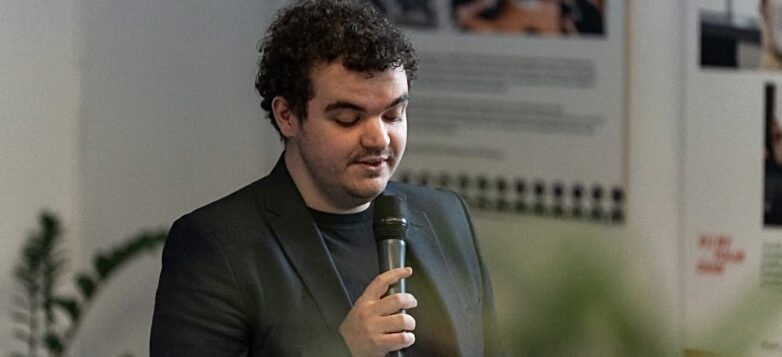
Gresa: Okay. So today is April 9th, 2025. Me and Lennart are joined today by—
Gresa: If you wanna say hi?
Elion: I’m Elion. Nice to meet you both.
Gresa: Today we just wanted to discuss your experience, your kind of experience in the war, in the 1999 Kosovo War. And I guess the first question we wanted to start off with is: where you’re from, what your family was or is like, and just your childhood experience back home. Yeah—maybe just a short autobiography of your time during the war.
Elion: I’m Elion. I’m 27, and I was raised in Peja, in the west of Kosovo. It’s a really beautiful city, which was heavily damaged during the war in Kosovo. So my memories as a child were not the most beautiful ones, because I saw destroyed houses, burnt houses. And for me, it felt normal to see places like that.
I mean, after the war in Kosovo, I was really young. I was only a year and a half when the war happened, and almost two when we came back. So luckily, I don’t have many memories of the war itself, but of course, I do have memories from after the war. I remember seeing a destroyed city, everything being rebuilt, because Peja was damaged up to 70%, which is quite a lot.
Recently, I lived in Poland, where I studied for my second master’s in European Studies. I visited places that were also destroyed during wartime, like Warsaw, where I lived, which was completely destroyed during World War II. I felt connected to the story of Warsaw and also to the story of my city, Peja. It was the first time I realized how similar it felt, what happened to my place and what happened to the place where I was studying, even though it was a much earlier war.
My childhood, besides that darker part where we had to see everything being rebuilt, was still okay. It’s not common for children to grow up seeing destroyed places and burnt houses. But my family was also affected, we lost family members, and my grandparents’ house was burned. My grandpa was really sad because he lost his library, he had more than 3,000 books. We lost so many photos and really important things.
My aunts’ houses were also burned. But besides that, I had a happy childhood, I would say. I was raised by two wonderful parents, and I had a sibling, my sister. We had a happy childhood, generally speaking, and I’m grateful for that, because we knew what we had been through.
We were part of a transition process, and it’s not easy for a child to grow up in a place that’s rebuilding itself. You have to witness all the changes, you feel them closely. At that time, Kosovo wasn’t even a state; it was just an undefined territory fighting for independence. Then, in February 2008, we declared independence.
So, mine was a childhood in a country being constructed from the ground up. It was quite interesting when I tell people what happened. I remember a friend from Barcelona once asked, “Is it possible that you were a refugee? That you experienced all of this?” He couldn’t imagine it.
My family was deported in animal trucks to Albania, and they didn’t know what fate awaited them. They thought they were going to be killed and end up in a mass grave. My mom is a doctor, a medical doctor, and she said, “I just took my diploma, our IDs, your birth certificate, and some clothes for you.” But she hid the diploma, the IDs, and some photos because she had seen films about Auschwitz, the Second World War, and the war in Bosnia. She said, “I knew they might try to say we don’t exist—that we have no identity. So I had to prove we existed.” She took the risk of carrying the documents, even though people were burning IDs and papers near the Albanian border.
So this is more or less who I am. The war shaped my personality and identity because I was raised with post-traumatic memories, not my own, but those of the people around me. Everyone would talk about “before the war” and “after the war.” You always had these comparisons.
For me, the topic of war was very common. But for children raised in peaceful places, it sounds utopian or unreal, something you can’t even imagine. But that’s what it means to be a child of war and post-war in a place building its identity from the very beginning.
Lennart: I remember you said something about growing up in ruins. Was that image, of Peja in ruins, something you normalized? Did you feel like that was just an everyday thing? Did you think that everywhere was like that?
Elion: Yeah, I got it. The thing is, the picture you see, like even when you watch something on TV framed from a certain angle, you assume that’s the full reality. As a child, you believe that what you see around you is how it is everywhere, because that’s all you know.
And at that time, I hadn’t even traveled. We had just returned from Tirana, but I don’t really have memories of Tirana because I was really young. So after the war, seeing ruined places just seemed normal to me. That was what reality looked like.
I wasn’t overthinking it, it was simply what I saw and experienced. Luckily, things started changing. Peja began to be rebuilt, and I would say it happened relatively fast. Now, if you go to Peja, you won’t find any visible signs of those ruins. There’s no physical memory left of the war.
And that’s kind of sad. Because when nothing is left, there’s no way to show people what actually happened in 1999. The difference between the Peja of then and now is huge. So yes, I do wish they had preserved at least some ruins. Not to traumatize people, but for memory’s sake, maybe as a museum or a single building that shows what happened. Because otherwise, people can only see those times through photos.
I actually have photos of myself standing in the ruins of houses in my neighborhood. And when I visit those spots or look at those pictures now, it still feels surreal—what I saw and went through as a child in the post-war period.
Gresa: So connecting that back, you said your childhood was shaped by this post-war environment. Would you say you missed out on a “normal” childhood, like what kids in peaceful countries might have had?
Elion: That question has a yes and no answer. Of course, children can still play even under those circumstances. But we were blocked from having a truly normal childhood during the war.
My cousins had to restart school as refugees and adapt to new lives. I was still too young for school or even kindergarten. For my mom, it was really difficult, she had to work as a doctor in Tirana while also trying to find someone to take care of me.
After the war, I remember playing in the ruins, especially in two burnt houses that stayed like that for six or seven years in our neighborhood. That was just part of our daily life. Looking back, it feels unreal now. But it happened. And even with all that, I’d still say I had a good childhood.
It’s interesting, I’ve never actually talked about this before. This is the first time I’ve shared these experiences because no one ever asked. I’ve never had the opportunity to reflect on how I was affected as a child by all that happened after the war.
Lennart: It’s fascinating. I was trying to put myself in your shoes, and I can see how as a child you’d normalize whatever surrounds you. The idea that you played in burnt houses, it sounds shocking to others, but to you it was just normal.
Elion: Exactly. For us, it was normal. Children growing up in places like that simply don’t know any different.
We didn’t grow up with smartphones or technology. That was our reality. I was lucky in one way: our house wasn’t burned during the war. It was heavily damaged, but it wasn’t burned down completely. And when we get to the part about my photo at the museum, I’ll explain more about that.
Gresa: You mentioned playing with your friends. Do you remember what their experiences were like, especially those who were a little older and might have more direct memories of the war? Did you ever talk about it together?
Elion: I wouldn’t say we talked about it as a group. Now that I think of it, I only had these discussions with my cousins. One of them was 14 during the war and the other was 11. They remember everything. I’d ask them questions like, “How did that affect your mental health?” I was really curious.
Imagine, my cousins were transported in those animal trucks with us to Albania. They remember seeing dead bodies in the street. That’s incredibly traumatic.
I’m really thankful I don’t have memories of that. I honestly don’t know how that would’ve shaped my personality or mental health if I did. And even now, when I talk to people who are just seven or eight years older than me, many of them don’t want to talk about it at all. It’s too traumatic. They have very dark memories.
That’s why I mostly talked about it with my cousins. They remembered the trauma, like being ordered out of their house by soldiers or police. For them, childhood ended at that moment. They might’ve tried to restart it, but those memories stay forever.
Gresa: And your sister, she’s younger, right?
Elion: Yes, she was born after the war, so she doesn’t have any wartime memories. She was lucky in that sense.
Gresa: Do you think what your parents went through during the war affected the way you were raised? Did it change them in ways that influenced how they raised you?
Elion: I would say yes, definitely. But maybe because my mom was a medical doctor and my dad a pharmacist, they both came from scientific, medical backgrounds, it might have been a bit easier for them to process all the trauma. My mom even studied post-traumatic stress disorder after the war. She helped people dealing with it; for a time, she worked as a social worker, too.
Sometimes I can’t even believe how they managed to process the trauma so well. If I were in their place, I don’t know how I would’ve handled it, especially knowing how emotional I am. But they really managed not to let it affect us as children. They tried their best to protect us from what had happened.
Also, we left relatively early, just three days after the NATO bombings began. So my family didn’t experience the worst of the war for an extended time. But when I hear about one of my mom’s aunts who stayed in Kosovo for two whole months during the war, she’s still traumatized. When she talks about it, I’m shocked at what she went through, seeing people killed, hearing bombings constantly, and not knowing what would happen next.
I would say I was raised hearing those stories. And I was very curious as a child—I always wanted to know what happened, why it happened, what the occasion was. I had so many questions for my parents. I was really curious about the war.
And for me, war felt like a normalized thing. It was like, maybe this is just what happens to people, something that everyone goes through, and then you just have to survive it. I don’t even know how to explain it.
Lennart: That’s really interesting. So in your mind, war was just… normal. Like how the ruins were normal, war was too?
Elion: Yeah. That was more or less what I thought as a child. And then later I realized, this is not normal. Not at all.
Gresa: I want to go back to Peja specifically. In other parts of Kosovo, like Pristina or Mitrovica, people often describe growing up in multiethnic neighborhoods. For example, my mom told me she grew up playing with kids of all backgrounds. Was that the case in Peja?
Elion: No, not really. Especially in my neighborhood, it wasn’t like that. The children I grew up with were mostly of Albanian origin. I don’t remember Serb children in my neighborhood, so it wasn’t multiethnic like Mitrovica or other cities.
But even though I didn’t grow up with kids from other ethnicities, I also never had any problems with other ethnic groups in my city. Still, as a child, I’d say my world was mostly surrounded by Kosovo Albanians.
Gresa: Did your mom ever mention learning Serbian in school?
Elion: Yes. My mom told me that during her time in school, they had to learn both Serbian and Albanian.
Lennart: And after the war, did you ever have to learn Serbian in school?
Elion: No, not at all. We didn’t study Serbian after the war.
Gresa: Did the schools ever bring up the war in history class?
Elion: Barely. We had maybe two or three lessons about it, but not much. I think it was in seventh or eighth grade, but I don’t really remember much about it. We definitely didn’t talk about it a lot.
Gresa: You said earlier that you didn’t go to kindergarten during the war. Was that just because of the war, or because of the state of the city afterward?
Elion: It was only because of the war. Afterward, I did go to kindergarten. I think I started around February. But during the war, I was a refugee, and I was really young, so there wasn’t a way for my mom to send me anywhere. It was tough for her to work and find someone to take care of me at the same time.
Lennart: Can you tell us about the photo you mentioned earlier? What exactly is the story behind it?
Elion: Sure. One day I posted a photo on Twitter and Instagram, on my social media. It’s a photo of me during the war, standing on the stairs of my house. In the background, you can see that the house is heavily damaged, clothes are everywhere, and it’s just a huge mess. That photo captured the state of our home after the war. My dad took it, he just decided in that moment to capture what was around him.
At the time, I never imagined that photo would become a piece of history, of my personal history, and my family’s. One day, I was in Peja looking through some old albums, just flipping through, and I saw that photo again. I was applying for a training related to refugees, and I thought, “Wow, this is so interesting. I should post it.”
I wrote a short story about it, and after posting it, I got a lot of reactions on social media. One of my friends contacted me and said, “Hey Elion, do you know the Children of War museum is opening in Pristina? We love your photo, could you donate it to us?” I was really happy that they reached out to me. Of course, I said yes. It’s part of my story, what happened to me and my family.
So I donated it. That was around August or September. And the museum was officially opened this January. It was really emotional to see my photo framed and hanging there, for people to see. Even your professor, Anna, sent me a photo of it on Facebook, she saw it there. That really meant a lot.
It makes me happy to know that others are seeing a part of my story.
Gresa: That really does sound like an incredible picture, and an important piece of history. The way your father captured it, it’s so good that he thought to take that picture. Do you know what was going through his mind at the time?
Elion: He was actually taking a lot of pictures, not just of our house, but of the city too. We also have photos showing how the house was damaged. He had a bit of a passion for photography. So yeah, that photo became a visual testament to my story. It’s really interesting that I have something from that time. It means a lot.
Lennart: What happened after you donated the photo? Did it lead to anything else?
Elion: Yes! After I donated it, I actually got calls for interviews. I gave an interview to Deutsche Welle, which is a broadcast service in many languages. Their headquarters are in Bonn, Germany, but they publish in all the Balkan languages too.
They came to my house and filmed at the exact place where the photo had been taken, because they wanted to recreate the moment and setting. Then I went to the museum and spoke in front of the framed photo, about my experience and what the museum means to me.
For me, the museum is really important. It gives a voice and a perspective that hasn’t been heard much: the perspective of children during and after the war in Kosovo. We were part of that history. We felt what happened. This museum gives people the chance to see what it was like to grow up in that environment.
Gresa: That makes perfect sense. Do you ever feel like your experience as a child of war is somehow less than that of others who were older or who remember more directly?
Elion: Of course. I haven’t been affected like some other children who witnessed killings or other horrific scenes. I’m actually very lucky in that sense. My experience is more about the post-war environment, because I was very young during the war itself.
And honestly, I’m thankful I don’t remember those things. Like I said earlier, I don’t know how my mental health would be today if I did. It was still tough, seeing a country rebuild, but what I went through can’t be compared to what some other children endured. What they saw and felt alongside their families is on another level.
Lennart: Then for you, it makes sense to focus more on the post-war experience. Do you have any memories or experiences after the war that really shaped you, even though they weren’t directly from the war itself?
Elion: Yes. After the war, I’ve been involved in many different projects, mostly focused on reconciliation between Kosovars and Serbs. I’ve worked on these issues through poetry, journalism, and documentaries. These are different ways to promote peace and understanding.
Especially among people who were children at that time, most of us don’t have detailed memories of what happened, so we’re open to reconciliation. We want peace. We’re part of the peacebuilding process.
From my experience, these tools, storytelling, writing, documentaries, can really help promote reconciliation. Of course, it’s still hard, especially with the way politics are in the region. But I still think there is a will to cooperate, and I hope that one day we’ll find a way to reconcile. That we’ll cooperate together and find stability for the region. Because, of course, we don’t want to see more wars. We want a region that’s stable, that cooperates, and that sees itself going in a European direction.
Gresa: If I can jump in—when it comes to reconciliation, from my perspective it seems like a lot of the work is being done on the Kosovar side. Do you feel like it’s one-sided? Or do you also see Serbians and others in the region putting in the effort?
Elion: Well, from what I’ve seen, and maybe this depends on the circles I’ve been involved in, there is a willingness to support reconciliation from both sides. But there are still issues, especially among some younger people in Serbia who say they don’t want to accept Kosovo as independent.
They have to cope with the reality that Kosovo is now independent. It’s a state. And as soon as that reality is accepted, then we can start to build peace and cooperation. Because if we keep living in the past, or denying what exists now, there will always be obstacles.
As long as we deal with the present reality, cooperation will be easier. That should be the goal for our region, especially for Kosovo and Serbia.
Lennart: Do you think there’s a real chance that people in Serbia will accept Kosovo’s independence someday?
Elion: I hope so. I can’t say for sure, I’m not Nostradamus to predict when it will happen, but I really hope it does. I want to remain hopeful for the sake of the region. Because if something like that doesn’t happen, the future could be unstable. We don’t know what could happen geopolitically. Things change quickly. But I really hope there will be cooperation between us and that we find a solution to what we’re facing now.
Gresa: And would you say that sharing your story, like you’re doing right now, helps build those relationships? Do you think that the more people share their stories, the more that helps reconciliation?
Elion: Of course it helps. What I’ve seen is that in places like Serbia or elsewhere, people often don’t know what really happened. There’s a lack of information. But when you tell the story, when people are informed, they start to understand.
Media literacy is really important in this context. A lack of information or misinformation can make the issue worse. That’s why I believe it’s so important for people to get informed first, learn what happened, and then judge.
Lennart: One more thing, something we’ve been thinking about. As we’ve been doing this project, we’ve found it difficult to get people to talk about their experiences as children during the war. What would you say to those who haven’t shared their stories yet, but maybe want to?
Elion: Well, if they want to share their stories, there are a lot of platforms, media outlets, researchers, places where they can do that. And I think there’s room for everyone.
But if someone doesn’t want to talk about it, I would completely respect that. These are personal stories. For many people, it’s not easy to speak about what happened. Some might even feel that not talking about it helps them heal.
Everyone has a different story, a different angle, and a different way of processing what happened. I’m not in their shoes, so I can’t judge. But I do believe that informing others about what happened is one way to move toward a solution. So I’d always encourage it if someone feels ready.
Gresa: So even if someone doesn’t feel ready yet, would you say it’s still important to gently encourage them to speak, because more awareness leads to reconciliation?
Elion: Yes, if they want to, I would encourage them. But only if they’re truly willing. We already have a lot of stories that have been shared, a lot of research and documents on this topic.
But at the end of the day, it’s personal. I wouldn’t judge someone who decides not to speak. Still, maybe if they do share, it would even help them feel better, knowing others now understand what they went through.
And one thing I would stress: people should not judge others’ stories. If something happened to someone, it happened for a reason. It’s part of history now. What matters is that we don’t judge the past, we work together to rebuild the future.
Gresa: Do you have any final words you’d like to share? Maybe about your experience, or about the importance of awareness?
Elion: What I’d like to say is that I’m really happy to see young people like you doing this kind of research, and conducting interviews on such important topics. I would really encourage you to continue working in this field.
Also, keep publishing things that are meaningful to the public, because your work might be a helpful hand for society, and for the reconciliation process.
Lennart: Well, thank you so much, Elion, for agreeing to do this interview and for sharing your experience with us. Like you said, we just want to help spread awareness about the experiences of children of war, and you’ve helped us tremendously.
Elion: Thank you for having me.