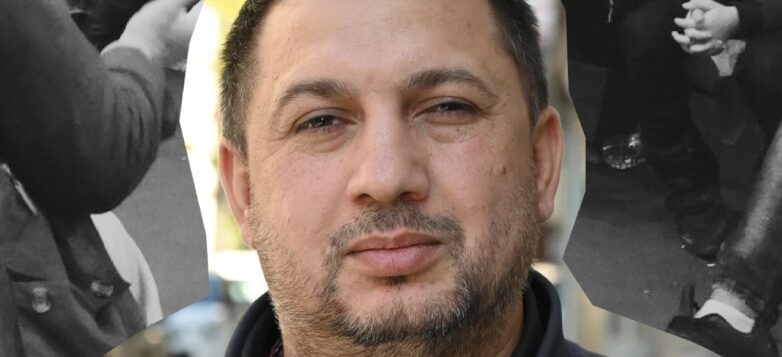
Ridvan Gashi: I am Ridvan Gashi, I come from Fushë Kosovo [from now on Kosovo Polje], I live in a mahalla, called mahalla “Logionica,” which from the 1990 until 1999 was known as a mahalla where there was a big number of Roma who lived in it, there were more than 5000 Roma there. I will say how life was there before the war, then I will talk about how it is now.
Before the war, there were good living conditions for the Roma in that mahalla, all the Roma vere integrated. When I say they were integrated, I mean everyone was working, everyone had their own craft where they worked, there was some kind of order so to speak, where everyone knew what they were doing and where. They were not dependent on social aid, as it is now, they were organized politically, they were employed, and we had activism, political activism as well, Roma had their voice heard, in Kosovo Polje. Many Roma in Kosovo Polje worked for known companies such as the power plant company, the water company, the flower company — a company where before the war, from ‘90 till ‘99, over 500 families worked, now there is no one working there, because the modernization happened and everything went private. One family took over that company, and they don’t have even one Roma employee. However, that company, with over 500 Roma families, is also known as a historical working space for the Roma.
To talk a little from my family. I come from a family where we are four brothers and four sisters. It’s really a known family in Kosovo Polje, Gashi, a big family so to speak. Before the war we were all together, living in one place. Now, at this moment… As you know the war happened in 1999. That was for the Roma, how to say… migration happened for the Roma community. My family also migrated. And at this moment, now, I have at least one family member in every European country, and we are even more spread out. I have family members from my mother’s side in Canada, from my father’s side I also have [family members] in all of these places such as Norway, Sweden, and these non-European countries which are close [to Kosovo].
This was a migration which we didn’t want, because after the war that happened between Kosovo and Serbia, Roma have suffered the most, we migrated the most, all the people close to you and the most loved people today are not close to you, and, say, more than 70% of our family is not in Kosovo, they are abroad in many different countries. They left over 25 years ago, and we didn’t see each other for that long. We don’t know anything about each other, and we have no contact with them. Yes, there are these social media sites where we found at least the closest family members, such as uncle or aunties, but if we go deeper, knowing their children and other family members we don’t know our family.
In the past, my father worked three jobs, and we had a good life. He worked at the power plant, at a company called “Junko,” plus privately he worked with horses. So he worked three jobs so that we would have a better life. But everything that he worked on was destroyed in the year 1999, which brought us to zero. It wasn’t our fault, we didn’t want our house to be destroyed, our family to be destroyed. It brought us to zero. We left Kosovo for three months, after three months we returned to our house and we saw that everything was destroyed. By whom and how, we don’t have any information, but we came to that situation where we needed to leave our home because, from both sides they were saying you are with the Serbs, when the Serbs came they were saying you are with the Albanians, that is why we saw the best way is leaving Kosovo, until the situation calms down.
Three months later we came back to our house and saw that everything was different. There, my father took upon himself to organize the Roma, to re-organize our life. We stayed in our house, without windows, without doors, without anything. Little by little we were getting help from international organizations. We renovated our house, and until a few years ago we lived in that old house, which was built many years ago by our family.
Elvis Avdi: Why was life better? What were your family customs? What was the feeling when you came back to your house?
Ridvan Gashi: Before, there was a different situation in my family. We waited for the last train to eat, and we ate with five of my uncles in one house. More than 40 family members lived in one house. That is one of the things which cannot be turned back ever. It was a tradition in my family and in many other families to live together and we found a place for each other: when we ate food, when we slept, when we watched television and everything.
Why did I say it was a different situation? Because before the Roma had their employment, they had where to work, all the children were going to school. Our mothers weren’t working, but our mothers had the job of welcoming guests in the house, which was: 40-50 people were living in the same place, my mother had to make maybe 30 breads a day, which was a big job for a family to prepare, but it was a tradition to wait for the last train which was around 10 or 11PM, which was coming from Greece or Germany, to eat food, and wait if some guests came, because if we ate all the food there would be none for guests. Imagine how hard it was for the whole family, with the children, to wait and respect the guests. Today we see at what level you wait for the guest; they come after that, you take him to a restaurant and you end with that.
This is what I said, there was some kind of order, it was known that my father had a job, it was accepted by the people, by the Albanians and Serbians, they all worked together for sometime, up unti… There was some kind of separation between the Roma, Albanians, and Serbs,[up until] 1995, 1997 and 1999, when they started to say, “No, you are with them,” or “You are with the others.” But us as a small group, people who do not have a country and don’t have anything, we didn’t know where to go and what to do. There were Roma that were on the Albanian side, there were Roma who were on the Serbian side, there were also Roma who didn’t know what to do.
We went nowhere, we stayed there also when the Albanians came, we stayed at our house. The Albanians said to us, “You better leave your house, because it’s possible that some other Albanians will come who do not know you, and they can bother you.” We left our house at the last moment, because we didn’t want to leave. For many years we lived there, and we didn’t do anything to anyone, we were a known family. In my family more than 20 people were musicians, playing bass drum, zurna. Who were playing in weddings, Albanian weddings. Even though we were known, it wasn’t safe for us to stay in Kosovo Polje or Kosovo. They told us, “Please, we cannot guarantee for you to stay in your house, because [they] can come from other towns and from other places, you better leave your house.” We didn’t leave our house, we stayed.
But when the other group came… I was really young back then, and I will never forget that. My family was rich, because we were working, we had a truck, tractor, cars, horses, we had many things. When one group of Albanians came, they were saying, “This is my horse.” And I said, “Okay, tell me” — because I was hot blooded, because he came to my house and wanted to take wealth, he’s taking us for thieves, and I said, “Tell me one sign that that horse is yours.” He didn’t know. Then I told him what it was, and then he saw that it was not theirs. Afterwards he said, “This is my tractor.” Then I asked them to tell me the serial number, because I know it, we had it for many years, they didn’t know, and there they saw that it wasn’t it. They were telling us that we are thieves, “Take everything you have outside, if we find something, it will not be good for you.” We saw what the situation was, and then we left, because it’s better [to leave] than some kind of incident.
Elvis Avdi: What was the feeling when you had to leave your house?
Ridvan Gashi: Yes, we lost everything, we came to zero, they took everything we built, they destroyed our house, they burned our house. And when we came back, we realized that life will start again but we would not have a good image. As I said, we waited up until unknown people came to us, not our people, people who came from other places. When they came, we saw that the last thing to do for us was to leave. Too many Roma were talking to each other: “Let us organize, sit together, live together, so we wouldn’t leave our houses.” But there was no organization, what to do, where to go, we don’t have any place besides the region or somewhere further, we left our house, say, with the last train, we were the last to leave Kosovo, we caught the last train, because we would have problems with everyone, we would have lost many family members, as many Kosovars did, not just the Roma. I saw my family get ready, without [carrying] food. Everyone took clothes and other things. What I did is I took out my school books, and I filled my backpack with different canned food and biscuits. And I took with me my backpack, weighing maybe 20 kilograms, thinking that we’d stop somewhere.
That backpack had enough for us to eat for three days. That was one idea of mine, how to say, we didn’t know where we were going. And it was a good idea, it was unbelievable that the whole family ate what we had, biscuits, canned food, and what was given to us, for three days, because it was a war time. While leaving our mahalla, I saw groups who were destroying, stealing and KFOR was watching, neither did they know their mission when they came, they didn’t know where they were going, or coming. They saw us leaving our house, we saw us leaving our house, an image where we are losing everything, like you don’t even know where you are going. We left everything, we were lucky, as I said, to catch the last train and go to the region, nearby countries, we stopped at a place called Kraljevo.
We paid to die in order to travel to that place. From Leposavic to Kraljevo we went with a bus which was not for 200 people. 200 Roma got on one bus, we laid the luggage down and we sat on top. No chairs, no nothing. Three-four times before we arrived in Kraljevo we were about to die, because the bus driver didn’t know that NATO had dropped bombs, that the places were without bridges, we were about to go down at the bridge. We had two-three difficulties until we arrived at the place. When we arrived there, we didn’t know where to go. We slept in a place, in a meadow. In that meadow there that night there was an earthquake. There were many people, we had women, children, babies, without any bathroom, without anything, a place where it is impossible to live not one day, but not even one hour, even a minute was too long.
But then, came a person with a great heart, who was nothing to us, he was not family, he took the women and the babies. Five to ten women and babies were placed in one room to sleep. The rest of us took jackets or whatever we had and slept in the meadow. Below the trees, at that place where we were, that same night there was an earthquake. I don’t remember the exact date, and the earthquake was not that big, but for me, that was like an alarm from God, that he wasn’t satisfied with the people at that time, that was when we went there.
Now, let me tell you when we came back to our houses. What was interesting to see was that everything was destroyed, the grass was so tall, taller than our house. Let me tell you, from zero, there was nothing, we asked ourselves, what are we going to do? From where? Because [the situation] was still unstable. Where will we work? Where will I sleep? We didn’t know what the situation was until we came back to see. Everything was destroyed. However, luckily, there was KFOR, there were organizations that were giving us something to eat, to drink, and that gave you motivation because someone was thinking about you having something to eat.
Then little by little, we started to fix the first one room, then the second, then the roof was fixed by an international organization. That was some kind of beginning for us, a “re-birth.” A person who worked for over 40 years and then lost everything, then you need to be re-born, start over, work from zero and continue. For us it took around one or two years during which not a single child went to school, no one worked any job. We survived thanks to the packages that we were receiving from the UN, the UNHCR, and other international organizations. We, the Roma, organized ourselves and worked alone.
What I have to mention is what I said before about our horses. During the three months that we were not there, a person took them and took them far away. He said that they were his, but they didn’t stay at his place. A neighbor who stayed and didn’t leave, told us that the horses would come, hit the doors, break down the doors and get inside the yard. Or when they could not open the doors, they would cry because they could not enter the yard. He then came again and took the horses, but they again ran away from him, this happened three-four within three months, and then he got angry at them, and came for the last time to take them, and took them far away so they would not come anymore. That is something that stays in our mind.
Elvis Avdi: What was your feeling when you heard all those stories, that the grass was so tall?
Ridvan Gashi: Let us go back 25 years ago, and what we suffered to reach this level, we are losing too much memory of what was so difficult to us, because now that I am going back to all of these things, it is really difficult for me, emotionally. Because I said that my family was in Kosovo Polje for over fifty years, my grand father, my uncles, my father, worked so hard to bring us to that level for fifty years, and then someone destroys everything without a reason, and you come to a completely different image, you don’t see anything that was yours, not even your clothes, your dogs being killed, and then when you see that image, you can say, “Why did I come back to live in this house?” But we needed to come back, because we didn’t have any other way.
As I said before, some of our family went to Canada by plane, some others went to other countries by sea, some of my family members lost their lives at sea, because they paid to go to Italy or Germany through Montenegro, the people left them in the sea and ran away. Some of them fell and some of them survived, those who survived are talking about how the other boat went down, many family members watched their family members die, and that happened to the Roma. They paid with money, they gave their gold, and at the end of the day you die in the water, why? because of the war, and that there was no stability for the Roma.
The Roma wanted a better life, to run away from the war, to save their children, but unfortunately, many Roma died there, the number is still unknown, how, where, or where are their remains. I have family members who are telling us, plus I have family members from my mother’s side, my aunties’ side, who have died in those waters, and even today there is nothing that is being done, like a memorial for those Roma. Where are their remains? It is known that it happened in the sea, but where, whether in Italy or in Montenegro, did they find a body? or at least do a monument for these Roma. This never happened.
But as I said before, we started again in Kosovo Polje. After that, doctors were coming to visit us every week. Because it is normal that when you don’t have proper food, you don’t have clothes, health would not be okay either. We got vaccinated, and then we started to learn in tents, to go to school in tents. We built tents and we started to learn there, do some activities, then the internationals came and did different activities.
What was interesting, three-four years after the war, 2001, 2002, 2003, we could not go out in the city. For the Roma it was hard to go out in the city, because the other side which stayed in Kosovo, the Albanians, didn’t like the Roma, because of the big disinformation which was spread during the war, that the Roma were with the Serbs, and I don’t know what. The Roma were poor, they were with neither side, and [Albanians] were blaming them for the war — they did the war, it is their fault that the war happened. For us, as soon as we went out in the city we would get beaten up. How many times we wanted to go to buy something just to go out in the city! We didn’t have the right to go anywhere. You needed to organize yourselves three-four people to go out, because it was not safe for us. But little by little, UNMIK and other organizations…. We had a pazar, and that is where it started, because we were not going to their pazar, but then they started to come to our pazar. So we made a small pazar, and that is when later on the Albanians, the Serbs, Roma, Ashkali, all in one place, and that is where they started to learn more about us and to be closer.
Elvis Avdi: Can we continue now after the war?
Ridvan Gashi: I will continue from 2002-2003, where I said it was hard to go out in the city. In one case I will say, when I went out with my mother in the city, we knew the Albanians didn’t want to see Roma, I don’t know, why, because the Roma were not at fault for what happened in Kosovo in 1999, but the disinformation at that time, and some Roma took one side or the other, and we stayed in Kosovo were at fault for that situation. Once I went out with my mother in the city, it was 2003 or 2002, I don’t know exactly, because some time has passed. A group of youngsters were calling us magjup, gypsy. “Why are you walking this way?” They started to speak, and one pushed me with his arm. I saw that there were ten of them, I was alone, and my mother was with me. In my mind I was about to fight with them, I took off my jacket, and got ready to fight with them. In that situation, it was hard for my mother, and she said, “Let us leave.” She called that boy and told them, “Please, let us finish what we came for, okay magjup, magjup, just let us leave.” And we barely walked away, ran away from that group.
It was really hard in the city, and to say another thing: in 1999, when there were the greatest tensions of the war, my mother, my sister, and another sister who was just a baby, also were stopped by the Serbian police, just because they saw the surname was Gashi, they said, “You are Albanians, we need to kill you.” They put them close to a wall, prepared their machine guns to kill my mother and two sisters. But God brought a neighbor who was a big person at that time, had a big position on the Serbian side, and was our neighbor. He was walking and saw that they wanted to kill them, then he told them: “Wait, who do you want to kill them? They are not Albanians, they are Roma. What did the Roma do to you? They are my neighbors.” “But their surname is Gashi!” “Let these people go their way.”
And that was one of the things we cannot forget. Our family and all the Roma faced one attack after the other from one side and from the other side, from both sides, and that we cannot forget. But I will continue talking about, after 2002, 2003 and after, how the life of the Roma, of my families, has changed. Little by little, we started – with some meetings that were happening with KFOR, UNMIK, and the OSCE, who were working with the communities -, to become more active, and little by little to ask from institutions to fix the situation of the Roma at the local level. What was interesting, at that time my father was a Roma activist, who started to organize the Roma, somehow to change the situation of the Roma. I was really young and staying close to my father, and I knew a lot because I was close to him. At that time the President of Roma from Prizren, Haxhi Zylfi Merxha, came to Kosovo Polje to see what was happening with the Roma. And my father together with another activist, Ramiz Berisha, who was working in health, my father Femi Gashi, started to work a little for the Roma in Kosovo Polje. While they were working for the Roma our situation started to become better and better, up until today.
When I mentioned Haxhi, he gave a great contribution to the Roma. Zylfi Merxha talked in the Assembly and in every meeting that he had, he said, “Are you saying that it is the fault of Roma that the war happened? Then tell me, how many Roma did you find that took part in the war? How many Roma are in the Interpol? How many Roma are in jail? How many Roma did you find that killed someone? None. Why don’t you like the Roma?” Those information that he provided, his statistics, and that he worked for the Roma created a security, and even today the Roma are more accepted in the country that we are living in. My father was a part of his Roma Political Party, and in Kosovo Polje we had that political activism, and with the internationals, and everything, it brought the situation that the Roma would have the right to go out in Kosovo Polje, to speak in Romany, to know what is happening in the city. Because, as I said before, we didn’t have the right to go out. There were situations where they were beating Roma just because they were going out in the city. And little by little we were learning, we could not go near them, we created our pazar, and then they were coming to our place to sell, and that is how little by little we were breaking these stereotypes, or that mindset that they had. UNMIK organized many meetings where Roma were present including Serbs, where they were talking to each other. Those activities have also opened the road for the Roma little by little. Let me not forget the OSCE, UNHCR, and all these organizations who were opening the road, and came up until today.
As a young activist, I was close to my father. Speaking about my father, not that he was the president, but he was the first person who was attending these meetings talking about the community, and the OSCE and UNMIK were sending him scripts [reports, minutes]. For me it was really interesting to see the situation, to see what is happening. And little by little it told us that the situation is becoming better. In 2005-2006 the Roma started to go to schools, whereas from 2001 up to sometimes in 2004, I am not sure, because many years have passed, from the tents we started to go to schools.
In schools we had two sides, there were Roma who were going to Albanian schools and we had Roma who were going to Serbian schools, they were going to either one or the other side, also today we have the same cases. Now, those Roma who are going into Serbian schools, the Albanians are saying, “Look at you, Roma are with the Serbs.” And what to say to the Roma who are going to the Albanian schools, now the Serbs will say, “Look, you are with the Albanians.” Even though 25 years have passed since the war, they are still blaming the Roma. Why are you going to one side or the other? This is all because we do not have a school in our language, we don’t have many children, and we see where to put our children to school. However, in Prizren, there are Roma who are going to Turkish or Bosniak schools. What to say to them? “You became Turkish,” or “You became Bosniak.”
Still, people’s mindset didn’t change. Still, there are people, also in high positions, who are telling me, my father, or other Roma: “Why are your children going to Serbian school? Why are they going there? That program is not in the Kosovo system.” It is the people’s right to send their children wherever. Until that moment when there will be one system, one school, one language. It is not our fault that they cannot come to an agreement, at that moment when they will come to an agreement, for the Roma it will be the same. It just will become better for the Roma, they will be less cursed, less beaten. For the Roma it will become better, because then they will not have the right to say, “You are with this side or the other.” I hope to God that there will be a union of the [school] system, of the school, not to have this language or that language, this system or the other system. But to be one, and not to have this separation.
What would I also say, while watching my father, little by little, I also got the idea to become active, I don’t know. I went to a meeting with my father, Zylfi Merxha was calling him to Prizren every month, I was going and listening to what they were doing, and while driving back home I also was listening, how Ramiz Berisha and other activists, my father, were talking about what was said to them. All of that was getting into my mind, and somehow I was growing up to become some kind of an activist, or to do something more. It came to my mind, I don’t know which year, 2006 or 2007, I opened an online Radio, while knowing computers, which my father had, maybe it was the first computer in that mahalla.
From 2004, 2003, 2005, I learned to work, and managed to open a website, to open a Radio, where many Roma were listening to me, watching me there. I was trying to inform the people about what was happening, I had a camera where I was also talking to people. Many people who lived in Germany, Europe, Australia, and also in Canada; my family. They were watching there, listening to music, and little by little, I learned, I created a mini studio of mine. They were watching me, we were talking, texting, and the contact between us grew. I found many of my family members there, because we didn’t have contact after the war, we didn’t have social media, as we have now, we had computers, messenger, flatcast, somethings that so few people knew. I worked there for 3-4 years, I worked there, until I knew people. After that I saw that I can work this job. I went to many trainings, meetings, and many organizations that have been organized in our municipality.
Later on, my father on one side, me on the other side, I can say that we were two activists. My father was like a political activist, and me as a civil activist, I had not opened my NGO back then yet. But so to say, all the contributions that were made in the past by all sides created better living conditions for the Roma. Today the Roma can say what they want. Then I did an interview for a Roma TV program, where I was working as a teacher in a center, like an educator and assistant at that center, with the Roma children. We were helping school children with their homework, learnings. It was a program that started in Plemetina, then went to Gracanica, from Gracanica to another municipality, and then came to Kosovo Polje. Not to forget a great contribution was given by Rand [Engel], who is well known to all the Roma, and he opened the center in Kosovo Polje together with Muhamet It was that the Roma are not on the same level as the Ashkali and Egyptians, they wanted to create that for the Roma. The persons who initiated that because they had forgotten the Roma and there was the needed to do the same for the Roma community, were me and my father, Ramiz and some other people who said that they needed to open that for the Roma, so that we have also there a class for our children; even though they were going to Serbian schools, they needed to have a learning center.
Then that happened, I was a part of that, but there were not many activists, there were just some of us in Kosovo Polje, there were only five of us, who were teaching these children. From that many youngsters were blessed, and today they have finished their schools. That was a great help for the Roma, to see that education is needed in life, for you to achieve something better. Not that it was: let’s say, it was the war and during the war it was impossible to find a job, no one wanted to employ Roma back then, but now 25 years after the war, they’re employing Roma as well. Now you can see the Roma everywhere, with different crafts, who find jobs. But 25 years ago, we didn’t have in mind that we can achieve what we’re achieving now. After that interview that I did for the RTK [Radio Television of Kosovo], they saw that I can become their colleague, I can work with them. After that they opened a call, and were looking for people who can work. They looked at me as a person who can work. Before that I didn’t have in mind to become a journalist, which I am today. I worked as an intern for around two-three months. After that, I became a part of the TV news, and now it is 16 years since I am part of the Roma TV news in the Roma language. I am a journalist who together with my colleagues is fighting for the Roma, for the Roma problems. We are creating different stories about the Roma language, culture, what are the difficulties in education, life, social themes.
From an online Radio, I joined an institution which is the national TV. It was a difficult road, a dream that I would never think a person could achieve. This was a new transition that happened in Kosovo, because no one knew what was going to happen in Kosovo until today. But after 2008, in the new Kosovo, new rights were given to the Roma. What was given to the Roma, to the Roma was given even before, in 2003, 2004, 2005, but since 2008, since independence, some rights were given to Roma, such as having a TV program, their education, like higher education.
For example, in Prizren many Roma have, they were given a secured deputy position [at the Assembly]. If you have two political parties, and one has 100 votes and the other has 101, they will win that position. At the local level, they also can have a deputy mayor in places where there are more Roma. With a small number of 200-300 votes you can have the right to have an Assembly member, to have your deputy, to have your people. That gave us motivation, aha, we can live in Kosovo, we can stay in Kosovo. Little by little, many Kosovars are good to the Roma, to my family as well. Many Kosovar Albanian and Serbian left Kosovo to work abroad. In this situation right now, for the past five years they’re employing the Roma as workers, without seeing whether he’s black, white, red, they’re employing the Roma. However, 10 years ago they didn’t even want to see Roma as workers. Now that the ice is broken, they employRoma, because they’re seeing, they either get Roma, or bring someone from Pakistan, India, Afghanistan. Because there is not enough working force, compared to the demand of the Kosovo market. This is good for us.
What else can I say, from going down to zero after ‘99, when we were burned, destroyed, and came back to a broken house… It took 25 years for us to build a new house. So much work, so much effort, so many people so we could build our house. After these many years, we managed to build it. What is interesting, I got married, I have children, and I am the oldest in the family. I said that the war has separated us. Half of my family is living abroad. Out of four brothers and four sisters, two brothers are abroad, and two sisters are abroad; two brothers and two sisters stayed here. The war has also separated us. Half of the family don’t see each other over 95% of the year. We see each other on social media. Whereas before the war I said we lived over 40 people in one house, my uncles, everyone in one house. We had food, we had everything to live together.
Now there is another image, where half of my family lives abroad. I said I have people in Norway, Sweden, Canada, almost every country. And this was done because of the war, not that we liked our Roma to leave their houses and go. And it’s not that they have a better life than what they had in Kosovo. Because they started a new life there. But there they don’t have their house, they have different culture, traditions, everything is different. Here, we who stayed, we have our house, we are not in another country, we are in our country, where we lived for years. And it’s a different situation, because we are close by with our family here. But they are 1000s of kilometers apart from each other, and they cannot gather in one place, like us who live in a Roma mahalla which is, as I said before there were over 5000 Roma, and now are around 10 to 12 thousand Roma, Ashkali, and Egyptians.
But what needs to be said is that over 60% of them are not from our municipality. There are Roma who came from municipalities where they were scared to stay there, like it is, or I shouldn’t mention any municipality. It’s because they are scared to live there, there are not many Roma there, and they integrated, they came to us, bought their lands, built their houses. Those of us who are from here, we are not many. There are many unknown people, whom I don’t know and who live in my area. But they found a model of municipality which doesn’t have problems, they don’t bother the Roma, and have jobs. Two hundred families from Kosovo Polje go out looking for recycling to provide for their family. That is not a good image for the Roma. But it is better to do that job to provide for their family than to do some kind of damage, to become thieves or just to stay at home.
Now the institutions have opened their hands a little, are helping the Roma, they’re giving social aid, giving different things to the children for school, then to the women who gave birth. This government has improved the living standards of the Roma in another way. With the recycling, and with other jobs that they’re doing, there is another standard [of living] for Roma, which you can see from the house [they build now]. It is not the same as in the year 2000 or 2005, now they have better standards, higher standards. I said that after I became a journalist, I was still an eager activist, for me it was not enough to be just a journalist, I opened an NGO, which will promote the Roma voice and culture at least a little bit. I opened that organization, and for many years I worked in many activities, which are for the Roma culture, Roma language, and history. I explained who the Roma are, I did many different trainings. Until today, from 2010 until today, I have worked on over 70 projects, we implemented and had great successes in many projects. Many models were created with different donors, and need to drive the work, which now is on another level.
In Kosovo Polje now we have a deputy mayor who is from the minority Roma, Ashkali, Egyptians. We have a deputy in the Assembly, we have three in the Assembly. We have people at the Office for Communities, we have over ten NGOs, we have three education centers, not to mention many other positions in which we have Roma, in social welfare for example, who accept the Roma and who work directly with them. When one Roma goes to apply for social aid, there is a Roma who will accept and work on their documents. That is a great achievement, to fight for their right, what they wanted to achieve for 25 years. Now we are told, in Fushe Kosova and in the whole of Kosova, that the Roma can work, just give them the right, they know how to work, and they can organize themselves. Because we are one of the municipalities… you can rarely see that in other municipalities they can organize themselves at the local elections and have three Assembly members. We did that ourselves, we didn’t see whether you are Roma, Ashkali or Egyptian. We became one and took over three seats in the Assembly so that our voice is stronger, and we are equal with all the sides.
Elvis Avdi: What message do you have in the end?
Ridvan Gashi: My message is, to speak about what I have gone through for the past 25 years together with my family: It is not good to say, “I came here and I cannot move forward.” I told you, we were rich, we had everything that my family would need. We worked for 40 years to reach that, then the war came and we lost everything. Then from zero we came to a standard where all the family is working, we have our house, our family is all around the world, there is not a place where we don’t have family members, because we are a big family, both from my mother’s side, and my father’s side. And there is a positive image, how can Roma achieve, in 25 years, the level of my family’s life in Kosovo Polje. And what is good, is that my daughter takes me as a model, and reaches the point where she said, “Yes, I want to fight for Roma rights, I want to be like you, I want to take the road that you took.” That is really good.
I would say to everyone, “Look for your dreams which you cannot achieve, but try and do everything, because one day you will achieve something like what the Roma have achieved in Kosovo.” Yes, it was difficult, but this image, when you see that you have achieved your goal, for your community, and you can speak in Roma a TV in the Assembly, in institutions, wherever, then, this is success. It is different from what is written on paper, and what is not given, and that the Roma still have difficult living conditions and that what I want from the Roma is to raise their voice, to ask for their rights. Because if we do not organize, and do not raise our voice, what are you waiting for? For someone to come and get you to work? No one will come. You need to go out and ask for your rights, look for a job, not to live off social aid.
I know a family which for 25 years lived with social aid and they still are under social aid, and they have five family members who can work. With five of them working for 400 euros, that means 2000 euros. 2000 euros to live in Kosovo is like living in America, 2000 euros is big. Lets say they will spend 1000 euros, but 1000 will stay. With that they can build their house, buy their car, for their education, everything with that money. But for some Roma the social aid got in their blood, and they want to stay under social aid. No, you will become disabled if you stay under social aid for 25 years. I always say that to the families: “Search [for a job], get employed, leave social aid.” Is it better 2000 euros or 150 euros? To be a victim, to cry, “Aaa, I don’t have anything to eat, I don’t have anything to drink,” but you can play with 2000 euros, your family gets jobs, your children get jobs, and then in their old age they will have a pension, have rights, have something from that, don’t think about today but what will happen in the next 25-30 years, 50 years. Because if you depend on social aid today, you will leave your kids with social aid. If your kids see you stayed under social aid, then they will say, “I am Roma, I need to stay under social aid.” And they will take as a model some families, not just us, but other Roma families, where they can become activists, politicians, and many other crafts.